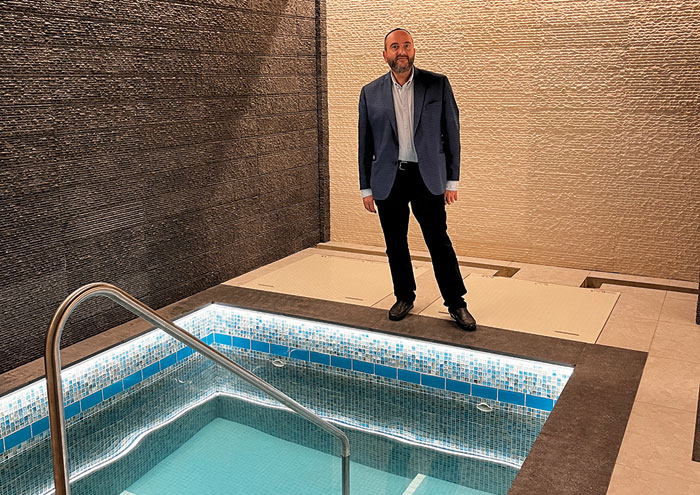
Jews who live in North Beverly Hills soon will be able to dip in a mikvah (ritual bath) that has the “feel of a Ritz Carlton spa,” said Rabbi Pini Dunner, the spiritual leader of Young Israel of North Beverly Hills (YINBH), where the new mikvah and kelim mikvah are located.
While long needed in the community, where people are too far to walk to the city’s other mikvahs, YINBH’s basement mikvah has been in the works since 2006, when the concrete for the mikvah’s floor was first poured, Dunner told the Journal.
During the pandemic, the rabbi saw an opportunity to power through the mikvah’s construction while the building stood empty. The mikvah is constructed of soft blue Italian marble, cream and black matte tiles and a ceiling that is underlit with pin lights to look like stars.
Although lovely, the mikvah’s real beauty, however, derives from Dunner’s mission to fill the mikvah’s immersion pool with the required 260 gallons of rainwater, which was not to be found in LA after a particularly dry winter.
Knowing that melted snow can also halachically function as rainwater, on March 22, Dunner loaded his car with seven shovels to drive 12 hours to Eden, Utah, where he met a team of workers and a rabbinic mikvah expert who had flown in from New York.
Upon arrival at Aspen Ridge at Powder Mountain, where the temperature was 14 degrees Fahrenheit, Dunner and his team quickly got to work. They filled 400 onion sacks with fresh snow to pack into a truck with a temperature set to-20 degrees Fahrenheit.
The onion bags were netted to avoid having the snow “pool.” “All it takes is two pints of melted snow to render the rest of the snow unusable for a mikvah,” Dunner said.
The next day, back in Beverly Hills, Dunner created a slightly sloping platform for the snow-filled sacks to drip into two 8-foot pits that he had set up next to the mikvah immersion pool.
Just as the mikvah was ready to receive its required natural water, Dunner’s freezer truck pulled in from Utah.
“What a moment,” he said. “When we opened the door to the refrigerator’s truck, a cloud of frozen air billowed out into the California sunshine. Our local team of workers clamored aboard to unload the snow as quickly as they could, so that none of the snow melted along the way.”
When no more bags of snow could fit on the mikvah’s platforms, the rabbi and the workers used the surplus of snow to launch into something never before seen on Alden Drive: a snowball fight, Dunner recalled with a laugh.
With the melted Utah snow now augmented by LA city water, the kelim mikvah is already open, but the main mikvah will open this summer, as soon as the final details and approvals are completed.
“There are simply not enough mikvahs in LA, and I thought it was very important for us as a community to take responsibility and ensure that there is a mikvah in Beverly Hills.” – Rabbi Pini Dunner
“There are simply not enough mikvahs in LA, and I thought it was very important for us as a community to take responsibility and ensure that there is a mikvah in Beverly Hills,” said Dunner. “The mikvah is not just for now, but for 10 years, 50 years, time that there is going to be a mikvah for the community to use.”
The halacha that communities are obligated to build mikvahs before shuls, schools and social facilities is what most inspired Dunner to create one of his own.
“Often, in the day-to-day humdrum of ordinary life, we tend to forget the spiritual,” Dunner said. “Particularly when it comes to the intimate aspects of married life, it is sometimes hard to remember that our union is not just a physical union, but it is a spiritual union.”
He continued, “The mikvah gives us opportunities to celebrate that Jews embrace living not just in material worlds, but in spiritual worlds [as well].”