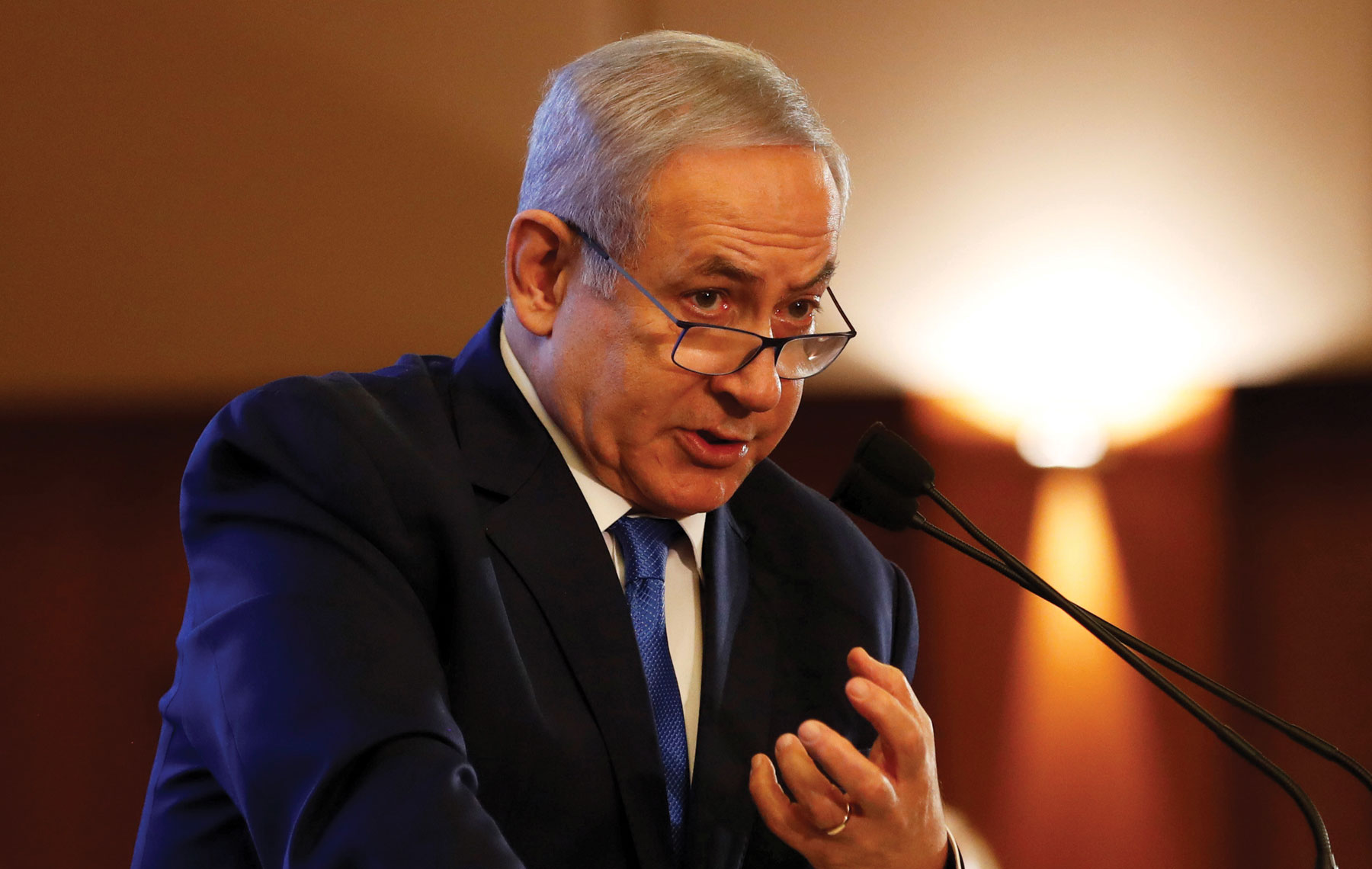
It’s impossible to defend Prime Minister Benjamin Netanyahu’s latest action to cut a deal with a racist, anti-Arab party in a desperate attempt to keep his seat on the Israeli throne. This is the tragedy of Bibi. He is a brilliant man who can do brilliant things, but he will do just about anything to save his job. His downfall is hubris: He believes no one can do for Israel what he can do for Israel, so in order to maintain power, the ends justify any means.
In this latest saga, in the words of The New York Times, “The embattled Mr. Netanyahu, grasping for every potential vote, has turned to the extremist party Otzma Yehudit, or Jewish Power, whose leaders have a long history of expressing support for violence against Palestinians, expulsion of Arabs from Israel and the occupied territories, and a ban on intermarriage or sex between Jews and Arabs.”
Bibi’s embracing of this racist party is such a blatant violation of democratic norms and basic decency that it earned him a rare public rebuke from AIPAC, which called the ideas of Otzma Yehudit “racist” and “reprehensible.” Author Yossi Klein Halevi went even further, calling Bibi’s move a Hillul Hashem, a desecration of God’s name, arguably the most serious sin in Judaism. Halevi’s reasoning is that “Kahanism isn’t merely a political movement…in its essence [it is] a theology that sanctifies hatred and vengeance in an apocalyptic messianic vision. A theology of Hillul Hashem.”
“This is the tragedy of Bibi. He is a brilliant man who can do brilliant things, but he will do just about anything to save his job.”
Bibi’s critics in this latest episode are not limited to the usual voices from the left. Staunch Israel and Bibi supporter Malcolm Hoenlein, executive vice president of the Conference of Major American Jewish Organizations, said the new deal was “very disturbing.”
As I’ve been following the rising chorus of criticism from across the political spectrum, I feel as if I’m watching a Greek tragedy unfold.
Part of what makes this a tragedy is that Bibi has done some very good things for Israel, and I don’t just mean economically, although that is significant. I mean specifically in terms of Israel’s relationships with Arab countries.
In fact, the very same week that he cozied up to an anti-Arab party, something extraordinary happened. The leader of the glorious Arab nation of Egypt announced that if the Jews ever return to his country, he would support them, defend them and even build new synagogues.
“Bibi’s inflated ego, however, must also take responsibility for his gross failure to show any vision in resolving the conflict with the Palestinians.”
What makes this extraordinary is not just the sentiment but the fact that it was expressed publicly. If there is one thing that has corroded Arab-Israeli peace prospects through the years, it is the public venom against Jews that permeates Arab and Muslim societies. So, when a 3,000-year-old Arab nation breaks the ice and publicizes something positive about Jews, that in itself is transformative.
Whether Bibi deserves all the credit for that budding transformation is immaterial. The fact is, it has happened under his watch. Of course, he knows that only too well. So well that it has inflated his ego to the point that he believes he is indispensable and invincible.
Bibi’s inflated ego, however, must also take responsibility for his gross failure to show any vision in resolving the conflict with the Palestinians. For years, his approach has been to continually buy time and muddle through, hoping he can downplay the conflict while focusing on bigger fish like Iran. That approach has an expiry date. It is wearing thin. At some point, he will have to stick his neck out and commit to a direction to resolve the conflict. Right now, his only direction seems to be political survival.
On that front, in our cover story this week, political editor Shmuel Rosner analyzes this latest Bibi drama of political survival from all sides, bringing in as many voices as possible. Some of these voices may surprise you, others won’t.
From my end, my guess is that Bibi will end up regretting his latest bare-knuckle political maneuver. For someone who is supposed to be media savvy, he should have anticipated the terrible optics his move created. But more importantly, he should have seen how this would tarnish his legacy. It is now forever ingrained in his record that he was willing to partner with a racist party for political ends. Instead of a great statesman, he will be remembered more as a ruthless politician.
That is not just a Greek tragedy, but a Jewish and an Israeli one.