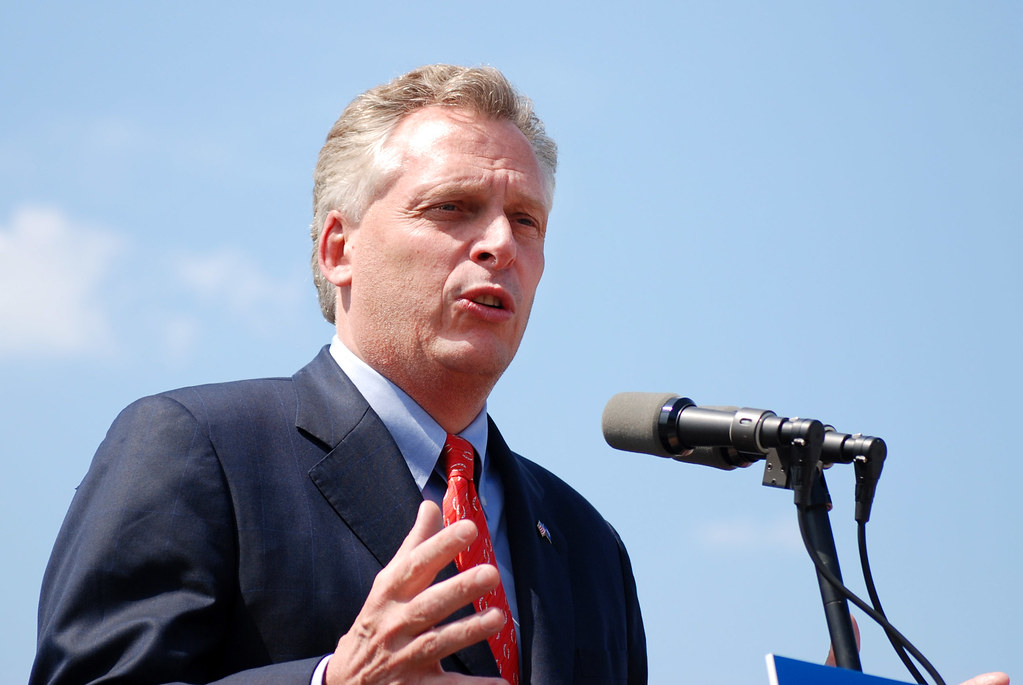
Two days before the second anniversary of the Charlottesville Va. riots, former Virginia Gov. Terry McAuliffe (D) discussed his new book, “Beyond Charlottesville: Taking a Stand Against White Nationalism,” in a Jewish Democratic Council of America (JDCA)-hosted conference call with reporters on Aug. 9.
McAuliffe, who served as governor of Virginia from January 2014 to January 2018, said, “As governor I never saw anything in my life as I saw that day.”
“It was all dark and all you could see was hundreds and hundreds of torches, like a snake coming down the mountain,” McAuliffe said, adding that the neo-Nazis and white supremacists “had their shields and their swastikas” and screamed about how they “are going to burn” Jews.
Initially, the city of Charlottesville was controlling the riots while the state government served in a support role, but on Aug. 12, McAuliffe decided that he had seen enough and declared a state of emergency.
“By 11:50 a.m. [state officials] felt pretty good,” McAuliffe said, saying there had been “some skirmishes” but nothing overtly serious. Shortly thereafter, a neo-Nazi drove his car into the crowd, killing 32-year-old Heather Heyer and injuring several others. In June this year, the 22-year-old killer was sentenced to life in prison.
Following the incident, President Donald Trump called McAuliffe to discuss the riots. McAuliffe, who has known Trump for 20 years said he told the president, “You really [need] to ramp down the hate speech.” McAuliffe said that Trump sounded amenable to that suggestion, but speculated that “somebody got to Trump and said, ‘No you will not condemn neo-Nazis… in fact you won’t even use their name.’”
Four days after the riots Trump issued his now infamous remark that there were “very fine people on both sides.”
“There were not good people on the neo-Nazi, white supremacist side,” McAuliffe said, adding he told the neo-Nazis the day after the riots to “go home” and called them “a bunch of cowards.”
Trump’s defense has been that he was talking about both sides of the debate regarding whether or not Confederate statues should be taken down throughout the country. McAuliffe said he didn’t buy that defense “because he didn’t use the words neo-Nazis or white supremacists” in his Aug. 15, 2017 remarks.
“This was about hatred, violence, disgusting behavior,” McAuliffe said. “This was going to be [the neo-Nazis’] coming home party.”.
McCauliffe added there was a silver lining to the riots because they “ripped off the scab of racism and anti-Semitism in this country,” adding that “white people aren’t comfortable” with a discussion of racism and anti-Semitism in America and the riots forced the country to have that conversation.
He also said that a lot of the neo-Nazis and white supremacists who attended the Charlottesville riots were later fired from their jobs. The following year, only five people attended the 2018 Unite the Right rally. This suggests that the neo-Nazi groups who attended the 2017 riots have been “shattered,” McAuliffe argued.
However, he added he was concerned about potential “lone wolf” shooters who become radicalized by white supremacist propaganda online, pointing to the Aug. 3 shooting at a Wal-Mart in El Paso, Tex. that killed 22 people and injured 26 others.
“That’s the thing that is scary for all of us,” McAuliffe said.
He added that while he didn’t blame Trump for the recent shootings, he believes the president is “partly culpable” for his rhetoric. “He needs to tone down his rhetoric,” McAuliffe said.
McAuliffe also called for red flag laws, which allow for courts to temporarily bar an individual from obtaining a firearm, as a way to disarm those who promulgate white supremacist rhetoric online. He also called for schools to start “teaching issues of tolerance” in early education.
Said McAuliffe, “You’re not born to say, ‘I want to burn Jews.’”