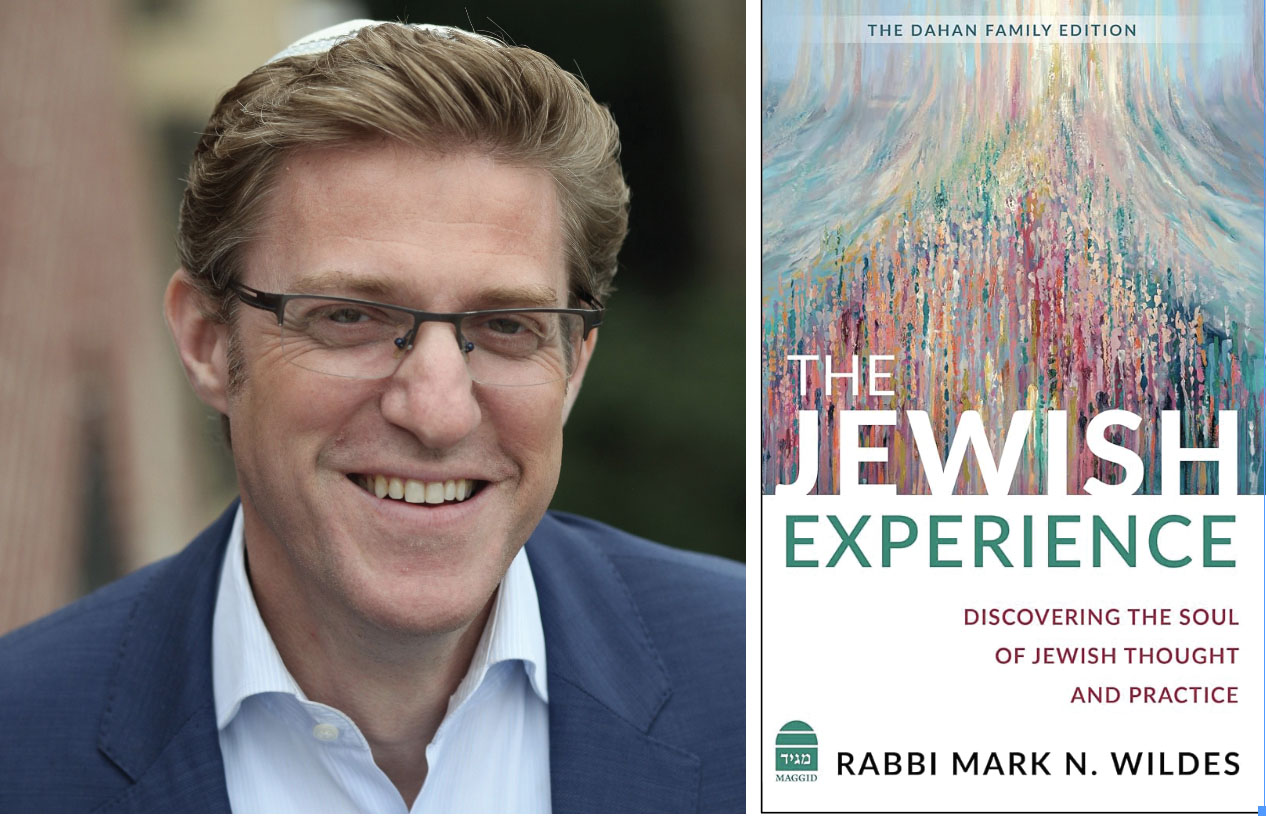
In a viral TED Talk with millions of views, Simon Sinek explained that the most successful organizations, companies and leaders communicate not only what they do or how they do it, but also why. Why should anyone care about their company or product as opposed to another? “If all Apple communicated was that they make beautifully designed computers, they wouldn’t outsell their competitors, because telling others what you do is simply not inspiring,” observes Rabbi Mark Wildes. “To motivate others to act, people need to know the why. This is the reason Apple’s marketing communicates why they exist. As Sinek puts it: ‘People don’t buy what you do but why you do it.’”
Wildes’ “The Jewish Experience: Discovering the Soul of Jewish Thought and Practice” aims to make the case for why be a committed Jew – why someone should buy in to being a thoughtful and dedicated practitioner of our faith.
Drawing on decades of teaching thousands of millennials at the Manhattan Jewish Experience (MJE), Wildes’ book presents, in a warm and accessible manner, the core beliefs and practices of Judaism – discussing God, Torah, prayer, charity, Shabbat and Tikun Olam – and seeks to answer the questions: Why do these beliefs and practices matter? How can they transform our lives today?
The argument to observe Shabbat, for example, is one that he believes is incredibly compelling in our high-speed age. “We all know when we’re really connecting with someone and how challenging it is to bond with others when we are competing with technology,” Wildes notes. “We live in such a distracting world. And that is why Shabbat is so imperative today. It is a kind of self-imposed blackout to ensure that we truly connect with each other, our community and our spiritual Source. That is why, of all the Torah’s observances which I have found young people attracted to today, hands down – it’s the Sabbath that wins. Hence the new ‘unplugged weekend retreats’ that have become so popular. These digital detoxing weekends, which first became popular in the United States and then found their way to Europe and Australia, stress mindfulness and begin by having everyone drop their smartphones into a black trunk. People understand that technology, while an indispensable tool for virtually every profession, is also keeping us from deepening our relationships and finding more happiness and meaning.”
Wildes’ case for prayer cites the contemporary American-born Israeli scholar Rabbi Yitzchak Ginsburgh. He suggests our liturgy is a reflection of the limitless love God has for the Jewish people, and the protection He has offered us for millennia. “According to some kabbalists, our prayers mirror Jewish history,” Wildes argues. “We start with the preliminary Birchot HaShachar, just as the patriarchs built a relationship with God before establishing a formal religion. We then move into the lengthy Psalms of Praise, in which we prepare to thank God for the Exodus, symbolizing our extended slavery in Egypt and preparation for freedom. The Shema speaks of the actual redemption from Egypt, while the silent Shemoneh Esrei represents the intimacy with God at the Red Sea. Our wandering in the desert parallels life’s challenges, which correspond to the afternoon prayers. Finally, in Maariv, recited in the dark, we ask God to end our exile and bring the Final Redemption.”
Wildes is, of course, a seasoned Jewish outreach professional. He knows there are countless Jews out there seeking to find their letter in the scroll, as Rabbi Lord Jonathan Sacks of blessed memory often put it. Citing the founder of Chabad Hasidism, Rabbi Shneur Zalman of Liadi, Wildes writes that: “For a Torah scroll to be kosher, there must be enough space around each black letter so that no two letters are touching. Our Sages teach that each of our souls corresponds to one of the 600,000 letters of which a Torah scroll is comprised. However, if one actually counts all the letters, they total just over 300,000! There are those of us who are ‘black letters,’ who are deeply connected and have found our place in Judaism. Yet, there are also those of us who are ‘empty space,’ who are still exploring our Judaism and developing our personal connection to our heritage. Yet for a Torah scroll to be kosher, both the black letters and the empty spaces must be included.”
In “The Jewish Experience,” Rabbi Wildes offers readers with both years of Jewish education and none at all an inspiring and informative guidebook to our most foundational beliefs and traditions. Even if you’re already bought in before you crack open its pages, after you’re done with the book, you’ll want to invest even more.
Rabbi Dr. Stuart Halpern is Senior Adviser to the Provost of Yeshiva University and Deputy Director of Y.U.’s Straus Center for Torah and Western Thought. His books include the newly released “Jewish Roots of American Liberty,” “The Promise of Liberty: A Passover Haggada,” “Esther in America,” “Gleanings: Reflections on Ruth” and “Proclaim Liberty Throughout the Land: The Hebrew Bible in the United States.”