
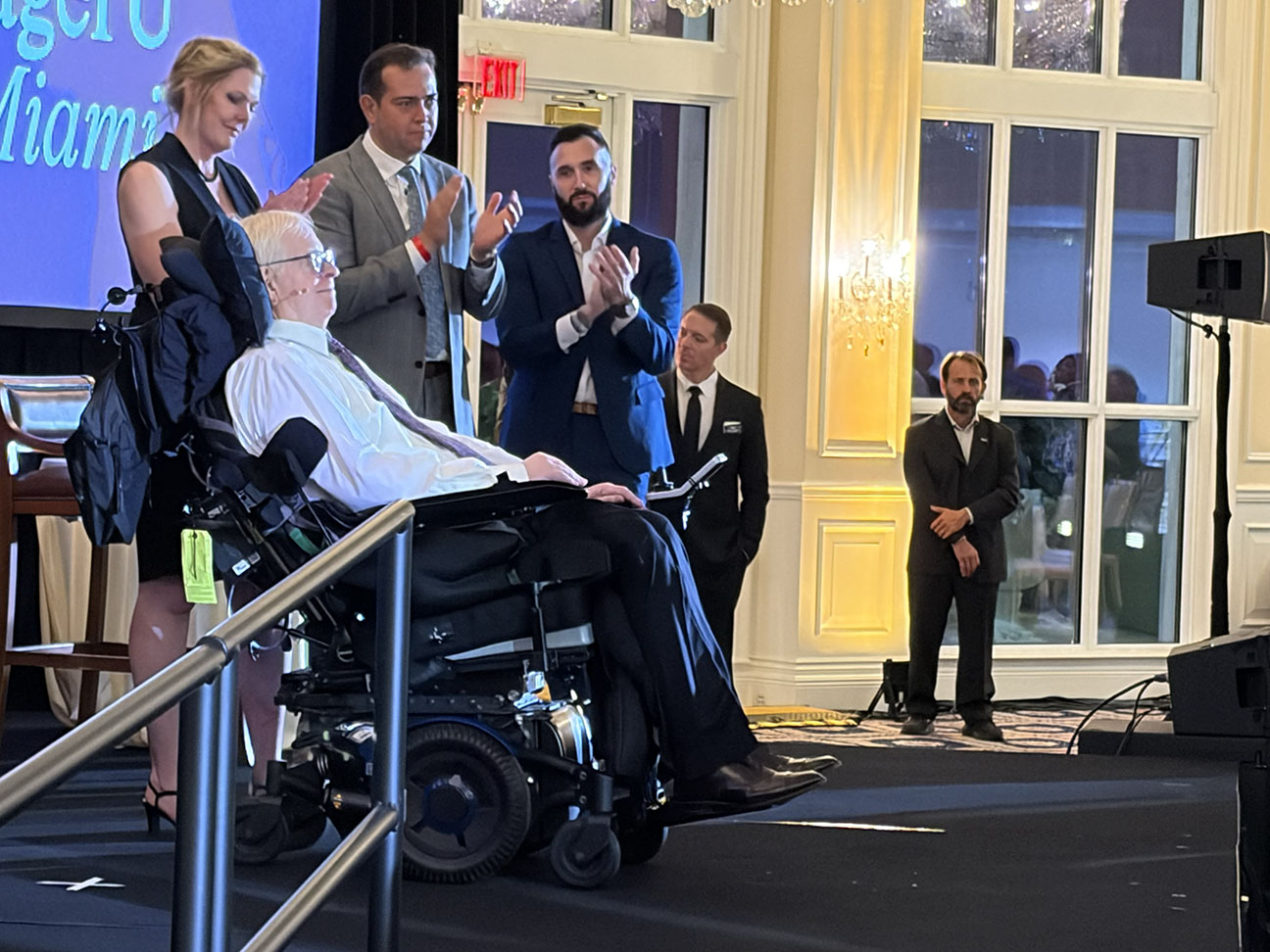
“Most people wait until tragedy strikes before thinking about how to incorporate tragedy into their life,” Dennis Prager said to a packed ballroom at a Miami resort Thursday night. “And then the shock is often too great to absorb into their emotional and psychological system.”
That was a stunning statement. Who lives a life that “incorporates” tragedy?
Dennis’s tragedy occurred on Nov. 12, 2024, when a fall in a bathroom left him paralyzed from the shoulders down. He was rendered quadriplegic, but fortunately sustained no brain damage.
It’s odd to use the word “fortunately” when describing what Dennis calls a “catastrophic injury,” but that dissonance between nightmares and miracles defined both his talk and his rational philosophy of life.
Dennis has spent a lifetime deploying that philosophy in bestselling books, speeches, essays and decades of radio, including a weekly “happiness hour.”
At the PragerU event Thursday night, he gave us a taste.
His body couldn’t move, but his mind was as sharp as ever. He considers it a “miracle” that he can talk without the use of a ventilator. Having a brain and a voice that are intact means he can continue doing what he loves most: sharing his ideas with the world.
The last thing we should do, he told us, is feel sorry for him.
He let us know that since his accident, he has completed one book, “If There Is No God: The Battle Over Who Defines Good And Evil,” and now works a few hours almost every day to complete his commentary on Leviticus, the fifth volume of his Torah commentary, “The Rational Bible.” In addition, for the past two months he has been doing a weekly podcast on PragerU and been interviewed on multiple other podcasts.
I’ve been a regular visitor over the past few months. I’ve seen him in action. The more often I visit, the less I think of his body and the more I think of Dennis.
Of course I can’t completely ignore his condition, but I find myself gravitating naturally to happy schmoozing, something we both enjoy. His personality, his humor, his wisdom, it’s all still there. He put a lump in my throat when he told the crowd: “After visiting me each day for a week, David commented that he felt he was talking to the old Dennis, not the new Dennis.”
After his accident, he told us, he had three choices: be dead, be depressed, or persevere. He showed us the third choice Thursday night, a man determined to give the “old Dennis” to the world.
It is surely the ultimate test of a big life. If Dennis truly believes everything he has written about gratitude, happiness, good and evil and suffering, then an accident, however horrible, shouldn’t change that.
If anything, it seems to have strengthened those beliefs.
“Many of the conclusions I reached helped prepare me intellectually, and perhaps even emotionally, to deal with my accident,” he said. When he quotes from a book on happiness he wrote 30 years ago, you get a sense that he needs to hear it as much as we do.
His take on happiness, as he wrote in his Journal cover story for Rosh Hashanah, is anything but schmaltzy:
“In formulating my views on happiness,” he told a crowd entranced by his every word, “I have had to deal realistically with the ubiquity of unjust, often seemingly pointless, pain and suffering.”
This has had two effects on him. First, it has “engendered immense and constant gratitude in me. And since gratitude is the mother of happiness, I have been able to be happy.”
At the same time, he always reminded himself that “tragedy is not confined to the ‘other guy.’ I am just as likely to be the ‘other guy.’ And now I am.”
He’s never had more credibility, he quipped, to weigh in on notions like happiness and gratitude. “I hope that how I am dealing with this awful injury will be of help to many others,” he said. Indeed, one can argue that after his accident, he may have even more impact than the old Dennis.
For one thing, he abhors the word victim.
“You cannot be happy if your primary identity is that of a victim, even if you really are one,” he said. “People who have chosen to regard themselves as victims cannot allow themselves to enjoy life, because enjoying life would challenge their perception of themselves as victims.”
There is no question about Dennis being a victim:
“I cannot move my legs, and worst of all, I cannot move my arms. I envy paraplegics. I would give anything to be able to wheel myself around, use a keyboard, hug my wife, children, grandchildren, and friends. I have spent most of the last nearly two years trying to recover the ability to breathe without a ventilator and to regain my normal voice.”
Despite all that, he told us, he refuses to see himself as a victim.
“One reason is that seeing myself as a victim would ensure anger and depression, negating any possibility of happiness. Another is the effect my seeing myself as a victim, with its concomitant anger and depression, would have on those who love me and, for that matter, all those who visit me.”
Given the miracle that he can still share his ideas with the world, he prefers to “regard myself in many ways as quite lucky, without denying any of the objective facts of my condition.” His biggest stroke of luck is his amazing wife and advocate Sue, who has stood by him through challenges too long to list.
One idea he loves to share is the value of memory. If we only live in the here and now, it’s as if the past never happened. Instead of being envious of his pre-accident past, he impressed on us that he is immensely grateful for seven long decades of happiness.
Seeing him now, it’s exceedingly difficult to internalize both devastation and inspiration. This is the challenge Dennis poses. We can’t ignore the devastation, but he’s showing us only inspiration.
That inspiration was in full bloom last night. I can’t recall a scene where one man talks for a full hour and hundreds of people at a crowded gala sit completely silent. The man lengthened our attention spans. He could have gone on for another hour.
It struck me that the Dennis Prager story is quite rare. What are the odds that a man who spends half a century preaching gratitude and happiness finds himself confronting his own advice after a catastrophic injury?
Dennis knows that the optics can make our hearts crumble. He knows how hard it must be to see him paralyzed.
Perhaps his biggest accomplishment is to make us feel better. Using his brilliant mind and his familiar voice, he manages to convince us that he really is grateful that he still has both.
The highlight of the night for me came down to three words: “I love life,” he told a loving crowd.
No one left the evening without that sentiment.
Shabbat shalom.































