
Twentieth-century Jewish fiction in America was a wild ride. It was up, all the way up, even after literary and social critic Irving Howe famously sounded the death knell for the genre in his introduction to a now notorious 1977 collection of Jewish-American literature.
Howe argued that as the generation linked directly to the immigrant experience of Jews in America died out, there would be nothing meaningful from which to draw. By the late 1970s, the future of Jewish writing was a barren desert, as far as Howe was concerned. It had “probably moved past its high point” having found “its voice and its passion at exactly the moment it approache[d] disintegration.” He posited that there would be little left to write about as Jews fully assimilated into American culture, as they abandoned the tell-tale signs of Yiddish-inflected speech and forgot about the conflict, struggle and suffering of living in the Lower East Side tenements.
On one hand, we can hardly blame him because it was stories of the immigrant experience that catapulted Jewish-American fiction to the top. By the 1920s the genre had already become wildly popular within the immigrant community. Most of it was written in Yiddish, and under editor Abraham Cahan, The Jewish Daily Forward (Forverts) became one of the largest foreign-language daily papers in the world, with the advice column, “A Bintel Brief,” being read daily by hundreds of thousands of immigrants. Novels like Anzia Yezierska “Bread Givers” (1925) and Cahan’s “The Rise of David Levinsky” (1917) were early breakouts when it came to mainstream readership.
By the 1950s, Jewish-American fiction had expanded to become globally known and was beginning to redefine the broader field of American literature. As the children and grandchildren of immigrants moved into the middle class and suburbs, a new generation of authors began writing in English, incorporating the cadences of Yiddish and the psychological weight of the immigrant experience into mainstream fiction.
Writers like Saul Bellow, Bernard Malamud, Philip Roth and Grace Paley became critical and commercial giants. They wrote bestsellers and won Nobel Prizes and National Book Awards. Some of their work — hello, “Portnoy’s Complaint” — became major cultural talking points. The existential anxieties of Jewish immigrants and their children — struggling with identity, feeling like outsiders and navigating displacement — resonated with a post-1945 American generation dealing with its own identity crisis and the insistence that America be a melting-pot.
Jewish fiction writers had made it in America. It was a success that transferred into academic and university settings too. For most of the second half of the 20th century, many contemporary American literature courses would include Roth or Bellow on the syllabus. (As academic and literary trends have become increasingly hostile to Jewish — not to mention “white” and male — texts we’ve seen less and less of this.) But, as Howe would argue, all of this success was tied directly to the ability of these writers to tap into the immigrant experience even as they had fully assimilated into American culture, and even as they rejected the label of being “Jewish” writers, preferring in most cases to be seen only as American writers.
Jewish fiction writers had made it in America. It was a success that transferred into academic and university settings too. For most of the second half of the 20th century, many contemporary American literature courses would include Roth or Bellow on the syllabus.
The formidable Cynthia Ozick disagreed profoundly with Howe. She called his prediction “self-imploding” because the immigrant experience is universal and not distinct to Jews. Because Jews also have a rich cultural and religious tradition to draw from, defining Jewish literature by such a fleeting, historical moment was a mistake, and so Ozick reframed the argument.
If Jewish literature was going to die out, it would be because Jews in America were desperate to assimilate and to become secular, to be seen as Americans first. So there would need to be a reckoning of sorts among Jewish writers. The antidote, according to Ozick, was not for Jewish storytellers to reminisce about delis and knishes, but to root their fiction in the sacred: theology, liturgy, intellect, covenant, tradition. In the expanse of Jewish history and Torah, Ozick saw a perpetual source of inspiration for Jewish writers.
It must have sounded crazy to say such a thing at a moment when Jews were becoming more secular than ever — not to mention upwardly mobile. Why go backward? In America, as evidenced by the way their grandparents and great-grandparents had discarded their Judaism in order to make it in the New World, religion was not just unnecessary. It was an impediment to belonging and success.
But Ozick was right. Beginning in the 1990s and early 2000s, Jewish fiction in America began to reinvent itself, and the defining feature was Jewish ritual. Fiction writers like Dara Horn, Allegra Goodman, Nathan Englander, Tova Mirvis, Shalom Auslander and others published books that grappled with Jewish religious tradition, approaching the material from highly distinct angles ranging from deeply respectful reimagining to fierce, dark satire. One could sense in some of the works a reverence for God and the traditions of Judaism. In others, there was a complete and utter rejection of those things, a desire to hold the tradition and its leaders accountable. But the point was that Jews had found their distinctive voice again, and it was all because of an ancient religious tradition that captivated some and angered others. Jews were once again grappling with their sacred texts and traditions, and the result was masterful storytelling. People took notice, and a third wave of Jewish fiction in America was born.
Ultimately, these writers realized Ozick’s vision by proving that Jewish-American literature didn’t need the Lower East Side tenements to survive. By taking Judaism’s rituals and laws seriously — whether to honor or fight them — they found an inexhaustible source of literary energy. And just as the new wave of Jewish-American fiction writing took off, the literary tradition came full circle as post-Soviet Russian-Jewish immigrant writers like Gary Shteyngart, Lara Vapnyar, Boris Fishman, David Bezmozgis (okay, he’s Canadian) began to re-invent the canon again by returning to the immigrant issues of the early 20th century in a contemporary context. Since these writers grew up in the Soviet Union, their works are largely devoid of anything ritual or religion-based, proving that Jewish fiction has the capacity to re-invent itself indefinitely.
The third-wave writers had a great run, and some of them are still going strong. But while the mainstream boom of turn-of-the-century “ritual focused” Jewish-American novel didn’t vanish overnight, the landscape shifted significantly during the 2010s. Around this time, the publishing industry shifted its focus toward highlighting underrepresented and “diverse” voices, and emphasizing structural racism and post-colonial themes in its major marketing drives. Jews may be an ethnic and religious minority in America, but because they had spent so many decades at the core of the American literary establishment, publishers often saw Jewish writers as little more than another subset of white writers that had already had their turn.
Jews may be an ethnic and religious minority in America, but because they had spent so many decades at the core of the American literary establishment, publishers often saw Jewish writers as little more than another subset of white writers that had already had their turn.
Words like “power” and “privilege” began to haunt the discourse surrounding Jewish-American fiction. And the question of intersectionality — where Jewishness has no seat at the table — became a central component of any discussion about what stories deserve to be told in this particular cultural moment. With the interest in Jewish stories waning, global events that put Israel into the spotlight chipped further away at the possibility for Jewish writers to maintain their status as key players in the American fiction world. And after Oct. 7? Forget about it.
Industry tracking analyses suggest that general fiction deals explicitly centering Jewish or Israeli content at major presses have experienced sharp declines following the global polarization post-Oct. 7. A recently released Anti-Defamation League report alleges a pattern of systemic exclusion of Jewish and Israeli artists in American cultural spheres.
According to the report, authors have faced pressure to alter manuscripts by removing Hebrew words, Israeli settings and Jewish character names while literary agents increasingly label modern Jewish-themed work as too risky for publication. But it’s important to note that some novels with Jewish themes — such as Taffy Brodesser-Akner’s “Long Island Compromise” and Joshua Cohen’s Pulitzer Prize-winning “The Netanyahus” — have in fact been published to acclaim. But the point is that such books are much fewer and farther between. (It’s also important to note that there were a number of Israeli novels published in the U.S. in 2024 and 2025 — including ones by Maya Arad, Ayelet Tsabari, Iddo Gefen, Etgar Keret, and others—but here I’m focusing primarily on Jewish fiction by American writers.)
And so the question that has been hovering around the perimeters of some conversations about the future of Jewish-American fiction is whether it will continue to exist at all, whether reinventing itself will even be an option moving forward. Some might say Howe was right to sound the death knell; he just had the wrong reasons and the wrong decade.
But of course that’s not true. And the good news is that Jews don’t like to be told they can’t play, and so new Jewish publishers are emerging to provide homes for good Jewish fiction. The British independent publisher High Line Publishing Studio is the newest, founded by Neil Blair (J.K. Rowling’s agent). Its Odessa arm, helmed by Executive Publisher Jacky Klein, serves as a global home for Jewish and Israeli fiction.
Canary Publishing, backed by Scot Shay and led by long-time writer and editor Howard Lovy, is an independent press that aims for regular fiction releases to counter the “silent boycott” of Jewish themes in major publishing houses.
Writing on the Wall is a unique and multigenre site by William Kolbrener and Ronit Eitan that publishes Israeli and Jewish poetry, fiction, and art and features a beautiful quarterly literary magazine, Balagan.
Finally, Meg Keene Books, the new fiction imprint under Adam Bellow and David Bernstein’s Wicked Son Books (distributed by Simon & Schuster), aims to publish exceptional Jewish and Israeli fiction across genres — books in which Jewish or Israeli life, culture and ideas are central to the story. The first acquisition, Booker-prize winning author Howard Jacobson’s novel “Howl,” was recently announced and it caused a bit of a stir. “Howl,” which explores what it’s like to be a Diaspora Jew in a post-Oct. 7 world, was published to acclaim in the U.K. but had trouble finding a U.S. publisher. Meg Keene Books was the solution, and thanks to Keene, U.S. readers will now have no trouble finding it. It’s a triumph in a time when Jewish literary news has often been grim.
I spoke with Keene last week about Jewish literature and what it’s like to be a renegade in the publishing world.
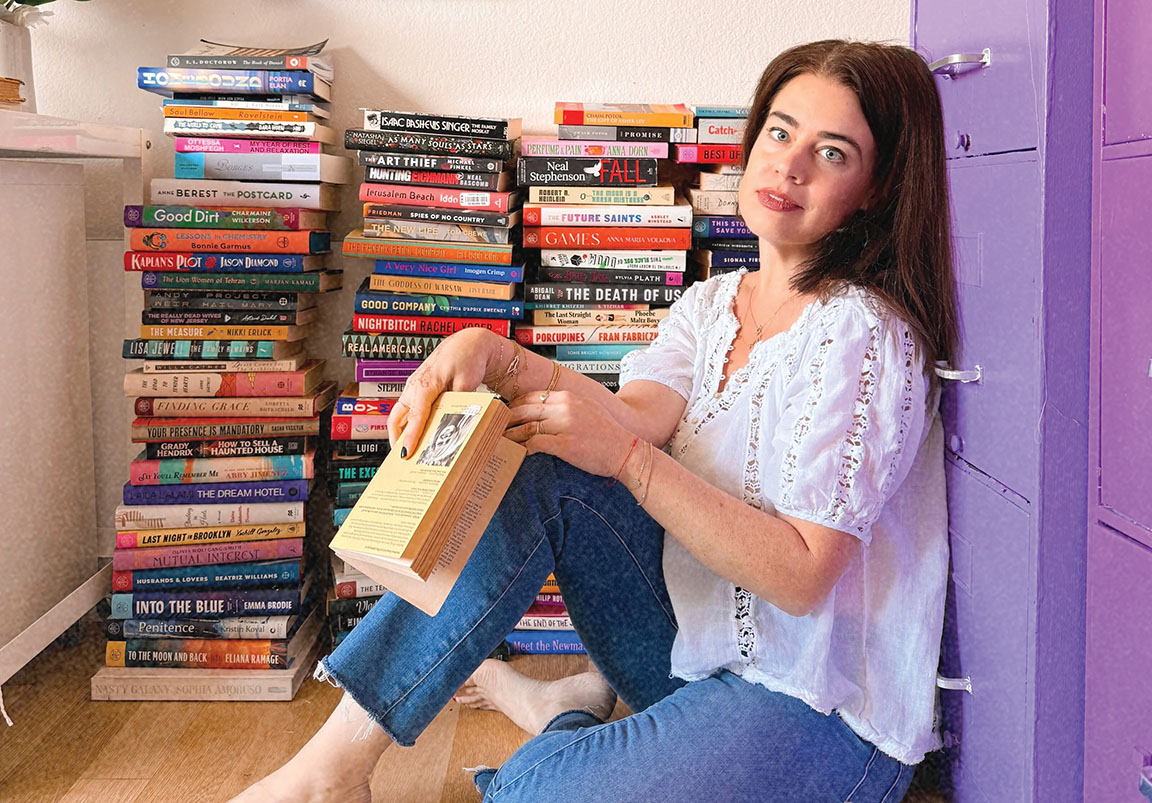
Keene, who served as a consultant and research partner for the ADL’s report and helped gather data and investigate how Jewish and Zionist writers were being sidelined in mainstream literary spaces, also has her own experience with the dark side of publishing fiction with Jewish content. A prospective literary agent famously advised her to remove Hebrew terms and cut scenes set in Israel from the novel she had written to avoid having it flagged by editors who were wary about publishing Jewish material.
Flash forward to 2026, and the tables have turned. Keene now has the opportunity to help shape the future of Jewish fiction in America.
It’s an enormous responsibility, and it’s not one that Keene takes lightly. She’s a fast and voracious reader — she read 140 books just last year — and so this new position has her reading anywhere and everywhere. At a recent Lily Allen concert someone noticed that Keene had brought a book and a manuscript with her and wondered when she found the time to read both. “I was standing in the bathroom line reading,” she said. These days her days and nights are spent rereading the Jewish classics like Roth and Bellow and also reading newer authors like Dani Shapiro and Toby Lloyd. In other words, she’s fully immersed in Jewish fiction, and it’s a job she loves.
Keene’s background isn’t in literature exactly, but she’s a writer and bestselling author, a “small-empire builder” (she spent 15 years as the founder and editor-in-chief of A Practical Wedding, growing it into a seven-figure media company and the largest independently owned wedding publication in the English language) and a former dancer who has a degree from NYU/Tisch in experimental theater. There’s something refreshing about seeing someone like Keene at the helm of this publishing project. She’s smart, she’s driven, she’s proven herself to be successful at whatever she does and it would be difficult to find someone outside of the literary world who loves Jewish fiction more than she does.
So what kind of books is Keene looking for?
She is definitely not looking for “books where a character named Rachel spins the dreidel at a Hanukkah party.” She wants novels where “Jewishness is integral to the way the story is told, and vital to the book’s soul.” She wants to read “about what it means to be a Jew in the world.” She wants serious books that are wildly readable. “I do not want writers sanding off the difficult, political, erotic, strange or culturally specific parts of their work in order to make it more marketable.”
“I’m looking for books that are structurally Jewish,” she said. “Where the Jewishness is in some way load bearing, and that doesn’t mean any one thing. It doesn’t mean it has to be religious … or set in Israel. … It doesn’t mean there has to be Hebrew. There are so many different ways that, as Jews, we reflect our Jewishness in our art.”
What makes a book or author Jewish is up for debate, even among Jewish literary scholars, who themselves have long disagreed on the answer to this question. Does an author have to be Jewish for a book to be Jewish? Canadian poet and novelist Anne Michaels wrote “Fugitive Pieces,” one of the most important novels dealing with Holocaust representation. It’s a deeply Jewish work, but the author herself is not Jewish. Likewise, there are many Jewish authors whose works don’t address Jewish themes or subjects at all. So it’s a bit murky when we try to pin down what exactly is a Jewish novel.
Keene wants to highlight a range of backgrounds among Jewish writers. “I want to make sure all the books are not coming from Ashkenazi Jews, for example, or all from American Jews, or all from Israeli Jews.” This is where it gets interesting. We talk about the history of American-Jewish literature, but in a global world where British Jewish (Howard Jacobson), Israeli (Keret, Gefen, Arad, etc.), and Jewish writers of other nationalities can now be published in the U.S., the landscape of Jewish writing in America looks different. And Keene is here for all of it.
“I have incredibly high standards for art and literature. But I’m not a snob. I really love high art to low art. … It’s important that I’m not going to publish all lit fic or all Jewish family dramas or something that feels really expected.” Keene even plans to publish Jewish horror and romance, along with literary fiction and memoir.
Given that many Jewish writers feel that parts of the publishing world have become hostile to — or at least wary of publishing — Jewish-themed books, newer fiction writers in particular have become anxious about submitting their work. But Keene wants to make sure that she is able to help develop the next generation of talent and wants to develop relationships with these writers as well. “When you talk to some Israeli literary agents who are representing a lot of the Jewish American authors as well … many will tell you that they’re afraid we lost a generation of talent because there are five years of manuscripts on ice at this point because it really started in 2020,” she said. “I talk to agents who have a pile of manuscripts on ice, and can’t possibly work through all of them.”
Given that many Jewish writers feel that parts of the publishing world have become hostile to — or at least wary of publishing — Jewish-themed books, newer fiction writers in particular have become anxious about submitting their work.
“So there already is this fear that we’ve lost a generation, or a microgeneration, of talent, and [there are] Israelis and Jews who are opting out of MFA programs because [they feel] no one’s going to read their work, or are graduating from MFA programs feeling that they don’t have a path to anything.” Most people in this situation will abandon a writing career and do something else. “I’m concerned that we already lost all of those writers, and I don’t want to lose new ones.”
It’s certainly true that the general feeling among many Jewish writers, especially in fiction, is that the publishing and literary worlds are not friendly to them right now. The widely read PEN American piece, “A Silent Moratorium,” outlines the experience of many writers that supports this, as does the ADL report mentioned earlier. One left-leaning Jewish outlet recently questioned these findings, and in reconfiguring the data came up with a more positive outcome, but that doesn’t really solve the problem that too many Jewish writers feel that the publishing world is against them right now.
The new MFA program in Creative Writing at JTS speaks to this as well. Directed by acclaimed Israeli writer Etgar Keret, one goal of the program is to “give a home to Jews who, since Oct. 7, 2023, see the publishing world as increasingly inhospitable to Jewish themes and writers.” (Full disclosure: I am a second-year student in the program.)
“We’re living in an era where Jewish writers are having a hard time getting into writers’ programs, getting published even,” said JTS Chancellor Shuly Rubin Schwartz. “And if they do get into a program they are reticent to do so and they’re not sure how [their writing] will be received.”
Like the newest publishing houses catering to Jewish writing, the JTS MFA program responds to a problem with a solution. Rather than continuing to complain about opportunities that are not given to us, we create our own. The JTS program boasts some of the best names in Jewish writing as part of the faculty and board. In addition to Keret, Shalom Auslander, Rachel Kadish, Tova Mirvis, comedian Alex Edelman, “This American Life” creator Ira Glass, filmmaker Joseph Cedar, Maya Arad, Ruth Franklin, Nicole Krauss, Iddo Gefen, and New Yorker fiction editor Deborah Treisman among others are affiliated.
As new Jewish fiction writers begin to emerge, Keene will be waiting. One of the takeaways from our conversation is that it would be a mistake to underestimate her. She’s smart, scrappy and strategic; she’s cutthroat when she needs to be, and she’s ready for the fight. That may very well be exactly what we need right now.
Since Oct. 7, many Jews across the world feel increasingly isolated as Jewish identity has become inseparable from what happens in Israel whether we like it or not. We are scrutinized through a lens that is reserved only for Jews. We are often subjected to litmus tests in which others determine whether we are the right kind of Jews. And our grievances are minimized in many cases by both individual and institutional entities. Sure, we can cry about it. But we can also get up and do something about it. We can make beautiful things, we can tell incredible stories, and we can create the world we want to live in.
“I’m really tired of us begging for crumbs and begging for people to like us,” she reflected. “I think that has to stop. It doesn’t make anyone want to like you more. If you go into a middle school cafeteria and you go up to the cool kids and beg them to like you, you are never going to sit at their table. Instead, you form your own group, and you have fun, and you look interesting, and then kids want to hang out with you.” In other words, it’s time to become the new cool kids.
“I’m really tired of us begging for crumbs and begging for people to like us.”
“I want my authors to talk about their Jewishness in whatever way they want to talk about it, and it can be weird and it can genre bend. It just has to be brilliant.” From hospitals to Hollywood, Jews have a history of building institutions focused on excellence. Before long, “everyone is begging to come in the door, so I’m like, my job is to create great Jewish books for Jewish readers, and then people will say, ‘Why can’t I come to your cool party and read your amazing books?’ And I’ll say, ‘Oh, actually, you can. You just can’t be a Nazi here at this party.’”
Monica Osborne is a former professor of literature and Jewish studies. She is Editor at Large at The Jewish Journal and is author of “The Midrashic Impulse: The Contemporary Literary Response to Trauma.”