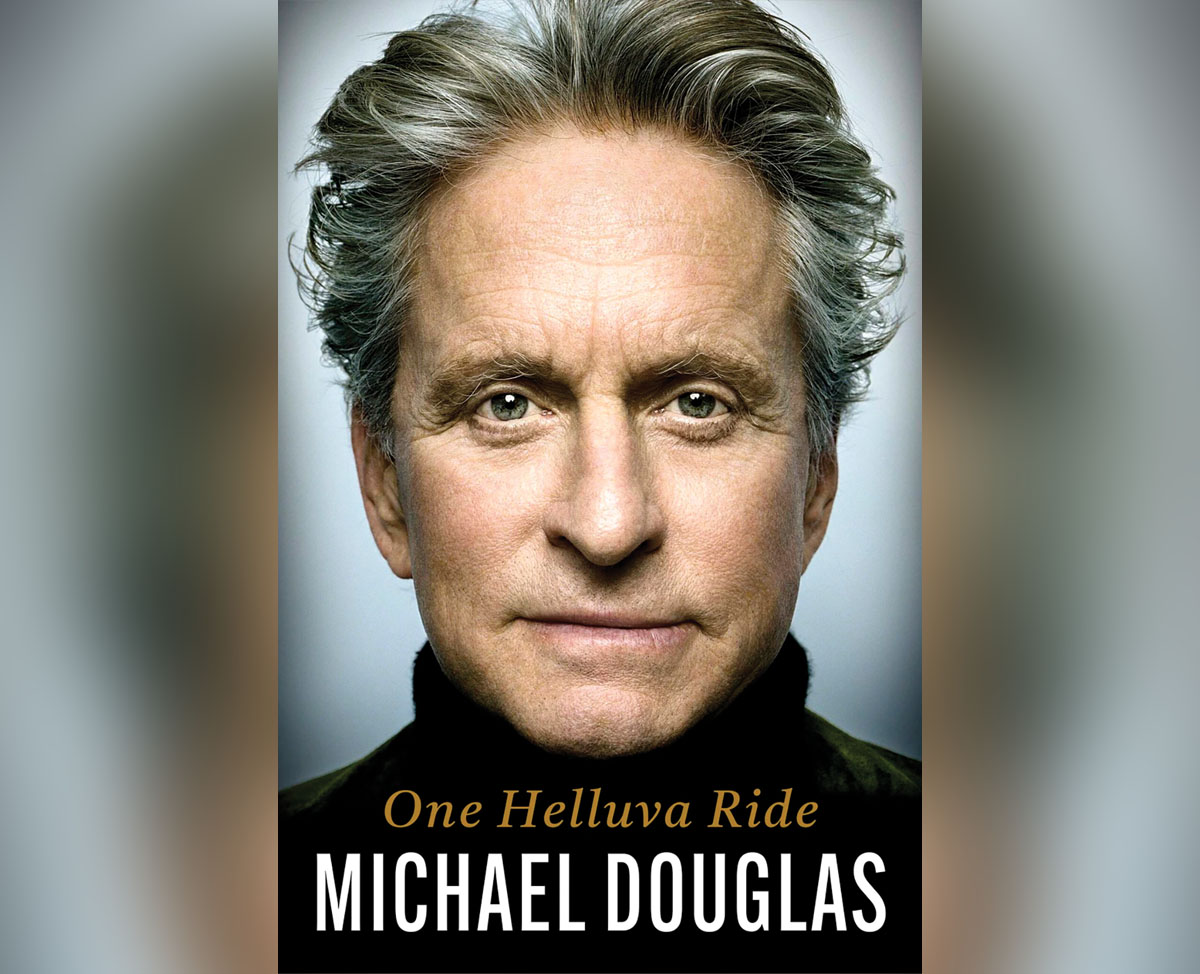
Michael Douglas considers himself to be a lucky bastard.
But he’s also been through a hell of a lot.
At 82, he’s survived cancer, is married to the love of his life, Catherine Zeta-Jones, has been in iconic films including “Wall Street” and “Basic Instinct,” and grew up with the pressure of having a famous father, the legendary actor Kirk Douglas, who could at times be violent.
In his memoir, “One Helluva Ride,” he notes his father was born on Dec. 8, 1916, in Amsterdam, New York, with the name Issur Danielovitch Demsky. The child of Russian Jews, his father changed his name to avoid discrimination with a Jewish-sounding name. Liking the sound of his friend Karl Malden’s name, he wanted a strong-sounding first name and went with Kirk. After working dozens of odd jobs in his youth, from selling newspapers to being a bellhop, he’d go on to star in movies such as “Spartacus” and “Paths of Glory.”
Growing up in New York, Beverly Hills and Connecticut, Michael Douglas writes that his father would sometimes hit him in anger. He wanted his son to become a lawyer. But as we know, he took on the same profession as his father. At first his dad told him he was a terrible actor, but eventually he got some praise. He also writes that because his father didn’t look like a Russian Jew, he would hear people say antisemitic things.
Kirk Douglas married actress Diana Dill, and his son writes that his father popped in between stage shows to see his baby boy come into the world. The parents got a divorce, largely because of Kirk’s infidelity.
In one anecdote, he writes that after starring in Disney’s “20,000 Leagues Under the Sea” his father sued Walt Disney for using him in an ad without paying him. The suit was dropped, and he never worked for Disney again.
Michael Douglas won the Oscar for Best Actor for his role as New York financial shark Gordon Gekko in 1987’s “Wall Street.” But after a scene where Douglas fumbled some lines of dialogue with co-star Charlie Sheen, Douglas writes that director Oliver Stone asked if he was on drugs, and said that Douglas he looked like he’d never acted before in his life. This stoked his fears of never being able to escape his father’s shadow. But he soon realized Stone was challenging him and “twisting his melon” to keep him sharp. The scene was actually pretty good, but Stone wanted to tap into Douglas’ anger. In his Oscar acceptance speech, Douglas would thank his father for coming to his college shows. He found it to be a turning point that he’d won an Oscar, something his father never did.
In addition to “Wall Street,” “Fatal Attraction” and “Basic Instinct” had great impact on pop culture as well as being somewhat risqué erotic thrillers. Douglas opined that the former “did for marriages and infidelity what ‘Jaws’ did for swimming in the ocean – it scared the hell out of people.” He plays Dan, an attorney with a beautiful wife (Anne Archer) and young daughter. He has an affair, cheating with Alex (Glenn Close), who wants more. She threatens to tell his wife about the affair, and he threatens to kill her. Douglas reveals that due to poor audience testing, the ending was changed to be more conventional and less artsy.
For “Basic Instinct,” he was offered $14 million to play a detective opposite Sharon Stone. “The entire film was a huge gamble,” he writes. “No star in my position had ever dared to make a film so explicit. But I figured what good is winning an Oscar if you can’t take some risks?”
According to Douglas, in the middle of a heated argument in a trailer where he asked director Paul Verhoeven if he was sleeping with Stone, blood came out of Verhoeven’s nose. In the book he says an artery burst, but there were rumors Douglas had punched him. He also calls screenwriter Joe Eszterhas a coward for claiming there would be script changes. After an early version of the script was leaked there were protests, as some believed depicting lesbians or bisexuals as murderers was damaging, while Douglas and the director issued a statement that the film is not a negative depiction but simply a psychological thriller. There was also a fight to make sure the film didn’t get an NC-17 rating, which would have made it “dead in the water.”
At this point in his life, Douglas used cocaine and drank and writes that he “lost sight” of his son Cameron, who was in a downward spiral.
Douglas recalls racing to see his father at Cedars-Sinai after a helicopter crash in which there were several deaths, but the 74-year-old Kirk Douglas survived. Kirk had survivor’s guilt and said he would try to be “the father he had not been when I was growing up.”
Douglas believes the chief function of a film is to entertain. If people take a positive message from it, that is great. He allows that some may view a villain as a hero, such as worshipping “Wall Street’s” Gordon Gekko and his claim that “greed is good,” but he believes people come to be entertained, and audiences will draw from it what they will. In addition, he recounts how a reporter with The Los Angeles Times called to ask for comment about the claim that he was running a prostitution ring out of his house, when it turned out he had sold the house a year before to a pediatrician, Dr. Paul Fleiss, husband of the infamous “Hollywood Madam,” Heidi Fleiss.
In the final chapter of the book, he writes about Dr. Saul Frenkiel diagnosing him with squamous cell carcinoma, telling him he had stage IV cancer. Age 65 at the time, Douglas writes: “I wondered if my luck had run out. Was this it?” His wife was 40, his son Dylan was 10, his daughter Carys was seven and his older son Cameron had gone to prison.
His choices were aggressive radiation and chemotherapy or surgery, including on his tongue, which would disfigure him and hurt his ability to act ever again. He was angry at several doctors who had not properly diagnosed him.
Douglas had not appeared on “Late Show with David Letterman” for 18 years after he felt the host “went too far” in a joke about his mother, but now was the time to return and on Aug. 31, 2010, he announced on the show that he had cancer. He mentions that his good friend and legendary L.A. Lakers and N.Y. Knicks coach, Pat Riley, cried when Douglas told him the diagnosis.
Eventually the cancer went into remission.
This is a thrilling book that many will love. Douglas does not need to act anymore but still clearly loves it, recently starring in Netflix’s “The Kominsky Method.” His illustrious career is impressive, and he notes that people still come up to him quoting his lines from “Wall Street.” This is a highly entertaining book by someone who is willing to share far more than most actors.