Vegetarianism and Impossible Utopias
I was briefly a vegetarian in first grade. One Friday night, it finally dawned on me that the chicken on my plate was the same as the chicken I had just visited at the petting zoo. I announced at the table that I would no longer eat meat. My mother chuckled quietly, correctly divining that my hunger would soon get the better of me. And it did.
Many other children make such pronouncements about eating meat. It may very well be that vegetarianism is innate, part of God’s original plan.
After the flood, Noah restarts civilization. The Torah depicts this moment as if creation were beginning anew; like Adam, Noah is also blessed to be fruitful and multiply.
The Adam-Noah connection goes deeper. Noah was the first child born after Adam’s death. The medieval commentator Hadar Zekenim writes that Lemech named his son Noah, from the Hebrew word for consolation, because his birth brought the world comfort right after Adam’s death.
Yet this new beginning starts from another place. On the sixth day of creation, God declares that the world is “very good.” The Midrash says this is because Adam was finally created; the letters in the Hebrew word for “very,” meod, are the same letters as those in Adam’s name.
When Noah leaves the ark, God sees humanity differently. He declares that “every inclination of the human heart is evil from childhood.” At this point, there are no illusions about human nature anymore; humans are weak and corruptible creatures. God accepts these flaws because He expects humanity to redeem itself through faith and fidelity to the covenant.
One significant change in the post-flood world is in diet. God tells Noah, “Every creature that lives shall be yours to eat; just like the green grasses, I give you all these.”
God permits Noah and his descendants to eat meat. As the Talmud points out, this only begins with Noah; Adam ate only plants and fruits.
Adam was a vegetarian. And several Jewish thinkers have considered why this was so.
In the 15th century, Rabbi Joseph Albo offered a human-centered view of vegetarianism. Albo disavows a focus on animal welfare. However, he explains that God prohibited meat for another reason: to preserve Adam’s character. Killing animals would “teach a person the evil trait of shedding blood for nothing,” and inculcate the character trait of cruelty.
Joseph ibn Kaspi, a 14th-century philosopher, takes a sharply contrasting view. He says that humans must recognize how much they resemble animals, and that understanding the connection between all living beings is a foundation of the Torah. In his work Mishneh Kesef, he writes:
“One of the reasons that led the Giver of our Torah to command us to have compassion on the other animals (as our Sages said, the suffering of living creatures is a Torah prohibition) was, in my opinion, to teach us that we human beings are very similar to them, and that we and they are children of one father, and we share a similar type of life.”
Humans and animals share a common nature; God prohibited Adam from eating meat because humans must respect animal life.
Humans and animals share a common nature; God prohibited Adam from eating meat because humans must respect animal life.
Concerns like those of Ibn Kaspi have spurred advocates for vegetarianism throughout history. As early as 2,500 years ago, the Pythagoreans in Greece and the religious renunciant movements of ancient India took on vegetarian diets. However, both drew partly on belief in the transmigration of souls and the possibility that the animal you are eating may once have lived in human form.
Modern opposition to killing animals is philosophical. Jeremy Bentham wrote, “The day may come when the rest of the animal creation may acquire those rights which never could have been withholden from them but by the hand of tyranny.” Nearly two centuries later, that line inspired Peter Singer’s manifesto, “Animal Liberation,” which condemns “speciesism,” the favoring of humans over animals. As Singer titled the first chapter of his book, “All Animals Are Equal.”
To understand Judaism’s view of vegetarianism, one must explain why, after requiring Adam to be a vegetarian, the Torah explicitly allows Noah and his descendants to eat meat. What changed?
Commentaries on the Torah offer three basic theories to answer this question. The first comes from the Ramban, who argues that since Noah saved all the animal species, from then on all animals owe their lives to human beings.
Contemporary advocates of eating meat make a parallel argument. They explain that domestic animals exist only because humans cultivate them. They owe their lives to humanity. As one late-19th-century author put it, with a bit of English humor:
“The pig has a stronger interest than anyone in the demand for bacon. If all the world were Jewish, there would be no pigs at all.”
Rabbi Samson Raphael Hirsch offers a second answer: Humanity changed physically after the flood. Humans now needed animal meat to live. Hirsch adds that if our physical condition were still the original one, meat would probably not be permitted. Some modern research raises a related concern. While individuals can thrive on vegetarian diets, vegetarianism may not be viable for large populations. One study concluded that removing animal farming from the United States would “create a food supply incapable of supporting the US population’s nutritional requirements.” Vegetarianism may not be practical as a wholesale measure.
A third answer focuses on the human soul. Don Isaac Abrabanel, in his commentary to Deuteronomy 14:3, writes: “What seems most correct to me on this question is that meat was forbidden to Adam because of his perfection, and permitted to Noah and his sons because of the wickedness of their nature.”
God said after the flood that “every inclination of the human heart is evil from childhood.” That means one could not expect perfection from humanity; people would hunt animals, and the Torah would have to accept that flaw.
Instead, the Torah set significant limits on how people could obtain and use meat. The Torah forbade Noah to tear flesh from a living animal. Other laws, such as using a sharp knife for slaughtering, not slaughtering a mother and its young on the same day, not cooking meat with milk, and not eating blood, all attest to a discomfort with meat eating.
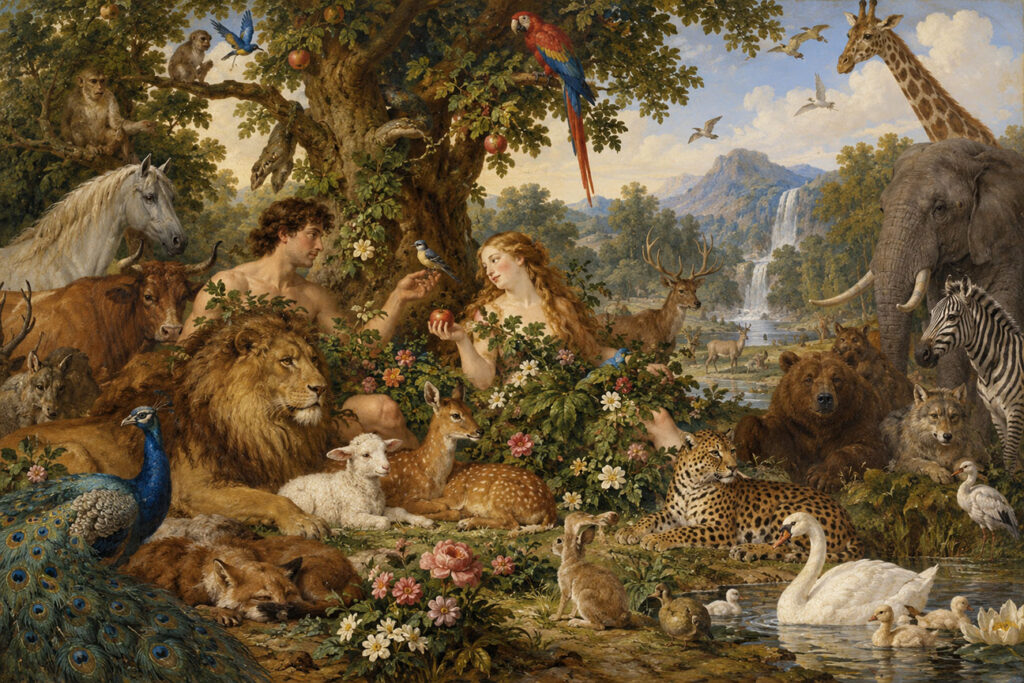
Vegetarianism might be an ideal. Judaism dreams of a future of complete harmony, when “the wolf will live with the lamb, and the leopard will lie down with the goat.” But we need to be practical and take into account human nature. We cannot expect to live in a utopia right now.
But we need to be practical and take into account human nature. We cannot expect to live in a utopia right now.
Rabbi Abraham Isaac Kook wrestled profoundly with this in his essay “A Vision of Vegetarianism and Peace.” He explains that ideally man should be a vegetarian:
“[T]here is a general moral failing in the human species, in that humanity does not live up to the noble and elevated moral sentiment that would refrain from taking the lives of any living creatures for the sake of its own needs and pleasures. … It is utterly inconceivable that the Master of all creation, who has compassion on His creatures, blessed be He, would establish such an eternal law in His very good creation: that the human species could survive only by corrupting its moral sensibility through the shedding of blood, even the blood of animals.”
That is why Adam ate no meat. But humanity fell and could no longer sustain that ideal. Kook adds that all of humanity will return to it in messianic times, and he applauds individuals who embrace vegetarianism now. Kook himself reportedly ate meat only on Shabbat and holidays.
Yet Kook then makes an unexpected pivot. He attacks those who want to make vegetarianism the norm. This is false idealism, where one who worries about animals acts “as though he had already set everything right, already removed the dominion of wickedness and falsehood, the hatred of peoples and the jealousy of nations, the enmity of races and the strife of families that bring down many slain and pour out rivers of blood.”
He then makes a critical point. He argues that if the law equally prohibited killing humans and animals, society would lower its regard for human lives to the lesser value of animals. Albo already presents this argument, stating that excessive concern with animal welfare diminishes the uniqueness of humans created in the image of God. Both Kook and Albo warn that this can lead to bloodshed.
Sadly, their warning proved to be true. Upon taking power, the Nazi regime immediately did two things: It created laws against animal abuse, and it stripped Jews of their rights. The two were linked from the start: In April 1933, months before its general animal protection law, the regime banned kosher slaughter. Nazi ideology both demeaned some people as animal-like and elevated certain animals to near-human levels. The Nazis were particularly obsessed with dogs; Jan Bondeson documents multiple attempts in Nazi Germany to train dogs to speak, including an entire school for dogs with academic subjects.
That blurring of lines between humans and animals in Nazi Germany opened the door for awful atrocities. This is a cautionary tale. One must remember that the pursuit of impossible utopias often ends up creating dystopias.
Thankfully, change is on the horizon. Right now, multiple startups are developing lab-grown meat; it will soon be nearly identical to animal meat. Slaughterhouses may become a thing of the past, and the ability to enjoy meat will no longer weigh on our conscience.
Israeli technology companies stand at the forefront of the lab-grown meat industry, driving this revolution.
Rabbi Kook would be proud.
Vegetarianism and Impossible Utopias Read More »