I recently visited someone at Hadassah Medical Center, Ein Kerem. While there, I saw an exhibit inside of the lobby leading to Davidson’s Tower.
It is breathtaking.
There are 10 works by Blima Nechama, each placed on an easel. What makes them special, in addition to their ethereal beauty, is that four of the paintings are of women; two others, while abstract, appear to reference the female. Blima Nechama (her professional name) grew up in Philadelphia and made Aliyah in 2005.
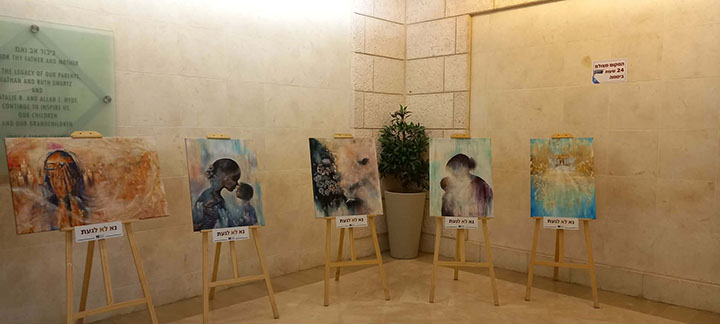
“On August 10, my artwork was installed in Hadassah Ein Kerem,” she told The Journal. “I went in thinking I was hanging paintings. That is not what happened.
“A security guard, a Russian man, followed me from piece to piece. He just stood there, far longer than I ever expected anyone to stay. A man cleaning the floor put down what he was holding and stood in front of one of the paintings without moving.
“And then there was Marisa Tuchinsky. She spent a long stretch of time at Hadassah Ein Kerem with her father, until he died there. She could not walk through those doors without all of it coming back at her.
“She wrote ‘Sometimes, something beautiful can give a familiar place a whole new feeling. Over the past week, I had the zechus (privilege) of walking through Hadassah Ein Kerem many times, visiting my two newest grandchildren. During those visits, I kept passing the magnificent artwork of Blima Nechama. Hadassah also held very different feelings for me from a few years back, when my father z”l was not well and I spent many months going in and out of the hospital. Seeing her artwork there now brought a different feeling to those same halls, giving a feeling of warmth, beauty, growth and life. These paintings are just magnificent.’”
“Others stopped too,” Nechama said. “Nurses told me what it does to a person to absorb hard news day after day, and that standing in front of a painting for one minute gave them somewhere else to put their eyes. None of these people walked in that day planning to look at art. It found them. On a hard day, when they had nothing left to say.
“Those conversations made me see something I had not fully understood before. Art does not need a gallery, and the people it reaches hardest may be the people who would never set foot in one.”
Many of Nechama’s paintings are of women. She said, “Resilience, healing, motherhood and the quiet process of becoming that, happen where nobody is watching. I paint the courage nobody sees. The dreams women carry and never say out loud. The silence that holds an entire life inside it.”
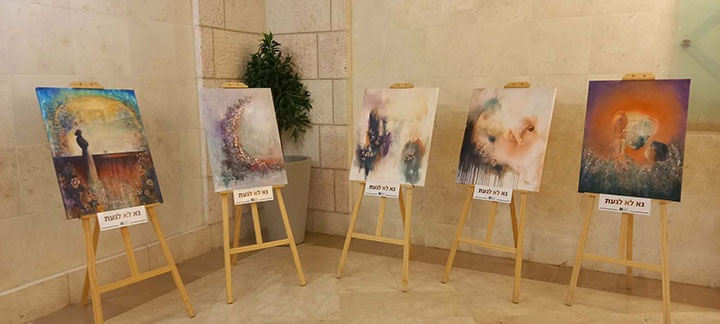
Nechama lives in the Haredi community. “In my world, painting is not a usual thing for a woman to be doing … so it took me years to give myself permission to make this work at all, let alone display it somewhere that it could be viewed by strangers. The world I live in does not display images of women in art.
“Much of my work has been shaped by these years of war, and by what women here do. They continue to carry, create, feed people, hold families together and rebuild, in circumstances that would flatten most people, and almost none of it is ever seen by anyone.
“I’ve been asked countless times. Whether I get pushback for being a Haredi woman who paints. … Nothing I paint is immodest. Modesty is actually an important part of both my life and my branding. I don’t even put photographs of myself on social media.
“At the same time, I want my work to hold space for the beautiful framework that a Torah life gives women. Watching the women in the Haredi world shape generations and carry traditions forward so that our community and Am Yisrael can continue is one of the most powerful things to me. I feel that portraying these women, their strength, tenderness, faith and role in carrying our people forward, is part of my mission as an artist.
“Beauty is the first thing you notice. What it does to you afterward is the part I care about most.”
Nechama says that seeing her work displayed in a hospital changed something for her. “These were not gallery walls or a collector’s living room. They were corridors where patients, families and staff were moving through illness, fear, loss, recovery and hope, and the paintings met them right there in the middle of it.
“I think there is a story here that is bigger than my paintings. … What does beauty actually do for a person at the moment they need it most and expect it least?”
She cited one example.
“A woman named Amy Muscoplat shared how deeply the artwork supported her during one of the most painful and difficult periods of her life. In a place often associated with fear, uncertainty and suffering, the painting offered something unexpected: beauty, comfort and hope. … In that space, the artwork became, in her words, a conduit for praising the Almighty for the gift of life.”
Muscoplat had seen Nechama’s art before. This time, “in the place where I’d once been treated in the orthopedic ward, the paintings of women, women and children, candle lighting, the Beit HaMikdash, Jewish art became the conduit to my praising the Almighty … for the artistic vision He creates in my own daily life too.”
This is not the first time Nechama has exhibited in a medical center. A clinic in a Haredi school reached out after renovating their waiting area. “The space was beautiful, but something was missing. … They wanted their clients to feel calm, welcomed and cared for. Together, we created a large canvas with soft pinks, golds and muted greens, inspired by nature and renewal.”
The paintings hang in the social worker’s room. “Everyone who walks into that room, from the youngest child to the adults, comments on the paintings and how much they see in them.”
After the piece was installed, the client looked around and said: “I feel like I can breathe in here now.” That moment captures what Nechama believes about art. “The right piece … changes how a space feels.”
Nechama creates original paintings, commissioned works for private homes, healing and wellness spaces. Her work has been exhibited in venues in addition to Hadassah Ein Kerem and, she says, “are collected by people who are looking for more than decoration.”
Organizations have also chosen her work as donor gifts. “More than once, donors were moved to tears because the artwork made them feel genuinely seen and appreciated.
“This is why I create. I believe art can bring warmth, connection, beauty and meaning into the spaces and moments that matter most.” Perhaps that is why she brands her creations as “Luxury Soul Art: artwork designed not only to be seen, but to be felt.”
Her work has been featured in publications and podcasts. She’s been in eight exhibits, this most recent one her first solo exhibit.
Returning to her exhibit in Hadassah, Nechama says, “One of the most powerful parts of this entire experience for me has been hearing from complete strangers. People have emailed me photographs of themselves standing outside the exhibition, along with warm, deeply personal letters about what the paintings have meant to them. I never expected that.
“Knowing my work reaches people at the exact moment they need it, that is why I paint.”
For artwork, commissions, designer collaborations or meaningful organizational gifting: blimanechama.com
Toby Klein Greenwald is an award-winning journalist, theater director, and editor of WholeFamily.com.