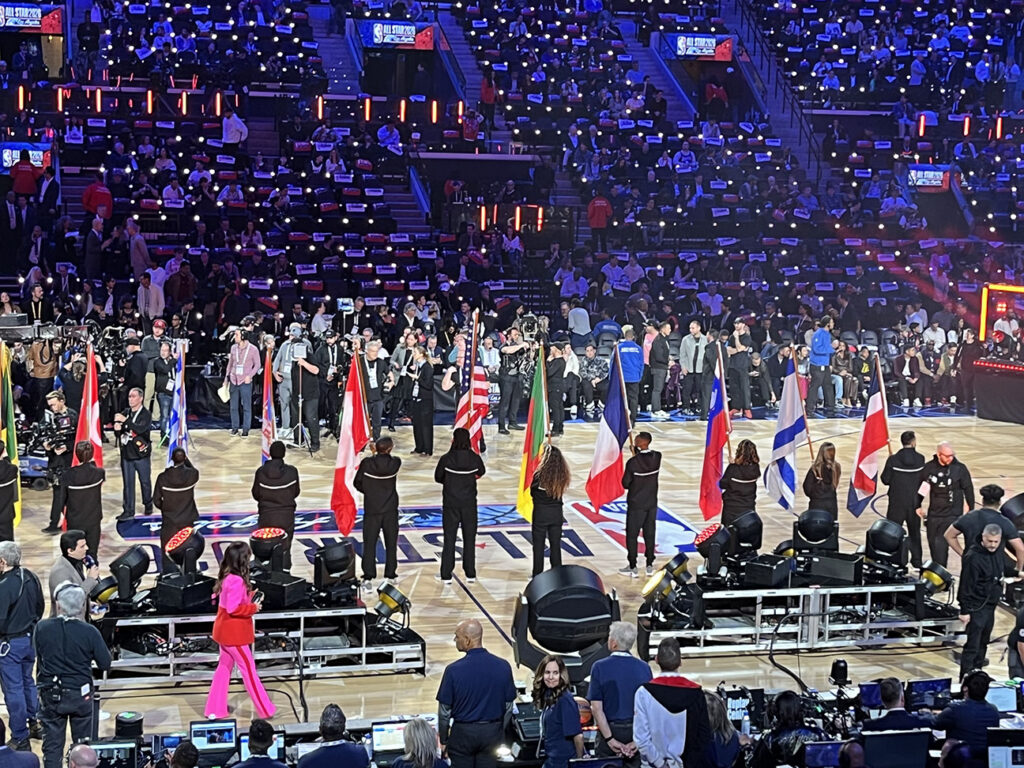
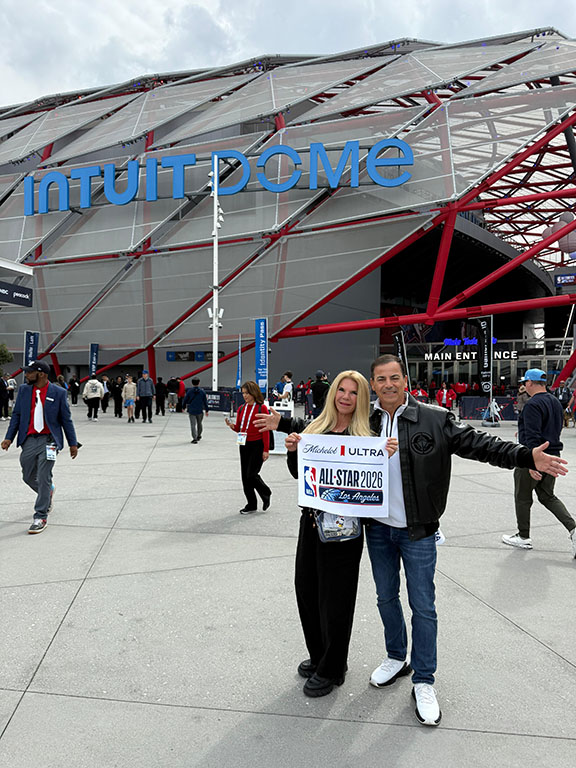
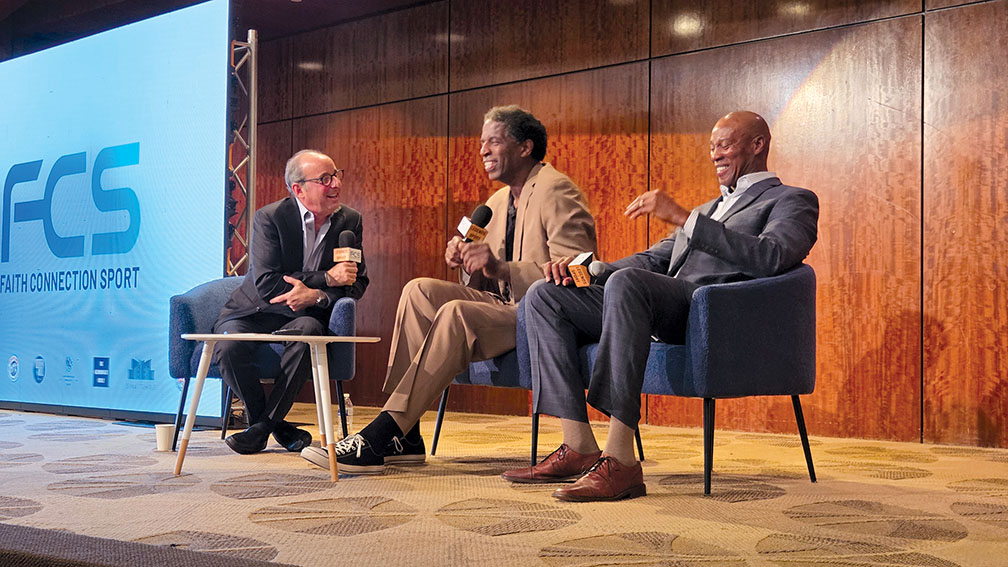
As the NBA All-Star Game brought the world’s top basketball players to Los Angeles, Sinai Temple and Fabric, a direct-to-fan mixed-media platform, teamed up to host a summit exploring how sports and faith can bridge divides, combat extremism and fight hate.
Opening the event, Erez Sherman, co-head rabbi of Sinai Temple, shared a personal reflection from his youth in Syracuse, New York. “Growing up the son of a rabbi, I learned one powerful word: AND. There was never a choice between faith and sports. It was never faith or sports. It was always faith and sports. To this day, I’m not sure whether my faith followed my sports journey, or sports followed my faith journey. But they have always traveled together.”
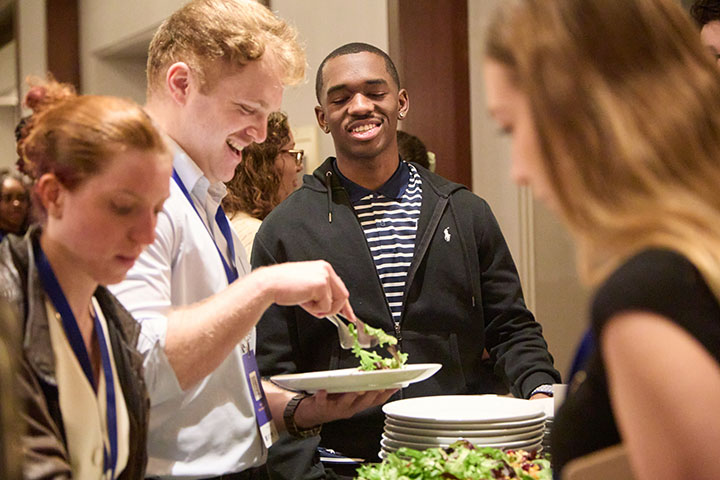
The audience reflected the event’s inclusive mission: Christians, Muslims, Hindus and Jews explored how sports can connect people across faiths, communities, and cultures.
The idea for the summit emerged a few years ago, after the pandemic. Sherman, a basketball fan and player, wanted to explore the connection between faith and sports and how athletics can serve as a vehicle to combat antisemitism, racism and hate.
“In both faith and sports, we find our greatest strength when we play as a team,” Sherman said. “At a moment of rising hate and deep social fracture, this gathering is about reclaiming shared values of respect, dignity and responsibility toward one another.”
For nine months, Sherman worked on the summit and invited athletes to share their stories of faith, along with sponsors who helped bring the event together. Held on Feb. 12, the event featured stories from top athletes who shared lessons learned both on and off the field. Fox sportscaster Chris Rix, a former quarterback for the Florida State Seminoles, spoke about his journey after retiring as a player. He went on to become both a coach and a minister.
For people whose work is a major part of their identity, stepping away from that role can be challenging. The same is true for athletes who see their profession as an inseparable part of who they are. Rix told a story about a client who had become suicidal. “He used to be a coach, and when he was fired, he was devastated. His entire identity was wrapped up in his title. It made me think a lot about what identity really means for people.”
Rix explained that true identity isn’t defined by what you do for a living — it’s rooted in faith and personal values. “I told him, your job was being a football coach, but that’s not who you are. You are a husband, a father and a person of faith in God. That is your core identity.” He added that “with all the noise the world is throwing at us, it’s important to remember what really matters in life.”
A.C. Green and Byron Scott, teammates from the Los Angeles Lakers back-to-back championship teams in 1987 and ‘88, have remained friends decades after their playing days. Both men are actively involved in charity and their communities, and their reflections were deeply personal, revealing how faith and basketball shaped their lives.
Green grew up in a household rooted in religion. “We went to church every Sunday. My parents made sure my siblings and I were raised with faith.” By the time he left high school at 17, Green realized faith was more than ritual. “It wasn’t just tradition — it was a connection from the mind to the heart. I knew I wanted a personal relationship with God. There was a power and confidence that came with faith,” he said, before adding with a laugh, “There was nothing I was afraid of — except Byron Scott.”
Scott’s upbringing was very different. Growing up in a gang-infested neighborhood in Inglewood, he recalled that simply getting to school and back home safely was a daily challenge. “My dad became an ordained minister and tried to push faith on me, but as a kid, my dream was to become an NBA player,” he said. He was less interested in religion.
Scott credited Green — nicknamed “Junior” by his teammates — with helping him discover a deeper connection to God. “When Junior joined the team, the faith he carried inspired me. He got me rebaptized and years later, when I met my wife, (to) became a Catholic.”
Scott, who was first a teammate and then a coach to Kobe Bryant, shared a poignant story about coaching Bryant in his final season. “That last year, my job was to get Kobe to game 82 relatively healthy. I’d call him at home and tell him, ‘Stay at home and just come to the game.’ I didn’t want him to get injured and tried to preserve him as much as possible.”
“Watching him that last night, every shot he took was remarkable. He was exhausted, but he pushed through. At the end, he came over, hugged me, and said, ‘I love you.’ I told him the same. I watched him grow from 17 years old into a global icon. I’m very proud of that.”
Another memorable moment took place years earlier. When Bryant told him he had never been to the beach, Scott took him there and told him about the Lakers’ “Showtime” era. “He asked me many questions and said, ‘I wish I had played with you guys.’ I told him, ‘No you don’t — you came at the right time. If you’d played with us, I would’ve been coming off the bench.’”
Former basketball player Tamir Goodman nicknamed “The Jewish Jordan,” arrived at the event from Jerusalem.
Goodman, who attended the summit with Fabric’s Israeli co-founder Saul Garlick and is the brand’s director of strategic initiatives, was born in Baltimore to an Orthodox family. He received a scholarship offer from the University of Maryland, one of the country’s top-ranked basketball programs. The team’s schedule included games and activities on Friday nights and Saturdays, so he decided to leave.
He accepted a scholarship from Towson University, where he became the first freshman to start in 11 seasons.
It wasn’t always easy being both Orthodox and a basketball player. Goodman faced antisemitism on the court, from audiences and, at times, from coaches. Despite the challenges, he never removed his yarmulke.
“I made history. I’m the first college basketball player in the U.S. who didn’t play on the Sabbath because the schedules were adjusted for me,” he said. “I don’t think it ever held me back — on the contrary, my faith gave me direction. It gives you strength and guidance. What would we be without faith? It’s everything.”
Sherman was inspired when he heard about Goodman’s determination to observe Shabbat while pursuing basketball “I went to my basketball coach and said, ‘See, I can play basketball and keep Shabbat.’” The two men later met and became close friends.
For Goodman, the person who inspired him never to abandon his faith was his grandmother, a Holocaust survivor. “She lost her entire family and rebuilt her life by herself. I thought of her whenever I stepped on the court and what she went through and said to myself: there’s no way I’m ever going to take my yarmulke off.”
Pleased with the success of the event, Rabbi Sherman promised to make it an annual tradition at Sinai Temple.