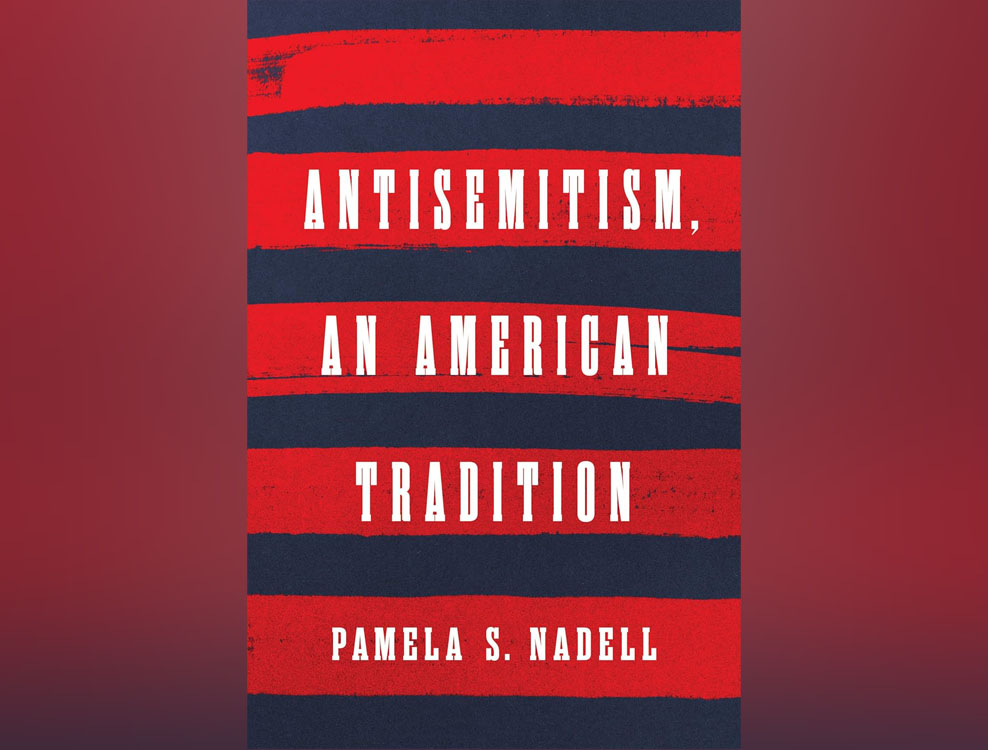
Pamela S. Nadell, Antisemitism: An American Tradition (New York: W.W. Norton, 2025) pp. 332.
When Jonathan Sarna, rightly acknowledged as the Dean of American Jewish historians, wrote the second edition of “American Judaism” in 2019, he had to account for something that was not as clearly present 15 years earlier when the first edition was published, namely, the thriving of Orthodox Judaism in the United States. America has once been considered the “goldena medina, but a treifena land. Seemingly, Orthodox Judaism had come to die in the United States. Sarna had to understand how and why it had not.
Similarly, when the American Jewish Historical Society published a comprehensive five-volume history – one might also call it a celebration — of “The Jewish People in America” in 1992, the titles of the volumes told a triumphant story “A Time for Planting,” “A Time for Gathering,” “A Time for Building,” “A Time for Searching: Entering the Mainstream,” “A Time for Healing: American Jewry Since World War II.” Knowing how the story of Jews in America turned out, each of the distinguished authors had to explore the roots of the exceptional success and acceptance of Jews in America in the epoch that they were to describe.
The Psalmist lamented: “By the Rivers of Babylon, we sat and we wept as we remembered Jerusalem.”
I take this to mean that the place from which one remembers an event shapes how the event is remembered.
And in 2026, the Jewish people in America are not in a good place.
Hatred is prevalent in America; the expression of hatred is not only permissible but often celebrated. Society is unstable, and the hatred of Jews is flourishing on both the left and right.
Thus, Pamela S. Nadell’s book “Antisemitism: An American Tradition” does not recount, as so many other American Jewish historians do, American exceptionalism, of the United States as the place where Jews came to live and antisemitism came to die, but of the long, deep, and widespread roots of antisemitism in American life and how and why they came to the fore at this moment in American history, at this moment in Jewish history.
I stress this moment because it was only 35 years ago, after the Pew Survey of American Jews in 1990, that many American Jews and many historians, sociologists, theologians and rabbis were wondering how the demise of antisemitism would impact the Jewish future. They were asking Jean-Paul Sartre’s question in “Antisemite and Jew”: Does it take the antisemite to make the Jew? Does the hatred of Jews force Jews to remain Jews and would they stay Jews – or what type of Jews would they remain — if there were no antisemitism? Jewish leaders and the established Jewish community wondered if they were spending too much money on Jewish defense organizations, such as the ADL, the American Jewish Committee and the American Jewish Congress, fighting a problem that was no longer.
In her meticulous and unrelenting work, Nadell examines antisemitism in American life. Consider and contrast the titles of her chapter with the AJHS series: “Blasphmers and Enemies: Colonial America”; “Anti-Jewish Prejudice: The Young Republic”; “A Misfortune to be a Jew: From Civil War to the New Century”; “An Uncomfortable Place for Jews: 1900-1933”; “A ‘Poison, Virulent and Dreadful’: Depression and World War II”; “No Age Is Golden: From the End of World War II to the New Century”; “A New Litany: Charlottsville, Pittsburgh, Poway, Jersey City, Monsey, Oct. 7 …”
“Antisemitism, An American Tradition” is a necessary – albeit unwelcome – correction to the theory of American exception. The book is important; its conclusions are discomforting precisely because they are real. As Nadell writes, antisemitism has always been there. Antisemitism has waxed and waned, sometimes expressing itself more intensely and sometimes less so, but has been found throughout American history. If you want to know where and how it has been present, then Nadell’s work is an important source recounting, documenting, and assessing antisemitic events and forces throughout American history.
I came away from this book impressed by the depth of her scholarship, but recalling a Hasidic story.
A Rebbe was asked: What is man?
He responded: “Take two pieces of paper in your hand. On one write: ‘For me the world was created.”
On the other write: ‘I am but dust and ashes.’
Put one in your left pocket and the other in your right pocket. And then ask the question again.”
“How does that answer the question?” the Hasid asked.
“Now put one hand in each pocket and take out the papers.”
“How does that answer the question?” the Hasid asked ever more despondently.
“Clap your hands.”
“What is man? Man is but dust and ashes, yet also the center of the universe.”
What is the situation of Jews in America? This non-master suggests.
Take two pieces of paper and write on one: “America is exceptional.” On the other write, “Antisemitism is a deep and enduring American tradition.” Put them in your pockets. Take the papers out of your pocket and clap your hands.
Would that Nadell were wrong, but we dare not pretend so.
Antisemitism is a deep and enduring American tradition. And yet America is also exceptional. American Jews live in the clash of those two realities: Which tradition prevails depends on what type of America the American people, and our political and moral leaders — or what’s left of them —want to create.
In 2026, these two realities are clashing. The outcome of this clash is far from certain.
Michael Berenbaum is director of the Sigi Ziering Institute and a professor of Jewish Studies at American Jewish University.