Every temple and sanctuary expresses a perspective on how God and man interact.
Many sacred spaces express the idea that God’s presence is exceedingly rare. These temples are in unique locations, in the one place where one can encounter the divine. Mircea Eliade writes in his book “The Sacred and the Profane” that “man becomes aware of the sacred because it manifests itself, shows itself, as something wholly different from the profane.” A sacred place is something like a holy oil well; it is there simply because it is there. Eliade uses Jewish sources to portray the Temple in Jerusalem in a similar manner. He quotes the medieval midrash that there is a Yerushalayim shel maalah, a divine Jerusalem in heaven, in which there is a heavenly Temple; and they align directly with the Jerusalem and Temple on earth. Eliade sees this midrash as an example of the mystery of “hierophany,” how the sacred can manifest itself in different locations within an otherwise profane world.
A careful reading of Parashat Terumah, which describes the construction of the Mishkan, the first Sanctuary, offers a very different picture. First, it needs to be pointed out that the Mishkan traveled wherever the Jews went. Clearly, it didn’t need to be in a particular spot to connect with God. A further look at the text reveals a great deal more, and speaks powerfully about how man can always approach God.
In her “Studies in Shemot,” Nehama Leibowitz notes multiple linguistic parallels between the passages describing the creation of the world and the building of the Mishkan. The Hebrew words for “make,” “finish,” “saw,” “behold,” and “bless” figure significantly in both. Rabbi Jonathan Sacks adds that the word for “sanctify” is another parallel. Even the context is similar; the Shabbat is mentioned in connection to both the creation of the world and the creation of the Mishkan. The Torah makes seven different connections between the Mishkan and creation.
Sacks explains this in the following manner. Creation was an act of withdrawal for God, to make space for human endeavor (and failure). The creation of the Mishkan was man withdrawing from his own space and making room for God. He writes that “The creation of the Tabernacle by the Israelites is the counterpart of the creation of the universe by God. Both were acts of self-renunciation whereby the one made space for the other.” The Mishkan and creation are mirror images of each other, where God and man each build a space dedicated to the other.
Leibowitz sees the connection in a more straightforward way, and says the linguistic parallels convey that “it is incumbent on man to imitate his creator…and assume the role of being his partner in creation.” The Mishkan is our way of continuing God’s work of creation.
I would suggest that there is one more critical element to this parallel. It not only connects the Mishkan to creation, but also in particular to the Garden of Eden.
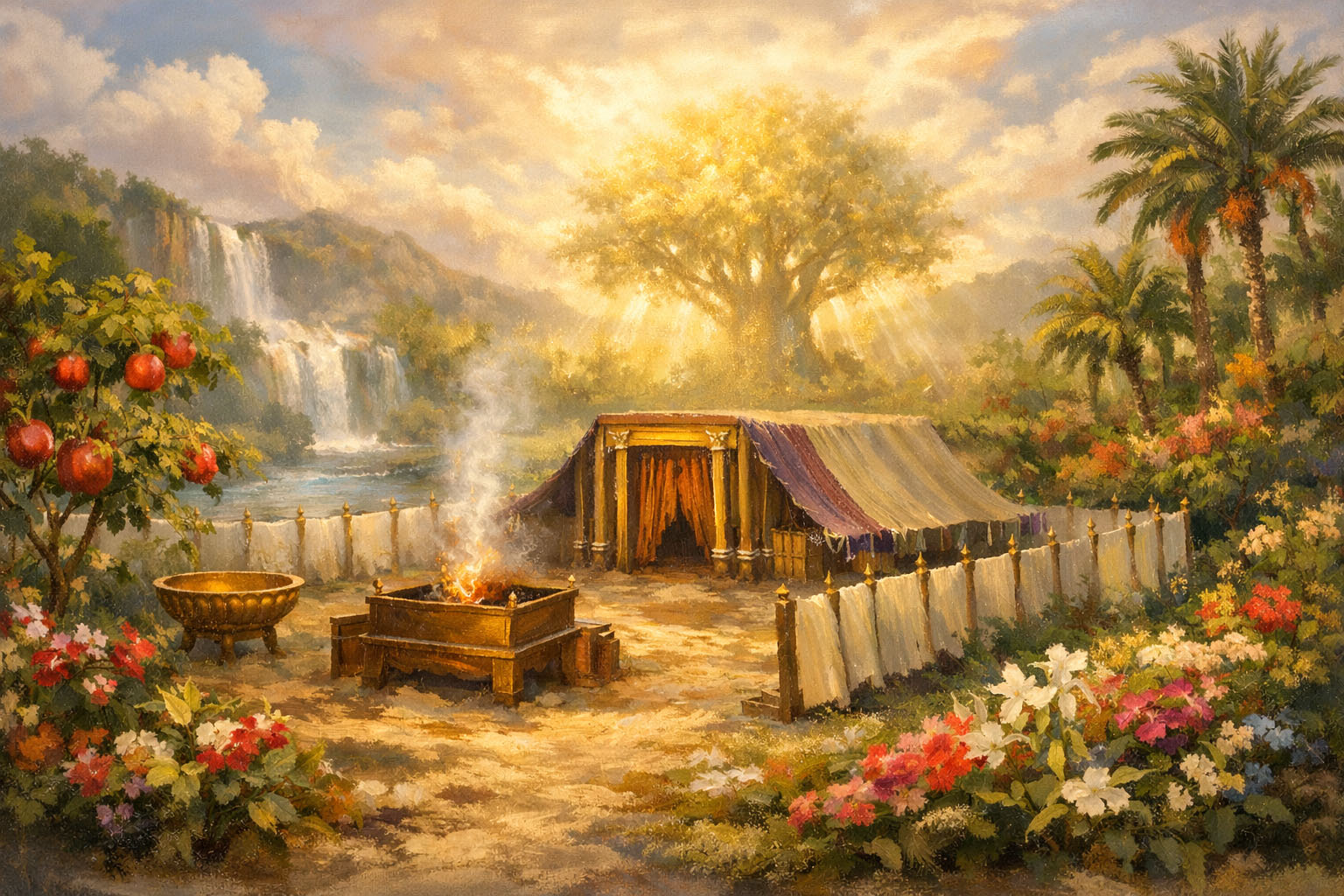
There are several strong similarities between the Mishkan and the Garden of Eden. The most significant similarity is that the Torah mentions the keruvim, winged supernatural creatures, in these two places only. At the end of the Garden of Eden narrative, they protect the path to the Tree of Life; in the Mishkan, they stand above the Ark of the Covenant. But there are several other parallels. They are the only places in the Torah where shoham stones are mentioned. There is an expectation for man to “work” and “watch” both. And God is “walking about” and “walking alongside” man in the Garden of Eden and the Mishkan.
The comparison between the Garden of Eden and the Mishkan offers a message about humanity’s ability to recover from sin and failure. One could easily assume that humanity would forever be cursed after Adam and Eve sinned and were expelled from the Garden of Eden. Imposing keruvim now stand on the path back to prevent their return. It looks like there is no way back.
This idea, that there is an original, irredeemable sin, is found in some Midrashim and is particularly influential within Christianity.
But the text tells us otherwise. The Mishkan’s design, which models the Garden of Eden, highlights that humanity can regain its former glory even after sinning and being exiled. The Garden of Eden never disappeared and is never remote; it is very close, just a short distance away in the Mishkan. One can return to the Garden of Eden again.
One can return to the Garden of Eden again.
This message of return is particularly significant to the Jews in the desert. The Jews constructed the Mishkan after the sin of the Golden Calf. That sin was a profound act of betrayal, of abandoning God for a mere idol. One might imagine that this sin would leave the Jews irreversibly tainted. Instead, the Jews are told to go ahead and build the Mishkan.
A comment from Rashi highlights how forgiveness is one of the primary themes of the Mishkan. He writes that “the Mishkan offers testimony to Israel that the Holy One, blessed be He, forgave them for the sin of the Golden Calf, for behold, He caused His Shekhinah to dwell among them.” The Sefat Emet elaborates that “because Israel had fallen very low through the sin, the Holy One, blessed be He, gave them testimony through the Mishkan in order to strengthen their hearts and to show that they had repaired the entire sin.” There is always a second chance. No one is cursed or tainted.
Our parsha offers a powerful message of renewal and repentance. One might imagine that sin can break our bond with God; we might imagine that the divine is far away, in a unique space too difficult to enter.
But it isn’t. God will come anywhere people let Him in.
Rabbi Chaim Steinmetz is the Senior Rabbi of Congregation Kehilath Jeshurun in New York.