fbpx

February 20, 2026

When Ambition Clashes With Love: Why I Can’t Stop Watching La La Land

It’s hard to explain why certain movies move me to the point that I have regular urges to see them again. Why waste time on an old movie you’ve already seen when so many great unseen movies are available with just one click on Amazon Prime?

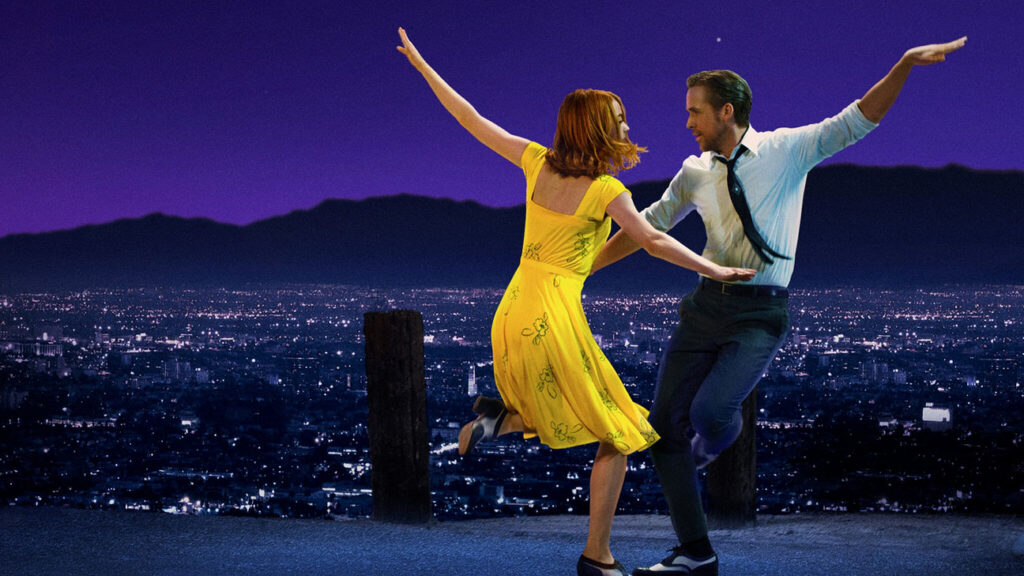
La La Land is one of those films that still has a hold on me. I just watched it for the fourth time, and it probably won’t be my last.

There’s one easy explanation for my fixation– I’ve grown to love this town, with all of its warts.

New York City was always my first choice when I was a kid in Montreal dreaming of America, but fate brought me to the City of Angels, a sprawling metropolis that feels positively sleepy compared to the electricity of Manhattan.

You can feel that electric vibe in hundreds of films and TV shows that have used Manhattan at the world’s greatest movie set. From the films of Martin Scorsese, Woody Allen and countless others, a “New York City movie” was a badge of coolness. No one can forget West Side Story, Taxi Driver or Serpico, not to mention Eyes Wide Shut.

Films set in Los Angeles have had their own alluring appeal, as directors like Paul Thomas Anderson and Michael Mann have shown. I’ve seen a whole bunch of them, many of them that I’ve loved.

But there’s something special about La La Land.

La La Land is not a crime thriller or a film noir classic—it’s a musical. Just as the West Side Story musical fit seamlessly on the gritty streets of New York City, La La Land, somehow, found a way to fit seamlessly in a city where you have to drive 20 minutes to get anywhere, often in traffic.

La La Land brought out the iconic jewels in that urban sprawl and married them to a story of dreams. The shots of Mulholland Drive under a golden light, among many others, have a beauty that matches any I’ve seen in other great musicals.

That might be the key word: beauty. La La Land conveys a raw, authentic beauty for a city no one would ever describe as beautiful.

But there’s a deeper reason why I can’t stop watching the film. It confronts us with one of life’s mesmerizing questions: what comes first, love or ambition?

The two protagonists are both dreamers with big dreams. That’s why they’re in LA.

The drama revs up when their dreams are ambushed by love.

What does one do then? What does one do when following your dream means you can’t follow your heart? How do you choose?

I won’t give the story away for those who haven’t seen the film. But I must add that the musical score transports you into the story in a way that holds your heart and doesn’t let go.

It’s quite a mix. Beauty in the images and the music, and emotional pain in a love story that makes you fall for the lovers.

We have many loves in our lives. We love our friends, our families, our community, our professions, our causes, our dreams.

But then there is that other kind of love— romantic love for a person that you can’t imagine being without.

Set in the City of Dreams, La La Land makes us confront the clash of individual dreams, those moments in our lives when one love conflicts with another love. There is an odd beauty in just the presence of two loves.

That may be why the film never gets old.


When Ambition Clashes With Love: Why I Can’t Stop Watching La La Land Read More »

Faith, Policy and Cultural Leaders Convene in Nashville for First Judeo-Christian Zionist Congress

Amid growing concerns over antisemitism within conservative circles, faith and political leaders gathered in Nashville last weekend for the First Judeo-Christian Zionist Congress — a two-day convening organized by ARISE (Alliance to Reinforce Israel’s Security and Economy), an Israel-based advocacy group, alongside a committee representing the country’s largest Evangelical denominations.

The Congress drew influential voices from faith, policy, education, media, sports and entertainment — spanning Evangelical, mainline Protestant, Catholic and Jewish traditions — to address the resurgence of antisemitism and reaffirm the Judeo-Christian foundations they argue underpin Western democracy.

“Antisemitism is making a comeback on the right, and it is now knocking on the door of the church,” said American Evangelical leader Rev. Johnnie Moore. “We are facing a test of whether Western civilization itself will survive — whether the values that built the freest, most prosperous societies in human history will be handed to our children or surrendered on our watch.”

Speakers included former U.S. Secretary of Education Betsy DeVos, U.S. Senator Bill Hagerty, bestselling Christian author Eric Metaxas, Championship Coach Bruce Pearl, Emmy

Award-winning actress Patricia Heaton and Israeli Mayor Haim Bibas, Chairman of the Israel Federation of Local Authorities. Several speakers addressed hostility toward Israel and Jewish people from prominent conservative voices, including commentator Tucker Carlson.

“A loathsome phenomenon has recently taken place among the radical right, using Christ as a weapon to demonize Jewish people and any non-Christians,” said Heaton. “This is the exact opposite of what God intended.”

Senator Hagerty framed the gathering in generational terms: “The sanctity of human life, the principle of loving your neighbor as yourself, individual liberty, moral responsibility — these are fundamental principles. This convocation is going to allow us to build upon them for generations to come.”

Organizers distinguished the Congress from traditional advocacy events by its action-oriented format. Participants left with concrete initiatives tailored to their respective fields, and the coalition model — uniting older denominational leaders with younger conservatives seeking moral clarity — is one organizers say they intend to replicate and scale.

The Congress acknowledged that advocacy for Israel must be grounded in the same

Judeo-Christian principles championed throughout the event, including commitment to growth within Israeli society itself.

Secretary DeVos closed with a call to action: “If we go forth united in purpose and conviction, and prepared for action, I have no doubt we can, with God’s blessing, continue to prosper and defend two lands He has so richly blessed — Israel and America.”

Faith, Policy and Cultural Leaders Convene in Nashville for First Judeo-Christian Zionist Congress Read More »

Rabbis of LA | Rabbi Ratner Tried ‘Everything’ First

Halfway through his first year as leader of the Pasadena Jewish Temple and Center,  Rabbi Josh Ratner told The Journal that “I wanted to try everything before I knew for sure what I wanted to do.” And after five less-than-fulfilling years as a commercial litigator and 14 years after his ordination, the San Diego native has found himself in a job he loves.

He found himself dissatisfied with the law pretty quickly. It was a matter of two things: “One was feeling conflicted between my Jewish self and my work requirements, not being able to navigate those two in a cohesive manner. The second was – I had started at a large New York law firm – and I found that to be a bit dehumanizing,” he said.

He was one of many lawyers, and the focus was on working as many hours as one could, doing a lot of grunt work. “It wasn’t as analytically inclined as law school had been – and as I had hoped law would be. The juicy stuff, the meatiest cases were reserved for the partners. We junior associates had to do more the scut work. It didn’t feel fulfilling to me.  And I was working really long hours.” His interest in law cooled after one year, he said. “I wrestled back and forth. We were living in Connecticut at the time. My wife was in training at Yale to become a doctor. So I tried moving to a smaller firm in Connecticut to see if that would change my perspective, to see if the basic issue was working for a big firm. But I found similar issues there. It was a dramatic change he said, but one he welcomed. “Having spent eight years in New York, I was ready to see greenery, foliage, trees, those kinds of things again.”

Telling the story from his new office that offers an unimpeded view of the San Gabriel Mountains, Ratner is relaxed and all smiles. For a moment, the rabbi turned to his childhood. “We weren’t a very observant home,” he said. “My parents were inclined to empower [him and his sister] to explore Judaism more substantially than they ever had. Both of them had been raised relatively Reform in practice. They weren’t avid shul-goers. But when it was time for my slightly older sister and me to go to school, they decided it would be a good project to put us in a nearby Jewish school.” It was a good decision, he said. “They grew, too. They became more observant in some of their practices – through us in some ways.”

What changed? “I was too young to know how I was before,” he said. But he reached back for several details. As a family, they started to observe Friday night dinners more – whether with family or friends. His parents made friends with the families of other students, and it gradually became an enlarged circle. “We also started going to services a bit more on Friday nights and Saturday mornings. It’s a process,” he said.

He also spent a year in Israel studying at the Pardes Institute, something that might have influenced his later choice of career. “I loved the opportunity to be fully immersed in Jewish living,” he said. “Something about the totality of that experience spoke to me.”

He was attracted to the law, because he was “always passionate about issues of justice, equality and fighting for those who may have been marginalized or not had the opportunity to advocate for themselves,” he explained.

He also grew up during the halcyon days of legal dramas on television – “’L.A. Law,’ ‘Boston Legal’ – those kinds of shows,” he said. “I saw law as exciting, intellectually engaging and also a chance to advocate for good causes – that’s what drove me.”

But deciding on a career in law was “more a process of elimination.  I knew I didn’t want to go into medicine. I don’t like blood or guts or anything internal about the body despite the fact I am married to a cancer surgeon. I knew I didn’t want to go into finance. It wasn’t appealing.”    

He wasn’t sure what else to do, “I had a background where I liked writing, I liked debate and advocating for causes, a whole host of issues. Law became the logical next step after college.”

After law school, Ratner spent a year clerking for a judge in Memphis, Tenn. while his wife was finishing her last year of medical school. Then they moved to Connecticut. He realized it was time to explore other options. The rabbinate “quickly emerged as an intriguing possibility,” he said.

“As I was opening my antenna to see what else was out there, I started to meet rabbis who were doing work outside of congregations and schools – those had been the primary modalities to me of what it meant to be a rabbi, doing work in social justice organizations, at universities, at Hillel. All of this expanded my awareness of what rabbis could do. I was looking for something a bit wider, not just limiting myself to one specific avenue.” Becoming a rabbi appealed to the attorney. The issues he had encountered in law school, “advocating for justice, a vision of a moral society – was something I actually could do as a rabbi. That opened my mind to thinking that [the rabbinate] is a career I could feel passionate about.” As a bonus, it could give him “a Jewish proximity to continuing to learn and to practice and have it be a part of what I do.”

He is married to Dr. Elena Ratner, a gynecologic oncologist specializing in ovarian malignancies, and they are the parents of Dimitri, Eli, Gabby and Sasha.

“She wanted me to be happy and fulfilled,” the rabbi said. “She was supportive. She knew I wasn’t [fulfilled] in law. She had spent some of the time I was in Israel with me. She had an appreciation of how much that experience meant to me.”

He said from the time he entered rabbinical school, “I have loved every minute of it. It has been a love affair. I have been so happy to find fulfillment in what I am doing. This vocation is sacred work. Every day I feel blessed.”

Rabbis of LA | Rabbi Ratner Tried ‘Everything’ First Read More »

Rabbis of LA | Rabbi Kahn on the Changes in Israel Since Oct. 7, 2023

As he prepared this month for his 10th life-altering trip to Israeli war zones and victim families since Oct.7, 2023, Chabad of the Valley’s Rabbi Yanky Kahn reflected on the changes he’s seen.

“What’s beautiful,” he said, “is how the world is getting involved. The whole world really feels the pain. Like I can say my wife and kids have adopted so many new people to our family.” He means this literally. “You know, you call your mother every day. And you also call her before Shabbos.

“So many people my wife [Hindy] and daughter [Chana] text before Shabbos, checking up on them. When we say we are going to Israel, I think the people from Israel were more excited that we were coming – like the widows, the orphans. They reached out and said ‘What can we do to help?’

“It’s a very special connection.”

Rabbi Kahn has also noticed a change in the attitudes in the state of Israel — a ”national change,” he called it. “People are asking for tefillin,” he said. “They are getting closer to Godliness. Really. You see the hostages themselves saying that they found God in the tunnel. They spoke to God. First they spoke to this crack, then they spoke to a light. People are coming closer to God.”

Why does he think this is happening?

“The only thing we have in life is Hashem,” he said. “The only things that are really important are your wife, your kids, your family, your community for God – that is all that is important in life. Nothing else is.”

It’s fine to have a nice car and a nice house, he granted. “Beautiful. Everyone should have them. But you are not taking those things to the next world. The only thing important, the only thing you are taking is the kindness you do, the caring you do.”

In the 78 years since statehood, Israelis have not been known for their religiosity. But if you go to Israel now, you can really see a change. “You notice they have been pretty anti-religious. Funny, you see Israelis here … I was just walking out of a hospital this morning, and I met an Israeli. I said ‘Do you want to put on tefillin?’ He said ‘I am going to do it the second I get home. I promise you.’ In Israel, they weren’t so in love [with Judaism].  But now I think their attitude has changed. People now are much more open.”

Rabbi Kahn did not exactly say the words “the war has had a positive effect.” But in a sense, yes it has, he said. “In a way, the war has brought us closer to Yiddishkeit, closer to Godliness.

“Unfortunately, though, when things are going good for people, they don’t count their blessings.

“They don’t stop and say ‘Thank you, Hashem.’

“When things are challenging, you turn to Hashem. So yes, you can say a lot of people have come  closer to God since Oct.7. We have put up a lot of mezuzahs and given out a lot of tefillin.”

But Rabbi Kahn emphasized this point. “Before the war,” he said, “this was not something we would do when taking another kind of trip, say a JLI [Chabad – Jewish Learning Institute] trip to Israel. We wouldn’t be giving out mezuzahs. Before, it wasn’t common. Now it is.”

He described a surprising scene on a recent flight from Israel.  “I went up and down the plane with a pair of tefillin,” said the rabbi. “And I can tell you 60% of the plane put on tefillin! There was such a feeling of love and brotherhood. If the tefillin was not taken by someone, if a person said no, it was just left quietly.

“There was such a feeling of everyone saying ‘thank you.’  A beautiful feeling of one family, which we all really are.”   

The rabbi kept bringing the conversation around to a central thesis: “No one wants to say that war is positive … but …” Doing that, he thinks, is akin to describing a close relative as strikingly unattractive – in the relative’s presence.

“I don’t wish this on anyone,” said the rabbi, “but it happens sometimes when you are going through a difficult period that you awaken different strengths, different opportunities. I just hope and pray we don’t go through any challenging times, and we shouldn’t be tested. I really hope that when things are good, people go to the synagogue and put on tefillin.”

To make certain his point about daily tefillin was understood, the rabbi said “Even if you are traveling to Hawaii or Fiji, make sure you take tefillin and put them on. Don’t just leave them at home and wait for times that are challenging. Appreciate all the good that you have now.”

But still, his heart “bleeds for the widows and orphans.”

The impact of the war, he thinks, is far from over. “I was just in a taxi, speaking to the driver, which I love doing. Drivers give you an update like no one else. I was trying to figure out if life was coming back to normal. The driver said his son was killed on Oct.7. It feels as if every family has a member or best friend or neighbor who was affected. As Jewish people, when someone else is in pain, it impacts all of us.”

To a non-resident, Israel looks normal.

For Rabbi Kahn, a normal appearance is not a positive. “Personally, I still feel the broken hearts from Oct. 7,” he said. “I am far from over. My message to everyone reading this is, appreciate all the good we have. Sometimes it takes a tragedy for us to appreciate. Moshiach will come when God sees how much brotherly love there is.”

Fast Takes with Rabbi Kahn

Jewish Journal: What is the most memorable moment of the last two  and a half years?

Rabbi Kahn: I was in total shock when I was asked to somehow produce a food truck [that would cost $30,000]. It was like going to someone and asking for a hundred million dollars. I was shocked by the chutzpah of the question. The fact we made it happen is very special.

J.J.: Where do you go for information?

R.K.: Israel National News, collive.com and chabadofthevalley.com/Israelrelief.

J.J.: What is your favorite music?

R.K.: Shlomo Carlebach.

Rabbis of LA | Rabbi Kahn on the Changes in Israel Since Oct. 7, 2023 Read More »

Beit Issie Shapiro, ‘Borrowed Spotlight’ Exhibit, Mayor Nazarian Appears at Temple Emanuel

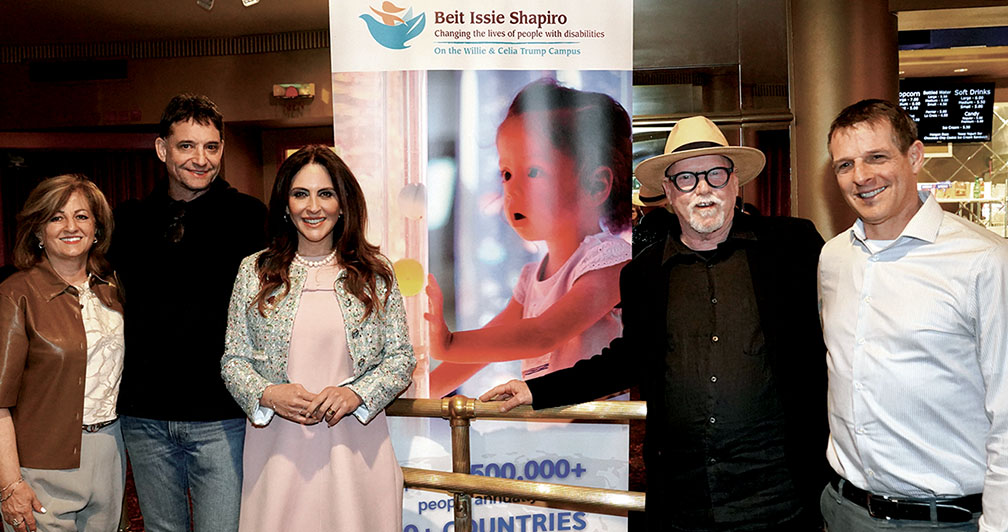
During his latest visit to Beverly Hills, Ahmir Lerner, executive director of Beit Issie Shapiro, met with community leaders and supporters to highlight the organization’s impact, including a talk at the Beverly Hills Tennis Club where he spoke about its mission to better the lives of people with disabilities and the remarkable work being done with wounded soldiers through the new “Tech for Heroes” service.

Lerner’s visit also included a special screening of the movie “Malachi,“ a documentary  that explores the life of a young man with a disability, highlighting both the social barriers he faces and the profound impact of compassion, dignity and human connection. The film’s director, Ido Bahat, joined the screening and engaged the audience with a Q&A.

Since its founding over four decades ago, Beit Issie Shapiro has served as Israel’s pioneering leader and innovator in the field of disabilities.


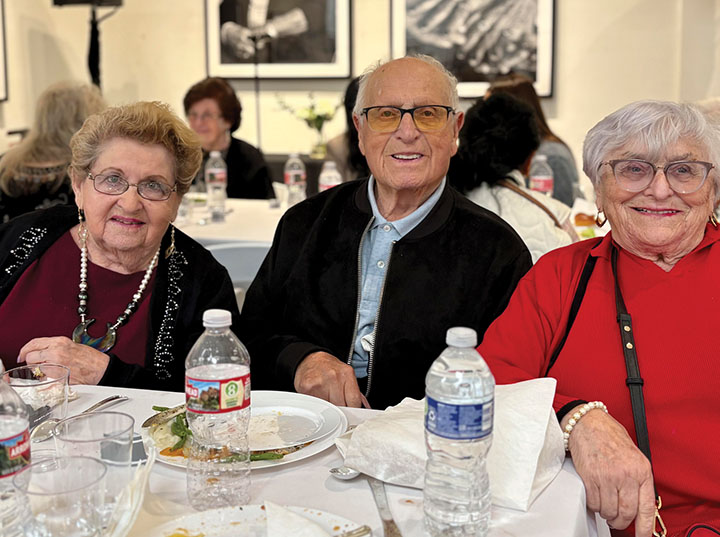
Holocaust survivor Masza Rosenroth at the “Borrowed Spotlight” luncheon. Courtesy of Jewish Family Service LA

On Feb. 11, a luncheon was held at Jewish Family Service LA’s (JFSLA) Café Europa that featured “Borrowed Spotlight,”  a photography exhibition and book dedicated to sharing Holocaust survivor stories. The portrait series, created to combat rising antisemitism and preserve Holocaust history, was captured by fashion photographer Bryce Thompson. It pairs Holocaust survivors with today’s most recognizable figures – including Cindy Crawford, Jennifer Garner, Billy Porter and David Schwimmer – using their public platforms to amplify the survivors’ stories. The exhibition features large-scale portraits of Holocaust survivors posing alongside A-list celebrities along with the survivors’ testimonies.

Maria Ross and Arnold and Jeanetta Perl at the “Borrowed Spotlight” luncheon honoring Holocaust survivors from JFSLA’s Cafe Europa. Courtesy of Jewish Family Service LA

At Café Europa, approximately 35 people turned out, including 20 survivors. Survivors and Café Europa participants Ella Mandel and Eva Nathanson, who are featured in the photographs, attended and shared their stories. Additionally, JFSLA staff spoke about the importance of celebrating survivors.

Café Europa is JFSLA’s weekly social program providing community and support for Holocaust survivors.


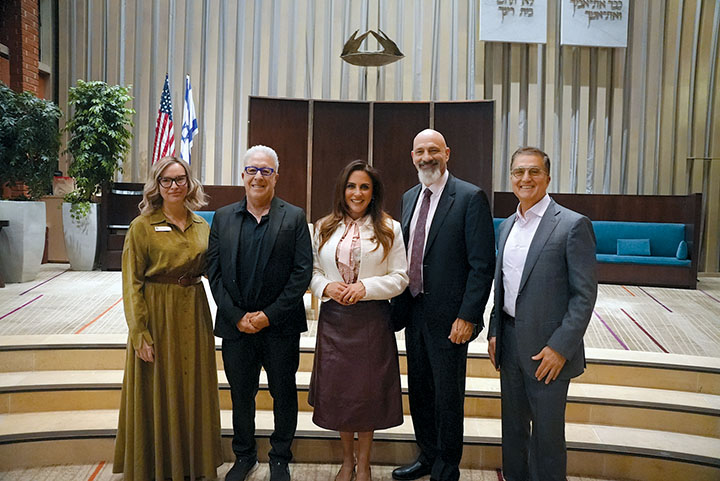
Sara Hiner, executive director of TEBH; Izzy Eichenstein, president of the TEBH Men’s Club; Beverly Hills Mayor Sharona Nazarian; TEBH Senior Rabbi Jonathan Aaron; and TEBH Co-President Farhad Novian. Courtesy of Temple Emanuel of Beverly Hills

On Feb. 10, Temple Emanuel of Beverly Hills (TEBH) held a special community conversation featuring Beverly Hills Mayor Sharona Nazarian. The discussion was moderated by TEBH Senior Rabbi Jonathan Aaron and organized by the Temple Emanuel of Beverly Hills’ Men’s Club.

The event is part of TEBH’s ongoing speaker series, which brings prominent civic, business and cultural leaders to engage in meaningful dialogue with the community. Previous speakers have included developer, civic leader and former mayoral candidate Rick Caruso and sports broadcaster and author Jay Glazer.

During the evening, Nazarian, the first Jewish Iranian-American woman to serve as a mayor in the United States, shared reflections on leadership, community engagement and civic initiatives, including her advocacy efforts and work on community-based projects in Beverly Hills and her commitment to combating antisemitism while promoting unity, civic responsibility and interfaith collaboration across the broader community. The conversation provided attendees with an opportunity to hear directly from the mayor in an intimate and thoughtful setting.

Beit Issie Shapiro, ‘Borrowed Spotlight’ Exhibit, Mayor Nazarian Appears at Temple Emanuel Read More »

From Fighting Antisemitism to Rebuilding Jewish Strength

At a recent “State of the Jewish Community” event at the 92nd Street Y in New York, Bret Stephens offered a bracing assessment: the fight against antisemitism, he argued, has largely failed. Despite enormous investments of money and attention, particularly in the years since October 7, antisemitism has surged.

I agree with much of what Stephens said that evening but I part company with Bret on one key point: I do not believe the fight against antisemitism has been futile. It has, in fact, brought huge dividends to the Jewish community and can in the future as well, if we fight the right fight.

It is certainly true that, in recent years, antisemitism has increased despite the millions of dollars poured into combating it. Jewish organizations have launched educational initiatives, hired advocates, built coalitions, filed lawsuits, and issued statement after statement condemning offensive rhetoric. And yet the problem has grown. Without question, these more recent efforts have not stemmed the rise in antisemitism.

But step back and consider the broader arc of American Jewish life.

In the latter half of the twentieth century and the first decade of the twenty-first, two models of combating antisemitism helped secure the place of Jews within American civic and political life: The civil rights model and the Israel lobby model, neither of which were explicitly framed as battles against antisemitism.

In the civil rights era, Jews played a pivotal role in a movement that dramatically increased Jewish security and well-being. The dismantling of restrictive covenants, the expansion of anti-discrimination laws, and the broad cultural shift toward equal protection under the law did not just benefit Black Americans; they transformed Jewish life. Jews gained entry into professions and neighborhoods from which they had been excluded. The country’s civic ethos shifted in ways that strengthened liberal democracy and with it, Jewish security.

The rise years later of the American Israel Public Affairs Committee and the broader pro-Israel lobby further solidified Jewish standing and gave us the confidence to act on our own interests. This movement made Jews powerful actors in the American political arena. Jewish leaders had audiences with presidents, shaped foreign policy debates and even became effective players in international relations, leveraging both perceived and real influence in Washington to advance Israel’s ties around the world and protect Jewish communities abroad.

So what went wrong?

In many of the institutions that most shape culture–NGOs, universities, K–12 education systems, professional associations—radical activists, buttressed by foreign funding, gained the upper hand precisely where Jews were weaker and less organized. While the Jewish community remained strong in electoral politics and high-level policy advocacy, it ceded ground in the education institutions that form moral narratives and train future elites.

We assumed that our good standing in politics, civil rights circles and law would hold the line. We relied on a model built for an earlier era, one in which combating antisemitism was primarily a matter of keeping the neo-Nazi variety of Jew hatred on the margins and keeping Israel-haters out of Congress. We relied on the civil rights model for allies, many of whom stopped believing in the core liberal values on which America was built and became increasingly hostile to Jewish concerns, and we relied on the AIPAC model at the federal level to protect our position while radical actors seized control in local politics upstream of congress.

That’s not to say that some of these efforts did not work. Some lawsuits have been highly effective. Some educational initiatives have been valuable. Some of the old alliances remain worthwhile. Advocating in the halls of Congress still bears fruit.

But these strategies have fallen flat where we have lost institutional power to ideologues who reject the premises of liberal pluralism altogether.

We need to reframe the fight as a battle to regain Jewish strength in institutions where we allowed it to erode to the point that we became disenfranchised and our kids faced hostility. I propose we stop talking about the fight against antisemitism and start talking about the struggle to rebuild Jewish strength.

That means doing, at an earlier stage of the political process, what AIPAC has done nationally: building disciplined, strategic power. It means investing in school board races, district attorney contests, university governance battles, and NGO leadership pipelines. It means exposing bad actors and raising money for moderate candidates who believe in pluralism and liberal values. It means building alliances, not necessarily with the same partners of the 1960s, but with those who share a commitment to a pluralistic America grounded in individual rights and open inquiry.

In other words, we must move from a defensive posture to a power-building one.

History proves that organized Jewish action can reshape institutions and strengthen security. The question is whether we are willing to place our efforts in the right fight.


David Bernstein is the Founder and CEO of the North American Values Institute (NAVI).

From Fighting Antisemitism to Rebuilding Jewish Strength Read More »

The Way Back to the Garden of Eden

Every temple and sanctuary expresses a perspective on how God and man interact.

Many sacred spaces express the idea that God’s presence is exceedingly rare. These temples are ‌in unique locations, in the one place where one can encounter the divine. Mircea Eliade writes in his book “The Sacred and the Profane” that “man becomes aware of the sacred because it manifests itself, shows itself, as something wholly different from the profane.” A sacred place is something like a holy oil well; it is there simply because it is there. Eliade uses Jewish sources to portray the Temple in Jerusalem in a similar manner. He quotes the medieval midrash that there is a Yerushalayim shel maalah, a divine Jerusalem in heaven, in which there is a heavenly Temple; and they align directly with the Jerusalem and Temple on earth. Eliade sees this midrash as an example of the mystery of “hierophany,” how the sacred can manifest itself in different locations within an otherwise profane world.

A careful reading of Parashat Terumah, which describes the construction of the Mishkan, the first Sanctuary, offers a very different picture. First, it needs to be pointed out that the Mishkan traveled wherever the Jews went. Clearly, it didn’t need to be in a particular spot to connect with God. A further look at the text reveals a great deal more, and speaks powerfully about how man can always approach God.

In her “Studies in Shemot,” Nehama Leibowitz notes multiple linguistic parallels between the passages describing the creation of the world and the building of the Mishkan. The Hebrew words formake,” “finish,” “saw,” “behold,” and “bless” figure significantly in both. Rabbi Jonathan Sacks adds that the word for “sanctify” is another parallel. Even the context is similar; the Shabbat is mentioned in connection to both the creation of the world and the creation of the Mishkan. The Torah makes seven different connections between the Mishkan and creation.

Sacks explains this in the following manner. Creation was an act of withdrawal for God, to make space for human endeavor (and failure). The creation of the Mishkan was man withdrawing from his own space and making room for God. He writes that “The creation of the Tabernacle by the Israelites is the counterpart of the creation of the universe by God. Both were acts of self-renunciation whereby the one made space for the other.” The Mishkan and creation are mirror images of each other, where God and man each build a space dedicated to the other.

Leibowitz sees the connection in a more straightforward way, and says the linguistic parallels convey that “it is incumbent on man to imitate his creator…and assume the role of being his partner in creation.” The Mishkan is our way of continuing God’s work of creation.

I would suggest that there is one more critical element to this parallel. It not only connects the Mishkan to creation, but also in particular to the Garden of Eden.

There are several strong similarities between the Mishkan and the Garden of Eden. The most significant similarity is that the Torah mentions the keruvim, winged supernatural creatures, in these two places only. At the end of the Garden of Eden narrative, they protect the path to the Tree of Life; in the Mishkan, they stand above the Ark of the Covenant. But there are several other parallels. They are the only places in the Torah where shoham stones are mentioned. There is an expectation for man to “work” and “watch” both. And God is “walking about” and “walking alongside” man in the Garden of Eden and the Mishkan.

The comparison between the Garden of Eden and the Mishkan offers a message about humanity’s ability to recover from sin and failure. One could easily assume that humanity would forever be cursed after Adam and Eve sinned and were expelled from the Garden of Eden. Imposing keruvim now stand on the path back to prevent their return. It looks like there is no way back.

This idea, that there is an original, irredeemable sin, is found in some Midrashim and is particularly influential within Christianity.

But the text tells us otherwise. The Mishkan’s design, which models the Garden of Eden, highlights that humanity can regain its former glory even after sinning and being exiled. The Garden of Eden never disappeared and is never remote; it is very close, just a short distance away in the Mishkan. One can return to the Garden of Eden again.

One can return to the Garden of Eden again.

This message of return is particularly significant to the Jews in the desert. The Jews constructed the Mishkan after the sin of the Golden Calf. That sin was a profound act of betrayal, of abandoning God for a mere idol. One might imagine that this sin would leave the Jews irreversibly tainted. Instead, the Jews are told to go ahead and build the Mishkan.

A comment from Rashi highlights how forgiveness is one of the primary themes of the Mishkan. He writes that “the Mishkan offers testimony to Israel that the Holy One, blessed be He, forgave them for the sin of the Golden Calf, for behold, He caused His Shekhinah to dwell among them.” The Sefat Emet elaborates that “because Israel had fallen very low through the sin, the Holy One, blessed be He, gave them testimony through the Mishkan in order to strengthen their hearts and to show that they had repaired the entire sin.” There is always a second chance. No one is cursed or tainted.

Our parsha offers a powerful message of renewal and repentance. One might imagine that sin can break our bond with God; we might imagine that the divine is far away, in a unique space too difficult to enter.

But it isn’t. God will come anywhere people let Him in.


Rabbi Chaim Steinmetz is the Senior Rabbi of Congregation Kehilath Jeshurun in New York.  

The Way Back to the Garden of Eden Read More »