When you were a kid, you probably had a Teddy Bear. If you were a girl, you probably had a Betsy Wetsy, a Chatty Cathy, more dolls. Boys would play cops and robbers, cowboy and Indians. A few years go by and toddlers have probably graduated to Barbie dolls and G.I. Joe “action figures” and electric trains.
Those toys have a connection that goes beyond department store shelves: They were all made by companies started by Eastern European and Russian Jewish immigrants: Morris Michtom, Louis Marx, Ruth Handler (née Moskowitz), the Hassenfeld brothers (Henry, Hillel and Herman) and Joshua Lionel Cohen and their companies, Ideal, Marx, Mattel, Hasbro and Lionel trains.
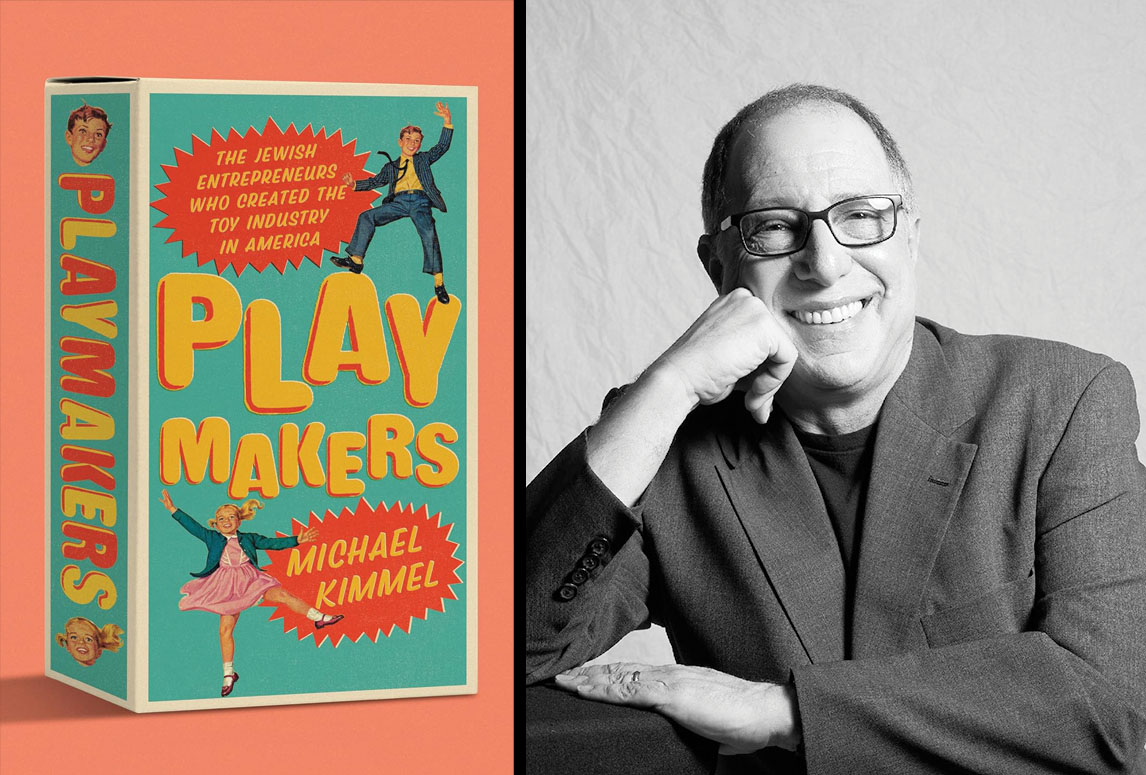
That’s the subject of Michael Kimmel’s entertaining history, “Playmakers: The Jewish Entrepreneurs Who Created the Toy Industry in America.” His provocative thesis is that not only did this group of Eastern European and Russian Jews create toys (many still manufactured and loved after nearly a century) — they created the modern idea of “childhood.”
In fact, the entire toy industry in America was largely Jewish, from the company founders and executives to the designers and factory workers, from the wholesale distributors and the army of salesmen, to the retail outlets and the large department stores that sold them.
As immigrants or first-generation Jewish Americans – many of them raised on New York’s Lower East Side – the toymakers did not have easy childhoods. Among other indignities, Kimmel notes that in early 20th-century New York public schools, “Jewish children who were disobedient or spoke Yiddish were punished by having their mouths washed out with nonkosher soap,” while noting that kosher soap was not even made in America until 1914. But he writes that they “remade America – and in particular, American childhood – not in their own image, but in the image of what they wanted it to be.”
Kimmel describes this as a “near-perfect assimilationist fantasy, the hermetically sealed, impenetrable claim to revered membership in the American social world.” This, even though they remained fenced out of that world; not even the Jewish owners of the department stores where the toymakers wholesaled their goods fully accepted them. The Jews who owned the stores were German Jews who came to America in the mid-1800s; educated and assimilated, they looked down on the more outwardly Jewish, Yiddish-speaking manufacturers as “Ostjuden.” Even as they became more successful and affluent by mid-century, Jewish toymakers were still viewed as alien. “The harder they worked to gain full acceptance into the mainstream of American society,” he writes, “the more they were reminded they really didn’t belong.”
But these early 20th-century Jews held onto their “near-perfect assimilationist fantasy,” he writes. “Yiddish Jews created the toys and dolls and manufactured them … all to ensure that the Christmas season would be at least as happy for Jews as it was for gentiles.” (One misbegotten attempt to cater to the gentile market was Ideal’s marketing of a baby Jesus doll. Ideal even got Pope Pius XII to bless the idea, but the toy was a bomb, Kimmel writes, because as Jews, “they didn’t understand that no one was going to have their children playing with the Christ child.”)
Kimmel, the great-grandnephew of Morris Mitchom, Ideal’s founder, started the book as a family history, and Ideal does get the greatest amount of attention. It’s a fascinating story. While he tries to give the full history of the industry, Morris, and his son, Benjamin Franklin Mitchom are the main characters of Kimmel’s story. And they have a great story to tell. He follows Morris (né Moshe) and his wife Rose, recently arrived in America, from the Brooklyn candy store where they made the first “teddy bear” (who coined the name is in dispute) after seeing an editorial cartoon of Theodore (Teddy) Roosevelt sparing a young bear to starting Ideal Toys which became the industry leader.
Morris starts out with the same liberal/socialist politics as many Jewish immigrants, and was a proud supporter of labor unions … at least until 1907, when his employees joined the Teddy Bearmakers Union and went on strike. The union prevailed, Kimmel claims, because of their skill in sewing the Mitchom bear’s “inscrutable, half-human smile,” a feature Kimmel – with one eyebrow ironically arched – claims makes the Mitchom bear look “more Jewish” than his competitors’ bears. After the strike, Morris switched his charitable donations from labor unions to Zionist organizations.
Morris was an innovator, creating dolls who cried, wet themselves and talked; his dolls used the new wonder material, plastic. Before the American toy industry, most dolls were either home-made rag dolls or German-made porcelain; making a doll “indestructible” he was told, would depress sales. He brushed them off: “You can’t give [an expensive and fragile porcelain doll] to a baby!” The embargo of German goods during World War I helped American toys gain a foothold.
Morris and the other early toymakers might have been “poor and terribly unhappy young men,” but they “took childish pleasure in the joy they brought to millions of children.” These serious men “retained the ‘inner child’ who had never been given free rein when they themselves were children.” It was a talent that was passed to the second generation of Mitchoms, as Morris’ son, Ben entered the business. Ben, Kimmel writes, “understood something essential about the minds of children and the ways dolls might engage them. He believed that what children wanted in a doll was the opportunity to play adult.”
Kimmel is a companionable guide to this story. “Playmakers” is filled with short anecdotes and asides. In the original telling of “Goldilocks and the Three Bears,” she breaks into the home of three bachelor bears … and let’s just say it does not end well for her. The association of girls with pink and boys with blue might feel ancient and immutable, but Kimmel writes that as late as the 1930s, a Parent’s magazine advised red – the color of courage and zeal – represented male attributes while blue stood for the feminine traits of faith and constancy. He makes a fair case that Popeye and Olive Oyl – created by the Jewish artist Elzie Crisler Segar and animated by the Jewish cartoonist Max Fliescher – are Jewish, and that the 1960s Beatles trading cards were only licensed after a Topps executive made a comment to the band’s Jewish manager, Brian Epstein in Yiddish.
It’s so much fun to read, you wish it had been more tightly edited. It’s a deeply researched book, sometimes too much so. Kimmel dedicates some 40 pages to the stories of Jewish comic book artists and writers. It’s an interesting story, and it makes sense to include them (they were going after the same audience), but it’s one that’s been told before in greater detail (and can be seen in the “Inventing America: The Comic Book Revolution” exhibit currently at the Skirball). The fact that the toymakers pretty much recede from the narrative make it feel like it was wedged into the book. The factchecking is also a little dodgy; he calls “Horse Feathers” the Marx Brothers first feature (it’s their third). More concerning is his claim that Whittaker Chambers, the English translator of “Bambi” was better known for “hounding some Jewish leftists named Rosenberg,” when he obviously meant Alger Hiss, who was not even Jewish.
But the book picks up toward the end, as the baby boom creates an even bigger market for toys. In his concluding chapter, Kimmel notes the irony that “Sesame Street,” created by the half-Jewish Joan Ganz Cooney, with its inner city setting of tenements and garbage cans, brought childhood back to the world the toy industry’s creators were trying to leave behind.