In 1959, Pete Seeger was asked by his record label to compose a feel-good record. “Pete, can’t you write another song like ‘Goodnight, Irene’? I can’t sell or promote these protest songs,” the label reps said. (Never mind that “Goodnight, Irene,” popularized by Seeger’s The Weavers, had actually been written by Lead Belly, not Seeger). “You better find another songwriter,” the rabble-rousing musician wrote back. “This is the only kind of song I know how to write.”
What Seeger composed, “Turn! Turn! Turn!” he intended as another protest song, amidst the social turbulence of his time. But his publisher missed his subtlety.
“Wonderful,” came the label’s response. “Just what I’d hoped for.”
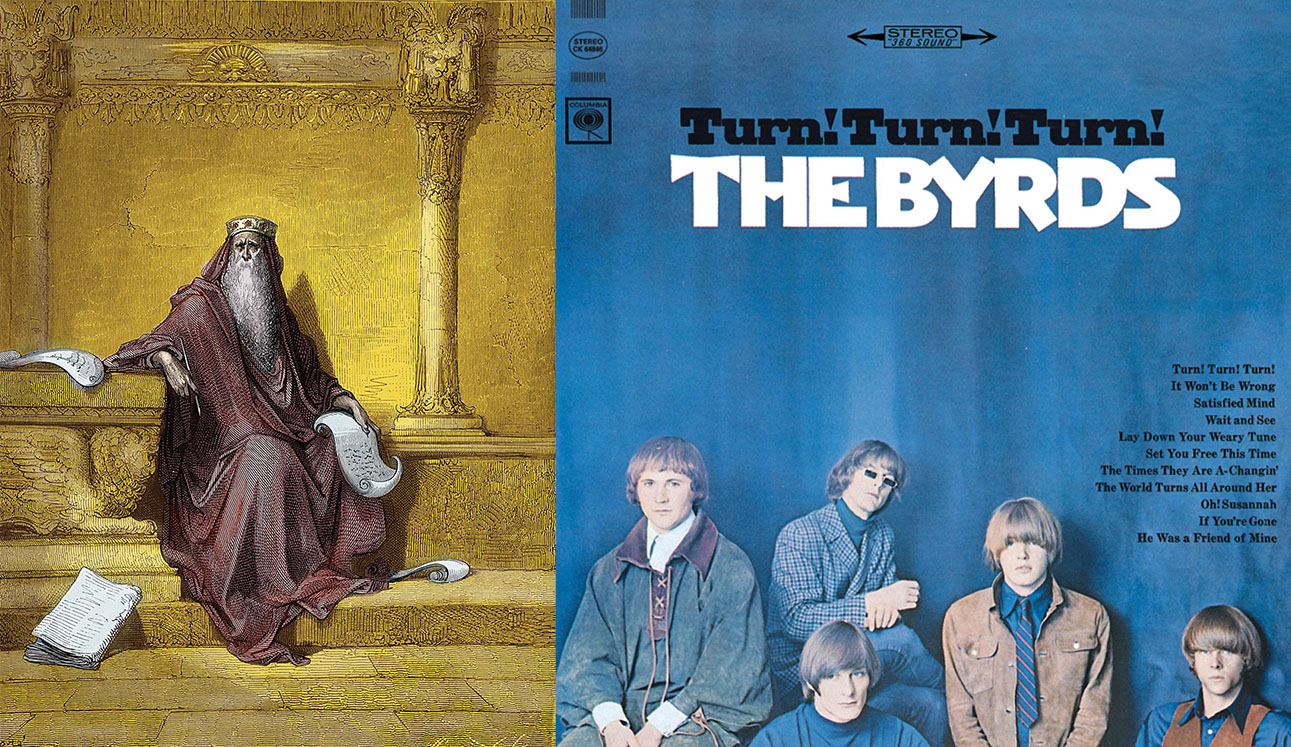
Though Seeger performed the song at a Greenwich Village folk venue as part of a 1962 live album, it was after multiple other artists added their own spins that the song took off. The Limeliters, Judy Collins, The Lettermen, The Seekers, and Nina Simone all offered their takes, but it was the Byrds’ rendition, more rock than folk, that topped the charts. It hit #1 in 1965. That year, America sent ground troops to Vietnam, draft cards were burned on college campuses, civil rights activists were attacked with fire hoses and police dogs, and President Lyndon Johnson strove to promote his “Great Society” programs. The soundtrack to this turmoil were harmonized voices encouraging Americans to “turn, turn, turn” and accept that history is a cycle, change is constant, strife will inevitably cool, and there is a season for everything.
The song became the musical snapshot of the time period, subsequently appearing in “More American Graffiti,” “Heart Like a Wheel,” “Forest Gump,” Ken Burns’ documentary on the Vietnam War, and three episodes of “The Wonder Years.”
Seeger, a brilliant lyricist, had based the song on one of the Bible’s books of wisdom, Ecclesiastes, which was just read in synagogues across the globe over the Shabbat of Sukkot. Its third chapter teaches that:
There is a time for everything,
and a season for every activity under the heavens:
a time to be born and a time to die,
a time to plant and a time to uproot,
a time to kill and a time to heal,
a time to tear down and a time to build,
a time to weep and a time to laugh,
a time to mourn and a time to dance,
a time to scatter stones and a time to gather them,
a time to embrace and a time to refrain from embracing,
a time to search and a time to give up,
a time to keep and a time to throw away,
a time to tear and a time to mend,
a time to be silent and a time to speak,
a time to love and a time to hate,
a time for war and a time for peace.
Ecclesiastes’ encouragement of equanimity in light of eternal change continues to find particular resonance in modernity, from the famous opening of Charles Dickens’ “A Tale of Two Cities” to then-President-elect Joe Biden’s victory tweet, “The Bible tells us that to everything there is a season — a time to build, a time to reap, a time to sow. And a time to heal. This is the time to heal in America.”
Who was Ecclesiastes? According to the Jewish tradition, he was none other than King Solomon, son of King David. A prince who became king, he was someone who had it all. Sitting atop a flourishing, secure kingdom, wealth, wisdom and an army at his command, the world was at his fingertips. As he describes it: “I made great works; I built houses and planted vineyards for myself; I made myself gardens and parks, and planted in them all kinds of fruit trees … I also had great possessions of herds and flocks, more than any who had been before me in Jerusalem. I also gathered for myself silver and gold and the treasure of kings and of the provinces; I got singers, both men and women, and delights of the flesh, and many concubines.”
But the king had what you might call the earliest recorded experience of a midlife crisis.
“Then I considered all that my hands had done and the toil I had spent in doing it, and again, all was vanity and a chasing after wind [hevel havalim in the Hebrew], and there was nothing to be gained under the sun.”
Having it all led the king exactly nowhere happy. Whatever he gained he knew would be fleeting. It would be hevel, gone with the wind.
How then to maintain a semblance of sanity and stability amidst ever-changing times?
Ya gotta have faith.
“When all is said and done, when all has been heard,” Ecclesiastes concludes, “fear God. And obey His commandments.”
Put simply, have belief. Be loyal to ancient traditions.
It is faith that lights the way through life’s constant change. It is faith that offers us the lyrics to sing, and belief the comfort when we cry. It is tradition that offers us guidance on when to move on and when to move forward.
Faith offers and brings about a sense of community and belonging. As Bryan Walsh put it in a 2017 Time magazine essay titled “Does Spirituality Make You Happy?,” “It’s as if a sense of spirituality and an active, social religious practice were an effective vaccine against the virus of unhappiness.”
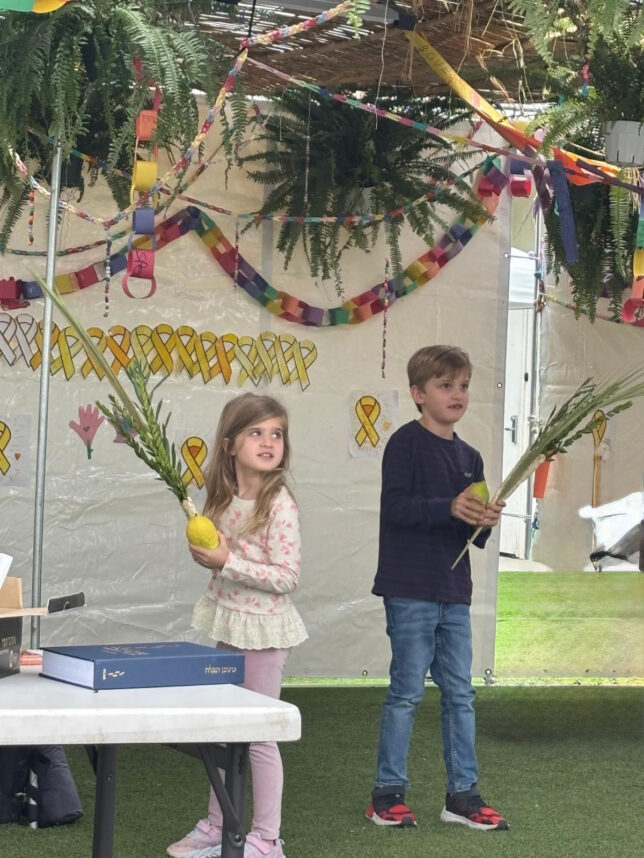
It is no surprise, then, that the book of Ecclesiastes is read in synagogue during Sukkot, in which we vacate our stable homes for ephemeral, rickety huts.
Take joy not in things, warns the book. Acquisitions are made and lost. “Take it from me,” the ancient king who ruled a vast kingdom, says. Authority can be fleeting. Castles can crumble.
History is a cycle. Generations come and generations go. What matters is what we believe.
Rabbi Dr. Stuart Halpern is Senior Adviser to the Provost of Yeshiva University and Deputy Director of Y.U.’s Straus Center for Torah and Western Thought. His books include the newly released “Jewish Roots of American Liberty,” “The Promise of Liberty: A Passover Haggada,” “Esther in America,” “Gleanings: Reflections on Ruth” and “Proclaim Liberty Throughout the Land: The Hebrew Bible in the United States.”