Tanchum Gershon Portnoy, who died on the first day of Rosh Hashanah at the age of 75, composed the beloved Eitz Chaim melody when he was just 22. Over the next half-century, it became part of synagogue life around the world. As his Shloshim gives way to Sukkot, I find myself returning to one particular memory of him, and to a lesson I learned while standing beside him in shul, singing his own melody.
I first discovered Tanchum’s “Eitz Chaim” 27 years ago, shortly after I came to America. I had grown up in Israel and somehow had never heard it. The first time I did, I immediately fell in love with it. I began using it and assumed that it was one of those melodies that had always been part of synagogue life.
Only after I came to Beth Jacob Congregation in Beverly Hills in 2013 did I discover where it came from. Eli Portnoy told me that his father had composed it. The melody appeared on Tanchum’s 1975 album Tanchumim.
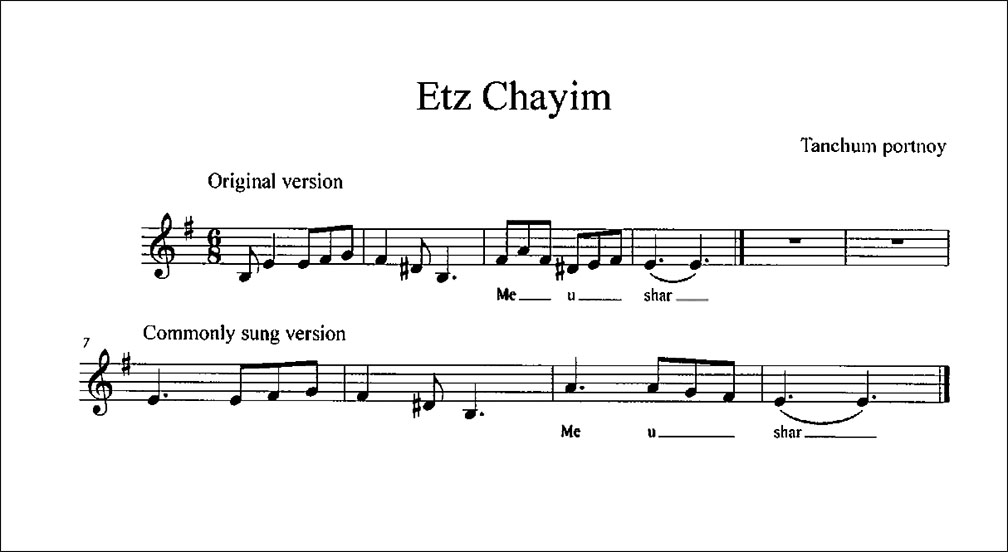
Listening to the original recording revealed something else: we do not actually sing the melody exactly as Tanchum wrote it.
There are several small differences, but the clearest occurs on the word me’ushar, “happy.” In Tanchum’s original, the opening “Me-” moves through several notes, and the melody then rises before resolving. In the version most synagogues sing, “Me-” is held straight, and the melody descends toward the final note.
It is a small difference, but once you hear it, it is unmistakable.
I had the privilege of singing “Eitz Chaim” several times while Tanchum was in shul. Twice I particularly remember him standing right next to me as we returned the Torah to the Aron Kodesh.
On one of those occasions, as we approached, I looked at him.
I was almost waiting for him to cringe.
Here was the composer himself, standing beside me, while the entire congregation was about to sing his composition “wrong.”
But Tanchum did not cringe. Quite the opposite. Just like the word we were singing, he looked completely happy.
I remember almost apologizing. I told him that we were not singing the phrase the way he had written it, and that synagogues everywhere seemed to have adopted the altered version.
Tanchum smiled and said:
Minhag Yisrael Torah hu: “The custom of Israel is Torah.”
I have thought about that response many times.
Of course, minhag Yisrael Torah hu does not mean that anything people happen to do automatically becomes Jewish law. But there is a deep Jewish instinct behind it: Torah is not preserved only in books. It also lives in the practices of a people.
The Talmud tells of an Erev Pesach that fell on Shabbat. Hillel was asked what someone should do if he had forgotten to bring the knife needed for the Korban Pesach before Shabbat. He remembered having learned the halacha, but could no longer recall it.
He responded:
“Leave it to the Jewish people. If they are not prophets, they are the children of prophets.”
When Hillel saw what the people actually did, the forgotten tradition returned to him.
The Talmud elsewhere expresses a similar instinct: “Go out and see what the people are doing.”
There is enormous importance in preserving the original source. But Torah also lives in people.
And I think Tanchum understood that.
There was the melody that Tanchum composed, and then there was the melody that Am Yisrael received. The recording preserved the original. But Jews carried his melody from synagogue to synagogue, sang it, taught it and made it part of their religious lives.
I believe that Tanchum was not upset by what happened along the way.
He was me’ushar.
But the more I think about that moment, the more I realize that it reveals something deeper than his understanding of minhag. It reveals something about the man.
I once learned from Rav Ilai Ofran of Kibbutz Yavneh a beautiful distinction between being a nadiv, a generous person, and being a nediv lev, a person generous of heart.
When the Torah describes the contributions to the Mishkan, it speaks of “every person whose heart moves him to give.”
A person can give something and still use the gift to enlarge his own presence in somebody else’s life. He still wants to control how it is used and whether it remains faithful to his intentions. The object may have left his hands, but emotionally he never really separated from it.
A genuine gift requires something harder: separation. The ability to say: I gave this to you. It is now yours.
That, in turn, requires yet another Jewish concept: tzimtzum, stepping back. I make a little less room for myself so that there can be more room for the person receiving the gift.
That is nedivut lev, generosity of heart.
And when I think back to Tanchum standing beside me, I realize that this is exactly what I saw.
Most composers who discovered that virtually everyone was singing their composition differently from the way they had written it would probably want to correct us. And who could blame them?
“That is not the note. That is not how I wrote it. This is my melody.”
Tanchum did not need to do that.
He had given something to Am Yisrael. Once Am Yisrael embraced it, he was able to let it become ours, even when we changed it.
Tanchum cared more about what the melody was doing for us than about what the melody said about him.
That willingness to hand something over also helped me understand another Jewish idea differently: mesorah, transmission.
Mesorah is not only about preserving something. It is about handing it over.
We receive something precious from those who came before us. We guard it, respect it and preserve what is essential. But eventually, if it is truly going to live, we have to place it into the hands of the next generation.
And the moment we truly hand something over, we surrender a measure of control. The next generation will hold it in its own hands and inevitably leave some of its own fingerprints on it.
That is not necessarily a failure of mesorah. In some ways, it is what allows mesorah to remain alive.
Perhaps that helps explain why I knew Tanchum’s melody for 14 years before I knew the name of the man who had written it. I sang it, loved it and used it. It had become so deeply absorbed into Jewish life that it felt like something that belonged to all of us.
On Shabbat Shuvah, at his family’s initiative, synagogues around the world were asked to sing Tanchum’s “Eitz Chaim” and to tell congregants the name of the man behind the melody. Eli expressed it beautifully: “My father gave the world a melody. This Shabbat, the world sings it back to him.”
As we mark Tanchum’s Shloshim, the lesson I carry from him is no longer only about music. It is about how a person gives.
Can we create something valuable and then step back? Can we allow another person to make it their own? Can we be not merely generous, but generous of heart?
There is something especially fitting that Tanchum’s Shloshim gives way to Sukkot, “the season of our joy.” It gives an added resonance to the word that has come to define this memory for me: happy.
From now on, whenever I sing his “Eitz Chaim” and reach that word, I suspect I will see him standing next to me again: a true nediv lev, who gave something beautiful to Am Yisrael and was genuinely happy to see it become ours.
May his memory be a blessing.
Chazan Rabbi Arik Wollheim serves at Beth Jacob Congregation in Beverly Hills, California.