fbpx

September 30, 2026

FlyDubai Flight to Tel Aviv Diverted to Saudi Arabia After Cockpit Stabbing

A FlyDubai flight bound for Tel Aviv made an emergency landing in Saudi Arabia on Wednesday after a violent confrontation in the cockpit left both pilots injured, sent the aircraft into a sharp descent and prompted Israel to scramble fighter jets.

Israeli officials spent much of the day examining whether the incident aboard Flight FZ1073 was an attempted terrorist attack. FlyDubai confirmed that a physical confrontation took place in the cockpit while saying the motive remained “under investigation.”

The aircraft was traveling from Dubai International Airport to Ben Gurion Airport when the emergency unfolded about 90 minutes into the flight as it entered Jordanian airspace. It diverted into Saudi Arabia and landed at Prince Sultan bin Abdulaziz Airport in Tabuk, in the northwestern part of the kingdom.

Both pilots were injured and taken to a hospital after the landing. Accounts from passengers differed on who provided medical care aboard the plane. One passenger said an Israeli dentist treated the stabbed pilot, while other accounts referred to a doctor and nurse providing first aid.

“All passengers are out of danger, Prime Minister Benjamin Netanyahu said in a statement Wednesday afternoon.

The pilot who stabbed them has been arrested and is currently being questioned by the Saudi authorities,” Netanyahu said. “We are in close contact with the relevant authorities to ensure the continued safety of the passengers and their safe return to Israel.”

Netanyahu also said, “One of the pilots apparently tried to crash the plane with everyone aboard.

I salute the heroes on the flight from Dubai who displayed resourcefulness and courage.”

Defense Minister Israel Katz described the incident as a terrorist attack.

“The grave incident on the FlyDubai plane was a jihadist terrorist attack attempt, which was thwarted only thanks to the bravery of several Israeli passengers who broke into the cockpit, overpowered the terrorist and, with their own hands, restored control of the plane to another flight crew who was present there,” Katz said.

“According to the initial information in our possession, the terrorist had one intention: to crash the plane with all its passengers,” Katz said, as Israeli officials increasingly described a possible terrorist or nationalist motive in the hours after the landing.

“According to the initial information in our possession, the terrorist had one intention: to crash the plane with all its passengers.” – Israel Katz

FlyDubai acknowledged the incident in a statement.

“A physical confrontation occurred in the cockpit,” FlyDubai said. “The motive is under investigation,” FlyDubai said.

The airline also said, “The aircraft has landed safely in Tabuk (TUU), and all passengers are safe and accounted for.”

The exact number of passengers aboard remained unclear Wednesday afternoon. One figure put the number at 174, including 27 children. Other accounts referred to around 150 Israeli passengers or more than 100 Israeli passengers.

Images and videos from the flight circulated on Israeli and social media throughout the day. One image appeared to show a passenger wearing a blood-soaked shirt. Other images appeared to show passengers involved in restraining the suspected attacker.

Accounts also conflicted over exactly what happened between the two pilots.

Israeli officials identified the suspected attacker as an Omani co-pilot and said the captain was attacked during the confrontation. Another account said the Omani co-pilot was himself stabbed during the struggle before being subdued by the captain, identified in that account as an Indian national.

Israelis near the front of the cabin rushed toward the cockpit while additional pilots traveling aboard the plane were seated farther back. Passengers and crew members entered the cockpit area, restrained the suspected attacker and helped return control of the aircraft to two reserve FlyDubai pilots were aboard as passengers.

“I was already screaming ‘Shema Yisrael’ and saying, ‘I can’t die, I’m my mother’s only daughter, I can’t do this to my mom,’” a passenger identified as Miriam told reporters. “We were all sure that we wouldn’t get out of here alive,” Miriam said.

The landing placed a plane full of Israel-bound passengers on Saudi soil despite Israel and Saudi Arabia having no diplomatic relations. Saudi Araba is not a signatory to the Abraham Accords, but following the 2020 Abraham Accords, which established relations between Israel and the United Arab Emirates and Bahrain, Saudi Arabia allowed Israeli airlines to cross its airspace on flights to and from the two Gulf states. In July 2022, Saudi Arabia broadened that policy by opening its airspace to all qualifying commercial carriers, allowing Israeli airlines to use Saudi airspace on routes to and from destinations beyond the UAE and Bahrain.

The the roughly three and a half hour Dubai-to-Tel Aviv route is about 1,323 miles.

Photos published after the landing also appeared to show damage to the aircraft’s rudder. The cause of that damage had not been established Wednesday afternoon, and no available source established that the descent caused it.

The aircraft transmitted squawk code 7700, signaling a general emergency, followed by code 7500, indicating unlawful interference with an aircraft. It later returned to 7700.

Flight-tracking data showed a sudden descent of close to 14,000 feet in less than 30 seconds before the first emergency signal was transmitted. A wider portion of the flight data showed the aircraft dropping from about 34,000 feet to 14,000 feet, at one point registering a descent rate near 30,976 feet per minute.

The incident triggered security consultations involving Netanyahu, Katz and senior Israeli military and intelligence officials. The Israel Air Force scrambled fighter jets while authorities tried to establish what was happening aboard the aircraft.

Attention then turned to how to return the passengers to Israel.

El Al informed Israeli authorities that it was prepared to send a rescue aircraft, while officials also considered the possibility of using an Israeli civilian or military plane.

Saudi authorities were not permitting an Israeli evacuation operation at that stage. It remained unclear whether Saudi Arabia had rejected a specific request involving an El Al aircraft or Israeli military plane.

FlyDubai sent its own replacement aircraft to Tabuk.

Mossad reportedly completed background checks on the replacement FlyDubai crew and approved the aircraft’s departure for Israel. Saudi Arabia, meanwhile, was refusing to permit a separate rescue flight aboard a chartered Israeli aircraft for passengers who did not want to board the Emirati carrier.

By late Wednesday afternoon, some Israeli passengers were still refusing to board the FlyDubai replacement flight. Some wanted to return aboard an Israeli carrier, while another account said passengers were uncomfortable boarding another FlyDubai plane with a non-Israeli pilot.

There has been no statement from the Saudi central government as of 5:00 pm Israel time. Authorities at Tabuk airport confirmed that both pilots had been hospitalized, while Netanyahu said the suspected attacker was in Saudi custody and being questioned.

The United Arab Emirates government had also issued no public statement on the incident as of Wednesday afternoon.

The investigation remained underway as conflicting accounts persisted over the identities and nationalities of the pilots, who stabbed whom, the suspected motive, the exact number of passengers aboard and the sequence of events inside the cockpit.

This is a developing story.

Brian Fishbach is reporting for the Jewish Journal from Tel Aviv.

FlyDubai Flight to Tel Aviv Diverted to Saudi Arabia After Cockpit Stabbing Read More »

The Sukkot Miracle in the Sky: The Heroes Who Saved an Israel-Bound Plane

Sometimes heroism announces itself with trumpets. Sometimes it happens at 33,000 feet, in a matter of seconds, when ordinary people realize that unless they act immediately, they and everyone around them may die.

On Wednesday, passengers aboard a flydubai flight from Dubai to Tel Aviv experienced a nightmare almost beyond comprehension. The co-pilot attacked and stabbed the captain, Indian national Smit Machchhar, and the Boeing 737 plunged dramatically before passengers and crew managed to regain control. The aircraft ultimately made an emergency landing in Tabuk, Saudi Arabia. Investigators have not yet publicly established the attacker’s motive.

But whatever investigators ultimately determine about motive, we already know something about courage.

Four men whose names deserve to be known — Yaniv Hayoun, Asaf Rejwan, Dr. Shota Musayev, and Tzvika Manes — were among those who confronted an unfolding catastrophe rather than waiting helplessly for someone else to save them.

There are moments when history gives you no time to deliberate. You either run toward the danger or away from it.

Yaniv Hayoun ran toward it.

According to accounts from the aircraft, after passengers gained access to the cockpit and confronted the attacker, Hayoun found himself facing something no ordinary airline passenger ever imagines: an aircraft descending dangerously and controls that had to be dealt with immediately. He described grabbing the controls and pulling back before trained crew members took over.

Think about that.

No committee. No meeting. No preparation.

A human being sees mortal danger and acts.

Tzvika Manes likewise described a violent struggle to overpower the attacking co-pilot. This was not cinematic heroism. There were no stunt doubles and no guarantee of a happy ending. According to Manes, it took sustained physical force to subdue the man.

Then there was Dr. Shota Musayev, an Israeli dentist who suddenly had to become an emergency battlefield medic thousands of feet above the earth.

Musayev said he heard screaming and ran toward the cockpit almost immediately. He later explained that he initially went forward to help confront the attacker, not because he knew medical assistance would be required.

Once the attacker had been restrained, Musayev encountered the gravely wounded captain, bleeding heavily from his head. Musayev says he managed to stop the bleeding and stabilize the captain’s blood pressure.

One moment he was fighting to save an airplane. The next he was fighting to save a life.

And none of this should overshadow another extraordinary hero: Captain Smit Machchhar himself.

Reports indicate that despite being seriously wounded, Machchhar managed to facilitate access to the cockpit before collapsing, allowing others to intervene. Prime Minister Benjamin Netanyahu publicly praised the Indian captain’s bravery.

He should be celebrated in Israel.

He should be celebrated in India.

He should be celebrated everywhere human courage is honored.

Captain Smit Machchhar was not born in Israel. But in the moment Israelis desperately needed him, he fought for their lives.

And there is something profoundly appropriate about this occurring as Jews prepare to celebrate Sukkot.

Sukkot is Judaism’s great festival of vulnerability.

For seven days we leave the illusion of permanence represented by our houses and enter a fragile hut. Its roof is deliberately porous. We can see the heavens through the schach. The Torah commands us to remember that security does not ultimately come from concrete ceilings, bank accounts or technological sophistication.

Human beings are vulnerable.

An airliner is one of the supreme symbols of modern technological mastery. Hundreds of thousands of components work together. Computers calculate trajectories. Pilots undergo years of training. Air-traffic controllers watch from the ground.

And yet, in seconds, the people aboard this aircraft discovered how fragile life remains.

Then something else happened.

Human courage answered human vulnerability.

That, too, is Sukkot.

The sukkah is fragile, but the people sitting inside it need not be.

Jewish history is filled with people who survived not because they were invulnerable but because, when danger arrived, somebody stood up.

The sukkah teaches that our shelter may be fragile. These men taught us that our courage must never be.

There is another remarkable dimension to this story.

Look at the geography and nationalities involved.

An Emirati airline.

An Indian captain.

Israeli passengers.

An emergency landing in Saudi Arabia.

A wounded Indian pilot receiving treatment after the aircraft landed on Saudi soil.

Whatever investigators ultimately establish about the attack itself, the rescue tells another story about the Middle East — one that deserves attention.

The region has known enough death.

Here was an extraordinary chain of people of different nationalities whose actions resulted in lives being saved.

There will be investigations, and there should be. Aviation authorities must determine exactly how this happened, whether warning signs were missed, what motivated the attacker, and whether security procedures for Israel-bound flights require revision. Those questions are urgent.

But investigation should not obscure gratitude.

We should know the names of people who run toward danger.

Yaniv Hayoun.

Asaf Rejwan.

Shota Musayev.

Tzvika Manes.

And Captain Smit Machchhar.

Their individual roles should continue to be documented carefully as investigators and eyewitnesses reconstruct precisely what occurred. But the larger truth is already unmistakable: when catastrophe threatened an aircraft carrying people toward Israel, human beings refused to remain spectators.

They acted.

And people lived.

As Jews enter our sukkot and look upward through their fragile roofs, perhaps we should think about an airplane high above the Middle East and the people aboard who suddenly discovered just how thin the barrier can be between life and death.

For those passengers, that barrier consisted of a wounded captain who kept fighting, courageous passengers who charged forward, medical assistance administered under terrifying conditions, and crew members who ultimately brought a damaged aircraft safely to earth.

Call it bravery.

Call it providence.

On the eve of Sukkot, I will also call it a miracle.

At 33,000 feet, a handful of human beings became the walls of a sukkah protecting everyone aboard.

And this Sukkot, Israel should say their names — and say thank you.


Rabbi Shmuley Boteach is the international bestselling author of thirty-eight books, translated into more than twenty languages. He has been hailed as “the most famous rabbi in America” (The Washington Post, Newsweek), “arguably the most famous Orthodox Jew on earth” (The New York Observer), and named one of the fifty most influential Jews in the world (The Jerusalem Post).

The Sukkot Miracle in the Sky: The Heroes Who Saved an Israel-Bound Plane Read More »

From Darkness to Hope

There are moments in life when darkness feels overwhelming and threatens to become a new and sickening reality. For the Jewish people, October 7 was one of those horrific moments.

We will never forget where we were when we heard what had happened to Israel and our people. As we absorbed the savagery of the Hamas massacre, watched Jewish families being murdered in Hamas videos, learned of hostages being taken, including the elderly and babies, and witnessed the trauma inflicted on an entire country, another shocking international assault followed. Before Israel had even begun to bury its dead, a severe wave of antisemitism erupted across the globe.

We have seen where incitement and unchecked hatred can lead. In May of 2025, in Washington, D.C., Elias Rodriguez murdered Yaron Lischinsky and Sarah Lynn Milgrim and shouted, “Free Palestine” as he was being arrested. In June of 2025, in Boulder, Colorado, Mohamed Soliman threw Molotov cocktails at a peaceful “Run for Their Lives” gathering while shouting “Free Palestine.” He injured 13 people, including 82-year-old Karen Diamond who later died from her wounds.  At a Chanukah celebration at Bondi Beach in December 2025, Sajid and Naveed Akram massacred 15 people and wounded more than 40 in an attack targeting the Jewish community. They were inspired by the Islamic State (ISIS) terrorist group and shouted “Allahu Akbar” during the massacre.

In Manchester, England in October of 2025, on Yom Kippur, Jihad Al-Shamie drove into people outside the Heaton Park Hebrew Congregation synagogue and stabbed victims, killing two Jewish men and seriously wounding others. During the attack, Al-Shamie called emergency services, claimed responsibility, and pledged allegiance to ISIS.

Other mass-casualty attacks have been attempted as well. In Michigan, Ayman Mohamad Ghazali drove a truck through the doors of Temple Israel and nearly 200 feet down a hallway while 140 children were inside its early childhood center. The FBI later determined that he was inspired by Hezbollah, the terrorist group that occupies parts of Lebanon, attacks Israel from the north, and is funded by the Iranian regime. His truck contained commercial-grade fireworks and approximately 35 gallons of gasoline. Miraculously, no children or teachers were physically harmed.

These attacks are extreme manifestations of something Jews everywhere have been feeling: the oldest hatred has returned in a form that feels both familiar and newly emboldened. Our children and grandchildren are feeling it too. Jewish, Israeli and non-Jewish Zionist students have faced harassment and intimidation in schools and on campuses from peers, student groups and educators. Extremists tore down posters of kidnapped Israeli hostages. Demonstrations glorified or excused terrorism. Misinformation spread rapidly across social media, while important context was often missing from mainstream reporting.

That context includes the “ring of fire” surrounding Israel: Hamas, Hezbollah, the Houthis, Iran’s regime and other forces that have repeatedly attacked it. Too often, this broader threat against Israel is overlooked while disproportionate emphasis is placed on Israel’s military responses. Nor is sufficient concern given to Qatar’s enormous investment in the United States, a country that presents itself as neutral yet housed Hamas leaders, promotes extremism through media such as AJ+, and continues to buy influence in America.

Many Jews have felt abandoned by spaces and people they once trusted. Institutions that spoke constantly about diversity and inclusion too often seemed unable or unwilling to recognize antisemitism when Jews were its targets, while Jews were frequently left out of diversity and inclusion curricula altogether. Friendships have been tested. Jewish history has been distorted. Israel has been demonized.

Anti-Jewish hate crimes have risen dramatically since 2022, confirming what Jewish communities say they are experiencing. In 2022, the FBI recorded 1,122 anti-Jewish hate crimes. According to FBI data, anti-Jewish hate crimes jumped 63% in 2023 and rose again in 2024 to a record 1,938 incidents. Although that number declined to 1,528 in 2025, it was still the third-highest level ever recorded, with anti-Jewish incidents accounting for nearly two-thirds of all religious-based hate crimes in the United States.

Influential inflammatory voices like Hasan Piker have defended Hamas, minimized the sexual violence of October 7, and used rhetoric widely condemned as antisemitic, normalizing hostility toward Jews and Zionists among millions of young followers. The rise  of political figures amplifying similar hatred is reflected in New York Mayor Zohran Mamdani (a member of the Democratic Socialists of America) and the influence of Tucker Carlson on the right.

Jews have found themselves defending not only Israel, but their own Jewish identity and their right to grieve over what happened on and since October 7. Many are asking questions they never imagined they would have to ask: Is it safe to wear a Star of David? Should I tell people I am Jewish or Israeli? Can I openly say that I support Israel? Should I raise my hand when Jewish or Israeli perspectives are missing during lectures on campus? And some are asking an even more painful, yet predictable question: Is it time to leave the country I have loved and called home for generations?

History teaches us that hatred rarely stops with one group. Six million Jews were murdered in the Holocaust, while the Nazis and their collaborators also persecuted and murdered millions of others, including Roma, people with disabilities, Poles and other Slavs, Soviet prisoners of war, political opponents, Jehovah’s Witnesses, and gay men. Antisemitism also contributed to the Nazi decision to launch WWII, causing mass destruction around the world, including in Germany itself. When Jews are targeted and society looks away, everyone should begin to worry. As Rabbi Lord Jonathan Sacks said, “The hate that begins with Jews never ends with Jews.” Yet far too many are looking away.

That is the darkness we are confronting in our generation: antisemitism coming from multiple directions, including far-left, far-right, and Islamist extremism, conspiracy theories, the demonization of Israel, and institutions and individuals willing to excuse or normalize hatred against Jews and Zionists.

But darkness is not the entire story. Across Israel and in Jewish communities worldwide, people of all ages are meeting this moment with courage and leadership. I know this because I see it every day through our international work at StandWithUs. Students and community members who never imagined themselves as activists have become speakers and leaders. Teenagers and college students are learning history, correcting misinformation, organizing programs, meeting with administrators, speaking to journalists, representing Israel and the Jewish people at city council meetings, and standing proudly in the face of hatred.

In August 2026, I spoke to 500 very talented high school and college student leaders from across the United States and Canada—our incoming North American StandWithUs Emerson Campus Fellows and Kenneth Leventhal High School Interns. After five days of intensive training by experts in law, strategy, marketing, Israeli history, Middle East current events, and so much more, I told them that if they remembered only one lesson that came from me personally, it should be this: Build your base.

Find your community. Find the people who share your commitment to truth, fairness, Israel and the Jewish people. Build relationships before you need them. There is strength and safety in numbers. None of us can do this alone, and the good news is that we do not have to.

That lesson extends far beyond students. Jewish physicians, faculty, psychologists, parents, attorneys, educators, and community leaders are finding one another, sharing resources, and building networks capable of responding when institutions fail. There is tremendous power in refusing to be bullied and in deliberately strengthening community.

Another important source of hope is the law. Hundreds of attorneys and major law firms have heard the stories of Jewish students facing discrimination, employees being marginalized, and families struggling to get institutions to enforce their own rules, and they are stepping forward. Through the StandWithUs Saidoff Legal Department and other civil-rights organizations, people facing antisemitic discrimination can access attorneys willing to fight for them at no cost. Our legal experts are challenging institutions, changing policies, securing settlements, and establishing important precedents.

Antisemitism is intended to make Jews afraid. To make us quieter, less visible, and less connected to who we are. Yet for many, the opposite has happened. We have found our communities and are working together against hate, discrimination, and intimidation. Jewish identity is growing stronger.

And we are not alone. Courageous allies, including Christians, Hindus, Iranians, Muslim Zionists, educators, attorneys, civic leaders, students, and people from many other backgrounds, are standing beside the Jewish community because they understand that antisemitism will not remain only a Jewish problem.

October 7 changed the way Jews see the world. It confronted us with a darkness we never expected to see. But instead of retreating, so many of us have found our communities, discovered our voices, and stepped forward proudly to bring hope and light into that darkness.

I am proud and grateful to say this: While we cannot choose when darkness comes, each one of us can choose how we respond to it. While there is no shortage of bad actors and anti-Israel campaigns challenging us relentlessly, so many of us have chosen to stand tall. That is the light. And even a small light can shatter darkness, let alone the light we create when Jews and non-Jews speak and act with courage and resolve. Never forget that hope and resilience have always been at the core of our story, and now all of us now have an opportunity to write the next chapter together. Am Yisrael Chai.


Roz Rothstein is the CEO and co-founder of StandWithUs.

From Darkness to Hope Read More »

The Wrong Lesson from Madison Square Garden

The clip of Brad Lander went viral. The Democratic nominee for Congress in New York’s 10th District was shouted down and told to leave a protest on the sidewalk outside Madison Square Garden. As reported by the Jerusalem Post, protesters called him a paid Zionist and told him they didn’t need his help. The irony was hard to miss: Lander is Jewish, but has been a vocal critic of Israel. He had come to denounce the rally inside the Garden as “fascist and hateful” and compared it to the pro-Nazi rally held there in 1939. 

Then the label landed on him. The man who had come to condemn an ideology was reduced, by some of the protesters, to one of their own: “Zionist.” For some in the crowd, that single word was enough to make him, in their eyes, the wrong kind of person to be standing there. Whatever else he believed or had come to say no longer mattered. That is how labels work: they turn people into categories, and categories into targets.

Inside the Garden, the scene was a good deal less menacing than the one outside. About 5,000 people, many of them Hindu Americans, watched a cappella singers, dancers, and speakers from multiple faiths. I was among them, with a friend who is Hindu. I am Jewish. 

The keynote speaker was Mohan Bhagwat, head of the Rashtriya Swayamsevak Sangh, or R.S.S. Reasonable people can disagree sharply about the R.S.S.’s record in India, and those arguments are worth having. But there is a difference between debating an organization’s conduct or history abroad and passing judgment on the people who gather to hear its leader.

The event was hosted by the American Hindus for Engagement and Dialogue, or AHEAD Forum, in partnership with more than 250 Hindu American organizations from across the United States. This is also the community whose temples keep getting vandalized. The F.B.I.’s most recent hate crime report recorded 28 anti-Hindu incidents in 2025, a 12% increase over the prior year. In September 2024, the BAPS Swaminarayan Mandir in Melville, New York, was spray-painted with threatening messages overnight; Suffolk County police opened a hate crime investigation. In March 2025, the BAPS temple in Chino Hills, California, was vandalized, causing more than $15,000 in damage. Hindu Americans are asking whether it is safe to go to a temple. The response from some running for office has been to associate them with Nazis.

Since the August event, more than 90 politicians have signed a pledge to refuse donations from anyone “affiliated” with the R.S.S. The fact that this pledge is framed around association rather than a showing of unlawful conduct by the donor matters. In NAACP v. Alabama, 357 U.S. 449 (1958), the Supreme Court recognized that compelled disclosure of organizational membership can burden freedom of association when disclosure exposes members to reprisals. Whatever one thinks of the RSS, a policy that turns an undefined association into a basis for excluding a citizen’s political contribution deserves careful scrutiny. When 90 U.S. politicians declare a citizen’s donation tainted, potentially by his weekend yoga class, that is not accountability. It is the machinery of exclusion, aimed at a religious and ethnic minority.

As a Jew, I know how this works because I have watched it happen to my own community. For most American Jews, “Zionist” means only that Israel should exist; nevertheless, it has become a slur that licenses almost anything. I am automatically associated with, and blamed for, the death and suffering of Palestinians — suffering that is real, and that I do not dismiss. But “genocide” is also a legal term with a specific meaning, and its use in describing Israel’s conduct remains the subject of intense legal and political dispute. A coalition of more than 70 organizations has documented how the accusation was generated and amplified beginning the day after October 7, before Israel’s ground operation had even started. The word has nonetheless been repeated so confidently, and so often, that many Americans now treat it as settled truth.

The consequences are not abstract. The Anti-Defamation League counted 6,274 antisemitic incidents in the United States in 2025, five times the number a decade earlier. In May 2025, Yaron Lischinsky and Sarah Milgrim were shot dead outside the Capital Jewish Museum in Washington as they left an event — they were about to be engaged. A month later, Karen Diamond, 82, died of burns after a man threw Molotov cocktails into a Boulder, Colorado rally for Israeli hostages. In both cases, the perpetrators appear to have acted on ideological hostility rather than random violence. That is where the politics of collective blame can lead: when a label becomes a license to see an entire community as guilty, violence can begin to look like justice.

The pattern does not care whether the target wears a kippah or a bindi. Find the most extreme association you can attach to a community. Repeat it until it hardens into fact. Then treat every member as that fact. If anyone objects, treat the objection as proof of complicity. At no point in this process does anyone ask the grandmother in Row 200 at MSG, watching the dancers, what she thinks. She is no longer a grandmother. She is a label.

In an instant, Mr. Lander went from being a fellow protester to being treated by some in the crowd as morally disqualified because of one word attached to him: “Zionist.” He did not seem to notice. Hindu Americans and Jews are living in an America where neither is offered nuance, and neither is offered the dignity of being one person rather than a category.

The politicians who signed those pledges should remember that the people they are judging are not abstractions in a debate about India. They are Hindu Americans. They live here, vote here, work here, raise their children here, and build their communities here. Before deciding what they represent, politicians should go to an HSS meeting, join a seva project, visit a Hindu temple, sit with a family over dinner, and listen to what Hindu Americans actually believe and care about. They may still conclude that the R.S.S. deserves condemnation. They may still oppose its politics, its leaders, or its influence. But they should know whom they are condemning. The people inside Madison Square Garden are not an ideology. They are Americans.


Karen Gal-Or is a former federal prosecutor and co-founder of Om and Shalom, a Pittsburgh-based Hindu-Jewish initiative that brings the two communities together to combat hate, strengthen civic ties, and advocate around shared values. 

The Wrong Lesson from Madison Square Garden Read More »

Empathy and Apathy

There are people who feel other people’s pain and those who are simply uncaring. It seems that this divide has always been part of the human experience. 

Pieter Bruegel’s painting “Landscape with the Fall of Icarus” (around 1558) portrays the ancient Greek’s Icarus falling from the heavens. Look at the painting. Where is Icarus? He is a tiny speck in a corner of the canvas, ignored by the plowman, the shepherd and the fisherman prominently portrayed. They are oblivious and uncaring about the boy who fell from the sky, and go about their work as if the spectacular fall had not occurred. It is a striking visual condemnation of human apathy. The peasants appear no less bestial than the animals in the painting.  

W. H. Auden’s poem “Musee des Beaux Arts” (1938) picks this Renaissance painting as its theme. Auden praises the “Old Masters” who “about suffering they were never wrong,” how in Bruegel’s Icarus “everything turns away quite leisurely from the disaster.” The plowman “may have heard the splash, the forsaken cry, but for him it was not an important failure.”

Auden’s poem reinforces the shocking lack of caring, portrayed by Bruegel’s painting, and the words of the poem constitute a powerful denunciation of the history of indifference to one’s fellow human’s suffering. 

The Hebrew Bible gave the Western world its moral framework, but one of its essential elements seems not to have penetrated the Western mind and heart – empathy, the responsibility for one another.

The Hebrew Bible gave the Western world its moral framework, but one of its essential elements seems not to have penetrated the Western mind and heart – empathy, the responsibility for one another.

The Torah is explicit on this topic: “Do not stand idly by the blood of your fellow” (Leviticus 19:16). The Talmud (Sanhedrin 73a) states unequivocally that one who sees another drowning, attacked by bandits or mauled by animals is obligated to save them. For the revered Jewish philosopher Maimonides, silence is transgression. 

The Kitzer Shulchan Arukh (29:15) states that “anyone who has the opportunity to protest and does not speak out in protest will be held responsible for that very sin.” Finally, the Ethics of the Fathers (2:5) states that “in a place where there are no people (of moral courage), strive to be one.” 

The failure of the world to embrace the idea of respect for the other, an important teaching of Judaism and Christianity, has had catastrophic consequences. This includes wars in virtually every country throughout the ages, culminating in the most brutal onslaught on decency and morality: the Nazi invasions of Europe and the Holocaust. 

Incredibly, modern society has found a way to surpass the lethal death spiral of the past. In our upside-down world, where truth is murdered by ideology, empathy is not merely lacking: it has been corrupted. There is bold and public empathy for terrorists instead of victims. This is a new and ultra-dangerous iteration of empathy, unique to our times. It is like Alice in Wonderland, in which everything is reversed, including logic. 

Anyone reading mainstream newspapers, watching television news or checking social media would think that Israel attacked Gaza for malevolent reasons instead of self-defence. Students, and sometimes professors, were hysterical – not about the pogrom perpetrated at a music festival in Israel, but about Israel’s response. Israel, indigenous to the Middle East, as the Torah, history and archeology tell us, is defamed as a colonial settler state whose very existence is challenged.

All of this delusional thinking and perverted behavior betrays a sickness in society beyond a lack of empathy. It is a mainstreaming of madness, a rejection of thought, knowledge and decency. It is a sign of a civilization in crisis. 

During this kind of moral collapse, human monsters arise and thrive. After World War Two and the Eichmann trial in Israel in 1962, Hannah Arendt asked how “does an entire civilization produce men for whom obedience replaces conscience? Eichmann is dead but the conditions that made Eichmann possible, the relief of personal judgment, those are not gone. They are never far away.” 

The lack of empathy then, and the current perverted empathy for terrorism now, is a recipe for disaster, for Jews in particular and for society in general.  

While sane people sit back in shock and bewilderment, the extremists and those gullible people living in Alice’s Wonderland take control of the sinking ship. Alice woke up from her dream. Will we wake up from ours?

While sane people sit back in shock and bewilderment, the extremists and those gullible people living in Alice’s Wonderland take control of the sinking ship. Alice woke up from her dream. Will we wake up from ours? 


Dr. Paul Socken is Distinguished Professor Emeritus and founder of the Jewish Studies program at the University of Waterloo.

Empathy and Apathy Read More »

Mining the Wisdom of a 3,000-Year-Old King’s Midlife Crisis

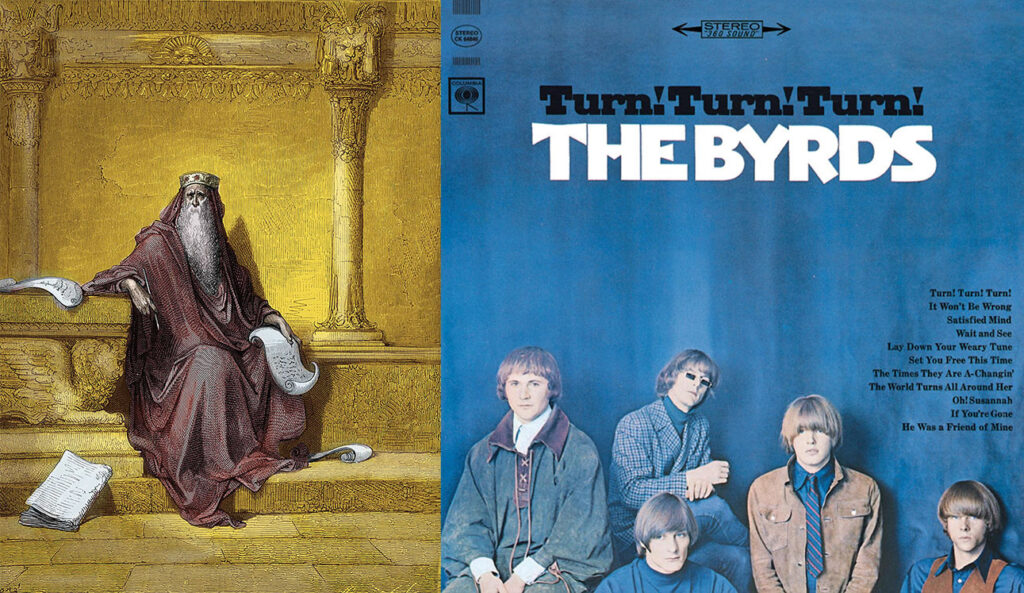
In 1959, Pete Seeger was asked by his record label to compose a feel-good record. “Pete, can’t you write another song like ‘Goodnight, Irene’? I can’t sell or promote these protest songs,” the label reps said. (Never mind that “Goodnight, Irene,” popularized by Seeger’s The Weavers, had actually been written by Lead Belly, not Seeger). “You better find another songwriter,” the rabble-rousing musician wrote back. “This is the only kind of song I know how to write.”

What Seeger composed, “Turn! Turn! Turn!” he intended as another protest song, amidst the social turbulence of his time. But his publisher missed his subtlety.

“Wonderful,” came the label’s response. “Just what I’d hoped for.”

Though Seeger performed the song at a Greenwich Village folk venue as part of a 1962 live album, it was after multiple other artists added their own spins that the song took off. The Limeliters, Judy Collins, The Lettermen, The Seekers, and Nina Simone all offered their takes, but it was the Byrds’ rendition, more rock than folk, that topped the charts. It hit #1 in 1965. That year, America sent ground troops to Vietnam, draft cards were burned on college campuses, civil rights activists were attacked with fire hoses and police dogs, and President Lyndon Johnson strove to promote his “Great Society” programs. The soundtrack to this turmoil were harmonized voices encouraging Americans to “turn, turn, turn” and accept that history is a cycle, change is constant, strife will inevitably cool, and there is a season for everything.

The song became the musical snapshot of the time period, subsequently appearing in “More American Graffiti,” “Heart Like a Wheel,” “Forest Gump,” Ken Burns’ documentary on the Vietnam War, and three episodes of “The Wonder Years.”

Seeger, a brilliant lyricist, had based the song on one of the Bible’s books of wisdom, Ecclesiastes, which was just read in synagogues across the globe over the Shabbat of Sukkot. Its third chapter teaches that:

There is a time for everything,

and a season for every activity under the heavens:

a time to be born and a time to die,

 a time to plant and a time to uproot,

a time to kill and a time to heal,

 a time to tear down and a time to build,

a time to weep and a time to laugh,

 a time to mourn and a time to dance,

a time to scatter stones and a time to gather them,

 a time to embrace and a time to refrain from embracing,

a time to search and a time to give up,

 a time to keep and a time to throw away,

a time to tear and a time to mend,

a time to be silent and a time to speak,

a time to love and a time to hate,

 a time for war and a time for peace. 

Ecclesiastes’ encouragement of equanimity in light of eternal change continues to find particular resonance in modernity, from the famous opening of Charles Dickens’ “A Tale of Two Cities” to then-President-elect Joe Biden’s victory tweet, “The Bible tells us that to everything there is a season — a time to build, a time to reap, a time to sow. And a time to heal. This is the time to heal in America.”

Who was Ecclesiastes? According to the Jewish tradition, he was none other than King Solomon, son of King David. A prince who became king, he was someone who had it all. Sitting atop a flourishing, secure kingdom, wealth, wisdom and an army at his command, the world was at his fingertips. As he describes it: “I made great works; I built houses and planted vineyards for myself; I made myself gardens and parks, and planted in them all kinds of fruit trees … I also had great possessions of herds and flocks, more than any who had been before me in Jerusalem. I also gathered for myself silver and gold and the treasure of kings and of the provinces; I got singers, both men and women, and delights of the flesh, and many concubines.”

But the king had what you might call the earliest recorded experience of a midlife crisis.            

“Then I considered all that my hands had done and the toil I had spent in doing it, and again, all was vanity and a chasing after wind [hevel havalim in the Hebrew], and there was nothing to be gained under the sun.”

Having it all led the king exactly nowhere happy. Whatever he gained he knew would be fleeting. It would be hevel, gone with the wind.

How then to maintain a semblance of sanity and stability amidst ever-changing times?

Ya gotta have faith.

“When all is said and done, when all has been heard,” Ecclesiastes concludes, “fear God. And obey His commandments.”

Put simply, have belief. Be loyal to ancient traditions.

It is faith that lights the way through life’s constant change. It is faith that offers us the lyrics to sing, and belief the comfort when we cry. It is tradition that offers us guidance on when to move on and when to move forward.

Faith offers and brings about a sense of community and belonging. As Bryan Walsh put it in a 2017 Time magazine essay titled “Does Spirituality Make You Happy?,” “It’s as if a sense of spirituality and an active, social religious practice were an effective vaccine against the virus of unhappiness.”

It is no surprise, then, that the book of Ecclesiastes is read in synagogue during Sukkot, in which we vacate our stable homes for ephemeral, rickety huts.

Take joy not in things, warns the book. Acquisitions are made and lost. “Take it from me,” the ancient king who ruled a vast kingdom, says. Authority can be fleeting. Castles can crumble.

History is a cycle. Generations come and generations go. What matters is what we believe.


Rabbi Dr. Stuart Halpern is Senior Adviser to the Provost of Yeshiva University and Deputy Director of Y.U.’s Straus Center for Torah and Western Thought. His books include the newly released “Jewish Roots of American Liberty,” “The Promise of Liberty: A Passover Haggada,” “Esther in America,” “Gleanings: Reflections on Ruth” and “Proclaim Liberty Throughout the Land: The Hebrew Bible in the United States.” 

Mining the Wisdom of a 3,000-Year-Old King’s Midlife Crisis Read More »

When a Melody Becomes Ours

Tanchum Gershon Portnoy, who died on the first day of Rosh Hashanah at the age of 75, composed the beloved Eitz Chaim melody when he was just 22. Over the next half-century, it became part of synagogue life around the world. As his Shloshim gives way to Sukkot, I find myself returning to one particular memory of him, and to a lesson I learned while standing beside him in shul, singing his own melody.

I first discovered Tanchum’s “Eitz Chaim” 27 years ago, shortly after I came to America. I had grown up in Israel and somehow had never heard it. The first time I did, I immediately fell in love with it. I began using it and assumed that it was one of those melodies that had always been part of synagogue life.

Only after I came to Beth Jacob Congregation in Beverly Hills in 2013 did I discover where it came from. Eli Portnoy told me that his father had composed it. The melody appeared on Tanchum’s 1975 album Tanchumim.

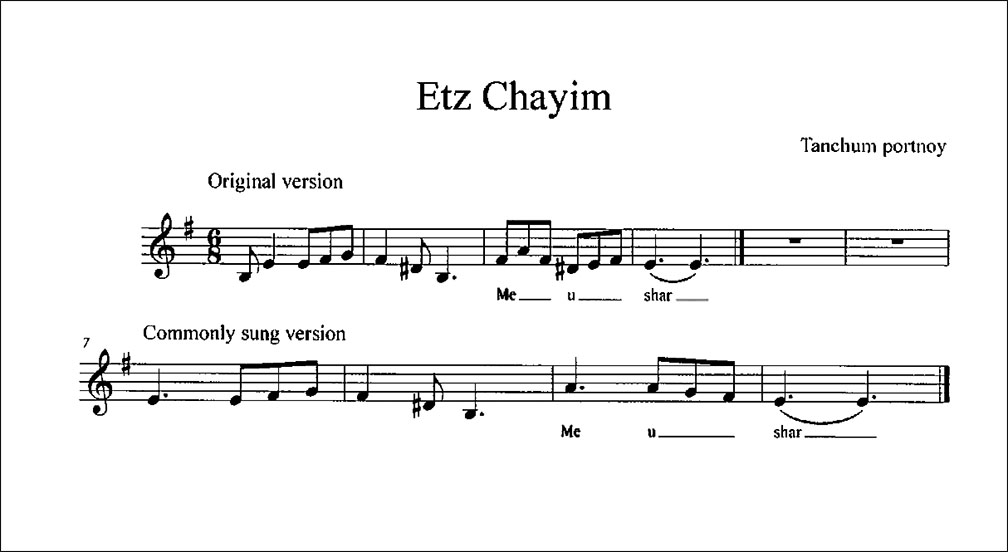
Listening to the original recording revealed something else: we do not actually sing the melody exactly as Tanchum wrote it.

There are several small differences, but the clearest occurs on the word me’ushar, “happy.” In Tanchum’s original, the opening “Me-” moves through several notes, and the melody then rises before resolving. In the version most synagogues sing, “Me-” is held straight, and the melody descends toward the final note.

It is a small difference, but once you hear it, it is unmistakable.

I had the privilege of singing “Eitz Chaim” several times while Tanchum was in shul. Twice I particularly remember him standing right next to me as we returned the Torah to the Aron Kodesh.

On one of those occasions, as we approached, I looked at him.

I was almost waiting for him to cringe.

Here was the composer himself, standing beside me, while the entire congregation was about to sing his composition “wrong.”

But Tanchum did not cringe. Quite the opposite. Just like the word we were singing, he looked completely happy.

I remember almost apologizing. I told him that we were not singing the phrase the way he had written it, and that synagogues everywhere seemed to have adopted the altered version.

Tanchum smiled and said:

Minhag Yisrael Torah hu: “The custom of Israel is Torah.”

I have thought about that response many times.

Of course, minhag Yisrael Torah hu does not mean that anything people happen to do automatically becomes Jewish law. But there is a deep Jewish instinct behind it: Torah is not preserved only in books. It also lives in the practices of a people.

The Talmud tells of an Erev Pesach that fell on Shabbat. Hillel was asked what someone should do if he had forgotten to bring the knife needed for the Korban Pesach before Shabbat. He remembered having learned the halacha, but could no longer recall it.

He responded:

“Leave it to the Jewish people. If they are not prophets, they are the children of prophets.”

When Hillel saw what the people actually did, the forgotten tradition returned to him.

The Talmud elsewhere expresses a similar instinct: “Go out and see what the people are doing.”

There is enormous importance in preserving the original source. But Torah also lives in people.

And I think Tanchum understood that.

There was the melody that Tanchum composed, and then there was the melody that Am Yisrael received. The recording preserved the original. But Jews carried his melody from synagogue to synagogue, sang it, taught it and made it part of their religious lives.

I believe that Tanchum was not upset by what happened along the way.

He was me’ushar.

But the more I think about that moment, the more I realize that it reveals something deeper than his understanding of minhag. It reveals something about the man.

I once learned from Rav Ilai Ofran of Kibbutz Yavneh a beautiful distinction between being a nadiv, a generous person, and being a nediv lev, a person generous of heart.

When the Torah describes the contributions to the Mishkan, it speaks of “every person whose heart moves him to give.”

A person can give something and still use the gift to enlarge his own presence in somebody else’s life. He still wants to control how it is used and whether it remains faithful to his intentions. The object may have left his hands, but emotionally he never really separated from it.

A genuine gift requires something harder: separation. The ability to say: I gave this to you. It is now yours.

That, in turn, requires yet another Jewish concept: tzimtzum, stepping back. I make a little less room for myself so that there can be more room for the person receiving the gift.

That is nedivut lev, generosity of heart.

And when I think back to Tanchum standing beside me, I realize that this is exactly what I saw.

Most composers who discovered that virtually everyone was singing their composition differently from the way they had written it would probably want to correct us. And who could blame them?

“That is not the note. That is not how I wrote it. This is my melody.”

Tanchum did not need to do that.

He had given something to Am Yisrael. Once Am Yisrael embraced it, he was able to let it become ours, even when we changed it.

Tanchum cared more about what the melody was doing for us than about what the melody said about him.

That willingness to hand something over also helped me understand another Jewish idea differently: mesorah, transmission.

Mesorah is not only about preserving something. It is about handing it over.

We receive something precious from those who came before us. We guard it, respect it and preserve what is essential. But eventually, if it is truly going to live, we have to place it into the hands of the next generation.

And the moment we truly hand something over, we surrender a measure of control. The next generation will hold it in its own hands and inevitably leave some of its own fingerprints on it.

That is not necessarily a failure of mesorah. In some ways, it is what allows mesorah to remain alive.

Perhaps that helps explain why I knew Tanchum’s melody for 14 years before I knew the name of the man who had written it. I sang it, loved it and used it. It had become so deeply absorbed into Jewish life that it felt like something that belonged to all of us.

On Shabbat Shuvah, at his family’s initiative, synagogues around the world were asked to sing Tanchum’s “Eitz Chaim” and to tell congregants the name of the man behind the melody. Eli expressed it beautifully: “My father gave the world a melody. This Shabbat, the world sings it back to him.”

As we mark Tanchum’s Shloshim, the lesson I carry from him is no longer only about music. It is about how a person gives.

Can we create something valuable and then step back? Can we allow another person to make it their own? Can we be not merely generous, but generous of heart?

There is something especially fitting that Tanchum’s Shloshim gives way to Sukkot, “the season of our joy.” It gives an added resonance to the word that has come to define this memory for me: happy.

From now on, whenever I sing his “Eitz Chaim” and reach that word, I suspect I will see him standing next to me again: a true nediv lev, who gave something beautiful to Am Yisrael and was genuinely happy to see it become ours.

May his memory be a blessing.


Chazan Rabbi Arik Wollheim serves at Beth Jacob Congregation in Beverly Hills, California.

When a Melody Becomes Ours Read More »

The Hidden Potential Within

On Sukkot, Jews around the world take up the arba minim, the Four Species: the etrog, lulav, myrtle and willow. According to the Midrash, these four species represent four types of Jews, each possessing different qualities.

The lulav, which comes from the date palm, has taste but no fragrance. It represents the person who possesses Torah knowledge but is lacking in good deeds. The fragrant myrtle, which has no taste, represents someone rich in good deeds but lacking in Torah knowledge. The etrog, possessing both taste and fragrance, symbolizes the person who excels in both Torah learning and good deeds.

Then there is the willow.

It has neither taste nor fragrance. Unlike the other species, it is plain and unremarkable. According to the Midrash, it represents the Jew who appears to possess neither Torah learning nor good deeds.

Yet without the willow, the mitzvah cannot be fulfilled.

That detail contains a profound lesson about how Judaism views human potential.

Rabbi Joseph B. Soloveitchik taught that although the person symbolized by the willow may appear to lack the qualities represented by the other species, this is only a surface impression. Beneath an unremarkable exterior may lie tremendous potential waiting to be developed.

The etrog, lulav and myrtle have already revealed their distinctive qualities. The willow has not — at least not yet.

It reminds us that we cannot measure another person’s potential simply by looking at where that person stands today. Every individual carries within him or her the capacity to grow, to blossom and to make a contribution that no one else can make.

Just as water can revive a withering willow, connection to Torah, community and God can awaken a person’s inner vitality and bring previously hidden qualities to the surface.

There is another remarkable aspect of the willow. Rabbi Soloveitchik noted that while the other three species participate in one mitzvah, the willow has an additional role. In the days of the Temple, there was a special willow ceremony during Sukkot, commemorated today on Hoshana Rabbah.

The seemingly least distinguished of the Four Species is thus given a distinction of its own.

Perhaps there is a message here for the way we look not only at others, but at ourselves. People easily become discouraged when they compare their accomplishments with those of people who appear more learned, talented or successful. We may conclude that what we have to contribute is insignificant.

A story about the legendary conductor Arturo Toscanini offers a different perspective.

Toscanini was renowned for his extraordinary ear and his almost obsessive attention to musical detail. On one occasion, he listened to a recording of an orchestral work with his biographer. When it ended, Toscanini asked whether he had noticed anything unusual.

The biographer had not.

Toscanini explained that the score called for 14 violinists, but he had heard only 13. The biographer investigated and discovered, to his amazement, that Toscanini was correct: one violinist had been absent when the recording was made.

To the ordinary listener, the orchestra sounded complete.

To the master conductor, one voice was missing.

A rabbi once shared this story with a student who was discouraged about his Torah learning. Surrounded by far more accomplished students, he felt that his own efforts were insignificant.

The rabbi told him that an untrained ear may hear an orchestra as a single sweep of sound, but the conductor hears every instrument. Similarly, a room filled with people studying Torah may sound to us like a blend of many voices. But to the Master Conductor, every voice matters. Each contributes something that no other voice can provide.

Without it, something is missing from the symphony.

The Mishnah teaches, Bishvili nivra ha’olam — “The world was created for me.” This is not an invitation to self-importance. It is a call to responsibility. Each of us has been given a particular combination of abilities, circumstances and opportunities. Recognizing our value should inspire us to discover those gifts and put them to use.

That requires honest self-awareness, meaningful goals and the discipline to keep moving forward even when progress seems slow.

Sukkot is called zman simchateinu, the season of our joy. Perhaps one source of that joy can be found in the Four Species themselves. We hold four very different plants together and make a blessing over them as one.

In doing so, we make a powerful declaration: There is room for every Jew. No one should be dismissed because his or her gifts have not yet become visible. No one should conclude that his or her contribution does not matter.

Sometimes the person who seems most like the humble willow is simply waiting for the right circumstances to reveal what was there all along.

And sometimes the voice that seems least noticeable to us is one the Master Conductor knows the symphony cannot do without.


Yosef Gesser is a longtime writer for various Jewish publications, covering Jewish thought, history, and Jewish personalities.

The Hidden Potential Within Read More »

Upgrading Our Spiritual Software: From Survival to Universal Consciousness

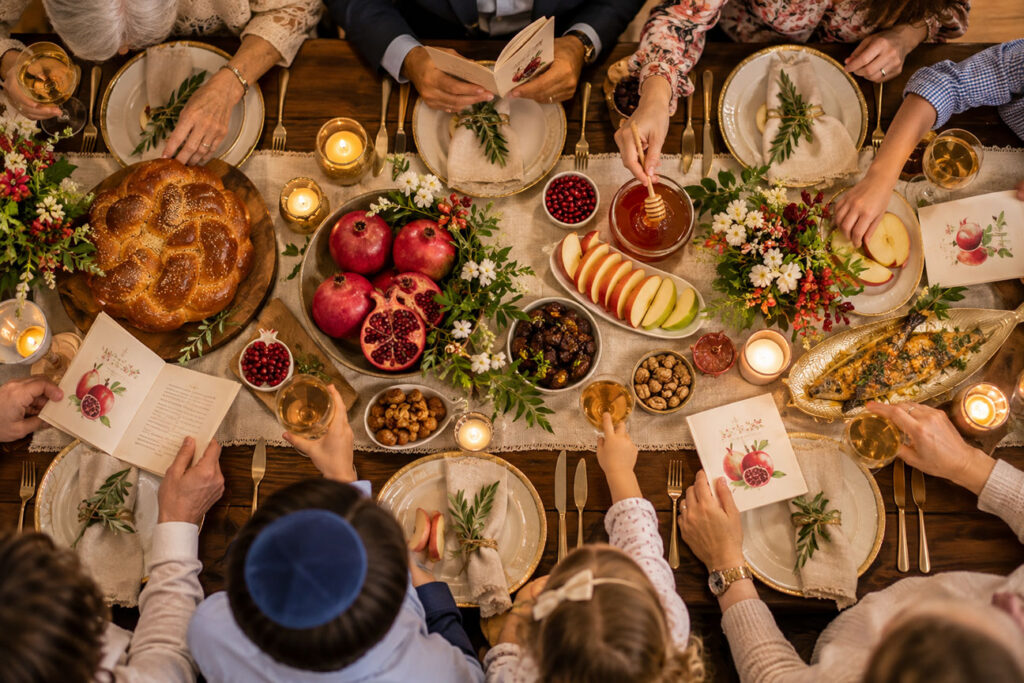
The scene was breathtaking: a massive, illuminated table set in the backyard of my family’s Los Angeles home on the second night of Rosh Hashanah.

As Persian Jews, the evening had its distinct warmth, energy, and vibrant vibe. Every place setting was arranged with precision—apples, honey, pomegranates, and all the traditional symbolic foods reminding us of our heritage and our hopes for the year ahead.

Yet, as the small booklets were passed around and we began reading the traditional blessings together, a familiar dissonance took root in me.

As a deeply spiritual person, I enter these sacred moments thirsting for connection, elevation, and genuine soul-fulfillment. Instead, as the text was read aloud, I was struck by two dominant refrains: a heavy emphasis on asking God to destroy our “enemies,” and a transactional approach to prayer that feels like a child asking a vending machine for personal favors.

Looking around the table at people reciting these words with matter-of-fact acceptance, I couldn’t help but feel that this text reflects our ancestors operating in existential survival mode—people who felt unsafe and surrounded by hostility.

Historically, that may very well have been their reality. Having witnessed as a child in Iran how one specific water faucet out of several was allocated to “Jews” in a public square, I fully understand that fear. But now, as a new grandfather to two thriving toddlers, I stand at the bridge between that painful past and the future they are stepping into.

Are we to run the exact same “spiritual software” year after year, without reflecting on what has changed and what it takes to get to the world we want to live in? Would this not be a missed opportunity to meet the moment and express the true spirit of our tradition, rather than just its literal, handed-down text?

Modern insights from psychology, sociology, neuroscience, consciousness, and quantum physics—all demonstrate how our mindset, intention, and words shape our reality. Feeding our minds, and the minds of our children, a linguistic diet of fear, division, and self-centered requests contradicts higher spiritual growth, and risks alienating the very younger generation we hope to retain.

Even from a purely religious perspective, this insular framing contradicts one of Judaism’s most profound callings of this season: Teshuvah—the duty to repair our individual relationships and fulfill our responsibility to elevate the wider world. How can we be a light to the nations if we trap our foundational prayers in an exclusive, self-focused bubble?

Imagine a holiday table where our children and adults are invited to contribute their own prayers to the group. Can we feel as much ownership of our texts as our ancestors did when they adapted liturgy as they moved cities, survived new rulers, and marked new eras? Change has always been essential to our survival.

One of the most inspiring features of the Iranian Jewish diaspora in Los Angeles is how committed its second and third generations remain to Jewish practice and community. As we look to the year ahead, may we pass along tools for our children and grandchildren to practice a Judaism focused on supporting the future they envision, rather than the pressure to fossilize the past they inherited.

In traditional circles, challenging original texts is often met with pushback or viewed as “not being one of us.” But as a grandfather, I write this out of deep respect, love, and hope for our community. I want our tradition to stay relevant and thriving. Loving a tradition doesn’t mean leaving its ancient language frozen in stone; it means having the courage to help it evolve.

I hope I speak for many who feel in their hearts that it is time to upgrade our spiritual language—moving beyond fear and exclusivity toward a consciousness that embraces the collective enlightenment, well-being, and cooperation of all humanity. I humbly ask our spiritual leaders to reflect, speak from the heart, and open the path toward updating our spiritual software. This is how we honor the memory of our ancestors, elevate our children, and fulfill our mission to heal the world.


Joseph Sumekh is a grandfather and life coach, living with his family in Los Angeles. 

Upgrading Our Spiritual Software: From Survival to Universal Consciousness Read More »

Bibi’s Last Stand

Editor’s note: Sign up for Dan’s new weekly newsletter and podcast, “Sanity Check,” at danschnur.substack.com. Politics … but calmer. 

For the last few years, we have been talking about how the Hamas terrorist attacks has created a generation of October 8 Jews. Now as Israelis prepare to vote for their next leaders, it appears that they are about to face an October 6 election.

According to the calendar, Israelis will go to the polls almost precisely three weeks after the third anniversary of their country’s most painful day. But as the voting draws closer, Benjamin Netanyahu and his most prominent opponents seem to be running a campaign in which the Gaza war may not play a significant role in the outcome.  Even while the candidates talk frequently about the war, their differences on Iran and its terrorist auxiliaries are largely tactical. As has been the case for much of the post-Intifada era, the choice on these issues largely comes down to either Netanyahu or the “Bibi-ism without Bibi” that it is now Gadi Eisenkot’s and Naftali Bennett’s turn to represent. 

The most significant war-related factors in the voting may be Netanyahu’s preparation for the attacks and his stewardship after they occurred. But many Israelis will answer that question based more on their broader impression of the prime minister than on specific conclusions about his decisions on the war, since it’s not clear how much Eisenkot and Bennett would have done differently. Eisenkot asserts that he would have prioritized the hostages’ return over battlefield gains. Bennett criticizes Netanyahu’s relationship with Qatar. But otherwise, the debate over Netanyahu’s wartime strategies can be seen more as a litmus test than a vote-driver.

The result is a campaign in which national security issues rank highest in public opinion polls even if those matters will ultimately determine a smaller number of votes. Foreign policy and security are still the primary deciding factors for the country’s conservative majority. But among the approximately 40 percent of the electorate that now identifies as center and left, the economy and other domestic policy are now higher priorities.

The war is still certainly the backdrop for the elections. But while voting will take place on a decidedly and tragically post-Gaza national landscape, the outcome will likely be shaped more by factors that preceded the terrorist attacks than those that followed them. While Israel has been shaped and scarred by Hamas’ violence, the nation’s politics seem to have returned to a pre-war condition — albeit a more intense version. It now looks like the role of the ultra-Orthodox in Israeli society, the nation’s relationships with the U.S. and the rest of the world, and the rising levels of West Bank violence will drive many more votes than the more direct ramifications of October 7.

This dynamic does not work to Netanyahu’s benefit. His reliance on the ultra-conservative parties that are propping up his coalition leave him with little flexibility on any of these issues. While conservatives still safely outnumber moderates and liberals in the electorate, both of his primary opponents have the ability to reach into his supporter base by arguing for right-leaning but not as extreme alternatives on each of these matters.

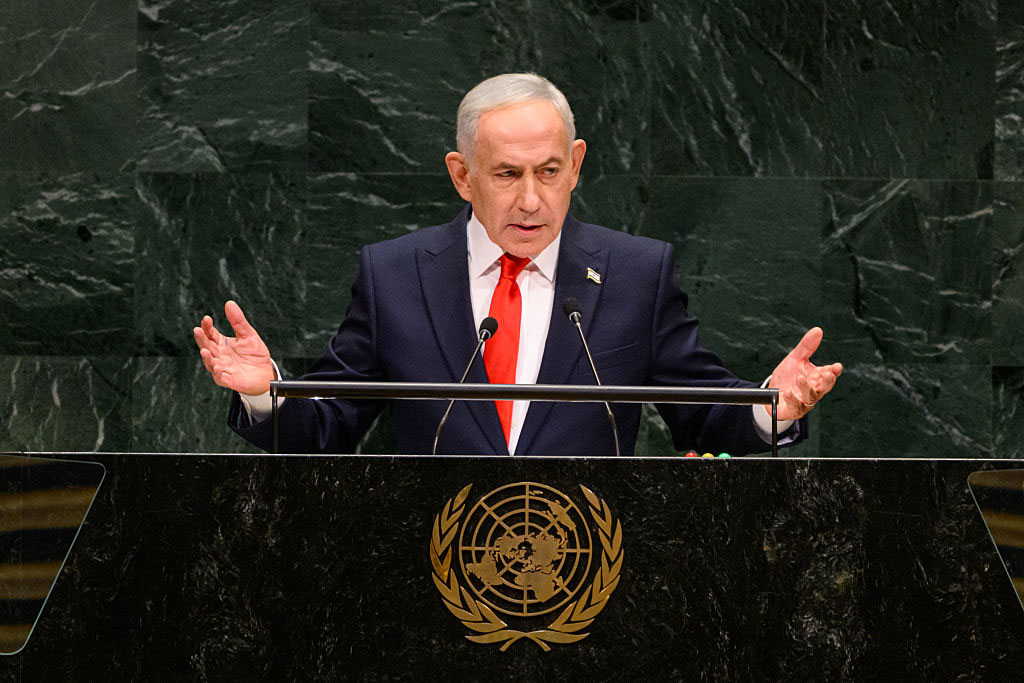
But if Bibi is unable to persuade enough Israelis to his side on the Haredi or West Bank settlements, he is the unparalleled master at rallying his country to stand together against their enemies. That’s what Netanyahu was doing in New York last week, when he used the United Nations General Assembly as a campaign stop to take on his fiercest international critics. The U.N. delegates in the audience were merely props: Netanyahu’s true audience were the voters back home in Israel, who he effectively reminded of his abilities to keep hostile adversaries at bay.

Zohran Mamdani is an even more helpful foil for Netanyahu. The New York mayor chose not to try to arrest the prime minister, as he had promised during his own campaign last year, nor to join the anti-Zionist rallies on the streets of his city. Those would have been even greater gifts to a Netanyahu re-election effort, but Mamdani’s animosity still remains an unintentional but invaluable political asset for Israel’s embattled leader.


Dan Schnur is the U.S. Politics Editor for the Jewish Journal. He teaches courses in politics, communications, and leadership at UC Berkeley, USC and Pepperdine. He hosts the monthly webinar “The Dan Schnur Political Report” for the Los Angeles World Affairs Council & Town Hall. Follow Dan’s work at www.danschnurpolitics.com

Bibi’s Last Stand Read More »