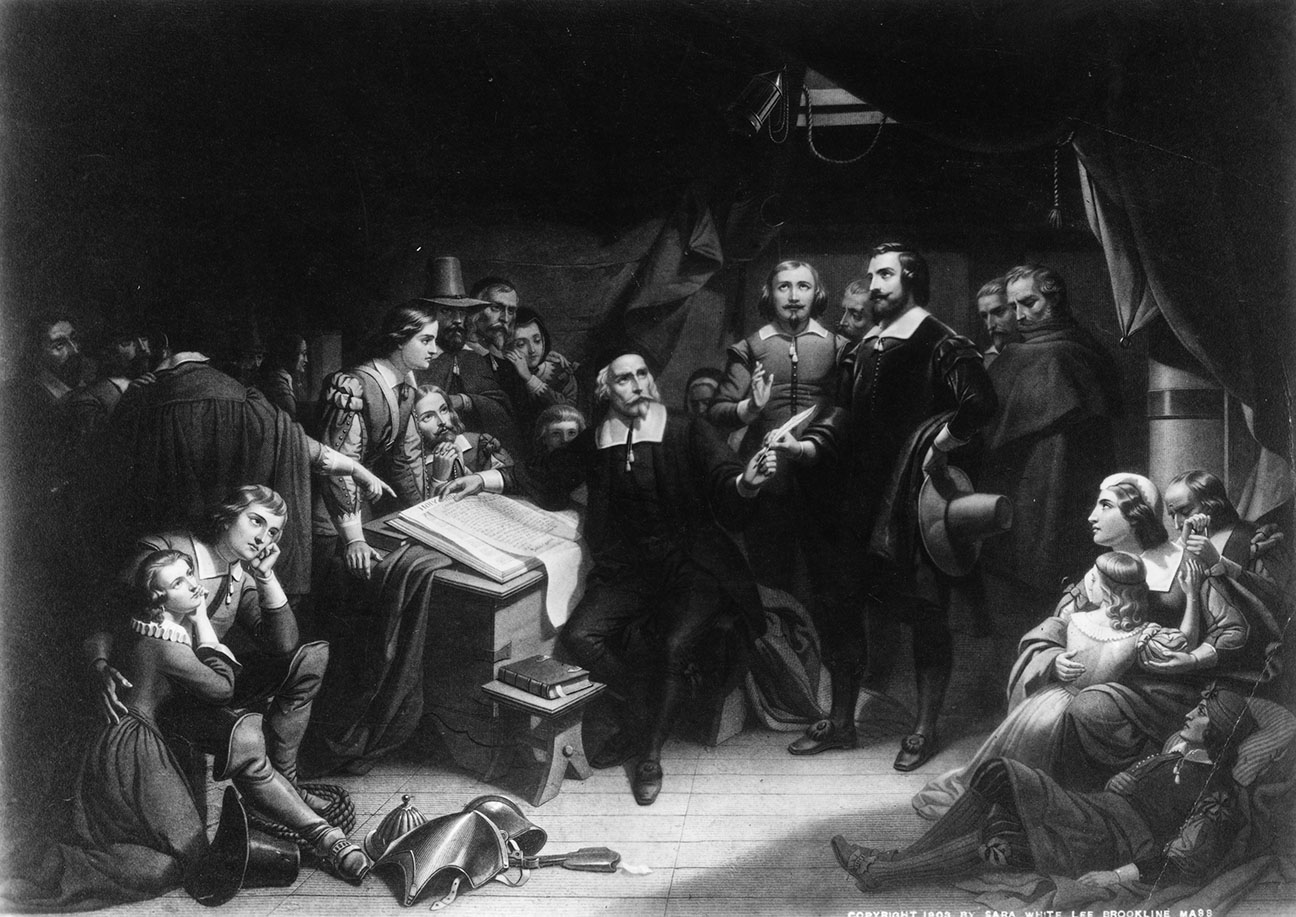
When the English Puritan William Bradford fled from religious persecution at the hand of King James I aboard the Mayflower and landed, with his fellow Pilgrims, on the shores of New England in 1620, he reflected on his experience in a way that would mark the American project from its very beginning as being inspired by the Hebrew Bible.
Bradford, who would serve as Governor of the Plymouth Colony intermittently for roughly 30 years, would even study Hebrew late in life. He wrote how “I have a longing desire to see with my own eyes something of that ancient language and holy tongue in which the Law and oracles of God were written; and in which God and angels spoke to the holy patriarchs of old time; and what names were given to things from the creation … My aim and desire is to see how the words and phrases lay in the holy text.”
Most striking about Bradford’s affinity for the Bible for those who hear the weekly parsha in synagogue is how Bradford drew explicitly from the Book of Deuteronomy in expressing the covenantal character of what would become, eventually, the United States.
In conveying the sense of fear and uncertainty of his fellow early settlers, Bradford wrote in his journal that “what could they see but a hideous and desolate wilderness, full of wild beasts and wild men— and what multitudes there might be of them they knew not. Neither could they, as it were, go up to the top of Pisgah to view from this wilderness a more goodly country to feed their hopes; for which way soever they turned their eyes (save upward to the heavens) they could have little solace or content in respect of any outward objects.”
The “Pisgah” mountaintop that Bradford wished he could ascend to is a reference to Deuteronomy’s third chapter. In it, God allows Moses, who had been punished from entering the Promised Land, to view it from a height, and take in its glory and splendor as comfort and consolation. “Go up to the summit of Pisgah and gaze about, to the west, the north, the south, and the east. Look at it well,” God instructs. And then, God continues his directive to Moses, “Give Joshua his instructions, and imbue him with strength and courage, for he shall go across at the head of this people, and he shall allot to them the land that you may only see.”
Moses, in other words, though himself anxious and uncertain over how his people will fare in the future, is given reassurance from his new vantage point that the Divine promise of flourishing in this new land for opportunity will eventually be fulfilled. It is this comfort of Moses that Bradford longed to experience.
Later in his journal, Bradford senses that the story that he is beginning will be one passed down for generations. He reflected “May not and ought not the children of these fathers rightly say: ‘Our fathers were Englishmen which came over this great ocean, and were ready to perish in this wilderness; but they cried unto the Lord, and He heard their voice and looked on their adversity.’”
In this he is paraphrasing Deuteronomy’s 26th chapter’s text that the Israelites were to recite upon presenting their first fruits to the priests in the Temple. It is a passage which subsequently became part of the Passover Haggadah. “My father was a fugitive Aramean. He went down to Egypt with meager numbers and sojourned there; but there he became a great and very populous nation. The Egyptians dealt harshly with us and oppressed us; they imposed heavy labor upon us. We cried to the Lord, the God of our ancestors, and the Lord heard our plea and saw our adversity, our misery, and our oppression.”
Bradford understood that to build a sustained community, devoted to obedience to God’s law and the maintaining of a just and prosperous society, the ability to successfully transmit communal values from generation to generation was key.
He then, citing Psalms, expressed gratitude for the Pilgrims’ endeavor, even amidst the challenges facing them: “Let them therefore praise the Lord, because He is good: and his mercies endure forever,” a verse Jews recite in their prayers daily.
Ten years later, the Puritan John Winthrop, who served as Governor of the Massachusetts Bay Colony, would articulate a Jewishly-inspired vision as well. He invited his fellow settlers to “enter into a covenant” with God and to “follow the counsel of Micah, to do justly, to love mercy and to walk humbly with our God.” By abiding by their desire to build a society modelled after that of ancient Israel “The Lord will be our God, and delight to dwell among us, as his own people, and will command a blessing upon us in all our ways.”
As the late British Chief Rabbi Lord Jonathan Sacks noted, this Hebraic strand of America has been a throughline throughout our nation’s history. “American presidents speak of Divine Providence and the sovereignty of God. They refer to covenant and the moral bonds by which societies are sustained,” Sacks wrote. “The liberty of which they speak is biblical rather than libertarian: a matter less of rights than responsibilities, not the freedom to do what one likes, but the freedom to do what one ought, thus contributing to the common good. The ‘American story’ is essentially that which Moshe articulated at the end of his life [in Deuteronomy]. America is the promised land to which successive generations of immigrants have come to find freedom from oppression and build, in John Winthrop’s famous phrase, ‘a city upon a hill.’”
The Pilgrims and Puritans understood then what all readers of the parsha understand now — that the Hebrew Bible, as Moses puts it in Deuteronomy 4:6, “is your wisdom and understanding in the eyes of the nations.” By abiding by its values, we can inspire others to say, “surely this great nation is a wise and understanding people.”
Rabbi Dr. Stuart Halpern is Senior Adviser to the Provost of Yeshiva University and Deputy Director of Y.U.’s Straus Center for Torah and Western Thought. His books include “The Promise of Liberty: A Passover Haggada,” which examines the Exodus story’s impact on the United States, “Esther in America,” “Gleanings: Reflections on Ruth” and “Proclaim Liberty Throughout the Land: The Hebrew Bible in the United States.”