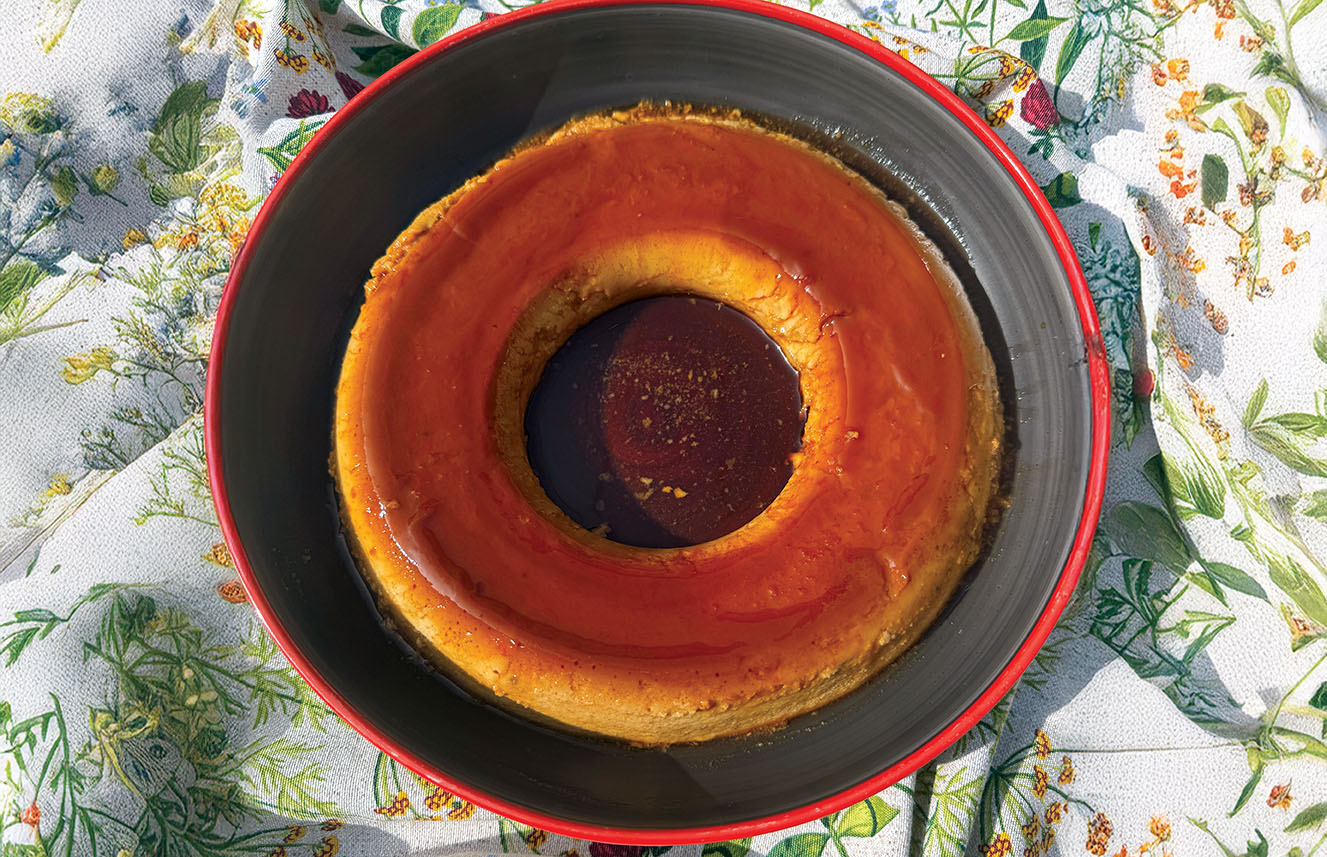
Flan, a soft, creamy custard with a clear caramel topping, has always been close to my heart. As a young boy growing up in the port city of Larache in northwest Morocco, my father was very thin and often sick. My grandmother Raquel, for whom I am named, decided that she would strengthen him by baking him a flan every single day. Every day, he would return from school, sit at the table and eat the entire flan. His siblings were not allowed to touch it. Within a few months, the flan worked its magic and he was strong and healthy again.
Naturally, this dessert always brings that happy memory back to him and flan is still one of his favorites. Growing up, my mother often made it for us too. That smooth caramelized custard was a regular treat in our home.
Flan was popular in medieval Spain and Sephardic cooks were known for their simple, elegant desserts, transforming eggs, sugar and milk into something silky and soothing. After the Expulsion of 1492, although they were scattered across North Africa and the Ottoman world, these women brought their treasured recipes with them. They soon adapted the flan recipes to the flavors they found in their new homes. In Morocco, they would have added orange zest; in Izmir, a splash of rosewater.
It’s pumpkin season and that means pumpkin in everything. Pumpkin pies, pumpkin muffins, pumpkin bread, pumpkin cheesecake and, of course, pumpkin spice lattes. When I found a can of pumpkin purée in my pantry, it inspired me to make a pumpkin flan.
Adding pumpkin felt like the perfect bridge between fall in America and the flavors I grew up with. It’s a natural extension of that long Sephardic tradition of adapting the ingredients of our new homes.
Pumpkin, or “calabaza” in Ladino, has long been a symbol of sweetness and abundance. It shows up as a star ingredient to eat with couscous, in stews, mixed with feta cheese in flaky borekas, and as a sweet jam preserve. We even serve it in the Rosh Hashanah Seder, where it is a symbolic food, eaten as a sign of good fortune and hope for the new year.
This time, I made my flan with coconut milk instead of regular milk, a small modern touch that worked beautifully. It reminded me that Sephardic cooking has always evolved, absorbing the new without losing its essence.
While pumpkin flan may fit in perfectly with an American seasonal trend, for me, it is something deeper. This pumpkin flan is a bridge between the generations of my family, a chance to imagine the kitchen of my grandmother Raquel.
Each spoonful imparts a taste of family memory, Jewish migration and the soft sweetness of home, wherever in the world that may be.
—Rachel
The first time I made a baked custard was as a teenager in Bellevue Hill, a suburb of Sydney. I made it in my aunt Rebecca’s kitchen, from a recipe lovingly handed down by her elegant mother-in-law, Judy Clifford. The recipe was exactly the same as a typical flan recipe, with a mixture of eggs, sugar, milk and vanilla. But the flan was topped with an elegant flutter of sweet, nutty, earthy nutmeg. It was so delicious!
The ancient Romans invented beating eggs to create honey-sweetened, as well as savory, custards. The recipe spread throughout Europe, but it was the Spanish who refined the dish, adding the signature caramel topping to the flan.
As Rachel writes, Sephardic Jews brought flan with them when they left Spain. But the conversos (Crypto-Jews) that remained in Spain used a dairy-free flan as a way to outsmart the inspections of the Inquisition. They called it Flan de almendras y naranja, which translates to Almond and Orange Flan. They used ground almonds and orange juice instead of milk, thus enabling them to eat a “dairy” dessert after a meat meal.
We hope you try this wonderful dessert for Shabbat and the upcoming Thanksgiving holiday. It’s sure to wow your guests.
—Sharon
Flan de Calabaza
Pumpkin Flan
1 cup sugar, for caramel
6 eggs
1/2 cup sugar
1 cup pumpkin puree
1 cup coconut milk
1 Tbsp vanilla
1 tsp pumpkin spice or cinnamon
Preheat the oven to 350°F.
Prepare a bain-marie by filling a large ovenproof dish with 2″ of cold water.
Prepare the caramel for the bottom of the flan by placing a cup of sugar in a heavy bottomed pot. Melt over low heat until sugar forms a golden syrup. Pour the hot syrup very carefully into a glass pie dish or metal cake pan, making sure to coat the bottom and sides of the dish.
In a large bowl, use a hand mixer or a whisk to blend the eggs, the remaining sugar, pumpkin, coconut milk, vanilla and pumpkin spice until the mixture is smooth.
Pour the custard mixture into the prepared baking dish.
Place the flan in the center of the bain-marie, then cover the entire baking pan with foil. Making sure not to spill the liquid, place in the oven and bake for one hour.
Remove flan from the oven when the edges are firm and the center is jiggly. Let flan cool on the counter, then place in the refrigerator for 6 hours or overnight.
Before serving, allow the flan to come to room temperature.
Remove from flan mold by placing a dish on top, then flip and give it a shake. If flan doesn’t slip out, let it rest upside down until it falls out.
Sharon Gomperts and Rachel Emquies Sheff have been friends since high school. The Sephardic Spice Girls project has grown from their collaboration on events for the Sephardic Educational Center in Jerusalem. Follow them
on Instagram @sephardicspicegirls and on Facebook at Sephardic Spice SEC Food. Website sephardicspicegirls.com/full-recipes.