If you saw a Hollywood film around the middle of the last century, you would be quite sure that all the leading actors — whether of Jewish, Italian or Greek descent — portrayed clean-limbed and straight-nosed Anglo-Saxon types.
Fortunately, times have changed, as witness “Tango Shalom,” which is populated by bearded Chassidim and their voluble spouses — not as caricatures or exotics, but as three-dimensional characters facing life’s dilemmas and joys.
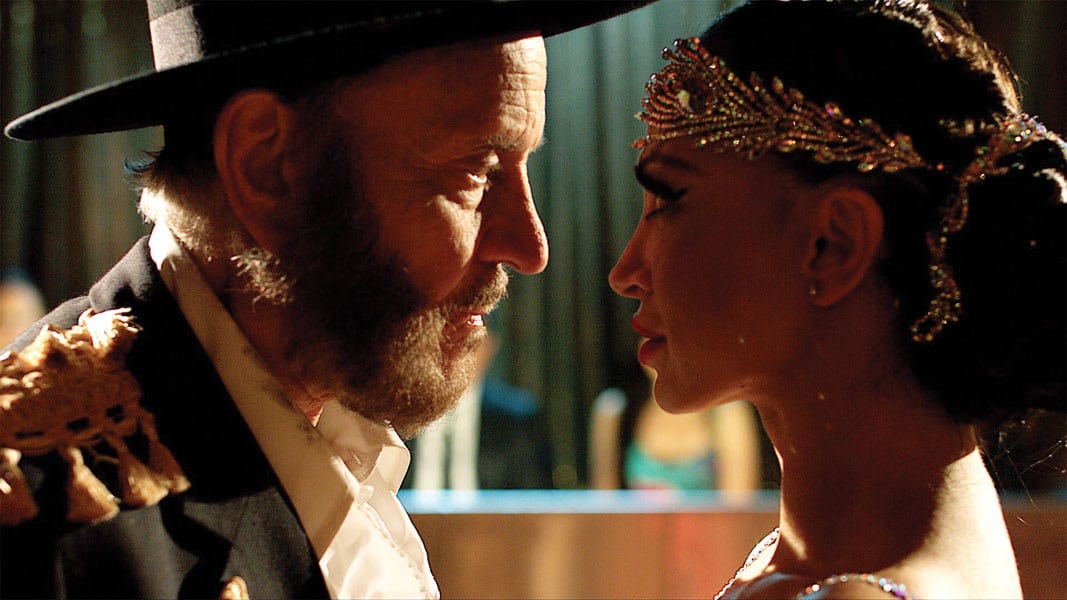
The protagonist in “Tango Shalom” is Rabbi Moshe Yehuda (Jos Laniado), who labors at a Hebrew school on the edge of bankruptcy in the Chassidic neighborhood of Brooklyn’s Crown Heights, teaching the boys the wisdom of the Torah and how to dance the Hora.
Desperate for money, by a twist of fate — or plot line — the rabbi encounters the lithe dancing instructor Viviana (Karina Smirnoff), who is looking for a male partner to enter a tango contest promising large amounts of money for the winners.
There is only one catch. Like any strictly Orthodox Jew, the rabbi is forbidden to touch a woman not his wife.
What to do? Rabbi Yehuda consults the local rabbinic sage, who admonishes him that as a married man the petitioner cannot even make eye contact with another female.
Not a man to give up easily, Rabbi Yehuda decides to seek counsel from spiritual leaders of a different cloth, first a Catholic priest, then a Muslim iman and finally a Hindu spiritual leader.
All are surprisingly sympathetic to the rabbi’s dilemma — perhaps having been tempted in their own past lives — but in the meanwhile the rabbi’s apparently scandalous relationship has been discovered and he is at risk of losing both his job and his wife.
Just in time, the odd dancing couple discovers a kosher way to dance without any physical contact — which I am not at liberty to divulge — they win a prize for innovative dancing, and all ends well.
Admirers of the film “My Big Fat Greek Wedding” will notice some of the same ethnic complications and sheer joy of living running through “Tango Shalom.” That is no coincidence since Joel Zwick, who directed “Greek Wedding,” also produced “Tango.”
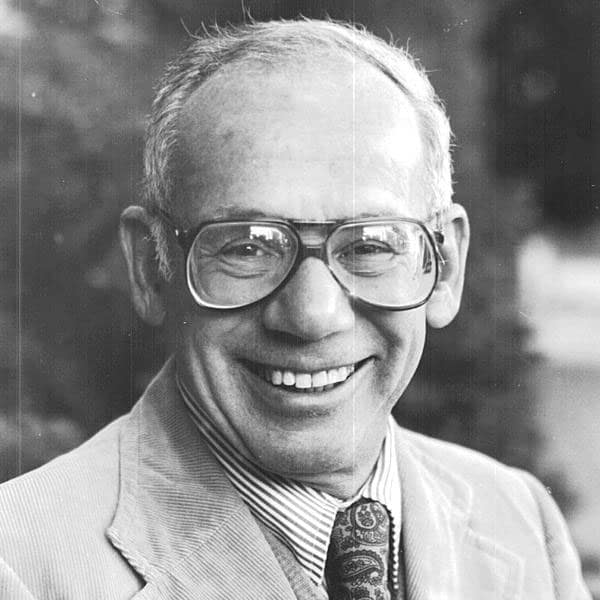
The latter film’s director is Gabriel Bologna, who is well suited for the assignment as the son of a Catholic father, Joseph Bologna, and a Jewish mother, Renee Taylor.
“I consider myself 100 percent Italian and 100 percent Jewish.” — Gabriel Bologna
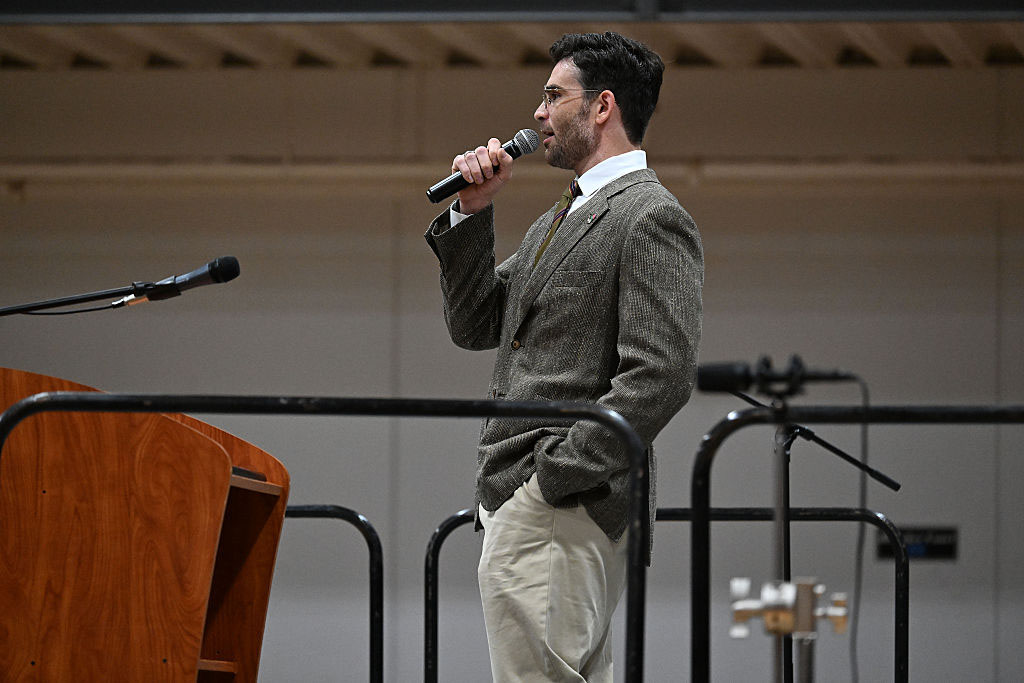
“I consider myself 100 percent Italian and 100 percent Jewish,” Gabriel Bologna observed at the beginning of our hour-long interview.
He cast his father as the Catholic priest, and dedicated “Tango” to him after the father died during production of the film. The younger Bologna, 52, has worked as actor, director, writer, producer and cinematic graphic designer in 37 films, starting in 1973.
Making “Tango” took some six years, from 2015 to the present, due to the pandemic and other uncontrollable factors, on a budget of $1.42 million. The relatively low cost — by Hollywood standards — was made possible because all the required locations — whether Jewish, Catholic or Sikh houses of worship — were provided by the respective congregations free of charge, as were the headquarters of the Lubavitcher Rebbe.
Practically all the outdoor scenes were filmed on the streets of Crown Heights, while the climactic tango contest was immortalized in Los Angeles.
Bologna described “Tango” as an “ethnic comedy” though he needed to be aware of the sensitivities of the various religious branches. In general, though, he said that “the more specific (in detail) such a film is presented, the more universal it becomes.”
There have been no complaints about the depictions of their faiths by the gentile and Jewish participants, Bologna said, although the Muslim congregation in which a segment of the film was shot, asked not to be identified for fear of repercussions.
Overseas, the film has been well received in the countries of the former Soviet Union and has won audience awards in Morocco and India, Bologna said.
“Tango Shalom” is currently presented at the Town Center 5 in Encino through Sept. 16, and will open on Sept. 10 at the Newhall in Santa Clarita. Additional theaters screening the film this weekend in the Los Angeles area are The Landmark, Town Center 5 in Encino, AMCBurbank 8, AMC Orange 30, AMC Promenade 16 Woodland Hills and Regal Irvine. After Oct. 29, the film will be available on all streaming and cable platforms and on DVD. For up to date information on screenings visit www.tangoshalommovie.com.