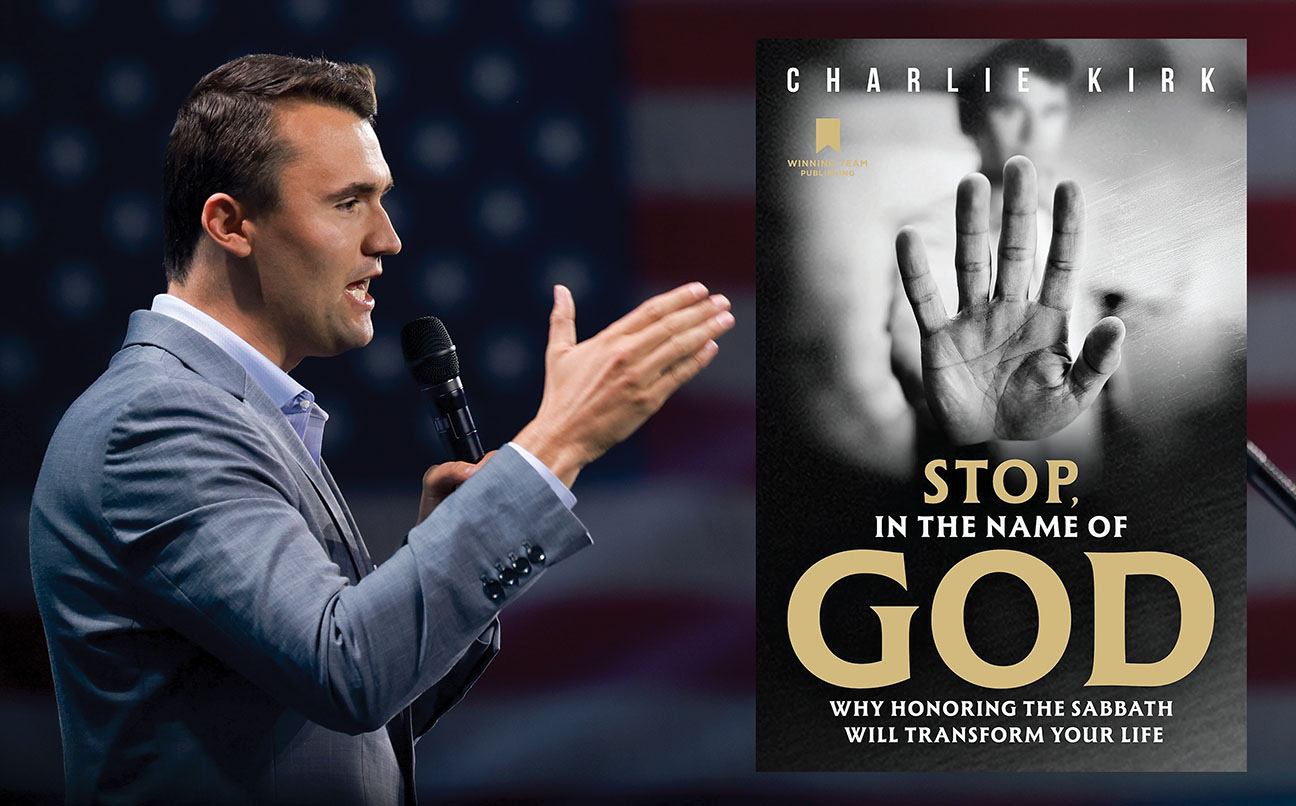
Charlie Kirk, the widely popular conservative activist who gained a national following in his mid-20s and was assassinated on a college campus in September 2025, is probably the last person you’d expect to embrace a Jewish ritual that forbids the use of digital devices from sundown Friday night to sundown Saturday night.
“I really don’t have time for that,” he tells a friend who suggested Kirk try observing the Jewish Sabbath. “I am running three different companies and have three hundred people on payroll. I have to raise $50 million a year and do three hours of radio a day. I will honor God by working harder, not by resting for a day.”
That is how Kirk, in his bestselling book, “Stop in the Name of God: Why Honoring the Sabbath Will Transform Your Life,” sets up the eventual decision that he says transformed his own life.
Given that the benefits of a day of rest in an overstimulated world have become so evident, one would think that Kirk’s book would be rather predictable.
It’s not.
One reason is that Kirk, a practicing Christian, was well aware that his religion was founded on the rejection of Jewish law, and Shabbat is the jewel of Jewish laws.
Kirk agonized over this question. “I have personally struggled with the idea of whether or not Christians are bound by the Sabbath…I wrestle with this greatly…I’ve spent years asking these questions with my Bible open and my heart burdened, trying to reconcile what feels like a glaring tension in Scripture.”
He reconciles this tension in several ways. First, by establishing the inherent human value of Shabbat:
“In a society where identity is increasingly tethered to output—where your worth is measured by how busy you are—the Sabbath invites you to stop and still be loved. Still be human. It rehumanizes us in a dehumanizing world… [the Sabbath commandment] upends social stratification by declaring that every human being, regardless of status, deserves dignity, rest, and space to breathe…it embraces every human regardless of their societal status.”
A second way he reconciles the tension is to focus on the shared Judeo-Christian belief in a Creator, framing Shabbat as a divine imperative.
“It is a weekly, embodied confession that we are created, not accidental. That there is a Creator, and He is not us,” he writes. “In a world governed by unrelenting drive, by the mantras of ‘faster,’ ‘harder,’ and ‘more,’ the divine voice says something astonishing: Stop. In His name, cease. Cease striving. Cease earning. Cease proving. Cease buying and selling and producing. This is not a suggestion. It is a divine imperative.”
This still leaves the stubborn fact that Christianity rejected Jewish laws. As Paul said in Colossians, “Let no one act as your judge in regard to food or drink or in respect to a festival or a new moon or a Sabbath day – things which are a mere shadow of what is to come.”
Kirk acknowledges the conflict:
“Few Christians today believe the Sabbath is on Saturday. Fewer still believe that it’s binding in any form. Most Christians see Sunday as the Lord’s Day and consider it a commemoration of the resurrection, not a Sabbath.”
Before making his case, Kirk is both candid and humble: “The following pages are not written from a mountaintop of certainty but from a well-worn path of seeking,” he writes. “I’ve come to believe that the Sabbath matters. That God’s rhythm is good. That rest is resistance in a world addicted to noise.”
Ironically, there is something Jewish, even Talmudic, about how Kirk resolves the dilemma:
“The argument that Christians are still bound to honor the Sabbath rests not on a single verse or cultural tradition, but on a rich, layered tapestry of biblical theology, covenant continuity, historical testimony, and pastoral wisdom.”
In any case, the book’s value doesn’t depend on Kirk’s compelling argument for why Christians should honor the Sabbath. In fact, he believes everyone should. That is why the book is, at heart, a love letter– a love letter from a faithful Christian who is grateful he has discovered this ancient Jewish ritual and wants to share it with the world.
It’s also a love letter to Dennis Prager, whose life’s work, Kirk says in his dedication, brought him to honoring the Sabbath.
“I am a close friend and student of Dennis Prager,” he writes in his introduction, “and for years I heard him brag about how he honors the Sabbath and how it’s the best part of his week. At times I found myself almost jealous of Dennis while listening to his Fireside Chats. ‘I’m too busy for that!’ I would say to myself when Dennis would air his monologues touting the biblical and moral importance of honoring the Sabbath.”
Kirk’s book is not only an homage to his teacher; it’s also an emulation. It is now his turn to share the wealth. He does so by taking the reader on a journey of spiritual and historical discovery.
His chapter on “The History of the Sabbath” is required reading for any Jews interested in their tradition. Kirk delves into the biblical, historical and mystical roots of the holy day, including how Shabbat sustained the Jews after the destruction of the Holy Temple: “The Sabbath became a portable sanctuary, a cathedral not in stone, but in time. When sacred space was razed, sacred time remained…the observance of Sabbath in exile was thus not an act of nostalgia but one of covenantal defiance… Sabbath became the connective tissue of Jewish identity, threading continuity through rupture.”
He quotes Jewish luminaries such as the late Chief Rabbi Jonathan Sacks– “The Sabbath is the most radical thing in the Torah”– and Rabbi Abraham Joshua Heschel– “The Sabbath is not an interlude but the climax of living.”
In a more ethereal passage, he quotes theologian Jacques Ellul: “God’s rest was not withdrawal from the world, but entering it in a new way, as the God who delights.” Thus, Kirk adds, the Sabbath is “a mystery of presence. It is not an interruption of history; it is the moment when history steps into the holy.”
With all of its eloquent homilies, historical references and spiritual reflections, ultimately, Kirk’s book can be summarized as a passionate and earnest pitch for personal transformation.
“I intend to persuade you of something that may, at first, seem quaint, old-fashioned, or even unnecessary: that the Sabbath is not merely a helpful tradition or a cultural relic—it is essential to the flourishing of the human soul,” he writes at the outset.
Does he succeed?
I think he does, for two reasons. One, you tend to believe him. The man reeks of sincerity. Two, he has done his research. When he waxes passionately about the Sabbath, it comes with plenty of knowledge, whether the lens is scientific (the Sabbath improves your sleep), spiritual or historical.
None of this should surprise us. Kirk made his reputation and gained millions of followers by traveling the country and engaging with college students, many of whom disagreed with his conservative views. He had a gift of debating with knowledge and civility, but he also had a gift of persuasion.
That confidence comes through in the book.
“We have laid out a robust case for why the Sabbath can truly transform your life—not as a burdensome rule, but as a lifeline of renewal,” he writes in his conclusion. “In a culture addicted to motion and noise, turning off your phone, quitting the scrolling, silencing Netflix, and stepping away from the endless stream of notifications is nothing short of radical.”
What becomes clear about this message is that with the explosive growth of technology that physically isolates us more and more, the value of Kirk’s book will only grow with time.
This is especially relevant given the sudden rise of A.I. companions, a much more dangerous category of addiction. On top of regular digital content like social media, now millions are getting addicted to digital relationships.
“Seventy-two percent of American teens have turned to A.I. for companionship,” researcher Amelia Miller writes in The New York Times. “A.I. therapists, coaches and lovers are also on the rise.”
This anti-human development is moving so fast it is adding a poignantly heroic dimension to the soothing rhythms of Shabbat. This sacred Jewish day, which liberates us from the addictive scourge of digital screens, if only for a day, may well become humanity’s last stand against the digital barbarians coming for our souls.
For the millions of humans who are replacing real humans with digital screens and artificial companions, Charlie Kirk, in his final act, has offered an answer: Stop and take a day off to rescue your humanity.
It’s called the Sabbath.