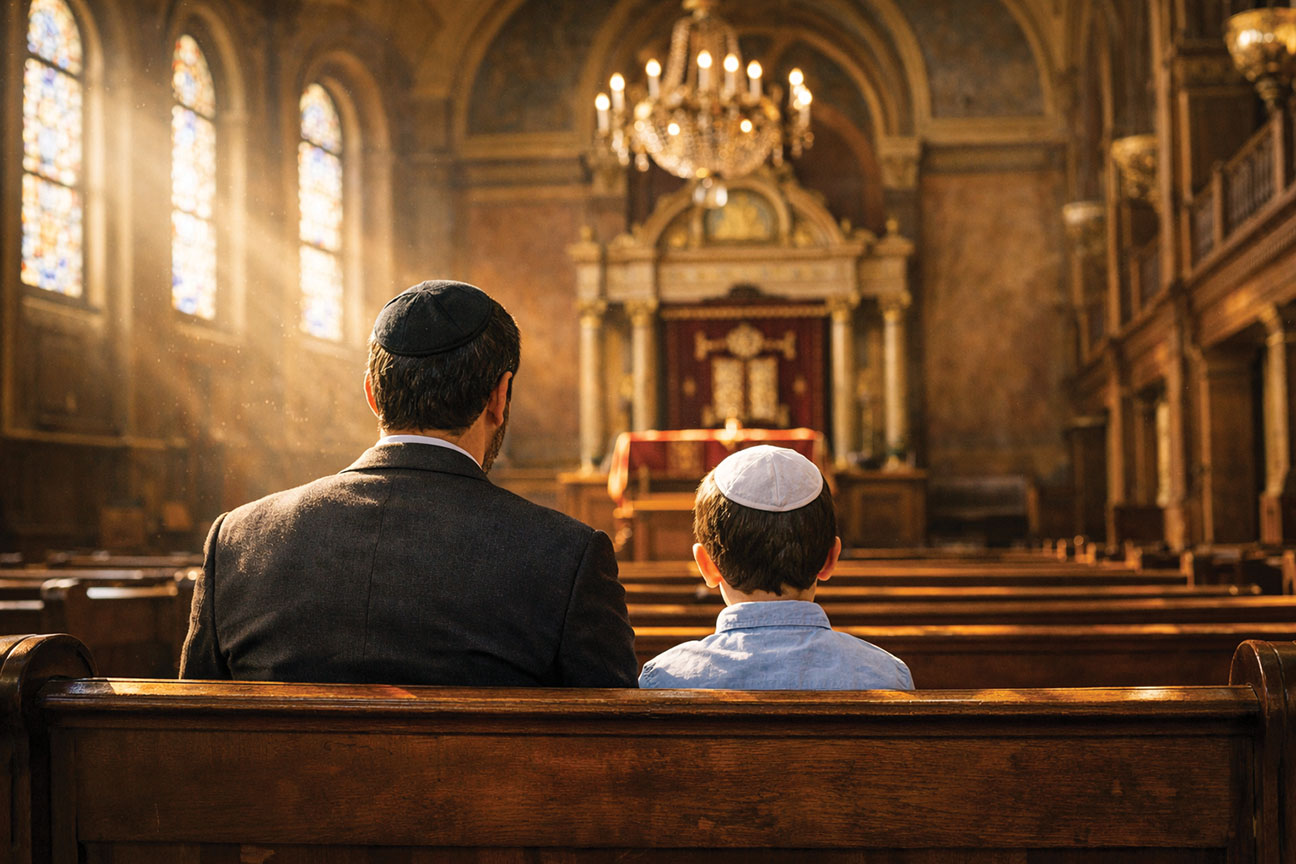
My son sat quietly in a pew beneath the chandelier at Philadelphia’s Congregation Mikveh Israel, his feet barely touching the floor. He is young — still at the age when much of the world arrives as a series of questions — and he studied the room with the focused attention of a child trying to make sense of something he knows matters.
Before him stood the raised platform from which the Torah is read, surrounded by pews arranged in the older Sephardic style, the room designed not for spectators but for a community gathered around the Torah.
Visiting this congregation was entirely accidental. We were walking from the U.S. Mint to the National Museum of American Jewish History along Independence Mall when I saw the sign: “Synagogue of the American Revolution.” I had visited the congregation as a child, brought there by my own family, and I knew its remarkable history. The building was open, and standing there with my son on that Philadelphia sidewalk, the decision took about 10 seconds. We had a moment, so why not show him, too?
What followed is something I suspect I will carry with me for a long time.
Upon entering, the sanctuary immediately signals that this is not the typical Eastern European-influenced synagogue. Mikveh Israel traces its roots to the Sephardic Jewish community of colonial Philadelphia, and the architecture reflects that heritage. The reading platform stands at the center of the room rather than at the front, placing the Torah physically among the people. Worship unfolds not as a performance directed at an audience but as something shared within the community itself.
Institutions like this remind visitors that Jewish life in America did not begin yesterday. Long before modern debates about identity and affiliation, small Jewish communities were already building durable institutions in the young republic. Members of Mikveh Israel counted among their number figures such as Haym Salomon, whose support for the American cause became part of the congregation’s legacy. The synagogue’s story is not only a chapter in Jewish history but also a thread woven into the broader fabric of the American experiment in religious freedom.
Near the platform sat a chair decorated with raised hands forming the distinctive gesture used during the priestly blessing. My son recognized it immediately. He pointed directly at the carving and looked into my eyes.
For most Jews, that symbol represents a ritual they observe. For us, it represents something else.
We are Kohanim, members of the Jewish priestly class. And a few months ago, during Rosh Hashanah services, my son had asked me to give the priestly blessing for the first time in more than 20 years. He tucked himself beneath my tallit, his small hands stretched forward beside mine, and together we offered the ancient words to the congregation. It had been his idea.
The blessing recorded in the Book of Numbers — “May the Lord bless you and keep you; may the Lord make His face shine upon you” — has been spoken by priests for generations beyond counting and remains one of the most enduring moments in Jewish worship. Yet I had quietly set it aside for decades, letting the practice recede into memory.
It was my son’s request that called me back to it. The transmission, in that moment, ran not from parent to child but in the other direction. He gave it to me.
Standing before that chair, the carved hands no longer felt like a symbol of heritage in the abstract. They felt like a direct echo of what had just happened between us. As we continued through the building, another surprise awaited me. On a wall outside the sanctuary sat a portrait of Rabbi Joshua Toledano on an easel. He had been my teacher in high school.
Rabbi Toledano taught me Talmud — not as a body of answers to memorize but as a discipline of questioning: learning to hold complexity without collapsing it, learning to listen carefully to voices in argument across centuries. That formation shaped how I read the world. Seeing his portrait there, in a synagogue tied so deeply to American Jewish history, collapsed time in an unexpected way.
I stood there for a moment explaining to my son who he was: a teacher who had taught me to ask hard questions and to listen, and who was now, in some sense, present in that room with both of us. The chain suddenly became visible. A teacher who shaped how I question and listen.
A student standing in one of the country’s oldest congregations. And beside him a son who questions everything, trying to make sense of a complicated world, and who had recently pulled his father back into a practice he had allowed to fade.
Jewish continuity is often discussed today through demographic reports and communal strategy sessions. We debate affiliation rates, synagogue membership and institutional decline. Those concerns are real. But standing there beside my son, the mechanisms through which tradition actually survives looked both simpler and more demanding.
It survives only where institutions, teachers and families accept the responsibility of transmitting something real. And it does not always move in one direction. Sometimes the child is the one doing the transmitting.
None of this is a coincidence. Since Oct. 7, 2023, my son has been different. He has been more serious about his Jewish identity, more deliberate in his practice. I tried to shield him from everything that followed Oct. 7, but there was only so much I could do. He has seen the hatred on the walls of this city. He knows.
And perhaps that is part of why he stands a little straighter in places like this one, in rooms that have endured.
When we stepped outside, my son walked ahead of me across the brick courtyard. He had more questions about the portrait, about the chair, about what it means to be a Kohen. I spent the remainder of the day trying my best to engage with him on everything. Behind us stood one of the oldest Jewish congregations in America. Before us stretched the ordinary movement of Philadelphia.
Between memory and motion lies the work every tradition must perform. Sometimes a father leads his son. Sometimes a son calls his father home. Jewish tradition has a name for that work. Not simply inheritance, but obligation: L’dor v’dor, from generation to generation.
Samuel J. Abrams is a professor of politics at Sarah Lawrence College, a senior fellow at the American Enterprise Institute and a scholar with the Sutherland Institute.