Humankind, according to the antisemite Eliot, can’t bear too much reality,
which surely is the reason why it focuses
on inanities, whose hocus-pocuses
sometimes attempt to banish it as a black holed banality.
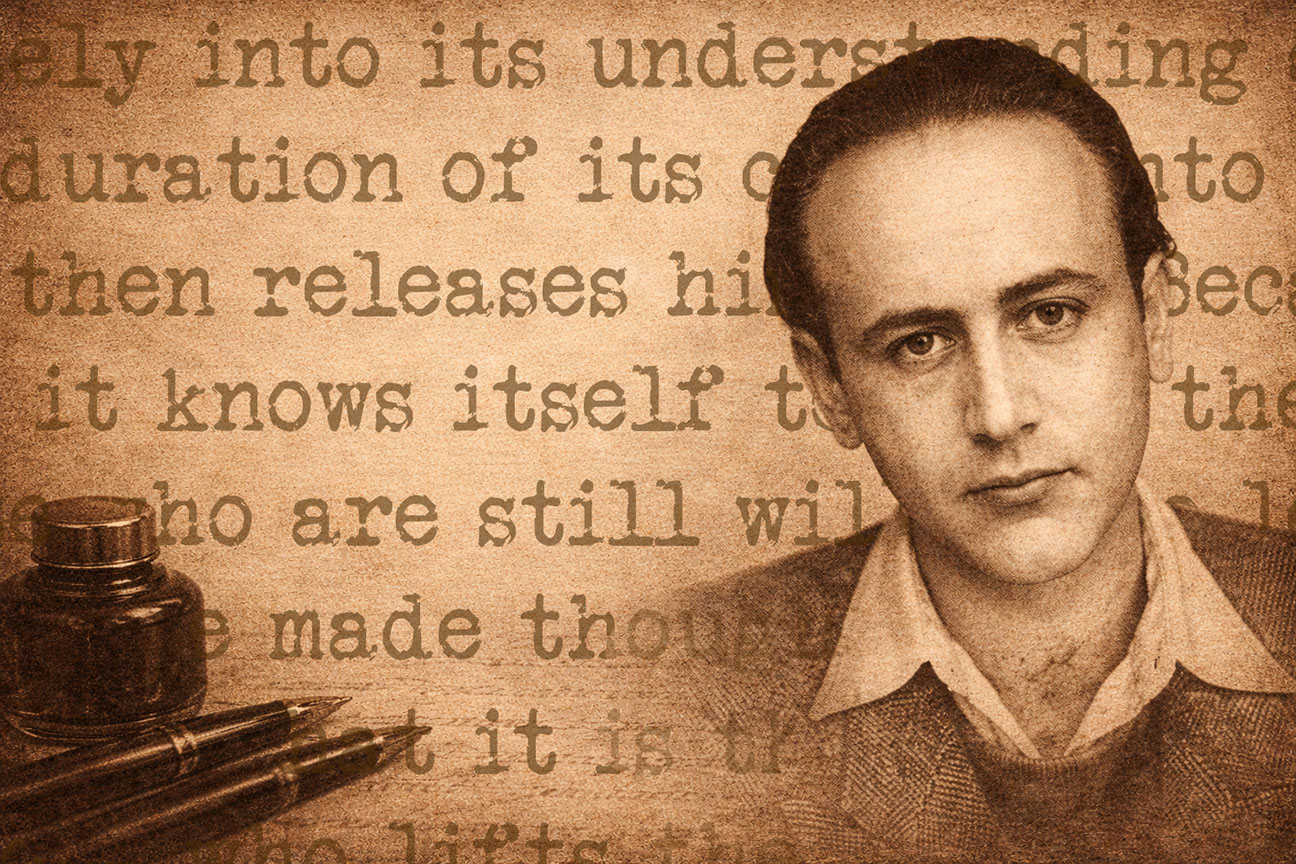
Paul Celan expressed this by implying that life is a poem,
shrunk into nothingness, just like the German word Gedicht
reduced by means of Lurianic tsimtsum to Genicht,
an irreality neologized to nothing as a noem.
Concept conceived by a creative kabbalistic curia,
tsimtsum’s program is enlightenment, the goal
of creativity a metaphor, black hole
the artistic product paradoxically proposed by Isaac Luria.
I wonder whether the Ari’s great kabbalistic concept, Isaac Luria’s
tsimstum, explains the irreality that made Celan poetically curious,
and one that’s far more suppositious, specious and spurious —
antisemitism — although unlike tstimtsum’s black hole, spitefully injurious.
In “The man who wrote poetry after Auschwitz: Paul Celan 100 years on,” TLS, 11/20/20, Mark Glanville writes:
“Humankind cannot bear very much reality”, wrote T. S. Eliot. By the time he gave his Meridian Speech, Celan envisioned his poems not so much as searches for reality but “blueprints for being”. Poetry had become an existential rather than an epistemological endeavour. Celan wrote that he was “an I clarifying itself in the process of writing”. But poetry had to be “antibiographical”. “The poem,” wrote Celan (quoted in Microliths), “takes even its author completely into its understanding only for the duration of its coming into being – and then releases him too … Because of this it knows itself to be on the way to those who are still willing to let themselves be made thoughtful. Is it a surprise that it is thus, given that even the one who lifts the poem into the visible is tolerated as ‘confidant’ only as long as the poem is in the process of becoming?” The poet, by this almost mystical interpretation, is no more than the medium for his verse, a notion that would have been appreciated by the surrealist school of André Breton and their practice of “écriture automatique”, which informed some of Celan’s earlier verse. Arguably, he has come full circle. “The poem”, though, “shows, unmistakably, a strong tendency to fall silent”, wrote Celan, implying an ultimate silence which language, with “shape and direction and breath”, survives. On the day he drowned himself in the River Seine, Celan left a biography of Hölderlin open on his desk, a sentence underscored: “Sometimes this genius goes dark and sinks down into the well of the heart”…..
In “Triangles of Life: Franz Rosenzweig started his most provocative work of philosophy in the trenches of World War ,” WSJ, 3/6/26, Benjamin Balint, reviewing Love Is Strong as Death: A Biography of Franz Rosenzweig by Paul Mendes-Flohr, writes:
In 1918, from the trenches on the Macedonian front, a 31-year-old German artilleryman sent his mother postcards covered in fragments of a philosophical system. From these narrow scraps grew “The Star of Redemption,” an audacious 1921 book conceived under fire that asks what remains of love—both human and divine—after war has marched a continent into the mud.
Here Mendes-Flohr shows how Rosenzweig’s story condenses a larger drama: the brief renaissance of German Jewry in the final, doomed years of the Weimar Republic (1919-33), with its ambitions and anxieties articulated in one brilliant man, acutely aware of his own finitude.
Gershon Hepner is a poet who has written over 25,000 poems on subjects ranging from music to literature, politics to Torah. He grew up in England and moved to Los Angeles in 1976. Using his varied interests and experiences, he has authored dozens of papers in medical and academic journals, and authored “Legal Friction: Law, Narrative, and Identity Politics in Biblical Israel.” He can be reached at gershonhepner@gmail.com.