As attorney Doreen Benyamin prepared to walk into the offices of California state legislators on Tuesday afternoon, she felt nervous. Just hours earlier, she and hundreds of other attendees at Jewish California’s Capitol Summit had sat through a crash course in lobbying, learning how to make a meaningful impression during brief meetings with elected officials. Now it was time to put those lessons into practice.
Joined by a group of fellow conference attendees led by Temple Beth Hillel Senior Rabbi Sarah Hronsky, Benyamin walked from the Sheraton Hotel in downtown Sacramento to the nearby state office buildings, where they would advocate for legislation concerning nonprofit security funding, protections for houses of worship and the inclusion of “Jewish” as both a religion and ethnicity in California data collection systems.
Like many of the approximately 700 people who attended this year’s Capitol Summit from May 11-12, Benyamin had traveled to Sacramento because she believed Jewish communities in California could no longer afford to remain passive observers in civic life.
“It’s really nice to be around other people who care and are actually doing something about the things they care about,” Benyamin said afterward.
That spirit of organized Jewish political engagement defined this year’s summit, an annual gathering hosted by Jewish California, the statewide coalition formerly known as the Jewish Public Affairs Committee of California. Over two days, Jewish communal leaders, elected officials, rabbis, activists and young professionals gathered in Sacramento not only to discuss rising antisemitism and growing communal anxieties, but also to sharpen their advocacy skills and strengthen relationships with lawmakers shaping policy in the state Capitol.
Jewish California describes itself as “our community’s voice in Sacramento.” Its 43 member organizations include Jewish Federation Los Angeles, the Anti-Defamation League, American Jewish Committee, Holocaust Museum LA, HIAS and Jewish Federation of the Greater San Gabriel and Pomona Valleys.
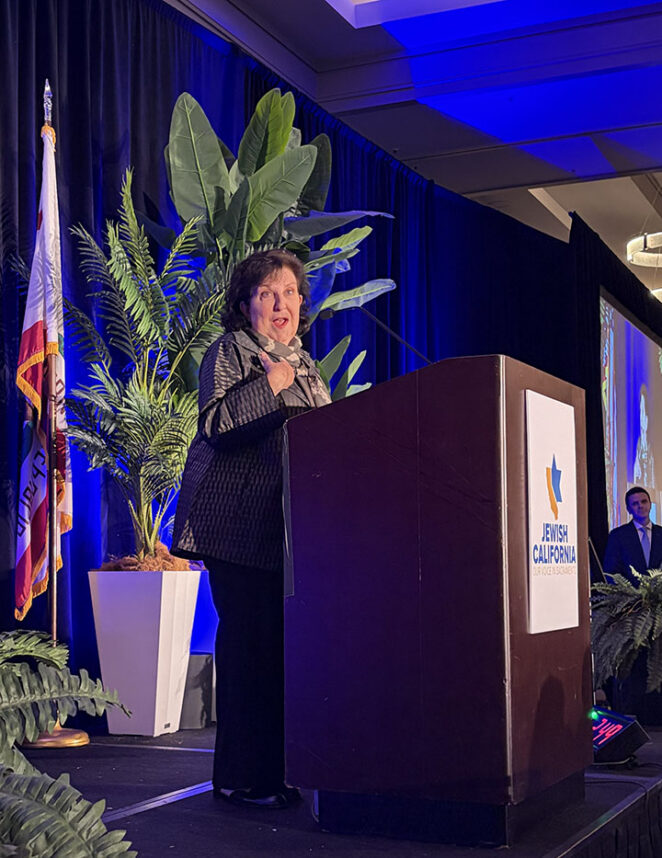
The summit opened Monday morning with remarks from Valley Beth Shalom Senior Rabbi Nolan Lebovitz, whose congregation is currently the only synagogue that belongs to Jewish California. Speaking before a packed ballroom at the Sheraton, Lebovitz urged more congregations to become engaged in statewide advocacy efforts.
“Our synagogue communities should be invested in the future of California,” he said.
That call for engagement echoed throughout the conference.
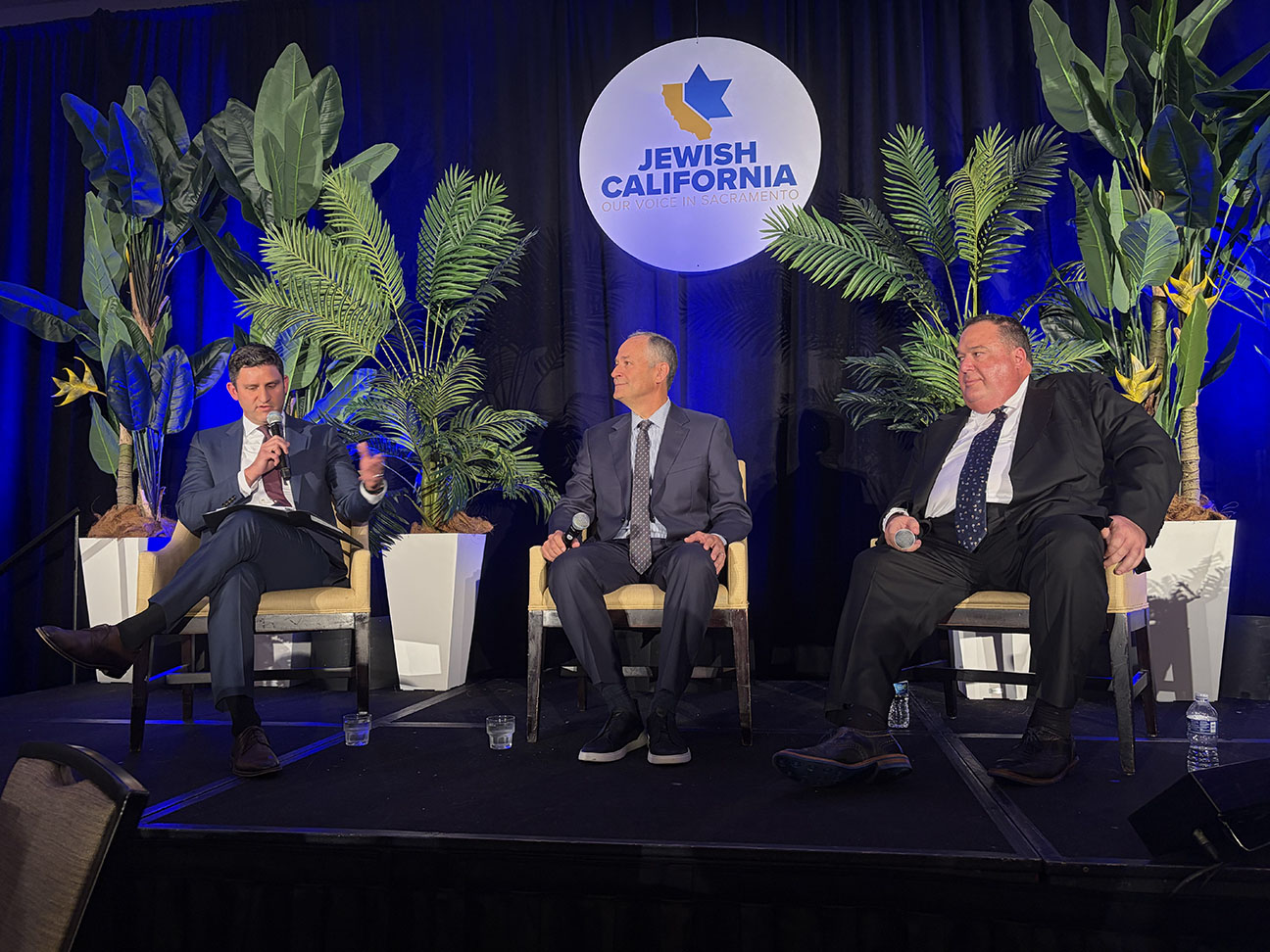
Former Second Gentleman of the U.S. Doug Emhoff, appearing in conversation with State Assemblymember Jesse Gabriel, reflected on his experience serving in the White House during a period of rising antisemitism across the country. He spoke emotionally about encounters with Jewish students who felt increasingly isolated in schools and public spaces.
“I was talking to a lot of Jewish kids who were feeling so beaten up and othered,” Emhoff said.
He drew applause after remarking, “Why a teacher would be talking to a fourth grader in math class about what’s happening in Gaza is beyond me.”
Gabriel also pressed Emhoff on whether former Vice President Kamala Harris might pursue another presidential campaign in 2028. Emhoff declined to offer specifics but acknowledged that Harris was “thinking seriously about it.”
Another major speaker, Los Angeles County District Attorney Nathan Hochman, focused his remarks on antisemitism’s growing impact on the legal system. He criticized recent developments in the case involving the 2023 killing of Paul Kessler, a 69-year-old Jewish man who died after being struck during dueling pro-Israel and anti-Israel demonstrations in Southern California. Hochman denounced the possibility that the perpetrator could avoid prison time after pleading guilty to involuntary manslaughter.
Yet while much of the summit centered on antisemitism and security concerns, organizers repeatedly emphasized that political advocacy requires more than outrage. It requires relationships.
During a “Lobbying 101” session Tuesday morning, Jewish California lobbyist Cliff Berg urged attendees to approach legislators not as adversaries, but as long-term partners.
“This is not about winning an argument,” Berg told attendees. “This is about educating and building a relationship.”
The summit’s structure reflected that philosophy. Alongside plenaries and panel discussions, attendees spent hours networking with Jewish leaders from across the state and meeting directly with elected officials. Monday evening’s banquet dinner drew more than 40 statewide officeholders, including State Senators Ben Allen and Henry Stern, both members of the California Legislative Jewish Caucus. Assemblymembers Dawn Addis and Rick Zbur were honored for their longstanding support of the Jewish community.
On Tuesday, Jewish Federation Los Angeles CEO Rabbi Noah Farkas moderated a conversation with Lieutenant Governor Eleni Kounalakis, who highlighted her record combating antisemitism and supporting Jewish communities. At one point during the discussion, an attendee quietly remarked, “Gosh, why isn’t she running for governor.”
But the summit’s emotional center remained the lobbying itself: ordinary Californians leaving hotel conference rooms behind to walk directly into the offices where state policy is shaped.
Benyamin, a member of Jewish Federation Los Angeles’ New Leaders Project (NLP), joined roughly 20 other young Jewish professionals from NLP who attended the summit together. During meetings with state senators and assembly members, attendees shared personal stories about why they had traveled from communities across California to advocate for Jewish concerns.
Rather than confrontational exchanges, the meetings were conversational and collaborative — exactly as organizers had hoped.
As the summit concluded Tuesday afternoon, the Sheraton lobby filled with attendees hauling luggage toward waiting Ubers and airport shuttles. Nearby, Jewish California CEO David Bocarsly finally allowed himself a moment to relax, sipping a celebratory whiskey after months of planning the event.
For Bocarsly, the summit’s success was not measured simply by attendance numbers or high-profile speakers, but by the sight of hundreds of Jews from across California choosing to participate directly in civic life.
“Seeing so many people from across the state who are willing to step away from their obligations at home, their work, their family, their schooling obligations, to come up and raise their voice because they believe it’s so critical to have a unified Jewish voice in Sacramento, that to me is the most rewarding, gratifying thing I can ever imagine,” Bocarsly said. “This is how we make California a better place.”