fbpx

May 18, 2026

Jewish Californians Gather in Sacramento to Turn Concern into Action

As attorney Doreen Benyamin prepared to walk into the offices of California state legislators on Tuesday afternoon, she felt nervous. Just hours earlier, she and hundreds of other attendees at Jewish California’s Capitol Summit had sat through a crash course in lobbying, learning how to make a meaningful impression during brief meetings with elected officials. Now it was time to put those lessons into practice.

Joined by a group of fellow conference attendees led by Temple Beth Hillel Senior Rabbi Sarah Hronsky, Benyamin walked from the Sheraton Hotel in downtown Sacramento to the nearby state office buildings, where they would advocate for legislation concerning nonprofit security funding, protections for houses of worship and the inclusion of “Jewish” as both a religion and ethnicity in California data collection systems.

Like many of the approximately 700 people who attended this year’s Capitol Summit from May 11-12, Benyamin had traveled to Sacramento because she believed Jewish communities in California could no longer afford to remain passive observers in civic life.

“It’s really nice to be around other people who care and are actually doing something about the things they care about,” Benyamin said afterward.

That spirit of organized Jewish political engagement defined this year’s summit, an annual gathering hosted by Jewish California, the statewide coalition formerly known as the Jewish Public Affairs Committee of California. Over two days, Jewish communal leaders, elected officials, rabbis, activists and young professionals gathered in Sacramento not only to discuss rising antisemitism and growing communal anxieties, but also to sharpen their advocacy skills and strengthen relationships with lawmakers shaping policy in the state Capitol.

Jewish California describes itself as “our community’s voice in Sacramento.” Its 43 member organizations include Jewish Federation Los Angeles, the Anti-Defamation League, American Jewish Committee, Holocaust Museum LA, HIAS and Jewish Federation of the Greater San Gabriel and Pomona Valleys.

The summit opened Monday morning with remarks from Valley Beth Shalom Senior Rabbi Nolan Lebovitz, whose congregation is currently the only synagogue that belongs to Jewish California. Speaking before a packed ballroom at the Sheraton, Lebovitz urged more congregations to become engaged in statewide advocacy efforts.

“Our synagogue communities should be invested in the future of California,” he said.

That call for engagement echoed throughout the conference.

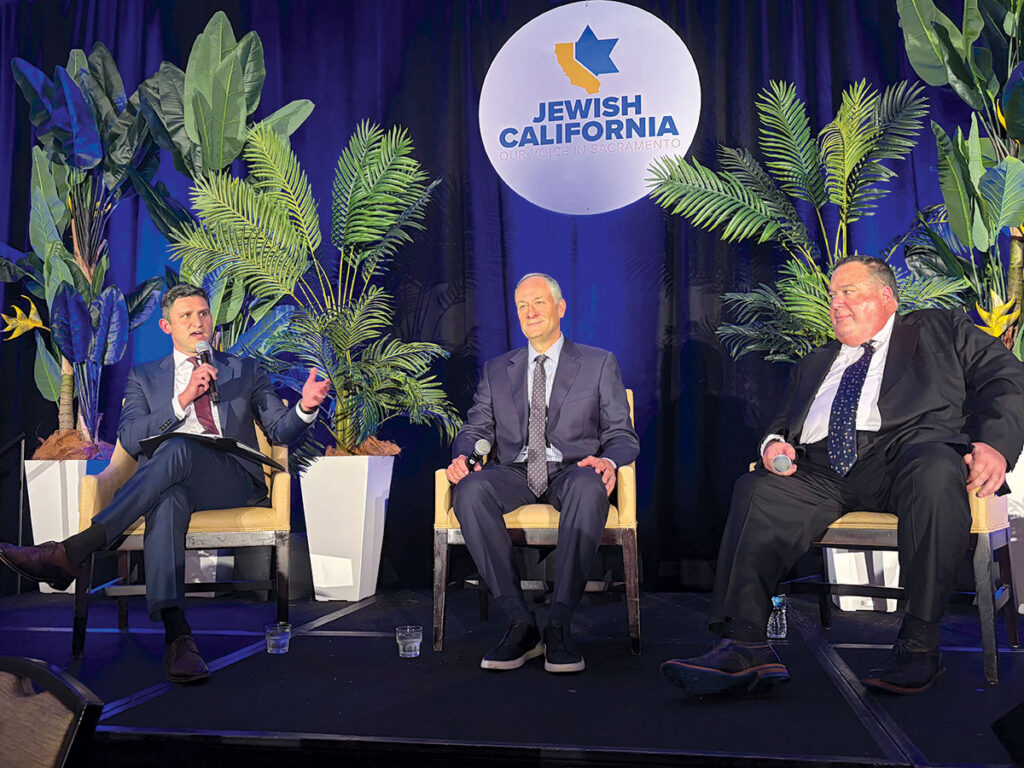
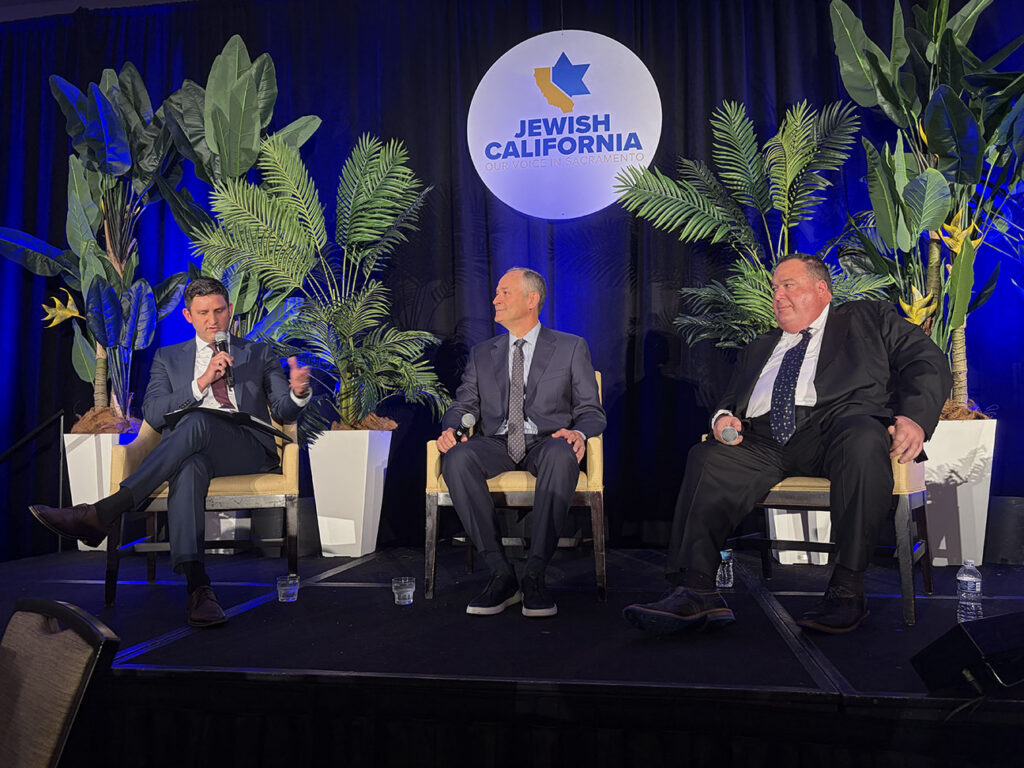
Former Second Gentleman of the U.S. Doug Emhoff, appearing in conversation with State Assemblymember Jesse Gabriel, reflected on his experience serving in the White House during a period of rising antisemitism across the country. He spoke emotionally about encounters with Jewish students who felt increasingly isolated in schools and public spaces.

“I was talking to a lot of Jewish kids who were feeling so beaten up and othered,” Emhoff said.

He drew applause after remarking, “Why a teacher would be talking to a fourth grader in math class about what’s happening in Gaza is beyond me.”

Gabriel also pressed Emhoff on whether former Vice President Kamala Harris might pursue another presidential campaign in 2028. Emhoff declined to offer specifics but acknowledged that Harris was “thinking seriously about it.”

Another major speaker, Los Angeles County District Attorney Nathan Hochman, focused his remarks on antisemitism’s growing impact on the legal system. He criticized recent developments in the case involving the 2023 killing of Paul Kessler, a 69-year-old Jewish man who died after being struck during dueling pro-Israel and anti-Israel demonstrations in Southern California. Hochman denounced the possibility that the perpetrator could avoid prison time after pleading guilty to involuntary manslaughter.

Yet while much of the summit centered on antisemitism and security concerns, organizers repeatedly emphasized that political advocacy requires more than outrage. It requires relationships.

During a “Lobbying 101” session Tuesday morning, Jewish California lobbyist Cliff Berg urged attendees to approach legislators not as adversaries, but as long-term partners.

“This is not about winning an argument,” Berg told attendees. “This is about educating and building a relationship.”

The summit’s structure reflected that philosophy. Alongside plenaries and panel discussions, attendees spent hours networking with Jewish leaders from across the state and meeting directly with elected officials. Monday evening’s banquet dinner drew more than 40 statewide officeholders, including State Senators Ben Allen and Henry Stern, both members of the California Legislative Jewish Caucus. Assemblymembers Dawn Addis and Rick Zbur were honored for their longstanding support of the Jewish community.

On Tuesday, Jewish Federation Los Angeles CEO Rabbi Noah Farkas moderated a conversation with Lieutenant Governor Eleni Kounalakis, who highlighted her record combating antisemitism and supporting Jewish communities. At one point during the discussion, an attendee quietly remarked, “Gosh, why isn’t she running for governor.”
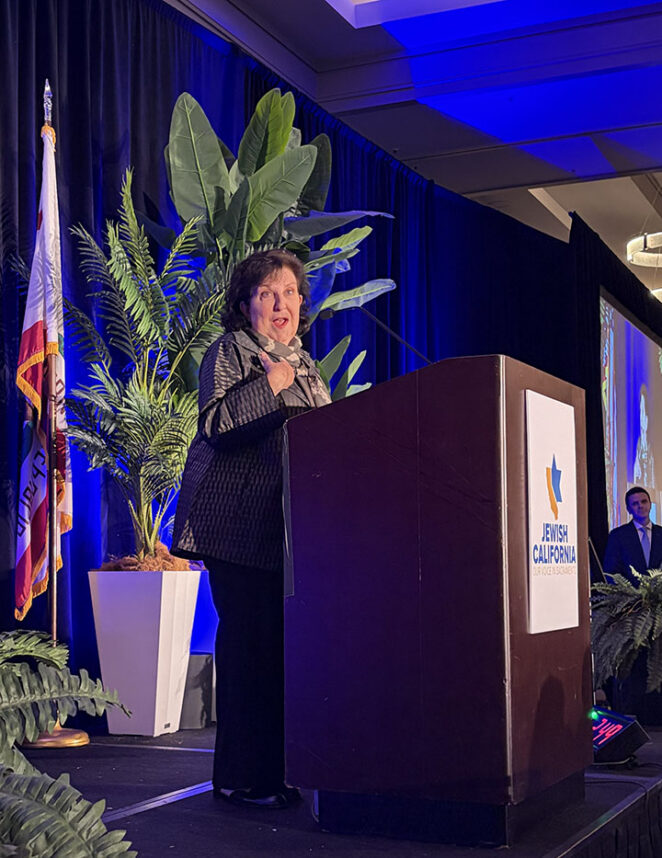
Anita Friedman, executive director of Jewish Family and Children’s Services of San Francisco, Peninsula, Marin and Sonoma Counties, accepts the Earl Raab Award for community activism and advocacy at Jewish California’s Capitol Summit. Photo by Ryan Torok

But the summit’s emotional center remained the lobbying itself: ordinary Californians leaving hotel conference rooms behind to walk directly into the offices where state policy is shaped.

Benyamin, a member of Jewish Federation Los Angeles’ New Leaders Project (NLP), joined roughly 20 other young Jewish professionals from NLP who attended the summit together. During meetings with state senators and assembly members, attendees shared personal stories about why they had traveled from communities across California to advocate for Jewish concerns.

Rather than confrontational exchanges, the meetings were conversational and collaborative — exactly as organizers had hoped.

As the summit concluded Tuesday afternoon, the Sheraton lobby filled with attendees hauling luggage toward waiting Ubers and airport shuttles. Nearby, Jewish California CEO David Bocarsly finally allowed himself a moment to relax, sipping a celebratory whiskey after months of planning the event.

For Bocarsly, the summit’s success was not measured simply by attendance numbers or high-profile speakers, but by the sight of hundreds of Jews from across California choosing to participate directly in civic life.

“Seeing so many people from across the state who are willing to step away from their obligations at home, their work, their family, their schooling obligations, to come up and raise their voice because they believe it’s so critical to have a unified Jewish voice in Sacramento, that to me is the most rewarding, gratifying thing I can ever imagine,” Bocarsly said. “This is how we make California a better place.”

Jewish Californians Gather in Sacramento to Turn Concern into Action Read More »
Rabbis of LA | Rabbi Aaron Wants to Bathe You in Sound

On the first Shabbat of every month, members of Temple Emanuel of Beverly Hills dive into a sound bath.  Rabbi Jonathan Aaron, a 30-year veteran of the community, explained: “The word ‘bath’ makes people feel as if they are going to take a bath,” he said. “But it’s more like they are bathed in sound. The sound completely fills the room. You lie back and allow yourself to bathe in sound. There’s no water. It’s dry – unless you bring water to drink.”

Rabbi Aaron’s interest in sound baths was sparked by his family. Shortly after the pandemic, the rabbi and his family – his wife and two daughters – became regulars at a Venice Boulevard yoga studio. His daughters and his wife, a yoga instructor, were daily regulars. One daughter obtained her instructor’s license in Thailand, and the other is a sound bath specialist.

“What’s interesting to me,” said the rabbi, “is that when I look at my daughters, in their 20s, and other younger people – I ask, ‘what are they looking for? Why aren’t they coming into synagogues?’ What’s funny was, the impetus for doing a sound bath: A lot of people are exploring mindfulness. Many are exploring meditation.”

He described what it felt like when he first experienced a sound bath. “It was late on a Wednesday night, at 9 o’clock,” the Boston native who became senior rabbi in 2016 told The Journal. “This was after the pandemic. My daughter said ‘Hey, let’s do this sound bath. I hear the woman is fantastic.’”

Something clicked; the Aaron family participated every week for a year. “We would go to a sound bath for an hour or 90 minutes,” the rabbi said. A Japanese woman led the exercises, and occasionally she sang. “When we were done,” he said, “there was this incredible, peaceful feeling.” But it was not a straight line. “Sometimes we would have a very agitated feeling because it’s not always comfortable. Sometimes it makes your body vibrate a little bit. It works on the beta waves in your head.”

Memories from those early experiences remain fresh in Rabbi Aaron’s mind. “What it does is bring a calming presence through the sound into your mind,” he said. “I will say there are times when my mind wanders like crazy.  Other times, I am able to concentrate.

“What I learned about meditation is, I am sure if I said to you ‘You should try meditation,’ you would say ‘OMG, my mind is working too much.’ Those are the minds that need meditation because it’s the muscle that you strengthen that allows your mind to wander.

“We all know our minds are going to wander,” Rabbi Aaron said. “Our minds are going to start thinking about the troubles we are having, everything going on in the world that is so difficult to deal with now. The meditation is ‘I’ve got to bring this back because I am just concentrating on the sound right now.’ Or, ‘I am just concentrating on my breath right now.’”

Asked if he experiences this differently from his daughters, the rabbi replied with a flat “no.” When he meditates, “It’s mindfulness meditation, which is only concentrating and noticing my breath,” he said. “I don’t have a mantra. Personally, I don’t like directed meditation as much. I like it when it’s ‘Just think about your breath.’

He suggests you try it for one minute. “In 20 seconds, your mind will go away, and then you’ll say ‘all I am doing now is concentrating on my breath. I’ll get to the problems of the world.’”

Does Rabbi Aaron exercise alone? Is there an ideal time of day? “When I personally meditate, I try to find a set time of the day when I can do it,” he said. “If I am not able to do it at the set time, when I get home, I will sit quietly, alone, for 20 minutes.”

During the pandemic, he led online meditation for his community four days a week. Eventually it became a regular event on Temple Emanuel’s schedule.

Rabbi Aaron led it for about two and a half years. “It’s hard to get back to it,” he remembered. “It would be for a half-hour. I would start with five to seven minutes of a D’var Torah or some kind of spiritual teaching. Next we would go quiet for 20 minutes. And then I would bring us back and finish.”

Rabbi Aaron’s instructions were perfectly clear: “Close your eyes and concentrate on your breath. Notice your breath. It’s ‘how’s my stomach lifting? What is the feeling in my neck? Is my heart beating harder? What does my breath feel like?’ And then I think, ‘I told my daughter I was going to call her. I’m just concentrating on my breath right now. I have a meeting at 3 o’clock, and I have to get there on time.

“I shouldn’t be thinking about those things now. I have to be concentrating on my breath. How am I going to go to that meeting? Your mind is going – ‘hold on. You’re just doing this for 20 minutes. Concentrate on your breath.’

“That is the exercise,” the rabbi said. “It’s not that you are bad if your mind wanders. It will wander. It’s the ability to bring it back for just a moment.

“Twenty minutes can seem like a long time. It is. During that span, there might be a few as 15, 20, 30 seconds when you are actually concentrating in that way. There might be other times where it’s almost the whole 20 minutes. That is the way a mind spins.”

“Close your eyes, and that’s it,” said Rabbi Aaron. 

Fast Takes with Rabbi Aaron

Jewish Journal: What is your favorite form of relaxation?

Rabbi Aaron: Golf.

J.J.: Your favorite Shabbat moment?

R.A.: When we are at home sitting around singing.

J.J.: Do you have an unfulfilled wish?

R.A.: I can’t say I do.

Rabbis of LA | Rabbi Aaron Wants to Bathe You in Sound Read More »

Rabbis of LA | How Rabbi Artson Fell in Love with God

American Jewish University’s Rabbi Artson, who will become the school’s Mordecai Kaplan Distinguished Scholar on July 1, is a man of strong opinions, but he also knows when to sit back and listen. The dean of AJU’s Ziegler School of Rabbinic Studies for a quarter-century thinks these traits are why he has been a good counselor, why he can help people: “Here is what you want. Let’s think about how to get there.”

Rabbi Artson says “getting there” doesn’t mean expressing every thought you have, every emotion you have. “It has to be more thoughtful than that. I always have been good at that. But I want to correct something: I have very strong passions. I don’t feel moderately about many things. My politics are centrist, but I am passionate about it. And just about everything I have an opinion about, I have a curmudgeonly and strong opinion about.” But has learned to “control that manifestation,” he said. “I am very political. I don’t mean duplicitous. I think about how best to move something toward a goal.”

He took something of a circuitous route the rabbinate. His mother – whose praises Rabbi Artson repeatedly sang – is an atheist, as he was in the early part of his life. “I came to Judaism around the same time Elana and I met and married,” he said. “I was in college (at Harvard). I had two roommates who were Christian. They were, and they are, good people. While I knew I couldn’t believe what they believed, I wanted to think about it. So I went to the Hillel rabbi, and he said ‘There’s no neutral way to think about God. You have to try it and see if it works for you.’”

The Hillel rabbi convinced Artson to attend services every Shabbat for two months. Less than that, he told the young Artson, and you are just going to be trying to figure out what the melodies are and when you stand and sit.

Artson remembers the moment precisely. “The Hillel rabbi gave me a book to read by Franz Rosenzweig, a German Jewish existentialist thinker around the time of Martin Buber, who also came back to traditional Judaism as an adult. I fell in love with Judaism. I fell in love with God. Unlike some people who grow up more traditionally, God was the first, and because I loved God I had to love Torah, and then I had to love the Jewish people. That was the order it came in. God, for me, still is the linchpin.”

Would the Bradley Artson of 1983 recognize the Rabbi Artson of today? His response was intriguing. “I wrote a credo in rabbinical school in 1985 because I realized the world would try to make me back away from my convictions,” he said. To make sure the credo would remain part of his record, “I glued it – I still do – inside my prayerbook. Every morning I read these paragraphs of my credo from 1985.”

Rabbi Artson’s Credo

“The two core assertions of traditional Judaism, assertions which I cannot prove but upon which I stake my life:

“The first axiom is that God is loving, compassionate, wise and passionate about justice. The second is that the Torah and rabbinic tradition are the preeminent vehicle for Jews to articulate a sense of God’s will and to concretize that will in our daily lives and our social structure.

“I refuse to read Halakhah or the Torah in such a way that it makes God seem cruel, nor will I sever the intimate connection between God’s will and God’s Torah.

“God is just, and Halakhah embodies God’s love and justice. From these two points, an agenda of ritual profundity, compassion and social justice emerges organically and traditionally.”

“What’s interesting to me,” he said, “is that I still believe this. This is still the essence of who I am. I use this to make sure that I am true to myself because the pressure of the world tries to push you away from your own center. Why? Because we are all terrified of people being different from us. We don’t tolerate it well.”

He also points to an annual ritual. “In teaching my rabbinical students, one exercise we do in the senior year class is that I have them write their own credo,” he said. “I teach them mine. Then I say ‘Yours doesn’t have to be anything like mine. It has to reflect you. I need you to have one so when you are out in the world, and you forget who you are, you can hold it up, look at it and remember.’ I think that is crucial.”

When he was younger, the San Francisco native said, “I taught more frontally. I teach more dialogically now. It’s more a conversation … I invite the students to discover the truth they already have, in part because I don’t believe in a coercive God. I believe in a God whose power is the power of relationship, the God who invites us to know what we already have. My teaching is much more along those lines, too. I believe everyone intuits what their optimal next step is, and the job of the teacher is to give that back to them.”

Asked if today’s students are different from those in 2000, Rabbi Artson said the student of 2000 was much more cookie-cutter. “They had gone to Jewish summer camp, they went to day school, they had done all the things you think rabbis do. Those students are gone. My students now spend time in an ashram. They chef in a restaurant. They taught fine arts at a college. Everything – except for that predictable rabbi path.”

Who has changed more over a quarter-century, the rabbi or the students? “Hopefully both,” the rabbi replied. “The great joy of teaching is twofold: I really love my students, and they do teach me more than anyone. I have the best Jewish job in the world because I meet young people who change me. They argue with me. They say you can’t think that.”

Rabbi Artson recalled two memorable students from his philosophy class. One wrote about colonial theory and the Jewish people. “He quoted a Tunisian Jewish thinker I never had heard of. After reading his philosophy paper, I bought a book by someone I never had heard of, and it opened a whole new world for me.”

Another student wrote about trans identity and Jewish thought. “She quoted a remarkable person who is a trans professor of English but who has written a book of Torah commentary,” the rabbi said. “It is one of the most brilliant books of Torah commentary, and it only could have come from someone who lived that life.

“My students are teaching me things that in a million years I never would think of by myself. I feel so lucky to have a job in which people come to you and say ‘I want to serve the Jewish people.’ How remarkable is that?”

Rabbis of LA | How Rabbi Artson Fell in Love with God Read More »

Emhoff at Jewish California Summit; Israel’s Birthday; New AFTAU Hire; Repair the World

Former Second Gentleman of the U.S. Doug Emhoff — the first Jewish spouse of a U.S. Vice President — recently shared how proud he is of being Jewish.

“I love being Jewish and I’m proud of being Jewish,” he said. “It’s still true and it will always be true. I think we need to feel that joy and that spirit, just that love of our culture and each other and embrace that… that’s my message.”

Emhoff made these comments as one of dozens of speakers at this year’s Jewish California Capitol Summit, held May 11-12 at the Sheraton Grand Hotel in Sacramento, where he was tasked with speaking about legislative and legal efforts to fight antisemitism, particularly on the state level.

He was appearing in conversation with State Assemblymember Jesse Gabriel (D-Encino) as well as attorney Alex Weingarten.

The 700 audience members in the hotel ballroom were perhaps most curious about whether Emhoff’s wife, former Vice President Kamala Harris, would be running again for the presidency in 2028, and Gabriel asked him straight out if this was a possibility. On this, Emhoff was intentionally vague. “She’s thinking about it — she’s thinking seriously about it,” Emhoff said.

Asked if he would ever consider running for office, he surprised some in the crowd when he said, “Maybe one day down the line I’ll throw my hat into something.”

Emhoff, among other topics, discussed how troubled he’s been by the rise of antisemitism. He denounced the recent attack at a synagogue in West Bloomfield, Michigan. “These kids are just trying to go to school and there was an attempt to harm them,” he said.

He also spoke about the efforts of the Biden-Harris administration to tackle Jew-hatred strategically and how much worse the problem has gotten in recent years.

Post-Oct. 7, he said, “we went from a problem of antisemitism to a crisis of antisemitism.”

Additional speakers at the two-day summit organized by Jewish California — formerly known as the Jewish Public Affairs Committee of California—included L.A. County District Attorney Nathan Hochman, Jewish California CEO David Bocarsly, Assemblymember Rick Chavez Zbur (D-Hollywood) and California Lieutenant Governor Eleni Kounalakis.


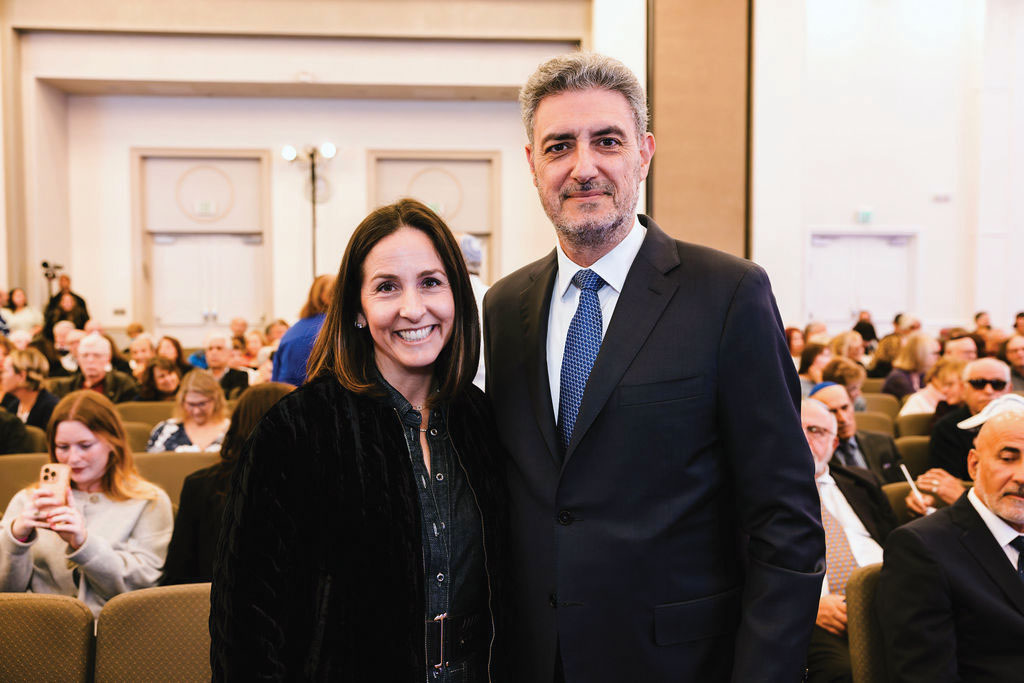
Jewish Federation Los Angeles Senior Vice President of Community Engagement Joanna Mendelson and Consul General of Israel in Los Angeles Israel Bachar. Photo by Kathy DeNinno Photography

On April 21, more than 600 people gathered at the Eretz Cultural Center in Tarzana to celebrate Israel’s Independence Day. Temple Ramat Zion Rabbi Ahud Sela, president of the Board of Rabbis of Southern California; Temple Judea Rabbi Cantor Alison Wissot; Zev Hurwitz, director of synagogue and rabbinic outreach at the Jewish Federation Los Angeles, and Rebecca Aghalarpour, executive director of the Eretz Cultural Center, organized the evening of song, dance and celebration.  Cantors and choirs from synagogues across the San Fernando Valley were featured along with the Keshet Chaim Dance Ensemble; ShinShinim; and Mia Mizrachi from de Toledo High School. Consul General of Israel in Los Angeles Israel Bachar and rabbis from across the San Fernando Valley were featured speakers.


American Friends of Tel Aviv University’s Shelley Medved. Courtesy of AFTAU

American Friends of Tel Aviv University (AFTAU) CEO Ben Pery has named Shelly Medved to the newly created role of integrated Chief Operating Officer and Chief Financial Officer.

Medved is a San Fernando Valley local. She brings over 14 years of nonprofit leadership experience and, as a Tel Aviv University MBA alumna, has a deep personal connection to the organization’s mission. She will be based out of AFTAU’s Los Angeles office.


Participants included Bianca Tomash (Black-Jewish Entertainment Alliance); Jacqueline Hantgan (Stephen Wise Temple); Amanda Berman (Zioness); Rabbi Yoshi Zweiback (Stephen Wise Temple) and Ethan Lipsitz (EXODUS).
Courtesy of Repair the World

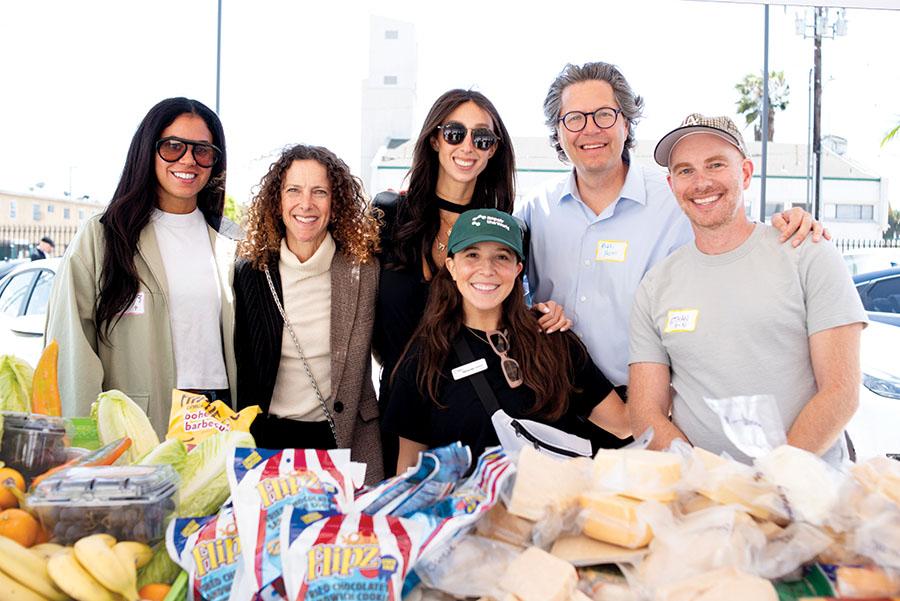
Repair the World Los Angeles recently partnered with Exodus Leadership, Pastor Michael JT Fisher, Stephen Wise Temple Rabbi Yoshi Zweiback, Zioness Movement, Greater Zion Church Family and the Black Jewish Entertainment Alliance for a day of service and connection in Compton. The April 26 gathering brought neighbors together across lines of difference, with more than 100 volunteers standing
side-by-side to make a meaningful impact in the community.

Through hands-on service, volunteers of all ages and backgrounds fostered meaningful connections. The joy of shared laughter, stories and impact was palpable throughout the day. This was the latest in a series of collaborative bridge-building service and learning opportunities that embody the organizations’ shared commitment to mutual service and solidarity. They are expected to partner again for the next volunteer opportunity in June, reconnecting in Pico-Robertson to make meals for those experiencing hardship. 

Emhoff at Jewish California Summit; Israel’s Birthday; New AFTAU Hire; Repair the World Read More »

Rachel Goldberg-Polin Speaks at L.A. Synagogues, Yom HaAtzmaut Program in Beverly Hills

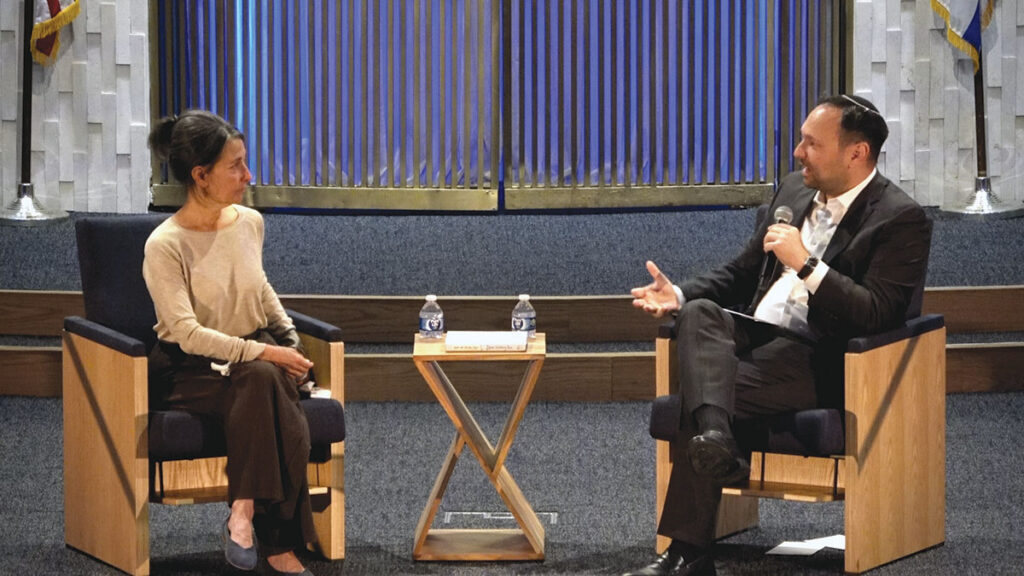
On April 30, Valley Beth Shalom welcomed 1,200 people to hear a conversation between Rabbi Nolan Lebovitz and Rachel Goldberg-Polin. She also appeared at Stephen Wise Temple, on May 3, where she appeared in conversation with Stephen Wise Temple Senior Rabbi Yoshi Zweiback.

Goldberg-Polin’s new book “When We See You Again”– a memoir of pain and strength detailing her experience following the abduction of her 23-year-old son, Hersh, by Hamas on Oct. 7, 2023, and his murder by the terrorist group 330 days later – topped the New York Times bestseller list the day before her VBS appearance. At the two San Fernando Valley synagogues, she talked about her journey through unthinkable tragedy and the process of carrying grief.


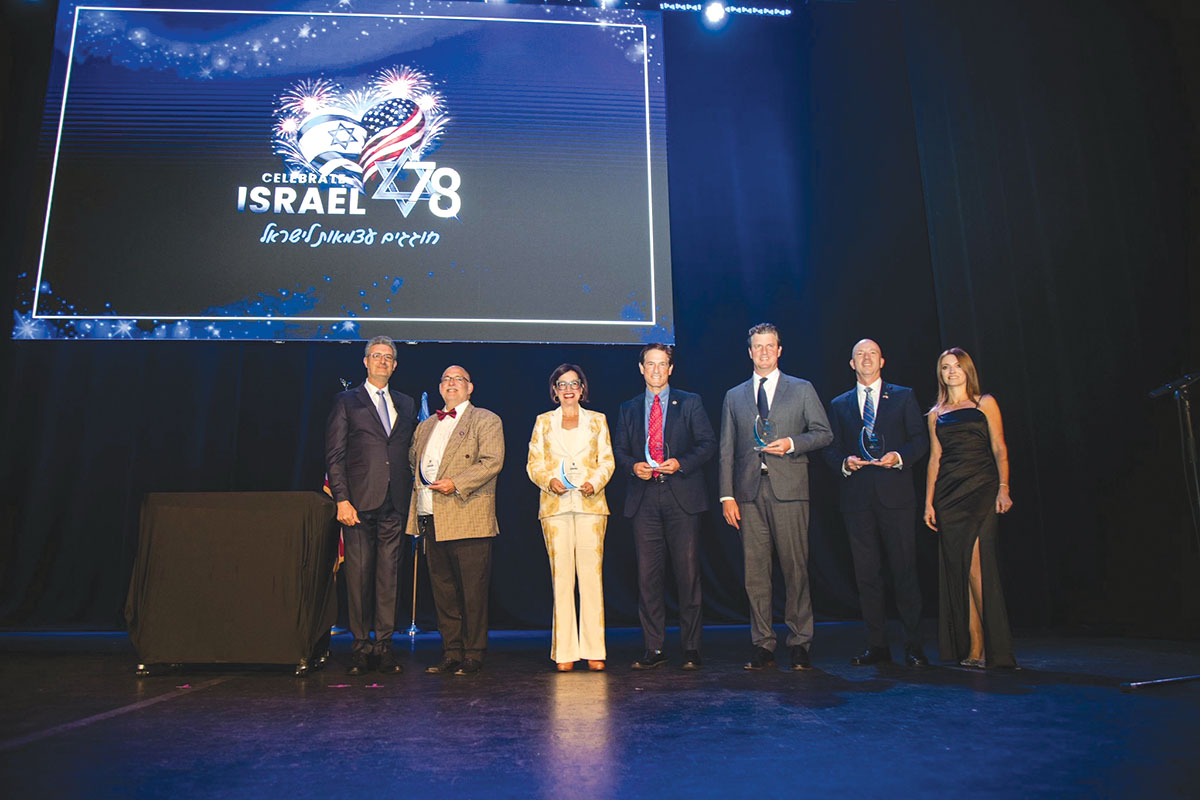
Community leaders and elected officials included: Consul General of Israel in Los Angeles Israel Bachar (first on left), L.A. County District Attorney Nathan Hochman (fourth from left) and State Senator Henry Stern (fifth from left) turn out in Beverly Hills to mark Israel’s Independence Day. Photo by Oded Sharoni

A packed, Israel-loving crowd filled the Saban Theatre on April 30 as the Consulate General of Israel to the Pacific Southwest held its annual celebration of Israel’s Independence Day, bringing together members of the Israeli and Jewish American communities, along with elected officials and diplomats, to mark 78 years since the founding of the State of Israel.

Security was visible at the entrance, with guests passing through metal detectors and a police presence outside the venue.

Actor and comedian Dan Ahdoot opened the evening, which included a lively dance performance by the Keshet Chaim Dance Ensemble and a set by Israeli singer Liraz Charhi, who also performed several songs in Farsi to the delight of many in the Iranian-American audience.

The program featured remarks from U.S. Reps. Juan Ciscomani (R-Ariz.), Brad Sherman (D-Sherman Oaks) and former Sephardi Chief Rabbi of Israel Yitzhak Yosef.

Consul General of Israel in Los Angeles Israel Bachar highlighted Israel’s position on the global stage, saying, “In just 78 years, Israel is now a regional superpower, standing together with the United States against the Iranian regime and its nuclear ambitions.”

Five officials were recognized for their contributions to U.S.-Israel relations over the past year, including Arizona State Representative David Livingston (R); outgoing Colorado State Senator Dafna Michaelson Jenet (D); California State Senator Henry Stern (D-Sherman Oaks); Los Angeles County District Attorney Nathan Hochman; and San Luis Obispo County District Attorney Dan Dow.

The evening also included a tribute to the U.S. and Israeli armed forces, with participation from active and retired Air Force personnel and pilots from both countries.

Several organizations partnered with the Israeli consulate to support the event, including the Saban Family Foundation, StandWithUs, Friends of the Israel Defense Forces, the Israeli-American Council and the Iranian American Jewish Federation.

StandWithUs CEO Roz Rothstein addressed the crowd, saying: “We stand with Israel knowing they have faced so many emotional and physical tests—and have not only survived, but continue to lead the world in happiness, innovation, and so much more…. Am Israel Chai.”

Attendees show their love and support for Israel by waving Israeli flags. Photo by Oded Sharoni

Rachel Goldberg-Polin Speaks at L.A. Synagogues, Yom HaAtzmaut Program in Beverly Hills Read More »

The Charles Bronfman Prize Announces CultivAid CEO Tomer Malchi as 2026 Laureate

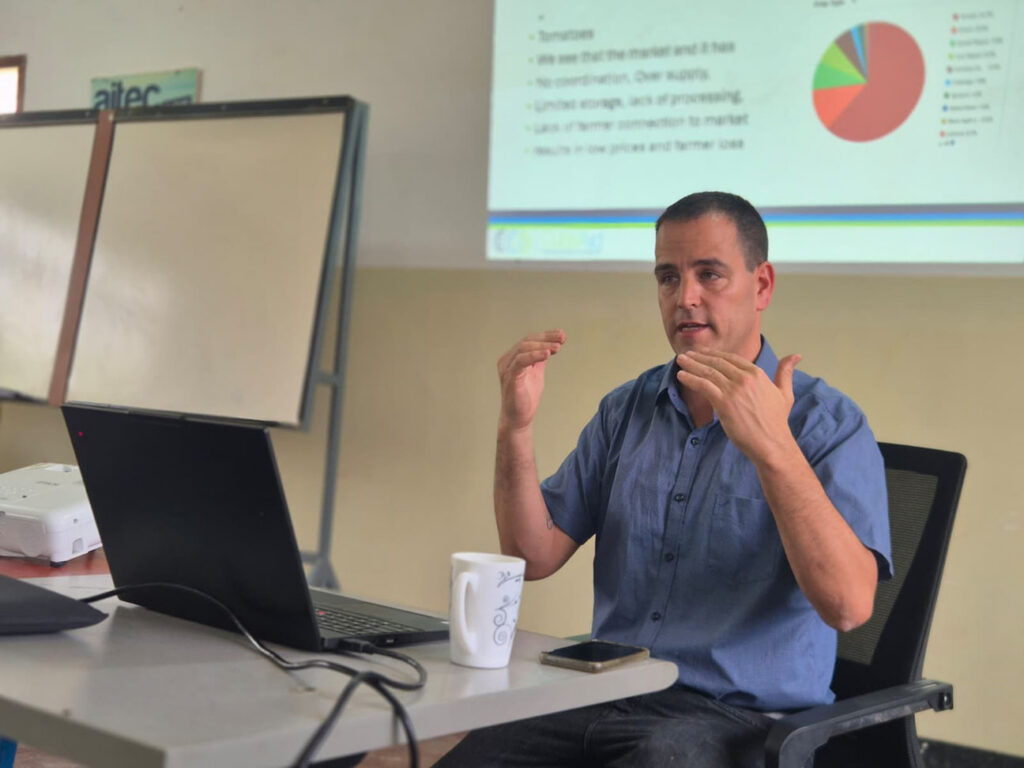
Dr. Tomer Malchi, Co-Founder and CEO of CultivAid, has been named the 2026 Prize Laureate of The Charles Bronfman Prize. The award, which comes with a $100,000 prize, recognizes visionary leaders whose work is rooted in Jewish values and delivers meaningful, measurable impact in the world.

In December, Malchi received a phone call from Charles Bronfman himself. He said he was both surprised and excited — he had submitted his application in August and made the finalist round, but still didn’t expect to win.

“The work that we’ve been doing is something that we put our heart into,” said Malchi. “And we do the work for the sake of the work. We don’t get a lot of press about our work, we don’t do a lot of media. So to get recognized, especially by someone like Charles Bronfman, it’s a huge honor for me and for the organization. It’s well deserved, I have to say.”

The Charles Bronfman Prize was founded in 2004 by Charles Bronfman’s children, Ellen Bronfman Hauptman and Stephen Bronfman along with their spouses Andrew Hauptman and Claudine Blondin Bronfman, to honor Charles on his 70th birthday, and it recognizes one Jewish humanitarian leader under 50 each year. Malchi’s selection was led by the newly appointed co-executive directors of the prize, Emily Kane Miller and Avital Ferd.

“The last few years have reminded us that we can’t control the world, but we can refuse to be diminished by it. We’re proud to steward a prize that celebrates the breadth and brilliance of Jewish leadership worldwide, particularly right now,” Kane Miller and Ferd said in a statement. “Tomer embodies everything this Prize stands for and is exactly the kind of laureate this moment calls for. We’re honored to have him as the first of our tenure.”

Born in Israel, Malchi was six years old when his family relocated to Monsey, New York. He earned a degree in Industrial Labor Relations from Cornell University before returning to Israel at 26, driven by a mission to tackle the interconnected crises of agriculture, water and nutrition on a global scale. He went on to earn his bachelor’s, master’s and PhD from the Faculty of Agriculture, Food and Environment at the Hebrew University of Jerusalem.

Since the age of 18, Malchi had been immersed in volunteerism and international development, guided by a foundational belief that sustainable development is built through systems, not projects. In 2013, he traveled to Ethiopia through Engineers Without Borders-Israel to help establish a sustainable farm. By 2016, he had co-founded CultivAid alongside Ben Cohen and Yair Keinan.

Today, CultivAid operates with a staff of nearly 100 across Tel Aviv, Tanzania, Kenya and Zambia, with an annual budget of approximately $3.5 million. Its model integrates research and development, farmer training and market-driven value chains into a single, self-sustaining system. For every $100,000 invested, CultivAid generates at least $500,000 in local revenue, and every farmer it works with sees yields increase more than fivefold.

“This honor validates CultivAid’s decade of work and empowers us to expand our model and unlock economic opportunity and sustainable food security for millions of people,” said Malchi.

This is only the beginning for Malchi and CultivAid. Now a father of two living near Tel Aviv, Malchi plans to put the $100,000 prize toward expanding CultivAid’s operations in Tanzania, Kenya and Zambia, a region home to 150 million people living in extreme poverty and a population expected to double by 2050 — continuing to strengthen the relationship between Israel and African countries.

For Malchi, the recognition is less a capstone than a catalyst. “If we have the ability to help others,” he said, “we have the responsibility to deliver.”

The Charles Bronfman Prize Announces CultivAid CEO Tomer Malchi as 2026 Laureate Read More »

Israeli Colleges and Universities Support Reservist Students in a Difficult Time

Since October 7, Israel has been in a prolonged war—first with Hamas, then Hezbollah, the Houthis, and now Iran. During this time, Israelis have suffered emotionally, physically, and mentally, especially those who were victims of terror attacks or fighting in the war.

During Mental Health Awareness Month, which is in May, two academic institutions are in the spotlight for their support of students in need: Afeka Academic College of Engineering and Bar-Ilan University.

Over at Akefa College in Tel Aviv, the administration has created a Quiet Tent, where students can be in a serene and calm environment while receiving personal guidance, taking part in mind-building workshops, and participating in activities to build their resilience, at their own pace.

“If we are to educate excellent engineers, those who will be entrusted with rebuilding and shaping this country’s future, we must first sustain them as human beings,” wrote Professor Yossi Rosenwaks, president of Afeka College, in an op-ed for the Times of Israel. “Resilience is not a byproduct of education. It is a prerequisite for it.”

Rosenwaks told the Journal since that October 7, more than 40% of students have been called up for reserves.

“There is a huge mental health impact when they get back from service, especially Gaza,” he said. “Two of our students committed suicide. They were both in Gaza. There is a huge mental health effect.”

The school decided on opening the Quiet Tent after asking the students what they could do to help them. All they wanted was a place to relax and be still. Professor David Seidman, Walter P. Murphy professor emeritus of Materials Science and Engineering at Northwestern University, and his family donated the money to fund the tent.

Quiet Tent

“The students appreciate it very much,” Rosenwaks said. “Our main role is to keep the students moving forward, even when the path is complex. They are our future and this is our moral obligation. We’re supporting the ones who help build and protect this country. This is part of the new Zionism.”

At Bar-Ilan University in Ramat Gan, which received the prestigious Minister of Defense Award of Recognition for its commitment to student reservists, an Academic Armor program was created for students fighting in the war. Over 30% of the student body was mobilized for IDF reserve duty, so the school founded a program where each reservist student received tuition assistance, academic credit, administrative support, and emotional counseling. The university also gave funding to students who were displaced from their homes due to the conflict. They supported them with housing and academic scholarships, private tutoring, class recordings, and emotional support from social workers and psychologists.

“The Defense Minister’s Award of Recognition validates what many in the security forces already say: Bar-Ilan is the academic home of soldiers,” said Zohar Yinon, Bar-Ilan’s CEO and senior deputy president.

Now, to continue its vital work, Bar-Ilan has introduced the Sunflower Center; it coordinates initiatives that promote mental well-being and resilience, so students, staff, and faculty can get the emotional support they need.

Chairperson of the Steering Committee for Sunflower, Professor Noa Vilchinsky, a professor in the department of psychology and director of the Psycho-Cariology Research Lab, said in a recent American Friends of Bar-Ilan University webinar, “What we see across the board is stress and uncertainty and lots of questions. It might turn into anxiety and even depression, because the situation is taking so much of a toll and is going on for a very long time. We need to assist students with being able to remind themselves that they can cope with the situation and that we are here to help them.”

They’re helping students on all fronts, from those who have been to the army, to the family members who were without their loved ones in the army and need to take care of their children while facing unimaginable stress.

Vilchinsky said, “We do [many] things to assist them. [Then], they can cope and continue without being left behind.”

Israeli Colleges and Universities Support Reservist Students in a Difficult Time Read More »