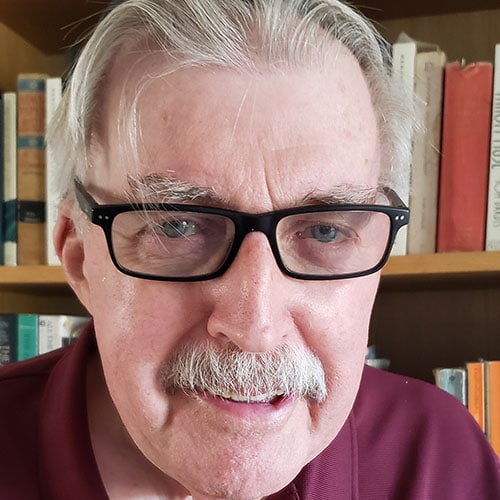
American Jewish University’s Rabbi Artson, who will become the school’s Mordecai Kaplan Distinguished Scholar on July 1, is a man of strong opinions, but he also knows when to sit back and listen. The dean of AJU’s Ziegler School of Rabbinic Studies for a quarter-century thinks these traits are why he has been a good counselor, why he can help people: “Here is what you want. Let’s think about how to get there.”
Rabbi Artson says “getting there” doesn’t mean expressing every thought you have, every emotion you have. “It has to be more thoughtful than that. I always have been good at that. But I want to correct something: I have very strong passions. I don’t feel moderately about many things. My politics are centrist, but I am passionate about it. And just about everything I have an opinion about, I have a curmudgeonly and strong opinion about.” But has learned to “control that manifestation,” he said. “I am very political. I don’t mean duplicitous. I think about how best to move something toward a goal.”
He took something of a circuitous route the rabbinate. His mother – whose praises Rabbi Artson repeatedly sang – is an atheist, as he was in the early part of his life. “I came to Judaism around the same time Elana and I met and married,” he said. “I was in college (at Harvard). I had two roommates who were Christian. They were, and they are, good people. While I knew I couldn’t believe what they believed, I wanted to think about it. So I went to the Hillel rabbi, and he said ‘There’s no neutral way to think about God. You have to try it and see if it works for you.’”
The Hillel rabbi convinced Artson to attend services every Shabbat for two months. Less than that, he told the young Artson, and you are just going to be trying to figure out what the melodies are and when you stand and sit.
Artson remembers the moment precisely. “The Hillel rabbi gave me a book to read by Franz Rosenzweig, a German Jewish existentialist thinker around the time of Martin Buber, who also came back to traditional Judaism as an adult. I fell in love with Judaism. I fell in love with God. Unlike some people who grow up more traditionally, God was the first, and because I loved God I had to love Torah, and then I had to love the Jewish people. That was the order it came in. God, for me, still is the linchpin.”
Would the Bradley Artson of 1983 recognize the Rabbi Artson of today? His response was intriguing. “I wrote a credo in rabbinical school in 1985 because I realized the world would try to make me back away from my convictions,” he said. To make sure the credo would remain part of his record, “I glued it – I still do – inside my prayerbook. Every morning I read these paragraphs of my credo from 1985.”
Rabbi Artson’s Credo
“The two core assertions of traditional Judaism, assertions which I cannot prove but upon which I stake my life:
“The first axiom is that God is loving, compassionate, wise and passionate about justice. The second is that the Torah and rabbinic tradition are the preeminent vehicle for Jews to articulate a sense of God’s will and to concretize that will in our daily lives and our social structure.
“I refuse to read Halakhah or the Torah in such a way that it makes God seem cruel, nor will I sever the intimate connection between God’s will and God’s Torah.
“God is just, and Halakhah embodies God’s love and justice. From these two points, an agenda of ritual profundity, compassion and social justice emerges organically and traditionally.”
“What’s interesting to me,” he said, “is that I still believe this. This is still the essence of who I am. I use this to make sure that I am true to myself because the pressure of the world tries to push you away from your own center. Why? Because we are all terrified of people being different from us. We don’t tolerate it well.”
He also points to an annual ritual. “In teaching my rabbinical students, one exercise we do in the senior year class is that I have them write their own credo,” he said. “I teach them mine. Then I say ‘Yours doesn’t have to be anything like mine. It has to reflect you. I need you to have one so when you are out in the world, and you forget who you are, you can hold it up, look at it and remember.’ I think that is crucial.”
When he was younger, the San Francisco native said, “I taught more frontally. I teach more dialogically now. It’s more a conversation … I invite the students to discover the truth they already have, in part because I don’t believe in a coercive God. I believe in a God whose power is the power of relationship, the God who invites us to know what we already have. My teaching is much more along those lines, too. I believe everyone intuits what their optimal next step is, and the job of the teacher is to give that back to them.”
Asked if today’s students are different from those in 2000, Rabbi Artson said the student of 2000 was much more cookie-cutter. “They had gone to Jewish summer camp, they went to day school, they had done all the things you think rabbis do. Those students are gone. My students now spend time in an ashram. They chef in a restaurant. They taught fine arts at a college. Everything – except for that predictable rabbi path.”
Who has changed more over a quarter-century, the rabbi or the students? “Hopefully both,” the rabbi replied. “The great joy of teaching is twofold: I really love my students, and they do teach me more than anyone. I have the best Jewish job in the world because I meet young people who change me. They argue with me. They say you can’t think that.”
Rabbi Artson recalled two memorable students from his philosophy class. One wrote about colonial theory and the Jewish people. “He quoted a Tunisian Jewish thinker I never had heard of. After reading his philosophy paper, I bought a book by someone I never had heard of, and it opened a whole new world for me.”
Another student wrote about trans identity and Jewish thought. “She quoted a remarkable person who is a trans professor of English but who has written a book of Torah commentary,” the rabbi said. “It is one of the most brilliant books of Torah commentary, and it only could have come from someone who lived that life.
“My students are teaching me things that in a million years I never would think of by myself. I feel so lucky to have a job in which people come to you and say ‘I want to serve the Jewish people.’ How remarkable is that?”