At 77, Lord Oliver Franks received a final assignment in Her Majesty’s service: to examine whether Argentina’s invasion of the Falkland Islands — and the British expedition to the far end of the earth to retake them — could have been prevented. His committee’s answer was no. Britain could not have known, because the Argentines themselves decided only at the last moment. Argentina invaded in April 1982. Margaret Thatcher responded with a fury the junta did not anticipate. The committee found flaws in intelligence collection and analysis. But the errors were symmetrical. The British did not foresee Argentine audacity. The Argentines did not foresee British resolve.
The Falklands have resurfaced in recent weeks, as if through a time tunnel. President Javier Milei covets the islands anew. Perhaps he calculates correctly: there is no Iron Lady in London this time. Perhaps he recognizes that Donald Trump is not Ronald Reagan (who himself hesitated before backing Britain). And perhaps he draws encouragement from Israeli ministers urging him to stand firm against the British. What business is this of ours? None. Israel’s score with Britain concerns its boycott policies – a clumsy attempt to influence Israeli conduct in the territories. So Israel, true to form, sticks its nose into a quarrel that is not its own, and will later complain, as victim, about the excessive attention it receives.
Some called the Franks report a whitewash; it absolved the establishment. There was a preconception: Argentina would not dare. There was a reality: it dared. There was a dilemma: what to do when the preconception collapses. There was a decision: remove the occupiers by force.
Sound familiar? Evicting an invader from nearly empty islands was easier than evicting Hamas from a densely populated strip. But in both cases a state was caught unprepared, and the failure to weigh the less likely possibility led to war. One difference: the British were surprised far from home, and the shock was one of principle, not essential security. We were surprised inside our own homes, and the shock seared our consciousness.
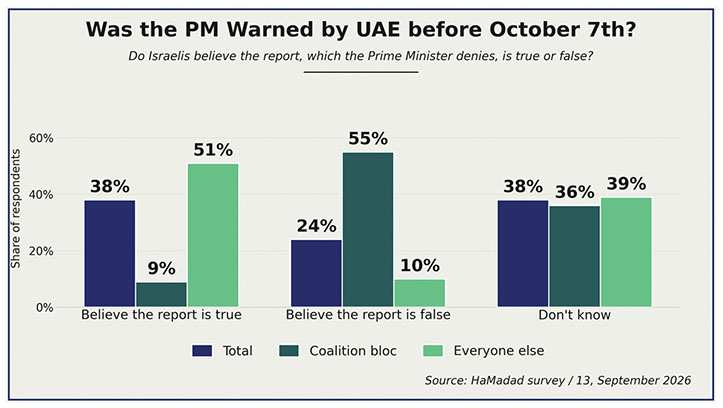
Israel was surprised on Oct. 6, 1973. Next week’s Yom Kippur is since both a day of attonement, and a painful reminder. Israel was more recently surprised on Oct. 7, 2023. That is a fact. For years Israel assumed Hamas rule in Gaza was preferable to Palestinian Authority rule. That is a fact. Israel allowed the transfer of money and resources that let Hamas entrench itself. That is a fact. Netanyahu was warned that something might happen in Gaza. As of last week, perhaps that too is a fact – though its wording is disputed, its concreteness is disputed, and so is whether it adds a critical layer to what was already known. In a bombshell report, two Israeli journalists reported that the president of the UAE had warned Netanyahu of a major Hamas operation days before the attack. Netanyahu denied the report and said he’d sue the reporters for libel.
Some say: Here is the smoking gun. Others say: unspecific warning changes nothing. Israel’s difficulty, like Britain’s in 1982, was in conceiving of an attack. No general warning could have dismantled that cognitive barrier.
What Netanyahu knew, and when, floods Israeli discourse. But some overstate its effect on voters on the eve of an election.
One of them argues: whoever held office during a failure of this magnitude should step aside, whatever their personal responsibility. But not all Israelis accept this, and those who reject it have examples to wave. Such a rule would have sent Franklin Roosevelt home after Pearl Harbor and Joseph Stalin home after June 22, 1941. Both stayed to manage the war that followed. Thatcher stayed for years after the Falklands.
Some also argue: Netanyahu was not merely in office when the blow fell; his decisions created the conditions for it. This is easy to prove after the fact, and suffers from the flaw of hindsight: only knowing what we know today can we point to the captain’s greatest errors. Any prime minister might have made a similar mistake, or a worse one.
None of this is to say that Netanyahu should stay, or go. It is to say that the P.M.’s opponents have no difficulty offering a narrative that demands his departure, even before the bombshell report, and his supporters one that justifies his staying even after. Netanyahu’s supporters say: he was surprised, recovered, led us to a victory of sorts. His opponents say: he was warned, did not listen, promised victory and did not deliver. Thatcher raised the Union Jack over the Falklands. Netanyahu has raised Israeli flags across the Middle East. But a war of sorts is still ongoing.
What could a voter do with these conflicting naratives? Democracy rests on the not-necessarily-informed decision of a multitude. George Mason of Virginia, a Founding Father, thought direct election of the president absurd – as unnatural, he said, as referring a trial of colors to a blind man. Last week the palette we blind men will choose from in a few weeks was completed: All parties formalized their final lists.
How to choose? There is Ronald Reagan’s famous question from his 1980 debate with Jimmy Carter. It may not help us pick a specific party, but might help some of us pick a direction. Are you better off than you were four years ago?
Something I wrote in Hebrew
This is the current state of our election, encapsulated:
At this stage, and until proven otherwise, it seems very difficult to shift voters from bloc to bloc, even under a cacophonous deluge of revelations, condemnations, appointments, tweets, videos and tours. It is likely that the election will be decided, if it is decided at all, because some voters will stay home (or not), or vote for parties that fail to cross the electoral threshold (or not), or succumb at the very last moment to an overwhelming emotion that guides their trembling hand to a ballot they never intended to cast (or not).
A week’s numbers
Sometimes “I don’t know” is the intelligent response (see column above).
A reader’s response
Jeremy Rosenfeld: “Don’t you Israelis see that you completely lose in the propaganda war?” My response: We do, and to be honest, we (Israel) don’t quite know what to do about it.
Shmuel Rosner is senior political editor. For more analysis of Israeli and international politics, visit Rosner’s Domain at jewishjournal.com/rosnersdomain.