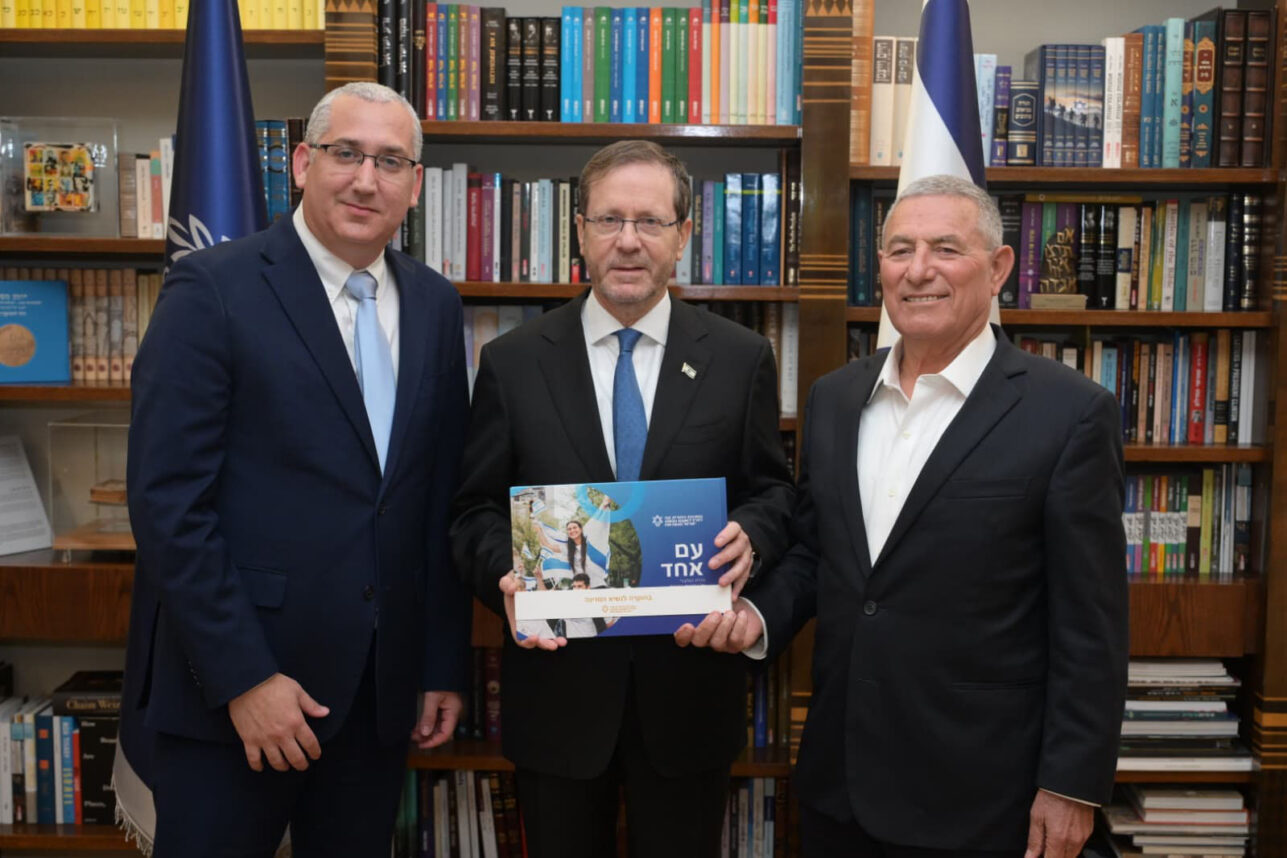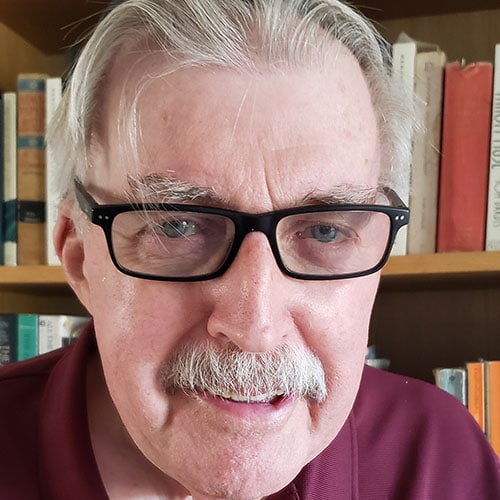
When the Southern California delegation of eight Chabad rabbis – part of a larger Chabad group – landed in Tel Aviv on a humanitarian mission last month, Rabbi Michy Rav-Noy reacted instinctively.
“I pulled out my guitar and started singing ‘Am Yisroel Chai’ as people were deplaning,” the executive director of Friendship Place said. “Music made them so happy. People’s faces were uplifted. I even went over to Baggage Claim and played some guitar.”
For Rav-Noy, the worldwide mission of 28 Chabad rabbis, organized by Rabbi David Eliezrie of Orange County, produced a gigantic salad of conflicting feelings.
For Rav-Noy, the worldwide mission of 28 Chabad rabbis, organized by Rabbi David Eliezrie of Orange County, produced a gigantic salad of conflicting feelings.
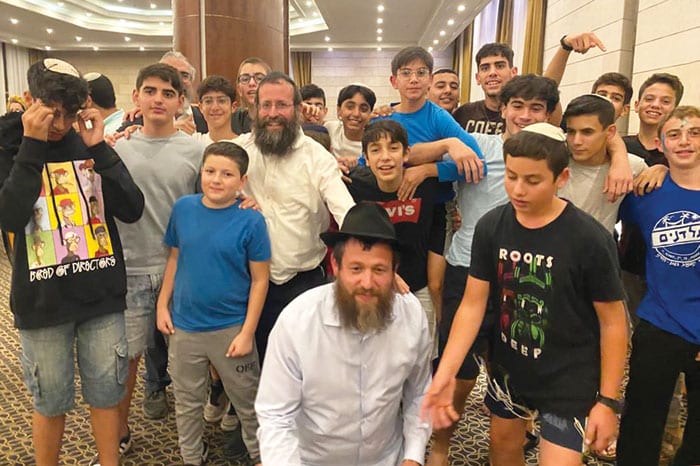
No stranger to such emotions, for 20 years Rav-Noy has led an organization that brings together special-needs young people and teenage volunteers.

From the first stop at a center where parents and relatives of hostages were cared for, the importance of the rabbis’ presence was undeniable. “It was apparent the most important thing was just to be there, to be ourselves, to show care and empathy and love,” Rabbi Rav-Noy said.
In addition, Rabbi Eliezrie asked everyone to raise money for the trip, to pursue contributions from their communities which would be distributed to the many Jews in need after Oct. 7. Rav-Noy, a 1992 graduate of YULA, calculated that every rabbi arrived with between $10,000 and $50,000, all of which was handed out. “Wherever we saw that there was a real need,” he said, “we distributed the money. That could also mean giving a $20 bill to a kid to make him happy.”
A memorable stop was made in Sderot in the western Negev, known as the bomb shelter capital of the world, a scant distance from Gaza. Normally a city of 40,000, it has been reduced to 5,000. “Everyone is out,” Rav-Noy said, “well, nearly. Some people just don’t want to leave – or they are too scared to leave their homes.
Chabad of Sderot is the only business in town that is open. The rabbi explained how it works in wartime: “Chabad of Sderot has been turned into a supermarket – eggs, diapers, shampoos, bread. Everything! And there is no cost. People reach out to Rabbi Asher Pizem. They tell him what they need, and he delivers it.” Not that everything goes smoothly. “Rabbi Pizem told us his greatest challenge is convincing supermarkets to send trucks down there, to deliver,” said Rav-Noy. “He has to beg. They don’t want to come down, which I understand.”
Turns out that Pizem has a menorah in front of his home, the worldwide Chabad headquarters, at 770 Eastern Parkway, in Brooklyn. The menorah is made from rockets that landed in Israel.
The visiting rabbis also noticed a sizable rocket-caused hole in the ground near a large space in a wall created by a rocket.
The Hamas terrorists don’t take any timeouts. “The craziest thing happened the day we got there,” Rabbi Rav-Noy said. “There was a swastika painted on the door of Chabad of Sderot. Somebody had put it there early in the morning.”
The rabbi was asked if he felt safe in the areas visited. “I think out of ignorance I felt relatively safe,” Rav-Noy said – until he heard from his aunt. “She told me ‘Michy, you need to all the time look. There are bad people everywhere.’ She told me, ‘Don’t walk around playing your guitar like you are not paying attention. Look.’”
The rabbi was unswerving about his mission: “I came there to make people happy.” The only time he felt vulnerable was when the rabbis were forced to hit the ground as rockets were flying overhead.
Rav-Noy said that at a lunch at Sderot, he and his colleagues raised about $25,000 for the rabbi of Sderot, and another $25,000 to $30,000 in Ashkelon, money raised from their communities. “We were conduits,” he said with a wry grin. “It was interesting to be looked at as a wealthy person.”
The three-car rabbinic caravan traveled from Sderot to Beersheba, home of Soroka Medical Center, the largest hospital in the Negev.
However, “on the way to the hospital,” Rav-Noy said, “we had to jump out of our cars and run to a shelter when a siren sounded. We had downloaded an app that lets you know when and where rockets are flying. You lie down, hands over your head. Very noisy. You have to lie there awhile to make sure shrapnel is not falling.”
Finally, Rabbi Rav-Noy related the story of a golden miracle with a sad ending.
He told of a Jew on his way to synagogue when he noticed a man with dark skin, dark beard. Just after thinking “he’s one of us,” he noticed the man had what looked like a Russian gun.
The Jew quickly reversed direction. He ran faster and faster. Suddenly, he felt a sharp pain — a gunshot — as he neared home. At closer range, he called out to his wife, “Sofia, Sofia, open the door!”
Once inside, it was obvious the shot had pierced a lung. The man started coughing blood. He thought he was going to die.
Out of nowhere, two guys began banging on the door. “We’re Jewish! We’re Jewish!” they called out. “We are here to help.”
Angels, Rabbi Rav-Noy interjected.
Sofia let them in. The two men saw her husband lying on the floor in blood. They ripped the door of a closet off its hinges to form a stretcher. They threw the victim into the car. Under gunfire — and taking hits — they drove from Sderot to Beersheba and Soroka Hospital.
Because of these two men, the victim went straight to surgery. Today he is alive and recovering. His voice rising, Rabbi Rav-Noy said “I don’t know how or why these two angels came to his house. One was named Leon. He was killed the next day because, I guess, he still was doing his safety missions.
The parents of the survivor went to Leon’s wife and told her, with gratitude, “Your husband saved my son’s life.”
Leon’s wife’s reply will not be forgotten. “Leon told me,” she said, “that when the war is over, he is coming to fix the closet.”