
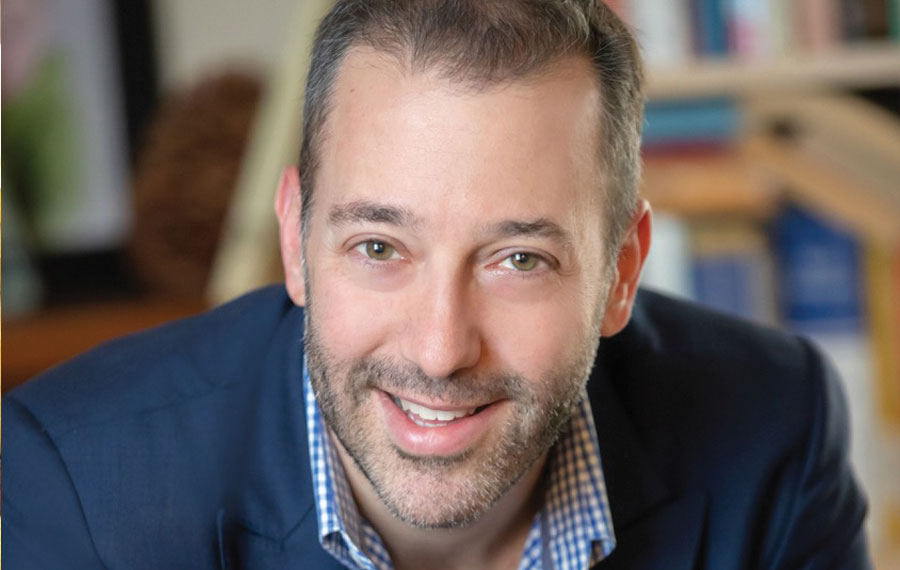
When Rabbi Ben Goldstein was hired as the new senior rabbi at Beit T’Shuvah, beginning July 1, an acquaintance said to him: “‘You’re going to raise your children around addicts?’”
Goldstein, 42, who has spent the past three years at Temple Aliyah in Woodland Hills, turned to that person and said of his decision to take the position at the Jewish residential addiction treatment center, “Absolutely.”
“The amazing thing about Beit T’Shuvah and the residents here,” Goldstein told the Journal, “is [they] understand the need for personal spirituality and religion in a way not everybody does.”
Established in 1986, the 138-bed center offers a faith-based approach to helping people in recovery by integrating psychology, spirituality, 12 steps and the arts. It also runs a congregation celebrating Shabbat and Jewish holidays year-round.
Since its inception, Rabbi Mark Borovitz has helmed Beit T’Shuvah. However, Borovitz stepped down to dedicate himself to directing Beit T’Shuvah’s Elaine Breslow Institute. The institute educates clergy and medical professionals about the nature of addiction, including treatment and prevention.
Beit T’Shuvah Board of Directors Chair Janice Kamenir-Reznik said in a statement, “We are thrilled to welcome Rabbi Goldstein to Beit T’Shuvah. His distinctive skill set, coupled with his passion for the work of Beit T’Shuvah make him uniquely qualified to assume the role of senior rabbi.”
“Whether you identify as an addict or not I think there is a piece of all of us that is in recovery.”
— Rabbi Ben Goldstein
“There is nobody to who I would rather pass the torch,” Borovitz said in a statement.
Goldstein however has no plans to try and fill Borovitz’s shoes. “They are literally big and they are flashy and different,” he said.
However, he does come to the position with some experience. Thirteen years ago, Goldstein was a rabbinic intern at Beit T’Shuvah, working as a spiritual counselor while still a student at the American Jewish University Ziegler School of Rabbinical Studies.
Back then, Goldstein said he had no idea what it meant to be a spiritual counselor but Borovitz told him: ‘You are an advocate for the soul.’ “That was my second year of rabbinical school,” Goldstein recalled, “and since then, I have seen myself as an advocate for the soul wherever I have been … and returning to Beit T’Shuvah is a perfect fit for that.”
Raised in an Orthodox home in Rochester, N.Y., Goldstein had a crisis of faith after the assassination of Israeli Prime Minister Yitzhak Rabin in November 1995. Goldstein was in Israel at the time on a gap-year program and said after Rabin was killed by the Orthodox Yigal Amir, “I was horrified by the response I saw around it. It was one of the things that started my departure [from Orthodoxy].”
Returning to the States, Goldstein graduated from Boston University and moved to Los Angeles to pursue acting. He simultaneously held down jobs in the Jewish community as a youth director at Congregation Beth Shalom in Santa Clarita and as an educator at the Museum of Tolerance, before attending rabbinical school.
Goldstein recalled his decision came when “I was in the car, on the on-ramp to the 101 Freeway and I asked myself, ‘At the end of the year, do you want to be known as a great actor or a great youth director?’ I said to myself, ‘I can be known as a great actor and still be a jerk but if I am a great youth director, I can be making lives better.’ ”
Goldstein graduated from Ziegler School of Rabbinic Studies in 2010 and his first pulpit position was at Temple Beth-El Mekor Chayim in New Jersey. He invited Borovitz — whom he’d grown close with during his time interning at Beit T’Shuvah — to lead his installation ceremony.
Returning to Beit T’Shuvah as senior rabbi 13 years after that internship, Goldstein said, “The core mission and core job hasn’t changed; the personalities have changed somewhat. It is amazing to get to work with this staff and residents.”
He added he’s looking forward to serving a congregation that is not a suburban Conservative community and the challenges that come with working with people wrestling with addiction, as well as with non-addicts who find themselves alienated from more traditional communities.
“Whether you identify as an addict or not,” he said, “I think there is a piece of all us that is in recovery and I think more and more that will resonate with people who don’t find themselves comfortable in a Saturday morning service.”
Drawing on his passion for theater, Goldstein hopes to expand the arts programming at Beit T’Shuvah. “There are a lot of artistic people who come through the house,” he said. “Music and theater are definitely part of their therapy.”
Additionally, he hopes to expand the meditation and mindfulness offerings and, less than a month into his tenure, he said he already has been inspired.
“Somebody got up last week [during services] and said something like: ‘We never thought as atheists we would be involved with members of the synagogue.’ They found their spiritual home here. As somebody who has worked [on] the pulpit for 10 years and [has seen] diminishing returns of Shabbat and Saturday morning services, I think Beit T’Shuvah, with its emphasis on spirituality and mindfulness and psychology and walking the path toward recovery, has so much to say to people who otherwise feel alienated from religion. I hope I can be a good person to facilitate that.”

































