To view previous dispatches, click here.
CHICAGO – When a phalanx of young masked agitators circled and torched a flag – half American and half Israeli – on E. Randolph Street, many of them in Vans and Adidas sneakers, on the second night of the Democratic National Convention, they were armed with more than just their sound system, microphone, a lighter and lighter fluid.
Over the course of just about four hours and 4,000 steps over a few blocks of the city’s downtown, they weaponized the proven tactics and strategies of street warfare that the Soviets pioneered, even deploying tricks from a modern-day digital “toolkit” and leveraging a media presence that was larger than its about 100 revolutionaries.
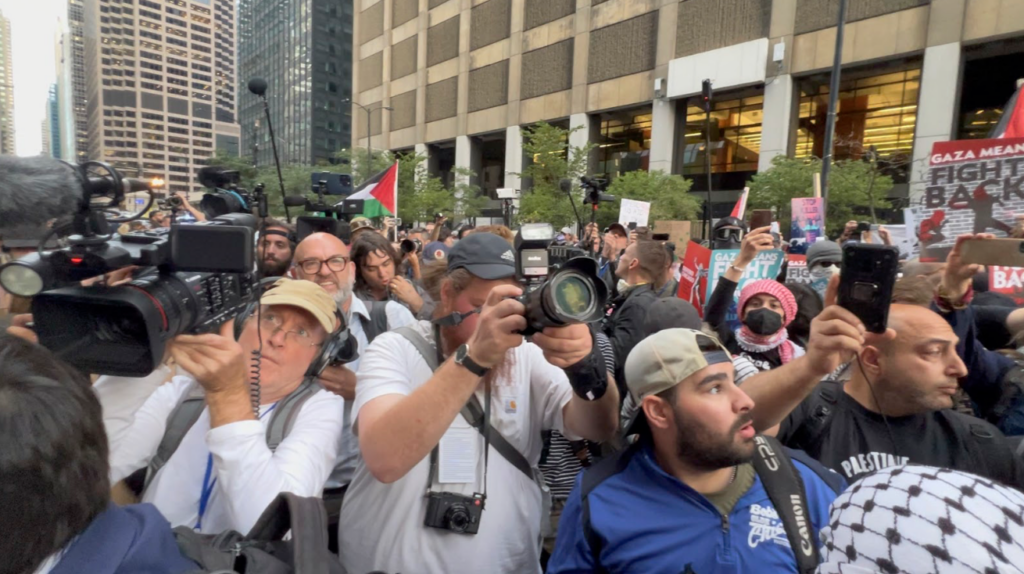
Throughout the night, a leader of the group, masked and dressed in black, like most of the activists, prefaced his instructions to the protestors with the polite communist honorific: “Comrades.”
Once again, much of the media only characterized the arrested as “pro-Palestinian demonstrators,” with the Associated Press erroneously saying that “the group” behind the protests was “not affiliated with the coalition of more than 200 groups,” called “March on the DNC 2024,” that organized anti-Israel protests in Union Park on Monday in the city’s West Side, about 1.5 miles away from the Tuesday night ruckus. The story was reprinted by the government of Qatar’s Al Jazeera propaganda website, as well as numerous media outlets worldwide.
In fact, as I documented in a dispatch from the Monday protests, a young man from one the one of the organizing groups – “Behind Enemy Lines” – handed out black-and-white fliers for the Tuesday night protest, called “MAKE IT GREAT LIKE ‘68! SHUT DOWN THE DNC FOR GAZA. The invitation had a logo on the bottom for “Behind Enemy Lines” and a QR code for its website, along with logos for two of the protest’s other controversial organizers: Samidoun: Palestinian Prisoner Solidarity Network and Palestine Action US.
Founded in 2011, Samidoun is an alleged front for the Popular Front for the Liberation of Palestine (PFLP), a self-described Marxist-Leninist organization designated a terrorist group by the U.S., Israel and the European Union. Its leaders deny the allegations but support PFLP leaders. At Tuesday’s protest, an activist read a handwritten statement from Samidoun.
Palestine Action US is an offshoot of the London-based Palestine Action, known for its direct action campaigns against companies that supply arms to Israel. It promotes “Tactics” on its Instagram account with links to a digital “Palestine Action US Toolkit” used in campus protests, in part how to deflect the tactics of well-trained police, like the Chicago officers out on the streets on Tuesday.

Lesser known, Behind Enemy Lines has become controversial for its support of “resistance by any means necessary,” in “solidarity” with Palestinans living “behind enemy lines” in Israel, Gaza and the West Bank. In its mission statement, it states: “The empire is the enemy. From the belly of the beast, we choose to resist it.”
Samidoun is among the official “members” of the March on the DNC 2024 coalition, and it’s among the organizations I have investigated as “members” and “supporters” of the coalition, in a new initiative that I am leading at the Pearl Project, a nonprofit journalism initiative named for my friend Daniel Pearl, murdered by militants in Pakistan in 2002 for being a Jewish grandson of Israel. I created a new Malign Foreign Influence Index to examine the ideology, funding and motivations of the groups.
With Tuesday night’s protests, I have expanded the index and added “Behind Enemy Lines” to the list of socialist-adjacent groups and Palestine Action US to the ranks beside Samidoun.
That now gives us 236 organizations in the index: 34 groups openly identify as socialist, communist or Marxist; 165 groups are “socialist-adjacent” and pro-socialist; and 36 groups are Muslim, Arab or Palestinian.
Why is it important to understand the socialist-friendly ideologies of these groups? The use of professional agitation by the Soviets and communists to sow discord in other countries is a well-documented strategy that played a significant role in their efforts to spread communist ideology and undermine opposing governments. This tactic, often referred to as “agitprop,” in a blend of agitation and propaganda, was a key component of Soviet foreign policy and communist movements worldwide.
What we saw on the streets of Chicago, from the flag burning photo op to activists locked at the elbows in a “de-arrest” tactic, is something I call agitation operations, or agitops.

Standing at the corner of N. Monroe and W. Canal, speaking to a small gaggle of journalists at night’s end, Chicago’s police chief, Larry Snelling, told me that, much like law enforcement everywhere, it’s action not ideology that police watch.
“When we look at affiliations, that’s not as important as someone’s actions. So we’re not looking at someone’s affiliations. When someone shows up, we’re looking at their actions, right?” he said, a camera light shining on him.
“Because regardless of what your affiliations are, you still have First Amendment protections, and we will allow that. But when you show up and you’re committing acts of violence, vandalism, that is not protected under the First Amendment. So, it was less about the people’s affiliations than it was about the actions of those individuals.”
He noted: “We do know there are organizations out there that engage in violent acts.”
We must pay attention to affiliation in doing threat assessment because the history of Soviet-inspired organizations inclined to violence is long.
In the early years after the Bolshevik Revolution of 1917, the Soviet Union established a dedicated department within the Communist Party called the Agitation and Propaganda Department, or “Agitprop.” This department was responsible for spreading communist ideology both domestically and internationally. The Soviets understood that propaganda alone was not enough; they needed to incite actions that would destabilize their enemies and create conditions favorable for communist revolutions.
Soviet agitators infiltrated and co-opted existing social movements, labor unions and political organizations in other countries. At the corner of E. Randolph Street and N. Clifton Street, a woman raised a sign above her head for the “Freedom Socialist Party,” which had a prominent role in the march on Monday.
Through the Communist International (Comintern), founded in 1919, the Soviets trained agitators from various countries in Moscow, teaching them how to organize strikes, protests and uprisings. These agitators would return to their home countries and work to incite unrest, often by infiltrating labor unions, student movements, and anti-colonial struggles. The goal was to create chaos and weaken the existing governments, making them more vulnerable to communist takeover.
Now, these tactics are adopted by nations like Iran and China, and those governments have strong relations with many of the groups in the Malign Foreign Influence Index.
In early August, Samidoun’s international coordinator, Charlotte Kates, jetted to Iran, where she was honored with the 8th annual “Islamic Human Rights and Human Dignity Award.” Another honoree: Ismail Haniyeh, the now-assassinated chair of the political bureau of “the Hamas movement.” Indeed, with Haniyeh’s assassination, the organization wrote a tribute, headlined, “Glory to the martyr.”
Examples of Soviet agitation abroad include the Spanish Civil War (1936-1939), Berlin Uprising (1953), Hungarian Revolution (1956), Prague Spring (1968), Greek Civil War (1946-1949), Vietnam War (1960s-1970s), Cultural Revolution in China (1966-1976), Italian Red Brigades (1970s-1980s) and penetration into U.S. civil rights movements, labor unions and anti-war protests during the Cold War (1945-1991).
The United States was, of course, funding its own foreign influence campaigns, and that is for another day of discussion.
Even after the collapse of the Soviet Union, state and non-state actors have studied and adapted the tactics of agitation and propaganda to influence political events and sow discord. Soviet and communist-inspired agitation groups have historically employed a variety of tactics in street warfare, especially when confronting police forces, in order to create chaos, provoke violent responses and undermine the authority of the state.
I’ve spelled out ten tactics I could see over the few blocks and few hours of the agitation on Tuesday night. I’ve broken them down systematically so that we can see the blueprint and strategy. Why does it matter to be systematic? Because their strategy is systematic.

1. Provocation and Escalation
• Inciting Violence: Agitators often deliberately provoked police forces by taunting or attacking them, knowing that a heavy-handed response could spark broader unrest. The goal was to escalate a peaceful protest into a violent confrontation, attracting media attention and rallying more people to their cause.
Soon after the battalion of black-clad activists first charged the police standing firm across N. Clifton, a young woman, describing herself as a “Behind Enemy Lines New York member,” stepped on the American-Israeli flag, saying, “I’m sorry if I look a little fucked up. It’s because the CPD is fucking beating us and kettling us and compressing us. We didn’t have room to move. Hitting us with their batons, so I’m sorry if I look a little fucked up right now.”
• Sacrificial Violence: Sometimes, agitators positioned themselves or others to be victims of police violence, even staging incidents where they appear to be assaulted by the authorities. These actions were often intended to gain sympathy from the public and discredit the police.
Indeed, after the first forward assault on the police didn’t work, the activists retreated to burn the flag and then turned around to assemble again against the police, this time facing N. Canal Street, a near-city block separating them. “Shame!” they shouted at the police, the Palestinian flag raised high above them. “The whole world is watching!” After a long wait and more chest-thumping, they turned around to lay a new assault on the police on N. Clifton, leading to the first dramatic images of clashes and first arrest. “Get off of him! Get off of him!” the activists chanted, as the media rushed to get photos and video footage of a police officer wrestling an activist to the ground.

2. Infiltration and Subversion
• Infiltration of Peaceful Protests: One common tactic was to infiltrate peaceful demonstrations and steer them toward more radical actions. By blending in with legitimate protesters, agitators created confusion and made it difficult for the police to differentiate between peaceful participants and those inciting violence.
“Behind Enemy Lines” did just that on Monday. As members of the “March on DNC 2024” pushed wheelchairs and strollers in their “family-friendly” march, some other protestors broke away to storm the barricades around the Democratic National Convention, winning arrests and headlines. One returned to Union Park out of breath. “I’m okay,” she told a friend.
• Messaging: Agitators used slogans, banners and chants designed to provoke strong emotional reactions and turn the crowd against the police. They also spread rumors and misinformation to create panic and confusion, making it harder for law enforcement to maintain control.
Tuesday night, the protestors were eloquent as the police made their first arrests: “Fuck you! Fuck you! Fuck you!”
They built the narrative that the police were “kettling” them, which means trapping them physically, and shouted, “Let us go! Let us go!”
Palestine Action US promotes a tipsheet on “Police Formations” that advises: “…if and when encircled, before your crowd decides to take on a police kettle formation line be 100% sure there isn’t more than one kettle you’re pushing thru [sic].”
Under a crosswalk sign, they pumped their fists in the air, cutting a strong silhouette as the sun set, and punctuating their messaging again with the chant, “THE WHOLE WORLD IS WATCHING!”

3. Use of Guerrilla Tactics
• Hit-and-Run Tactics: Agitators often used guerrilla-style tactics in street confrontations. They engaged in quick, disruptive actions, such as throwing projectiles or setting fires, and then quickly dispersed before the police could respond. This approach kept law enforcement on the defensive and makes it difficult for them to maintain order.
Indeed, the leader instructed the protestors to make quick, choppy turns, shouting, “LEFT! LEFT! LEFT!” to guide the assembly to take a turn, the mostly-white revolutionaries averting police, many of whom were from racial minorities.
• Urban Guerrilla Warfare: In more extreme cases, particularly during periods of intense political unrest, communist-inspired groups engaged in urban guerrilla warfare. This included acts of sabotage, ambushes and the use of firearms or explosives against police targets.
This didn’t seem to emerge on Tuesday night but it’s a tactic that is certainly something to track. Palestine Action US promotes a guide, “Fire Extinguisher Conversion: A Handy Guide from Palestine Action,” instructing activists, “How to modify a fire extinguisher to spray a jet of viscous fluid.”
4. Building Barricades and Defensible Positions
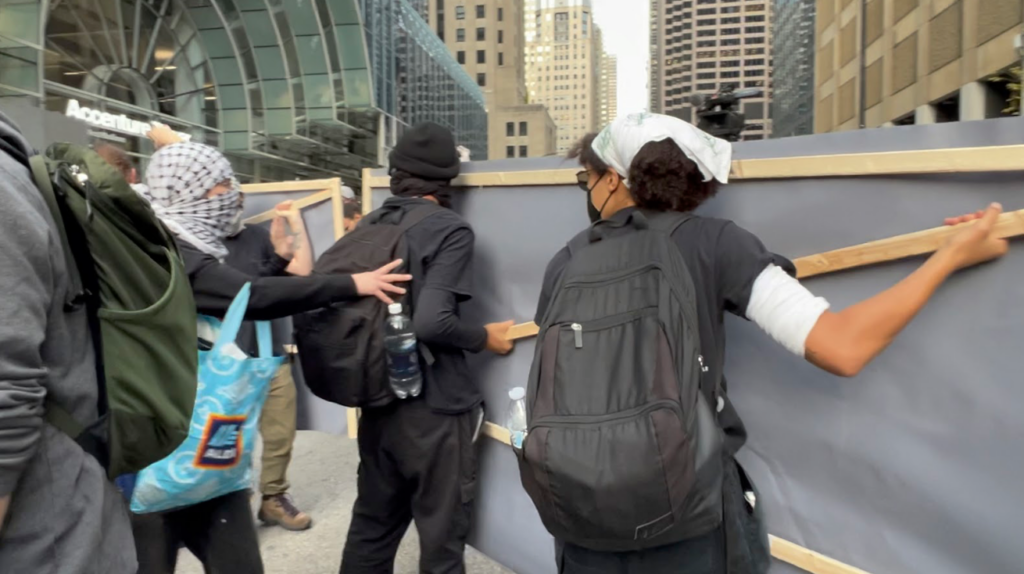
• Barricades: Building barricades using available materials, such as overturned vehicles, furniture, or construction debris, was a common tactic to slow down or block police advances. Barricades not only provided physical protection but also created symbolic zones of resistance.
This crowd started with some of their members holding barriers like shields reinforced with wood. A nice young revolutionary with an Aldi grocery store shopping bag restrained another revolutionary when he got agitated. “We’re here to descalate,” she reminded him gently. The protestors on college campuses, from Columbia University to University of California at Los Angeles, certainly made barricades with anything available.
• Defensible Positions: Agitators sometimes occupied strategic locations, such as buildings, rooftops or narrow streets, where they can more easily defend themselves against police forces. These positions allowed them to launch attacks from a distance and retreat if necessary.
That’s what Tuesday’s protestors did, attempting to dip in and out of Chicago’s streets, as the police shouted again and again: “Media out of the streets! Media out of the streets!”

5. Coordination and Communication
• Coordinated Movements: Agitation groups often used hand signals, walkie-talkies or other forms of communication to coordinate their actions in real-time. This allowed them to organize their attacks, retreat and regroup more effectively, making it difficult for the police to disrupt their efforts.
Tuesday night, these agitators used their megaphone, pushing a speaker system along with their movements, to communicate with each other. And they turned to good old-fashioned whispering in the ear to plan their next move. At one point, the police shouted at them, “Keep moving! Move!” One of the protestors slowed her friends down and responded defiantly they didn’t have to move fast.
Palestine Action US promotes on its Instagram account a tactic the protestors used, called “de-arrest.” It means “linking to each other, elbow-cross-elbow, while continuing to move or march together,” a formation that “can stop police from entering a crowd to grab a person of interest, and even be used to grab a person of interest out of the clutches of our aggressors.”
• Diversion Tactics: To stretch police resources thin, agitators often created diversions in multiple locations, forcing law enforcement to divide their forces. For example, they might stage a fake protest or small-scale incident in one area while preparing for a larger confrontation elsewhere.
That’s what happened Tuesday night, as the protestors split into small groups to diffuse police responses.

6. Use of Symbols and Propaganda
• Propaganda During Confrontations: During street battles, agitators often distributed pamphlets, leaflets and posters that portray the police, politicians and authorities as oppressors and the agitators as defenders of the people. This helped to sway public opinion and encourage more people to join their cause.
Until his posters spilled to the ground on N. Clinton, a congenial member of the protestors handed out a stack of posters with this message: “Stop genocide Joe. Stop killer Kamala.”
Another poster, left like trash on E. Randolph at night’s end, read: “DEFEND CHICAGO from the Democratic National Convention. GENOCIDE JOE NOT WELCOME. WE CHOOSE THE WORLD.”
This crowd had stickers, “DNC 2024,” with a darkened image of Kamala Harris, and the message: “DO NOT COME KILLER KAMALA. #SHUTDOWNTHEDNC.” It included the URL to its website: Behind-Enemy-Lines.org.
• Symbolic Acts of Resistance: Actions like burning effigies, desecrating symbols of authority, or displaying communist flags were used to inspire supporters and provoke the authorities. These acts were designed to create powerful visual images that could be used in propaganda.
On Monday, “If Not Now” protestors created effigies of Kamala Harris, Joe Biden and Benjamin Netanyahu, their facial features exaggerated and cartoon-like. On Tuesday, the American Party of Labor passed out black-and-red flyers, with an image of communist leader Vladimir Lenin, and the message: “DEATH TO FASCISM. FREEDOM TO THE PEOPLE!” The flyers littered the street afterwards.

7. Psychological Warfare
• Intimidation and Fear: Agitators sometimes used intimidation tactics, such as threatening violence, to create fear among the police and discourage them from taking decisive action. The goal was to demoralize law enforcement and reduce their effectiveness.
Sure enough, the Tuesday protestors shouted: “Resistance by any means necessary,” and the name of the protest, “MAKE IT GREAT LIKE ‘68!” was a clear rallying cry for violence.
• Noise and Disorientation: Loud noises, such as sirens, fireworks, or drums, were used to disorient police forces and make it difficult for them to communicate. This tactic created confusion and made it easier for agitators to carry out their actions.
When one of the protestors was arrested, his drum was included in his “belongings.”

8. Weaponizing Crowds
• Human Shields: Agitators would sometimes position themselves behind crowds of peaceful protesters or civilians, using them as human shields to deter police action. This tactic exploited the police’s hesitation to use force against non-violent participants.
On the streets of Chicago, the protestors cursed the media and also used the media, their black-clad uniforms getting lost sometimes in the scrum of journalists that followed them. They used several young women as speakers, making their appeal slightly less aggressive, one of them even quoting Chinese communist leader Mao Tse Tung.
• Crowd Dynamics: By manipulating crowd dynamics, agitators could turn large gatherings into chaotic mobs. They might incite panic or direct the crowd to surge against the police, overwhelming their defenses and creating opportunities for more aggressive actions.
The Tuesday night protestors didn’t have a crowd other than themselves to manipulate, but they worked hard, trying to win the loyalties of anyone watching, like travelers trying to catch a train at Union Station, as the protestors faced off against police. “Camera toward the cops!” the protestors shouted to the media. And to win the small crowd’s loyalties, they cursed the police. It worked.
A woman in the crowd asked sympathetically about the protestors: “Who in this line is armed? Who in this line has a vest on?”
A protester found she had gained one ally and responded, taunting the police: “Shields over their faces!”
A few hearts won, the protestors broke into their aspirational chant: “Free, free Palestine!”
“From the river to the sea, Palestine will be free!”
9. Sabotage and Infrastructure Disruption
• Targeting Infrastructure: In some cases, agitators would sabotage infrastructure, such as power lines, transportation systems, or communication networks, to create widespread disruption. These actions could destabilize the situation further and make it harder for the police to maintain order.
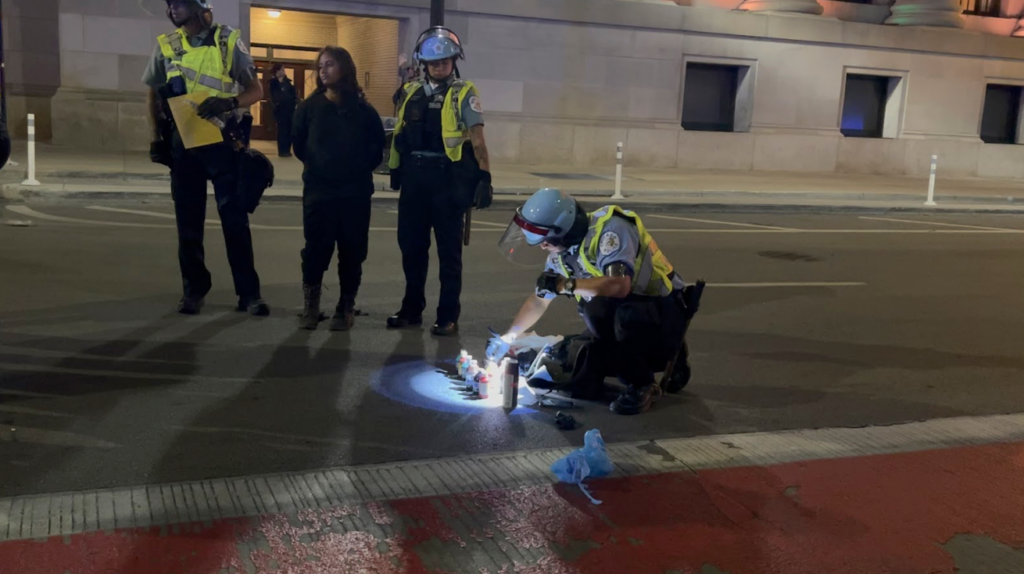
This didn’t happen Tuesday night but a tactic to watch. Police confiscated spray paint and bottles of something colored from one protestor, but it didn’t seem they found deadly weapons.
• Creating Obstacles: Tactics like spreading nails or broken glass on roads, setting traps or cutting off escape routes were used to hinder police mobility and create dangerous situations for law enforcement.
This was the fast scramble that played out on the streets Tuesday night as bicycle squads of Chicago police officers hustled to new locations to respond to the protestors changing direction quickly.
“Squad 3. Squad 3,” the instructions spilled out onto the streets over the police speakers, prompting the bicycle police to leap on their bikes, turn on their lights and scramble to a new location.
In its tipsheet, Palestine Action US has shared a message with student activists: “Buildings on campus are filled with everything you might need to construct barricades and protect an occupation,” using video from the Cal Poly Humboldt campus anti-Israel protest to prove its point.

10. Media and Public Perception Management
• Controlling the Narrative: Agitators were often skilled at controlling the narrative by staging events that were likely to be captured by the media. They knew how to present themselves as victims of police brutality, even if they were the ones instigating violence. This tactic helped them gain public sympathy and discredit the authorities.
That’s precisely what the protestors did Tuesday night, and they had a legion of observers from the National Lawyers Guild, carrying small notebooks and wearing lime green hats, earning them the name of “green hats.” They trailed the protestors through the streets and tracked the police’s every move and every arrest.
“We’re green hats!” they declared, as police blocked press and allowed them to get the name and date of birth of agitators arrested.
As arrests began, the “green hats” rushed to the police paddy wagons, shouting their phone number to arrestees so they would make their one free phone call to them for their legal services to get out of jail.
The National Lawyers Guild-Task Force on the Americas/San Francisco Bay Area chapter is listed among the members of the “March on the DNC 2024” coalition. It supports divestment efforts targeted at pulling investments in Israel, noting on its website a list of “THE COMPANIES PROFITING FROM GAZA GENOCIDE.”
It notes: “The companies listed here have provided Israel with weapons and other military equipment used in its attacks on Gaza, the West Bank, Lebanon, and Syria since October 2023.”
• Using Social Media: In more recent times, communist-inspired groups have also utilized social media to organize, spread propaganda, and document confrontations with police. Live streaming and viral videos have become powerful tools for influencing public opinion and rallying support.
From beginning to end, Tuesday night’s agitators exploited Big Tech to get its message to the world and make true their chant: “THE WHOLE WORLD IS WATCHING!” Samidoun @SamidounPP, Behind Enemy Lines @resist_empire and Palestine Action US @Pal__Action rallied media and supporters to their cause on Tuesday night, broadcasting their defiance afterwards.
What Tuesday night reveals is that the tactics of street warfare, honed over decades by Soviet and communist-inspired agitation groups, are alive and strong in today’s “resistance fighters,” as they call themselves, exploiting the cause of Palestinian people to challenge state authority, create chaos and push America toward revolutionary change.
By combining direct action with psychological and media strategies, these groups were able to maximize their impact, even when facing the well-equipped police force of the Chicago Police Department.
Their legacy continues to influence protest movements and agitators worldwide, from our college campuses to our streets. It’s important for us to recognize and understand these tactics, study how they are being deployed today and develop ways to counter them.
By doing so, we can prevent these groups from exploiting media attention to spread chaos and instead focus on finding lasting solutions to the challenges we face globally.
For many of Tuesday night’s agitators, it was a day’s work well done. It was mission accomplished on the corner of N. Monroe and W. Canal.
The night closed, with the police finishing up their last arrests, and as they settled onto their benches, several protestors kicked back in Chicago police wagon No. 6915, stretching their legs on a bench in between, laughing and joking.
Across the street, a band of police officers headed home on a bus with an uplifting message across the front: “Chicago. My kind of town.”
Asra Q. Nomani is a former Wall Street Journal reporter and the author of a book, “Woke Army: The Red-Green Alliance That Is Undermining America’s Freedom.” She is a founder of the Pearl Project, a nonprofit journalism initiative that is building the Malign Foreign Influence Index, examining the groups fomenting anti-Semitism. She has an MA in international communications, with a speciality in the study of propaganda. She can be reached at asra@asranomani.com and @AsraNomani.
Dispatches From Chicago: ‘Comrades’ Burning U.S. and Israeli Flags and Using Soviet-Style Tactics
Asra Q. Nomani
To view previous dispatches, click here.
CHICAGO – When a phalanx of young masked agitators circled and torched a flag – half American and half Israeli – on E. Randolph Street, many of them in Vans and Adidas sneakers, on the second night of the Democratic National Convention, they were armed with more than just their sound system, microphone, a lighter and lighter fluid.
Over the course of just about four hours and 4,000 steps over a few blocks of the city’s downtown, they weaponized the proven tactics and strategies of street warfare that the Soviets pioneered, even deploying tricks from a modern-day digital “toolkit” and leveraging a media presence that was larger than its about 100 revolutionaries.
Throughout the night, a leader of the group, masked and dressed in black, like most of the activists, prefaced his instructions to the protestors with the polite communist honorific: “Comrades.”
Once again, much of the media only characterized the arrested as “pro-Palestinian demonstrators,” with the Associated Press erroneously saying that “the group” behind the protests was “not affiliated with the coalition of more than 200 groups,” called “March on the DNC 2024,” that organized anti-Israel protests in Union Park on Monday in the city’s West Side, about 1.5 miles away from the Tuesday night ruckus. The story was reprinted by the government of Qatar’s Al Jazeera propaganda website, as well as numerous media outlets worldwide.
In fact, as I documented in a dispatch from the Monday protests, a young man from one the one of the organizing groups – “Behind Enemy Lines” – handed out black-and-white fliers for the Tuesday night protest, called “MAKE IT GREAT LIKE ‘68! SHUT DOWN THE DNC FOR GAZA. The invitation had a logo on the bottom for “Behind Enemy Lines” and a QR code for its website, along with logos for two of the protest’s other controversial organizers: Samidoun: Palestinian Prisoner Solidarity Network and Palestine Action US.
Founded in 2011, Samidoun is an alleged front for the Popular Front for the Liberation of Palestine (PFLP), a self-described Marxist-Leninist organization designated a terrorist group by the U.S., Israel and the European Union. Its leaders deny the allegations but support PFLP leaders. At Tuesday’s protest, an activist read a handwritten statement from Samidoun.
Palestine Action US is an offshoot of the London-based Palestine Action, known for its direct action campaigns against companies that supply arms to Israel. It promotes “Tactics” on its Instagram account with links to a digital “Palestine Action US Toolkit” used in campus protests, in part how to deflect the tactics of well-trained police, like the Chicago officers out on the streets on Tuesday.
Lesser known, Behind Enemy Lines has become controversial for its support of “resistance by any means necessary,” in “solidarity” with Palestinans living “behind enemy lines” in Israel, Gaza and the West Bank. In its mission statement, it states: “The empire is the enemy. From the belly of the beast, we choose to resist it.”
Samidoun is among the official “members” of the March on the DNC 2024 coalition, and it’s among the organizations I have investigated as “members” and “supporters” of the coalition, in a new initiative that I am leading at the Pearl Project, a nonprofit journalism initiative named for my friend Daniel Pearl, murdered by militants in Pakistan in 2002 for being a Jewish grandson of Israel. I created a new Malign Foreign Influence Index to examine the ideology, funding and motivations of the groups.
With Tuesday night’s protests, I have expanded the index and added “Behind Enemy Lines” to the list of socialist-adjacent groups and Palestine Action US to the ranks beside Samidoun.
That now gives us 236 organizations in the index: 34 groups openly identify as socialist, communist or Marxist; 165 groups are “socialist-adjacent” and pro-socialist; and 36 groups are Muslim, Arab or Palestinian.
Why is it important to understand the socialist-friendly ideologies of these groups? The use of professional agitation by the Soviets and communists to sow discord in other countries is a well-documented strategy that played a significant role in their efforts to spread communist ideology and undermine opposing governments. This tactic, often referred to as “agitprop,” in a blend of agitation and propaganda, was a key component of Soviet foreign policy and communist movements worldwide.
What we saw on the streets of Chicago, from the flag burning photo op to activists locked at the elbows in a “de-arrest” tactic, is something I call agitation operations, or agitops.
Standing at the corner of N. Monroe and W. Canal, speaking to a small gaggle of journalists at night’s end, Chicago’s police chief, Larry Snelling, told me that, much like law enforcement everywhere, it’s action not ideology that police watch.
“When we look at affiliations, that’s not as important as someone’s actions. So we’re not looking at someone’s affiliations. When someone shows up, we’re looking at their actions, right?” he said, a camera light shining on him.
“Because regardless of what your affiliations are, you still have First Amendment protections, and we will allow that. But when you show up and you’re committing acts of violence, vandalism, that is not protected under the First Amendment. So, it was less about the people’s affiliations than it was about the actions of those individuals.”
He noted: “We do know there are organizations out there that engage in violent acts.”
We must pay attention to affiliation in doing threat assessment because the history of Soviet-inspired organizations inclined to violence is long.
In the early years after the Bolshevik Revolution of 1917, the Soviet Union established a dedicated department within the Communist Party called the Agitation and Propaganda Department, or “Agitprop.” This department was responsible for spreading communist ideology both domestically and internationally. The Soviets understood that propaganda alone was not enough; they needed to incite actions that would destabilize their enemies and create conditions favorable for communist revolutions.
Soviet agitators infiltrated and co-opted existing social movements, labor unions and political organizations in other countries. At the corner of E. Randolph Street and N. Clifton Street, a woman raised a sign above her head for the “Freedom Socialist Party,” which had a prominent role in the march on Monday.
Through the Communist International (Comintern), founded in 1919, the Soviets trained agitators from various countries in Moscow, teaching them how to organize strikes, protests and uprisings. These agitators would return to their home countries and work to incite unrest, often by infiltrating labor unions, student movements, and anti-colonial struggles. The goal was to create chaos and weaken the existing governments, making them more vulnerable to communist takeover.
Now, these tactics are adopted by nations like Iran and China, and those governments have strong relations with many of the groups in the Malign Foreign Influence Index.
In early August, Samidoun’s international coordinator, Charlotte Kates, jetted to Iran, where she was honored with the 8th annual “Islamic Human Rights and Human Dignity Award.” Another honoree: Ismail Haniyeh, the now-assassinated chair of the political bureau of “the Hamas movement.” Indeed, with Haniyeh’s assassination, the organization wrote a tribute, headlined, “Glory to the martyr.”
Examples of Soviet agitation abroad include the Spanish Civil War (1936-1939), Berlin Uprising (1953), Hungarian Revolution (1956), Prague Spring (1968), Greek Civil War (1946-1949), Vietnam War (1960s-1970s), Cultural Revolution in China (1966-1976), Italian Red Brigades (1970s-1980s) and penetration into U.S. civil rights movements, labor unions and anti-war protests during the Cold War (1945-1991).
The United States was, of course, funding its own foreign influence campaigns, and that is for another day of discussion.
Even after the collapse of the Soviet Union, state and non-state actors have studied and adapted the tactics of agitation and propaganda to influence political events and sow discord. Soviet and communist-inspired agitation groups have historically employed a variety of tactics in street warfare, especially when confronting police forces, in order to create chaos, provoke violent responses and undermine the authority of the state.
I’ve spelled out ten tactics I could see over the few blocks and few hours of the agitation on Tuesday night. I’ve broken them down systematically so that we can see the blueprint and strategy. Why does it matter to be systematic? Because their strategy is systematic.
1. Provocation and Escalation
• Inciting Violence: Agitators often deliberately provoked police forces by taunting or attacking them, knowing that a heavy-handed response could spark broader unrest. The goal was to escalate a peaceful protest into a violent confrontation, attracting media attention and rallying more people to their cause.
Soon after the battalion of black-clad activists first charged the police standing firm across N. Clifton, a young woman, describing herself as a “Behind Enemy Lines New York member,” stepped on the American-Israeli flag, saying, “I’m sorry if I look a little fucked up. It’s because the CPD is fucking beating us and kettling us and compressing us. We didn’t have room to move. Hitting us with their batons, so I’m sorry if I look a little fucked up right now.”
• Sacrificial Violence: Sometimes, agitators positioned themselves or others to be victims of police violence, even staging incidents where they appear to be assaulted by the authorities. These actions were often intended to gain sympathy from the public and discredit the police.
Indeed, after the first forward assault on the police didn’t work, the activists retreated to burn the flag and then turned around to assemble again against the police, this time facing N. Canal Street, a near-city block separating them. “Shame!” they shouted at the police, the Palestinian flag raised high above them. “The whole world is watching!” After a long wait and more chest-thumping, they turned around to lay a new assault on the police on N. Clifton, leading to the first dramatic images of clashes and first arrest. “Get off of him! Get off of him!” the activists chanted, as the media rushed to get photos and video footage of a police officer wrestling an activist to the ground.
2. Infiltration and Subversion
• Infiltration of Peaceful Protests: One common tactic was to infiltrate peaceful demonstrations and steer them toward more radical actions. By blending in with legitimate protesters, agitators created confusion and made it difficult for the police to differentiate between peaceful participants and those inciting violence.
“Behind Enemy Lines” did just that on Monday. As members of the “March on DNC 2024” pushed wheelchairs and strollers in their “family-friendly” march, some other protestors broke away to storm the barricades around the Democratic National Convention, winning arrests and headlines. One returned to Union Park out of breath. “I’m okay,” she told a friend.
• Messaging: Agitators used slogans, banners and chants designed to provoke strong emotional reactions and turn the crowd against the police. They also spread rumors and misinformation to create panic and confusion, making it harder for law enforcement to maintain control.
Tuesday night, the protestors were eloquent as the police made their first arrests: “Fuck you! Fuck you! Fuck you!”
They built the narrative that the police were “kettling” them, which means trapping them physically, and shouted, “Let us go! Let us go!”
Palestine Action US promotes a tipsheet on “Police Formations” that advises: “…if and when encircled, before your crowd decides to take on a police kettle formation line be 100% sure there isn’t more than one kettle you’re pushing thru [sic].”
Under a crosswalk sign, they pumped their fists in the air, cutting a strong silhouette as the sun set, and punctuating their messaging again with the chant, “THE WHOLE WORLD IS WATCHING!”
3. Use of Guerrilla Tactics
• Hit-and-Run Tactics: Agitators often used guerrilla-style tactics in street confrontations. They engaged in quick, disruptive actions, such as throwing projectiles or setting fires, and then quickly dispersed before the police could respond. This approach kept law enforcement on the defensive and makes it difficult for them to maintain order.
Indeed, the leader instructed the protestors to make quick, choppy turns, shouting, “LEFT! LEFT! LEFT!” to guide the assembly to take a turn, the mostly-white revolutionaries averting police, many of whom were from racial minorities.
• Urban Guerrilla Warfare: In more extreme cases, particularly during periods of intense political unrest, communist-inspired groups engaged in urban guerrilla warfare. This included acts of sabotage, ambushes and the use of firearms or explosives against police targets.
This didn’t seem to emerge on Tuesday night but it’s a tactic that is certainly something to track. Palestine Action US promotes a guide, “Fire Extinguisher Conversion: A Handy Guide from Palestine Action,” instructing activists, “How to modify a fire extinguisher to spray a jet of viscous fluid.”
4. Building Barricades and Defensible Positions
• Barricades: Building barricades using available materials, such as overturned vehicles, furniture, or construction debris, was a common tactic to slow down or block police advances. Barricades not only provided physical protection but also created symbolic zones of resistance.
This crowd started with some of their members holding barriers like shields reinforced with wood. A nice young revolutionary with an Aldi grocery store shopping bag restrained another revolutionary when he got agitated. “We’re here to descalate,” she reminded him gently. The protestors on college campuses, from Columbia University to University of California at Los Angeles, certainly made barricades with anything available.
• Defensible Positions: Agitators sometimes occupied strategic locations, such as buildings, rooftops or narrow streets, where they can more easily defend themselves against police forces. These positions allowed them to launch attacks from a distance and retreat if necessary.
That’s what Tuesday’s protestors did, attempting to dip in and out of Chicago’s streets, as the police shouted again and again: “Media out of the streets! Media out of the streets!”
5. Coordination and Communication
• Coordinated Movements: Agitation groups often used hand signals, walkie-talkies or other forms of communication to coordinate their actions in real-time. This allowed them to organize their attacks, retreat and regroup more effectively, making it difficult for the police to disrupt their efforts.
Tuesday night, these agitators used their megaphone, pushing a speaker system along with their movements, to communicate with each other. And they turned to good old-fashioned whispering in the ear to plan their next move. At one point, the police shouted at them, “Keep moving! Move!” One of the protestors slowed her friends down and responded defiantly they didn’t have to move fast.
Palestine Action US promotes on its Instagram account a tactic the protestors used, called “de-arrest.” It means “linking to each other, elbow-cross-elbow, while continuing to move or march together,” a formation that “can stop police from entering a crowd to grab a person of interest, and even be used to grab a person of interest out of the clutches of our aggressors.”
• Diversion Tactics: To stretch police resources thin, agitators often created diversions in multiple locations, forcing law enforcement to divide their forces. For example, they might stage a fake protest or small-scale incident in one area while preparing for a larger confrontation elsewhere.
That’s what happened Tuesday night, as the protestors split into small groups to diffuse police responses.
6. Use of Symbols and Propaganda
• Propaganda During Confrontations: During street battles, agitators often distributed pamphlets, leaflets and posters that portray the police, politicians and authorities as oppressors and the agitators as defenders of the people. This helped to sway public opinion and encourage more people to join their cause.
Until his posters spilled to the ground on N. Clinton, a congenial member of the protestors handed out a stack of posters with this message: “Stop genocide Joe. Stop killer Kamala.”
Another poster, left like trash on E. Randolph at night’s end, read: “DEFEND CHICAGO from the Democratic National Convention. GENOCIDE JOE NOT WELCOME. WE CHOOSE THE WORLD.”
This crowd had stickers, “DNC 2024,” with a darkened image of Kamala Harris, and the message: “DO NOT COME KILLER KAMALA. #SHUTDOWNTHEDNC.” It included the URL to its website: Behind-Enemy-Lines.org.
• Symbolic Acts of Resistance: Actions like burning effigies, desecrating symbols of authority, or displaying communist flags were used to inspire supporters and provoke the authorities. These acts were designed to create powerful visual images that could be used in propaganda.
On Monday, “If Not Now” protestors created effigies of Kamala Harris, Joe Biden and Benjamin Netanyahu, their facial features exaggerated and cartoon-like. On Tuesday, the American Party of Labor passed out black-and-red flyers, with an image of communist leader Vladimir Lenin, and the message: “DEATH TO FASCISM. FREEDOM TO THE PEOPLE!” The flyers littered the street afterwards.
7. Psychological Warfare
• Intimidation and Fear: Agitators sometimes used intimidation tactics, such as threatening violence, to create fear among the police and discourage them from taking decisive action. The goal was to demoralize law enforcement and reduce their effectiveness.
Sure enough, the Tuesday protestors shouted: “Resistance by any means necessary,” and the name of the protest, “MAKE IT GREAT LIKE ‘68!” was a clear rallying cry for violence.
• Noise and Disorientation: Loud noises, such as sirens, fireworks, or drums, were used to disorient police forces and make it difficult for them to communicate. This tactic created confusion and made it easier for agitators to carry out their actions.
When one of the protestors was arrested, his drum was included in his “belongings.”
8. Weaponizing Crowds
• Human Shields: Agitators would sometimes position themselves behind crowds of peaceful protesters or civilians, using them as human shields to deter police action. This tactic exploited the police’s hesitation to use force against non-violent participants.
On the streets of Chicago, the protestors cursed the media and also used the media, their black-clad uniforms getting lost sometimes in the scrum of journalists that followed them. They used several young women as speakers, making their appeal slightly less aggressive, one of them even quoting Chinese communist leader Mao Tse Tung.
• Crowd Dynamics: By manipulating crowd dynamics, agitators could turn large gatherings into chaotic mobs. They might incite panic or direct the crowd to surge against the police, overwhelming their defenses and creating opportunities for more aggressive actions.
The Tuesday night protestors didn’t have a crowd other than themselves to manipulate, but they worked hard, trying to win the loyalties of anyone watching, like travelers trying to catch a train at Union Station, as the protestors faced off against police. “Camera toward the cops!” the protestors shouted to the media. And to win the small crowd’s loyalties, they cursed the police. It worked.
A woman in the crowd asked sympathetically about the protestors: “Who in this line is armed? Who in this line has a vest on?”
A protester found she had gained one ally and responded, taunting the police: “Shields over their faces!”
A few hearts won, the protestors broke into their aspirational chant: “Free, free Palestine!”
“From the river to the sea, Palestine will be free!”
9. Sabotage and Infrastructure Disruption
• Targeting Infrastructure: In some cases, agitators would sabotage infrastructure, such as power lines, transportation systems, or communication networks, to create widespread disruption. These actions could destabilize the situation further and make it harder for the police to maintain order.
This didn’t happen Tuesday night but a tactic to watch. Police confiscated spray paint and bottles of something colored from one protestor, but it didn’t seem they found deadly weapons.
• Creating Obstacles: Tactics like spreading nails or broken glass on roads, setting traps or cutting off escape routes were used to hinder police mobility and create dangerous situations for law enforcement.
This was the fast scramble that played out on the streets Tuesday night as bicycle squads of Chicago police officers hustled to new locations to respond to the protestors changing direction quickly.
“Squad 3. Squad 3,” the instructions spilled out onto the streets over the police speakers, prompting the bicycle police to leap on their bikes, turn on their lights and scramble to a new location.
In its tipsheet, Palestine Action US has shared a message with student activists: “Buildings on campus are filled with everything you might need to construct barricades and protect an occupation,” using video from the Cal Poly Humboldt campus anti-Israel protest to prove its point.
10. Media and Public Perception Management
• Controlling the Narrative: Agitators were often skilled at controlling the narrative by staging events that were likely to be captured by the media. They knew how to present themselves as victims of police brutality, even if they were the ones instigating violence. This tactic helped them gain public sympathy and discredit the authorities.
That’s precisely what the protestors did Tuesday night, and they had a legion of observers from the National Lawyers Guild, carrying small notebooks and wearing lime green hats, earning them the name of “green hats.” They trailed the protestors through the streets and tracked the police’s every move and every arrest.
“We’re green hats!” they declared, as police blocked press and allowed them to get the name and date of birth of agitators arrested.
As arrests began, the “green hats” rushed to the police paddy wagons, shouting their phone number to arrestees so they would make their one free phone call to them for their legal services to get out of jail.
The National Lawyers Guild-Task Force on the Americas/San Francisco Bay Area chapter is listed among the members of the “March on the DNC 2024” coalition. It supports divestment efforts targeted at pulling investments in Israel, noting on its website a list of “THE COMPANIES PROFITING FROM GAZA GENOCIDE.”
It notes: “The companies listed here have provided Israel with weapons and other military equipment used in its attacks on Gaza, the West Bank, Lebanon, and Syria since October 2023.”
• Using Social Media: In more recent times, communist-inspired groups have also utilized social media to organize, spread propaganda, and document confrontations with police. Live streaming and viral videos have become powerful tools for influencing public opinion and rallying support.
From beginning to end, Tuesday night’s agitators exploited Big Tech to get its message to the world and make true their chant: “THE WHOLE WORLD IS WATCHING!” Samidoun @SamidounPP, Behind Enemy Lines @resist_empire and Palestine Action US @Pal__Action rallied media and supporters to their cause on Tuesday night, broadcasting their defiance afterwards.
What Tuesday night reveals is that the tactics of street warfare, honed over decades by Soviet and communist-inspired agitation groups, are alive and strong in today’s “resistance fighters,” as they call themselves, exploiting the cause of Palestinian people to challenge state authority, create chaos and push America toward revolutionary change.
By combining direct action with psychological and media strategies, these groups were able to maximize their impact, even when facing the well-equipped police force of the Chicago Police Department.
Their legacy continues to influence protest movements and agitators worldwide, from our college campuses to our streets. It’s important for us to recognize and understand these tactics, study how they are being deployed today and develop ways to counter them.
By doing so, we can prevent these groups from exploiting media attention to spread chaos and instead focus on finding lasting solutions to the challenges we face globally.
For many of Tuesday night’s agitators, it was a day’s work well done. It was mission accomplished on the corner of N. Monroe and W. Canal.
The night closed, with the police finishing up their last arrests, and as they settled onto their benches, several protestors kicked back in Chicago police wagon No. 6915, stretching their legs on a bench in between, laughing and joking.
Across the street, a band of police officers headed home on a bus with an uplifting message across the front: “Chicago. My kind of town.”
Asra Q. Nomani is a former Wall Street Journal reporter and the author of a book, “Woke Army: The Red-Green Alliance That Is Undermining America’s Freedom.” She is a founder of the Pearl Project, a nonprofit journalism initiative that is building the Malign Foreign Influence Index, examining the groups fomenting anti-Semitism. She has an MA in international communications, with a speciality in the study of propaganda. She can be reached at asra@asranomani.com and @AsraNomani.
Did you enjoy this article?
You'll love our roundtable.
Editor's Picks
Israel and the Internet Wars – A Professional Social Media Review
The Invisible Student: A Tale of Homelessness at UCLA and USC
What Ever Happened to the LA Times?
Who Are the Jews On Joe Biden’s Cabinet?
You’re Not a Bad Jewish Mom If Your Kid Wants Santa Claus to Come to Your House
No Labels: The Group Fighting for the Political Center
Latest Articles
Iran’s Leadership Needs Money, Not War. The People Is Another Story.
Tucker Carlson’s Selective Pacifism and Theater of Moral Clarity
When Ambition Clashes With Love: Why I Can’t Stop Watching La La Land
Faith, Policy and Cultural Leaders Convene in Nashville for First Judeo-Christian Zionist Congress
Rabbis of LA | Rabbi Ratner Tried ‘Everything’ First
Rabbis of LA | Rabbi Kahn on the Changes in Israel Since Oct. 7, 2023
Beit Issie Shapiro, ‘Borrowed Spotlight’ Exhibit, Mayor Nazarian Appears at Temple Emanuel
Notable people and events in the Jewish LA community.
From Fighting Antisemitism to Rebuilding Jewish Strength
History proves that organized Jewish action can reshape institutions and strengthen security. The question is whether we are willing to place our efforts in the right fight.
The Way Back to the Garden of Eden
The comparison between the Garden of Eden and the Mishkan offers a message about humanity’s ability to recover from sin and failure.
What I Have is For You – A poem for Parsha Terumah
What I have is for you. Everything…
A Bisl Torah — Feeling Motivated?
We cannot ignore the extra soul God offers each week.
A Moment in Time: “Both/ And”
Improvise As Did the Covenant Code
In His New Book, Josh Shapiro Reveals a Secret of Possible Sabotage
Known as an excellent speaker, perhaps the best on his side of the aisle, Shapiro proves he has a flair for writing.
Clashing American Traditions
Antisemitism is a deep and enduring American tradition. And yet America is also exceptional. American Jews live in the clash of those two realities.
A Nation on the Court: Deni Avdija Sparks Pride Across Israel at NBA All-Star Game
Not only Israelis visiting from Israel arrived at the Intuit Dome — many local Israelis were there as well.
Print Issue: His Last Stop | February 20, 2026
The late conservative activist Charlie Kirk pens a love letter to the Jewish Sabbath, and invites the world to reclaim its humanity.
Sports and Faith Unite at Sinai Temple Summit
As the NBA All-Star Game brought the world’s top basketball players to Los Angeles, Sinai Temple and Fabric, a direct-to-fan mixed-media platform, teamed up to host a summit exploring how sports and faith can bridge divides, combat extremism and fight hate.
A Bridge-Building Dinner for College Students
The feel-good gathering, held at the Renaissance Hotel near LAX Airport, drew approximately 130 students.
A Purim Bread to Gladden the Heart
For Purim, the Jewish communities of North Africa bake a special Purim bread roll called Ojos de Haman (eyes of Haman), with a whole egg cradled in the bread, with two strips of dough on top forming an X.
Elaine Hall: Jewish Disability Awareness and Inclusion Month, “A Different Spirit” and Papaya Boats
Taste Buds with Deb – Episode 143
Table for Five: Terumah
A Home For God
Sparking the Soul of Sacred Practice
Wildes’ book presents, in a warm and accessible manner, the core beliefs and practices of Judaism.
Charlie Kirk’s Last Stop: Shabbat
The late conservative activist pens a love letter to the Jewish Sabbath, and invites the world to reclaim its humanity.
Rosner’s Domain | Undecided – on Priorities Too
Israel’s 2026 election will not be decided by the shouting matches on television or the megaphones at protests. It will be decided by a quieter group, one large enough to swing a dozen seats yet ideologically flexible enough to be wooed by competing camps.
Amid Security Concerns, Bari Weiss’ UCLA Daniel Pearl Memorial Lecture Has Been Canceled
A UCLA spokesperson told the Journal that Weiss’ team “withdrew” from the event.
More news and opinions than at a Shabbat dinner, right in your inbox.