It’s no secret that today, being labeled “white” can be a liability. And if you are Jewish, there are those who relentlessly argue you are not only white, but that your voice has no place in the discourse on fighting hate.
I have never believed that Jews, even the most blonde-haired and blue-eyed Ashkenazim, are white. That is the only commonality I share with the Ku Klux Klan.
But it’s also no secret that Ashkenazi identity and culture inform what most Americans think they know about Jews (cue the bagels, latkes and reruns of “Seinfeld”), and what many Jews think they know about each other.
When I arrived in America, I was the first Iranian Jew many Ashkenazim had met. My face, food and customs were strange. Even the way my community chanted Jewish prayers was strange.
I often wonder if those curious Jews ever realized that for me, they were truly alien, because until then, my entire world had consisted of dark-skinned, curly-black-haired Iranian Jews with names like Shokrollah and Shahnaz.
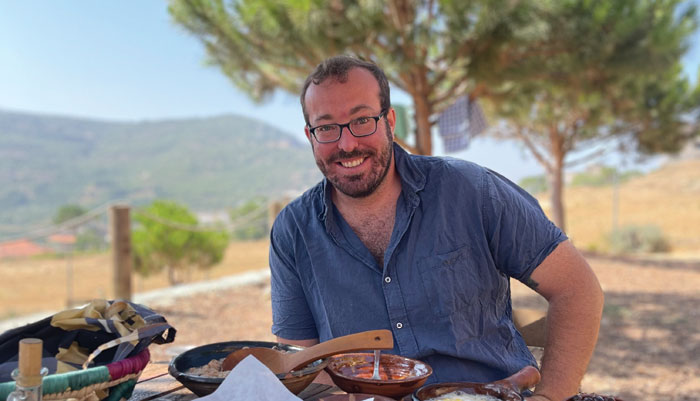
Daniel Osborn, a history educator and researcher, grew up in Massachusetts learning mostly about Ashkenazi history and culture, and attending a synagogue that was “entirely Ashkenazi,” he told me. Today, he is the President and Executive Director of Project Mosaics, a nonprofit he founded in Spring 2022 with the goal of using a “global approach to bringing the study of Jewish peoplehood into classrooms through digital multimedia content,” he said.
Osborn’s work is unique because it focuses exclusively on history education as it relates to non-Ashkenazi Jews (particularly from Iran), and because the program is currently offered to a population that may know the least about the diversity of Jewish history: students and teachers at public schools.
For Osborn, who is based outside of Boston, the emphasis on Jewish plurality, whether relating to history, arts or identities, is key. A high school freshman when Sept. 11 occurred, Osborn graduated high school frustrated with the nature of the social studies education he received at his public school.
“My understanding of the peoples that populate the Middle East and North Africa was malnourished because the history of this part of the world was not part of the education I received,” he said. And that included the history of the Jews of the Middle East and North Africa.
Osborn was already “years into an internal exploration” about Jewish history and identity when, as a junior at a Quinnipiac University in 2007, he visited Israel during a Birthright trip and had “deep, meaningful interactions” with young Israelis whose families hailed from Iraq, Iran, Morocco, Egypt and Yemen. The experience helped Osborn realize that he felt “intellectually ill-prepared” in understanding the dynamic plurality of the Jewish people.
In the years that followed, he graduated magna cum laude with a bachelor’s degree in arts and history, and received a master’s degree in secondary education teaching. In 2012, Osborn received a Master’s in Near East and Judaic Studies from Brandeis University, where his capstone project was titled “Defended with Distinction: A Political and Intellectual History of the Middle East in the Twentieth Century: A Curriculum.”
In 2016, Osborn received a doctorate in education in Curriculum and Teaching; History and Social Studies Education from Boston University. Project Mosaics is Osborn’s response to the omission of lesser-known, but deeply vibrant Jewish histories that teach students about the other half of world Jewry. And if anyone knows how to put together an engaging and nuanced curriculum, it is Osborn, who has also created professional learning programming for K-12 teachers that have emphasized inclusivity.
Osborn obtained his doctorate in education with the intention of “continuing to play a role in affecting change in history education in public schools, not as a teacher, but at the level of writing curriculum, influencing policy, and having a more seismic change,” he said. As a result, he became a curriculum writer. He also spent years working at nonprofits and helping train teachers to make classrooms more representative of human diversity.
The Project Mosaics website captures Osborn’s astute understanding of teaching. “Education is changing,” according to the website. “Students are demanding more inclusive history and educators need teaching tools that are accessible and compelling. There is room for Jewish joy and pluralism in this changing landscape.”
Osborn acknowledges the importance of learning about the Holocaust, but, given his background, he also understands the limits: “One thing I saw again and again was that students reported they were touched by Holocaust education, but they weren’t asked what they learned about Jewish people, how Jewish people identified, or how they felt joy as Jewish people.”
Yes, learning about Jewish joy is as important as learning about Jewish suffering.
“The Holocaust deserves to be taught,” Osborn added, “however, students need a multifaceted understanding of Jewish contributions over thousands of years. Otherwise, the Jewish people are narrowly defined.”
Holocaust education is vital, but its main takeaway for students can often focus on how Jewish people have been dehumanized. “It’s a real disservice because we also need education on Jewish joy, life and creativity.” – Daniel Osborn
Osborn is right. Holocaust education is vital, but its main takeaway for students can often focus on how Jewish people have been dehumanized. “It’s a real disservice because we also need education on Jewish joy, life and creativity,” he said. “It’s an incomplete education because we don’t say, ‘If antisemitism is wrong, here is what’s right.’”
Project Mosaics has launched its debut film series, “The Jews of Iran,” and Osborn has collaborated with poets, scholars, artists and memoirists to tell vibrant and untold stories of Jewish dynamism. In one video, “Rooted in Tehran,” author Roya Hakakian sheds light on Jewish life in Iran before the 1979 revolution (Hakakian is the author of “Journey from the Land of No: A Girlhood Caught in Revolutionary Iran”).
In several other videos, Esther Amini, author of “Concealed: Memoir of a Jewish-Iranian Daughter Caught Between the Chador and America” discusses the incredible story of the crypto-Jews of the Iranian city of Mashhad, as well as the trials and tensions of growing accustomed to life in America, while still feeling deeply connected to Iran.
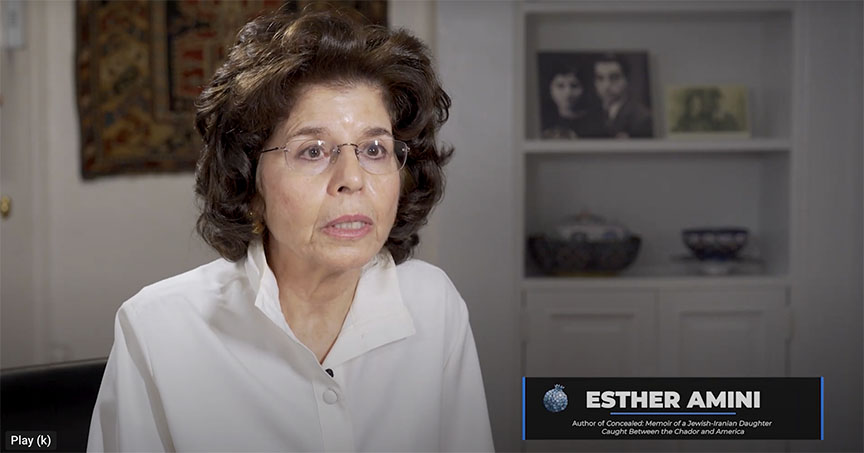
“Mizrahi Jews, coming from various Middle Eastern countries, have unfortunately been lumped together as all the same,” Amini told me. “This, of course, is not true. Each has a distinctly different story. I deeply commend Daniel for taking it upon himself to share our lives and enlighten not only the Jewish world but the world at large.”
Osborn is particularly invested in cultivating relationships with female memoirists and historians to create multimedia resources for students and teachers. Currently, Osborn, who is Project Mosaics’ only staff member, is working with a documentarian to create digital videos, such as “The Jews of Iran,” that may be used as core curriculum resources that will also be complemented by lesson plans, curated primary sources, and accompanying graphic organizers and handouts.
Videos are designed with student audiences in mind and decisions are based on Osborn’s understanding of trends in curriculum today. For example, he noted that short videos are now often replacing teacher lectures because they are seen as more dynamic.
“Curriculum won’t be taught just because it exists,” said Osborne. “Teachers have to be trained in how they implement it.” Osborn also does not “blame teachers” for what is taught or omitted in classrooms. “Teachers are a product of their own education,” he said. “We teach what we know, and we know what we’re taught.”
Today, Osborn’s primary focus is on public schools, but content will also soon be available at Jewish schools, after school programs and community centers. The mission of Project Mosaics has perhaps never been more critical, as we are currently witnessing levels of Jewish dehumanization, whether on campus, in the media, or even at a global music competition, not seen since the Holocaust. Osborn has a response to this painful challenge: “Studying Jewish people and Jewish history is itself a vehicle for seeing the humanity of Jews,” he said. “Once students see the humanity of Jews, that is one way we successfully counteract apathy and animosity.”
For more information, please visit projectmosaics.org
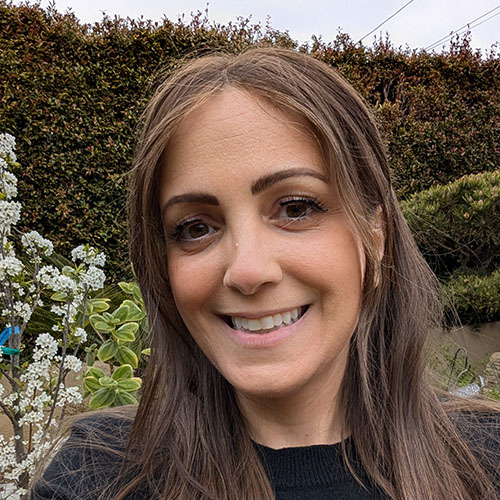
Tabby Refael is an award-winning writer, speaker and weekly columnist for The Jewish Journal of Greater Los Angeles. Follow her on X and Instagram @TabbyRefael.