fbpx

May 15, 2024

Experiencing Oct. 7 through Virtual Reality

It has been a while since I wrote in my column here at the Jewish Journal. There is a reason for my silence. I noticed that there were so many people, like myself, with views about Israel, Hamas, the Palestinian cause, antisemitism, genocide, and international politics. Like me, most live in relative safety, thousands of miles away from the trauma and terrifying human consequences of this current war. I realized that my opinion pieces were just that — my opinion, and nothing more. So, I did what I believe many others could have and should have done: Stop opining, and start to listen more.

I am writing this week after taking time to absorb the gravity of this unprecedented situation. I spent time in Israel, visited the sites of genocidal mass killings in the Gaza envelope, and delved into the experiences of Oct. 7 with its survivors. I am producing a virtual reality testimony program, “Be the Witness,” produced for the Israeli education organization Israel-Is. I also produced a forthcoming website with the A-Mark Foundation, which provides nonpolitical insights from experts in the Middle East using conversational video AI. I took time to listen and learn from the best minds in the field and make their expertise available to all.

This week as we remembered Yom HaShoah, the weight of the loss of 1,200 mainly Jewish lives on Oct. 7 was a terrifying reminder of the genocidal nature of antisemitism.

“Be the Witness VR” launched in London last week, the day after Yom HaShoah. Israel-Is CEO Nimrod Palmach has a mission to teach the world what ‘Israel is’ and has worked tirelessly to bring the story of the witnesses of Oct. 7 to the world so they can tell their own story in their own words at the places they experienced that day.

Using advanced immersive technologies, it is now possible to be at Kibbutz Be’eri and the site of the Nova music festival at Re’im. There, you can look directly into the eyes of Millet Ben Haim as she describes the moment the music stopped. 

Using advanced immersive technologies, it is now possible to be at Kibbutz Be’eri and the site of the Nova music festival at Re’im. There, you can look directly into the eyes of Millet Ben Haim as she describes the moment the music stopped. You can be under the bush as Mazal Tazazo describes the moment she awoke after being rifle-butted, only to find her two best friends lying next to her, dead.

I have felt many things during the learning journey I have been on: At times, sadness; occasional anger; consternation about the ways in which ideological extremism seems to continually overwhelm the middle ground; sorrow at how the evil of a small group of people can create deep divisions in families and communities worldwide; disgust at the way the perpetrators of Oct. 7 were not content to kill, but also raped, mutilated, and tortured their victims; wonder at the resilience of the young people caught up in this war through no fault of their own; and concern about the lack of empathy for Palestinians in Gaza, who have endured immense suffering at the hands of Hamas and the toll of war.

The one thing I have not felt is fear. There are several reasons for this. The first is the strength I have derived from the survivors themselves. I have been listening to their stories almost daily as we worked on “Be the Witness VR,” which includes five individual eyewitnesses telling their stories. They had much to fear, and yet, despite the immense trauma they have been through, they are resilient. Like the generation of Holocaust survivors who went before them, despite their profound disappointment in human behavior, they promote love and empathy. Knowing that Hamas is a lethal and manipulative enemy is not the same thing as fearing them.

Secondly, during my listening journey, I have witnessed the diversity and resilience of the Jewish people as never before. To much of the outside world, a Jew is a Jew is a Jew, all tarred with the same brush. What they don’t have the privilege of seeing is just how amazingly different we all are. They don’t see our sharply divergent views on politics, religion, and culture. As far as I can tell, there are 15 million different versions of what it means to be a Jew. There is one overriding exception, which is why antisemites can be forgiven for misreading our unanimity — when faced with anti-Jewish hatred, Jews know where the buck stops. We will fight for our survival.

One thing I have done during my hiatus is to take time to listen to Palestinian voices too. Not the angry, vociferous tirades we encounter on our news channels, but the ordinary people caught up in a war that is not of their making. It’s hard to hear when the volume is so loud, but my staunch opposition to Hamas and its destructive ideology does not need to mute the empathy I feel for the devastating loss that so many Palestinians have endured.

If we want humanity to prevail, our own humanity must also survive, however much we mistrust one another now. Germany was once the enemy that carried out Oct. 7 for the equivalent of 5,000 such days. Today they are our ally. 

I have spent much of my life studying the Holocaust, not because I am interested in how Jews died, but because I am interested in how Jews survived and have told their own story. Anti-Jewish hatred culminating in mass murder is part of a long history of persecution, regrouping, and restoration that has endured for many thousands of years. Hamas, like all the others, will one day be a blip, a distant memory in the Jewish people’s long and enduring legacy.

“Be the Witness VR” uses the latest technology to tell an ancient story—that in spite of everything, Jews will survive, we will teach the power of love and humanity over hate and barbarism, and we will all be stronger for it.


Stephen D. Smith is Executive Director Emeritus of USC Shoah Foundation and Founder of the Chatterbox Group.

Experiencing Oct. 7 through Virtual Reality Read More »

Breaking Barriers

Did the Jews kill Jesus? Who (or What) on Earth Is a Jew? Are Jews White?

These are among the uncomfortable questions that have been asked about the Jewish people. Some have been spread as lies throughout history. The more sinister accusations have led to devastating consequences, while others have put Jews in uncomfortable positions, ones where they are forced to defend themselves against stereotypes and fight for their place in the world. 

In their new book “Uncomfortable Conversations with a Jew,” Emmanuel Acho and Noa Tishby tackle these questions – and much more. After the success of Acho’s bestselling book “Uncomfortable Conversations with a Black Man,” the author, a former NFL linebacker, approached Tishby and asked if she wanted to co-write a new book in the same vein, but featuring information about the Jewish community.

They set out to tackle all the taboo subjects in the Jewish world: Jews and power. Jews and money. Jews and privilege. The Black and Jewish struggle. Tishby and Acho hoped to foster unity among the Black and Jewish community, as well as reveal the truth about Jews, no matter how uncomfortable it got.

The two started working on it – Tishby was already a celebrated author with her book “Israel: A Simple Guide to the Most Misunderstood Country on Earth” – and they set out to tackle all the taboo subjects in the Jewish world: Jews and power. Jews and money. Jews and privilege. The Black and Jewish struggle. Tishby and Acho hoped to foster unity among the Black and Jewish community, as well as reveal the truth about Jews, no matter how uncomfortable it got.

“I don’t like marginalized communities fighting in siloes. I think it’s extremely inefficient. What if we collectively fought for, and with, one another? We’d be much more efficient in creating collective success.” – Emmanuel Acho

“I don’t like marginalized communities fighting in siloes,” Acho told the Journal. “I think it’s extremely inefficient. What if we collectively fought for, and with, one another? We’d be much more efficient in creating collective success.”

Acho and Tishby’s collaboration began well before Oct. 7, before the antisemitism that was always below the surface spilled over into city streets, on social media platforms and on college campuses nationwide. 

“It was a time in which the Jewish community knew there was a problem, but the outside community did not and thought we were crying wolf,” Tishby said. “They didn’t realize there was a rise in antisemitism like we did, but Emmanuel had. He saw we were in pain, and he wanted to do something about it.”

The authors set out to answer the frequently asked questions about Jews and offer facts about topics including blood libel, the Holocaust, Zionism, cultural vs. religious Judaism and accusations about the Jews from “The Protocols of the Elders of Zion,” which purports that Jews are plotting global domination. 

In the book, Tishby and Acho go back and forth, with Acho asking the questions, Tishby giving answers and both of them relating on the similarities between the Black and Jewish communities. The book addresses the antisemitism that was always there, since the beginning of time, and the harsh realities of being a Jew in a post-Oct. 7 world. 

One of the chapters that addresses a long-held antisemitic belief is the one that asks, “Did the Jews kill Jesus?” Acho starts it off by saying, “One of the most fascinating areas of tension in society, as it pertains to how the world relates to Jewish people . . . or at least how my world — being a Christian — relates to Jewish people, is the question surrounding who killed Jesus.”

Tishby answers, “Ahh. We’re going hardcore, aren’t we? I love it. Growing up in Israel, I actually had little to no exposure to Jesus. Which is sad, considering he was a local. When I moved to the U.S., though, I realized that, to some extent, Jesus’s life and death were historically the source of a good amount of antisemitism — and this was a shock to me.”

Acho talks about how he learned that “the Jews cried out for Pilate to release a man named Barabbas, who had been imprisoned for murder, and to crucify Jesus instead,” but that the Jews did not physically kill Jesus. 

Tishby asks him, “Even if Jesus had literally been physically killed by a Jew — which we all, including the former Pope, agree he wasn’t — why would another Jewish person who lived thousands of years later be blamed for that? Let’s just say for the sake of this argument that the Jews killed Jesus for real, like actually, physically put him on the cross. That still doesn’t excuse blaming an entire people for what, say, 50 Jews might have done 2,000 years ago.”

Acho agrees: “Not to mention, as a Christian, Jesus had to die. The purpose of Jesus being born was to die and become the ultimate sacrifice for all of our sins, so that everyone could have the opportunity for right-standing with God. So, who killed Jesus is a worthless argument to begin with.”

The Jesus chapter, in the context of the new post-Oct.7 reality for Jews, comes off as lighthearted. The parts of “Uncomfortable Conversations with a Jew” that contend with Oct. 7 are much more emotionally difficult to read. 

The intro to the book, which is called, “Check on Your Jewish Friends,” is about Acho’s and Tishby’s experience that tragic day. It was Friday, Oct. 6, and Acho was signing on to social media just before midnight. He saw that Tishby was going live on Instagram, which was unusual for her. 

“I tuned in, if anything to make sure she knows she’s actually on live and hasn’t hit the button accidentally or some other scandalous business, and there she is, sitting at her desk,” he says. “It’s serious. It’s tense. And she seems a little frantic.”

He watched as Tishby, clearly distraught, talked about the Hamas terrorists who had invaded Israel, her homeland, as she saw what was happening from Los Angeles, where she now lives. 

“I couldn’t make out much from what she was talking about because I had no context,” Acho said. “All I could wrap my head around was ‘Israel’s been attacked’ — but truth be told, I didn’t really know what that meant because we’ve been here before; it’s not like this is the first time we heard the words ‘Israel’ and ‘terrorist violence’ in the same sentence. And after about 20 minutes, close to midnight, I logged off.”

Tishby stayed up all night on Instagram Live, piecing together the story and giving updates to her followers. 

“These testimonies from the South of Israel were horrifying beyond imagination,” she said. “These were the same stories I’d heard from my grandparents about what had happened to them in Europe, and it was now being done to Israelis in pastoral villages and at a music festival in the south of the country.”

When Acho woke up the next morning, he saw Tishby was still live, still wearing the same clothes from the previous night, still sitting in the same spot. Throughout the day, he kept checking in on her stream from his work desk, and offered to go live with her on his Instagram to give his followers updates about what was happening. 

“I set up my computer in my office and went live. I had so many questions for Noa, but my very first was simply, ‘Are you okay?’” Acho says. 

“I was very much not okay,” Tishby responded.

The two spent an hour talking about the events unfolding, and at the end, Acho asked Tishby, “What can I do to help?” 

“Stop what you’re doing and check on your Jewish friends,” she said. 

The book continues with more on Oct. 7, with chapters like “October 8th” and “You’re Too White” touching upon it. 

Everything is out in the open; nothing is off-limits. But when readers get to Chapter 16, there comes a truly uncomfortable moment for Acho and Tishby. Titled, “How This Book Almost Didn’t Happen,” it discusses when the book looked like it was going to fall apart, right after Oct. 7. 

“There was a moment in which Emmanuel asked me to come on his platform, on ‘Uncomfortable Conversations’ [on YouTube], and he invited another person I was not happy with – a person who is extremely radical,” Tishby said. “It exploded. The entire project exploded.”

Acho’s channel featured Tishby as a guest to talk about what was going on in Israel, and he told her that he was going to film a second interview with a historian and Middle East expert to explain how “we got to where we were at,” Tishby says in the book. 

“Then you sent me the trailer and, Emmanuel, I was devastated,” she continues. “You had edited me into a trailer for the interview not with an expert, but with a Palestinian woman who is a well-known anti-Israel activist and who, on Oct. 7, while bodies were still bleeding, justified Hamas’s actions, saying, among other things, that the number of dead Israeli women, children, and men is ‘bean counting.’ She rejected the description of the atrocities as ‘barbarism’ and appeared to defend the actions of Hamas, a designated terrorist organization.”

Though the book doesn’t state who the woman is, Acho had interviewed Noura Erakat, an attorney and associate professor of international studies, who in the past stated that Israel is on a “depraved pursuit of wealth and privilege.” 

Tishby was disappointed that one week after Oct. 7, Acho had interviewed Erakat, seemingly because there was pressure from his audience. 

“To be brutally honest, it felt like you were covering yourself with your followers by having both of us on,” Tishby said. “Putting me on a split screen with a woman who insisted on calling the members of Hamas who had raped women and burned babies ‘militants’ rather than ‘terrorists.’ It was too much for me. And the book collaboration ended.”

Eventually, after some time passed, and they both processed what happened, they decided to resume the book, and to accomplish something bigger that was obviously necessary. “It was very real and raw, and we learned a lot,” Tishby said. 

The two explored why they acted the way they did – Acho explained he wanted to hear the “pain and hurt on both sides” and Tishby admitted that she felt like she couldn’t trust Acho anymore. Eventually, after some time passed, and they both processed what happened, they decided to resume the book, and to accomplish something bigger that was obviously necessary.

“It was very real and raw, and we learned a lot,” Tishby said. “After we came through it, and decided the existence of the book is so important, we sat down and started the process again. That allowed us to grow so much. Anybody who reads the book now says that moment is the most revealing, gripping and intense part of it. They ask, ‘How are you guys still friends after this?’”

It’s clear: The two are comfortable being uncomfortable. 

This is certainly obvious in the chapters on the question of Jews’ whiteness, which is especially prevalent now, when Jews are being called white oppressors who commit genocide and aim to ethically cleanse Gazans. 

Chapter 5, “Sooo, Are Jews White?,” doesn’t shy away from the race issues in America and the tension between the Black and Jewish communities. 

Acho said to Tishby, “In America, my Jewish brothers and sisters have the privilege of being perceived as white. Historically, they have not been discriminated against in America based upon the color of their skin; they did not have to suffer Jim Crow laws, or public abuse without justice at the hands of the police. So, when Jewish people in America say that they are not white, it sounds to me like they’re trying to have it both ways. They get the benefits of being members of the oppressive class while also claiming minority membership.”

Tishby responded that to some people, Jews are not white enough, and to others, Jews are “too white.” She talks about how some Eastern European Jews are white-passing, but how they have historically been discriminated against in the U.S. and were only allowed to integrate into white society over the past two generations, assuming they had, “done their best to assimilate, or blend in with the way they dressed, spoke and lived. It was kinda like ‘don’t ask, don’t tell’ for Jews.”

“I hear that, and I don’t disagree,” Acho said. “But I still wrestle with the fact that a Black person has to worry about inherent disrespect and daily danger by law enforcement, and you don’t—and I think that’s a point of great tension.”

Tishby validates his concern, and tells him, “I don’t have to worry about being shot if I run a stop sign, whereas you do,” but then goes on to elaborate how perceiving all Jews as white diminishes the experience of Moroccan, Iranian, Israeli or other non-white Jews “who resent the idea of Jewish whiteness to the core.”

The conversation goes on for another two chapters, where Tishby discusses all the different parts of the world where Jews ended up, details the diversity of the community and explains how Jews have been hurt, even when they’ve assimilated, because they were perceived as being too white.

“Many Jews are both white-passing and our experience can only fully be understood through the prism of ongoing persecution, expulsion and execution,” Tishby says. “Plus, the collective trauma of what’s been done—plus, the never-disappearing anxiety of what could come next.”

Along with the conversational question and answer part of the book, “Uncomfortable Conversations with a Jew” offers resources for readers, like other books they should check out, a glossary of Jewish terms, people they can follow on social media and information on how they can be an ally, especially during these trying times. 

As an ally to Tishby and the Jewish community, Acho has gotten flak from both his followers and those on the pro-Palestinian side. Recently, he went out to dinner, and as he left the restaurant, he heard someone say, “I hope they pay you well.” He leaned into this person, who was a woman, and didn’t break eye contact, even though she was covering her face and head with a scarf.  

Acho asked, ‘Who is they?’” 

“You know who. The Zionists.”

Acho exhaled and said, “I am not pro- or anti-, I am pro-the goodness of all people. I’m not against Palestinians. I speak truth, love and humanity.”

He asked the woman what her name was, and she replied, “You don’t deserve my name.” He then told her to have a good evening.

“If this woman was bold enough to speak to me in this manner, what else might she be bold enough to do?” Acho said. 

Tishby was blown away by this. “Look at what happened. Emmanuel experienced an antisemitic attack that went to the oldest trope in the book. What would she do to a Jew who’s not 6’2″ and over 200 pounds? How aggressive would she get?”

It’s a harsh reality that Jews are living in, but both Acho and Tishby believe that sitting down and talking is the key to tackling the issues of today.

“Truth, love and grace are the best way to have a conversation. When you approach with love, that’s the best way to move a heart.” – Emmanuel Acho

“I always approach with love, because you catch more flies with honey than vinegar,” Acho said. “Truth, love and grace are the best way to have a conversation. When you approach with love, that’s the best way to move a heart.”

For Tishby, co-writing “Uncomfortable Conversations with a Jew” was her way of trying to solve problems, educate others and give her Jewish community support and guidance … something that’s absolutely necessary post-Oct. 7. 

“The remedy is always communication,” she said. “We needed to show people how to have these conversations. The only way out is to go through it. This is one example of how to do it, how to discuss Judaism and Zionism and all these things.”

She continued, “Jewish college and high school students ask me, ‘How do I answer to this? How do I answer to that?’ ‘When someone challenges me about Zionism, what do I say?’ This book is for the Jewish community to learn to have these conversations. Know your facts, and go through it. Have a conversation.” 


Kylie Ora Lobell is the Community Editor of the Jewish Journal. 

Breaking Barriers Read More »

Words Forged Through Fire

Amidst the cacophonous chants of “From the River to the Sea, Palestine Will be Free” and “Intifada Revolution” there remains, somehow, a controversy over the intent of these slogans. Pundits either naively or, puffed up with purposeful ignorance, suggest these phrases somehow mean less than a call for the Jewish homeland, which has just celebrated its 76th birthday, to become judenrein, free of Jews. The Nazis had a similar aim for the entire world, as they murdered six million of our people. 

In his book “Foundation of Faith,” a commentary on the tractate of Mishnah “Ethics of Our Fathers,” which is traditionally studied during the weeks between Passover and the holiday of Shavuot, Rabbi Dr. Norman Lamm, the late, long-serving President of Yeshiva University, offers a Jewish perspective on the power of words. It stands in stark contrast to the hateful chanting of those who seek to harm us.

Rabbi Lamm, whose fourth yahrzeit is the day after Shavuot, offers a key insight into the eleventh Mishnah of the first chapter. Commenting on the admonition of the scholar Avtalyon’s cautioning, “Sages, be careful with your words,” Rabbi Lamm elaborated that “Judaism regards words as more than mere verbal units, as just another form of communication. In Judaism words are, or should be, holy!”

When the Torah cautions against the breaking of promises it uses a Hebrew word that means “profane.” To misuse one’s mouth is to make unholy a sacred gift, our aptitude for articulation.

“The sanctity of our word is a measure of the confidence we deserve, whether in business or in family,” Rabbi Lamm argued, a warning to those who feel the unyielding inclination to spew meaningless musings over all manner of social media. 

“The sanctity of our word is a measure of the confidence we deserve, whether in business or in family,” Rabbi Lamm argued, a warning to those who feel the unyielding inclination to spew meaningless musings over all manner of social media. Appreciating the sanctity of speech should be a value all Americans, regardless of religion, possess. After all it was former Supreme Court Justice Oliver Wendell Holmes Jr. who argued “Life and language are alike sacred… Homicide and verbicide are alike forbidden.” 

Turning his attention to the Israelite military victory over the nation of Midian amidst the trek through the desert on the way to the Promised Land, Rabbi Lamm reminded his readers that God cautioned the Children of Israel against using the materials and vessels seized from the murderous Midianites until they had been purified and cleansed. “Every utensil that had been used over an open flame,” God instructs in the Book of Numbers’ 31st chapter, “must be purified by passing it through fire.” Discussing the subsequent Talmudic debate over whether a metal vessel that produces sound needs to be similarly sanctified, Rabbi Lamm notes a purposeful pun. Not only kol davar, every object, need pass through fire, but kol dibbur, each utterance. Expanding on this ancient principle, he writes:

“Every word spoken by human lips must be passed through the fire of the soul before it is spoken to the world at large. Every word must be passed through the flame of integrity, of sincerity, of consideration for others and the effect that the word may have on them. A word untempered in the furnace of integrity and wisdom is like a table unplaned and unfiled: Its splinters and rough edges can injure far more than the table can serve. A word not passed through the fire of consciousness is the master and not the servant of him who speaks it.”

The Jewish affinity for the positive power of speech extends beyond the religious sphere. When the renowned Israeli writer Amos Oz and his daughter Fania published what the late British Chief Rabbi Lord Jonathan Sacks called “their secular credo … of what it is to be a Jew,” father and daughter titled it “Jews and Words.” And, as Rabbi Sacks noted, when the great historian Simon Dubnow lay dying after being shot by the Nazis in the ghetto in Riga in 1941, his famous last words were, “Yidn, shreibt un farschreib,” “Jews, write and record.” The last thing Dubnow wanted to say to the Jewish people before he died in the Holocaust was to laud the lasting imprint of language. His final utterance, writes Rabbi Sacks, was that “the witness of words was our legacy to the world.”

As malevolent, murderous mottos continue to be directed against us, then, let us take Rabbi Lamm’s teaching to heart. We should respond, always, as proud Jews, a people who see speech as a sacred gift from the Lord and the meaning of our words as expressions of faith forged, continuously, through fire.


Rabbi Dr. Stuart Halpern is Senior Adviser to the Provost of Yeshiva University and Deputy Director of Y.U.’s Straus Center for Torah and Western Thought. His books include “The Promise of Liberty: A Passover Haggada,” which examines the Exodus story’s impact on the United States, “Esther in America,” “Gleanings: Reflections on Ruth” and “Proclaim Liberty Throughout the Land: The Hebrew Bible in the United States.”

Words Forged Through Fire Read More »

As Certain as Death and Taxes

In November 1789, as he neared the end of his life, Benjamin Franklin penned a letter to the French scientist Jean-Baptiste Le Roy, concerned after not having heard from him since the start of the French Revolution just a few months earlier. Le Roy, known for his work in physics and as a pioneer in the field of electricity, was an esteemed member of the French Academy of Sciences and a significant Enlightenment-era figure.

Franklin, writing in French, inquired about Le Roy’s health and the situation in Paris over the previous year. He then provided a brief update on the major developments in the United States, mentioning the recent ratification of the U.S. Constitution and the formation of a new government. “Our new Constitution is now established,” he wrote, “[and] everything seems to promise it will be durable.” Although, as he noted wryly, “In this world, nothing is certain except death and taxes.”

As was often the case with Franklin’s pithy one-liners later attributed exclusively to him – his “death and taxes” observation was not original. It first appeared in “The Cobbler of Preston,” a 1716 comedy by English playwright Christopher Bullock, with the main character, Toby Guzzle, uttering the immortal line: “’Tis impossible to be sure of anything but death and taxes.”

In any event, it is Franklin’s adaptation of Bullock’s quote that stood the test of time, and it has become synonymous with his name. Nevertheless, it has often struck me that what is missing in both Bullock’s original and Franklin’s reiteration is the one other certainty in the world – no less persistent and undoubtedly as permanent as death and taxes: namely, antisemitism.

Antisemitism has permeated societies for centuries. It has transcended geographical boundaries and historical epochs. From medieval Europe to the modern world, from the dusty provinces of the Ottoman Empire to the incendiary pages of Henry Ford’s Dearborn Independent periodical, from the evil rhetoric of Adolf Hitler to the paranoid theories of Joseph Stalin, antisemitism has proven incredibly resilient and pervasive, and it has cast a long shadow evident to this day.

The late Rabbi Jonathan Sacks wrote and spoke frequently about antisemitism. As he explained: “Antisemitism is not a unitary phenomenon, a coherent belief or ideology. Jews have been hated because they were rich and because they were poor; because they were capitalists and because they were communists; because they believed in tradition and because they were rootless cosmopolitans; because they kept to themselves and because they penetrated everywhere. Antisemitism is not a belief but a virus. The human body has an immensely sophisticated immune system which develops defenses against viruses. It is penetrated, however, because viruses mutate. Antisemitism mutates.”

And in its latest mutation, the cause of antisemitism is the Jewish people’s unshakeable love for and devotion to Israel, the sovereign country of the Jews, established – after almost two millennia of bitter exile – in their ancestral homeland, the land cited in the hallowed pages of the Hebrew Scriptures as God’s bequest to the Jewish people.

But as Rabbi Sacks observed, antisemitism has adapted and evolved over time, morphing into many different forms, even as it always retained its destructive core. Today, criticism of Israel has become the primary vehicle for antisemitism. And while the right to critique any nation’s policies is fundamental to democratic principles, it has become clear that anti-Israel sentiment and activism has veered, or more likely been deliberately directed, into the dangerous territory of bigoted, unbridled Jew-hatred. In polite company, no one will ever admit to hating Jews; instead, antisemites freely admit to hating Israel and Zionists, and indeed anyone who refuses to condemn Israel and call for its downfall (in other words, the vast majority of the world’s Jews).

Over the past few days, this façade was fully exposed for what it is in Los Angeles, at UCLA. After an illegal pro-Palestinian encampment was set up on the campus last Thursday, Eli Tsives, a 19-year-old theater and film major, attempted to attend a class. He was immediately obstructed by several students wearing keffiyehs and face masks. Despite showing his student ID and requesting access, Tsives, who was wearing a Star of David necklace, found his path firmly blocked by the group. Tsives is not Israeli, nor is the Star of David an exclusively Israeli symbol. Rather, it is a universally recognized Jewish symbol. This was enough for Tsives to be denied access to his class.

Jewish UCLA students have told me that they are frightened to walk around with yarmulkes and with their tzitzit visible. Last Sunday, in a big show of support for UCLA students, the L.A. community came out in force to show solidarity with Israel on the UCLA campus. The pro-Palestinian rabble – all of them cloaked in the keffiyehs that have become the mark of this latest manifestation of Jew-hatred – looked uncomfortable with the Jewish community’s unashamed, unadulterated love for Israel. And over the past couple of days, after confrontations between the illegal protesters and pro-Israel counterprotesters predictably descended into violence, LAPD finally came on campus to dismantle the unlawful encampment and to arrest the agitators who set it up and refused to leave.

The fight against antisemitism is a fight for the soul of America. All Americans must stand in solidarity with Jews against hate, and champion the values of understanding and tolerance.

The challenge ahead for American Jews is formidable, particularly in the post-Oct. 7 landscape. The response to this crisis will not only shape the future of Jewish community life in America, but it will also reflect the moral integrity of our nation. The fight against antisemitism is a fight for the soul of America. All Americans must stand in solidarity with Jews against hate, and champion the values of understanding and tolerance.

Last Shabbat, Jews across the world read the Torah portion of Acharei Mot, which includes the detailed rituals for the Yom Kippur service. The Day of Atonement is a profound opportunity for introspection and self-reflection, calling upon individuals and communities to recognize their shortcomings and seek forgiveness. In the spirit of Yom Kippur, American Jews must reflect on the complacency that has allowed us to believe antisemitism was no longer a significant threat. Recent events have shattered that illusion, revealing a disturbing resurgence of bigotry that demands a collective response.

Yet, we are not alone. Many of our fellow Americans are horrified by recent developments and will stand with us. As Rabbi Sacks so tellingly declared: “Jews cannot fight antisemitism alone. The victim cannot cure the crime, and the hated cannot cure the hate.” He added: “Antisemitism begins with Jews, but it never ends with them. A world without room for Jews is one that has no room for difference. And a world that lacks space for difference lacks space for humanity itself.”

And while the scourge of antisemitism may be as certain as death and taxes, this doesn’t excuse us from fighting back. We stave off death by staying healthy, and our accountants work hard to ensure we only pay the taxes we owe, and no more. It is time for us to stand up to antisemitism, to call it out for what it is, and to fight it with all our might.

The United States was the first country in human history to treat Jews as equals, allowing them to practice their faith without hindrance. It is time for our country to reclaim this glorious legacy, and to ensure that the tendrils of hate do not overwhelm the very essence of what made this country the greatest nation on earth.


Rabbi Pini Dunner is the senior spiritual leader at Beverly Hills Synagogue, a member of the Young Israel family of synagogues.

As Certain as Death and Taxes Read More »

Western Self-Hatred and the Offering of Israel

In 1978, as the protests against Shah Mohammad Reza Pahlavi were picking up volume and speed, Michel Foucault visited Tehran. He wrote several articles for the French and Italian press on the revolutionary proceedings and sat down for a conversation with the writer Baqir Parham to discuss world events. 

Turning first to the West, Foucault noted that the desire to establish a “non-alienated, clear, lucid, and balanced society” had begotten, over the preceding 200 years, Western industrial capitalism, which, he postulated, is “the harshest, most savage, most selfish, most dishonest, oppressive society one could possibly imagine.”

To Foucault, Marx was right in seeing religion as the opiate of the masses —except when it came to Shiite Islam.

The West, it appears, was pure evil. But new hope rose from the East, specifically from Iran, where young and old alike were casting off the yoke of tyranny. Foucault told Parham he agreed with those in Iran who said that Marx was right about religion being the opiate of the masses — except when it comes to Shiite Islam. Shiism is different, surmised Foucault, because of “the role of Shiism in a political awakening.”

Foucault cheered the crowds and wrote enthusiastically about the movement to oust the Shah (no doubt a corrupt dictator). Reading his words, one gets the impression that even more than wishing freedom for the Iranian people, Foucault seems to be excited about what he perceived as the Iranian rejection of modernity.

“Recent events,” he wrote just one month after his conversation with Parham, “did not signify a shrinking back in the face of modernization by extremely retrograde elements, but the rejection, by a whole culture and a whole people, of a modernization that is itself an archaism.” 

It wasn’t the Khomeinist movement that was retrograde, but modernity itself. As an archaic framework, it had to be removed, and Foucault celebrated what he perceived as Iran’s rejection of it. “Modernization as a political project and as a principle of social transformation is a thing of the past in Iran.”

As part of the French philosophical tradition (modern itself, alas), Foucault identified revolution with the Iranian people’s volonté générale. Accordingly, he hoped (in strange contradiction to much of his published thought), that while modernity has made Iranians alienated from themselves, the adoption of fundamentalist Islam would return them to their true identity and allow them to express true freedom. 

Foucault envisioned the Islamist revolutionary movement ending not in a ruthless theocracy but in an ideal “political spirituality,” ushering in a new form of nonalienated politics not only to the Middle East but to the whole world. His moral and political failure would haunt him for the few remaining years of his life, on which French author Didier Eribon writes that “The criticism and sarcasm that greeted Foucault’s ‘mistake’ concerning Iran added further to his despondency … For a long time thereafter Foucault rarely commented on politics or journalism.”

Revisiting Foucault’s romance with the Iranian revolution has nothing nostalgic today, when only two months ago an heir of Foucault as prominent as Judith Butler insisted that the Hamas attack on Israeli civilians on Oct. 7, which included mass murder, systematic rape, kidnapping of whole families and an attempted ethnic cleansing of more than 20 villages and three cities, was “armed resistance” and “not a terrorist attack.” The infatuation of thinkers in the Western radical left with Islamist terrorism has been more or less a constant, going back to the Soviet Union’s support of the PLO after 1967’s Six-Day War, when the Soviets saw a chance to put a proverbial spanner in the works, so as to undermine U.S. control of the region. But even without going into the historical-geopolitical reasons for this alliance, its symptoms have been constant — flaring up especially after 9/11. In its aftermath, one could read French postmodernist theorist Jean Baudrillard claiming that “the system forced the Other [= Al Qaeda] to change the rules of the game … Terrorism is the act that restores an irreducible singularity to the heart of a generalized system of exchange.”

Again we encounter Capitalism as the Infernal Fiend against which the terrorists rebel, and again the hope for authentic existence (“irreducible singularity”) born through the painful, though “unavoidable,” labor of mass murder. 

Islamist fundamentalism is an old favorite with these thinkers, and no doubt its sharp otherness from the secular West adds to its “authentic” charm. But there is nothing special about Islamist fundamentalism within this genre of thought, as can be witnessed, for example, as early as in Sartre’s infamous preface to Frantz Fanon’s “The Wretched of the Earth” (1961). Sartre conjures similar standards when he states that, in the rebellion of the colonized, “to shoot down a European is to kill two birds with one stone, to destroy an oppressor and the man he oppresses at the same time: there remain a dead man, and a free man; the survivor, for the first time, feels national soil under his foot.”

We find here the blueprint for the quest for authentic being through the aggrandizement of violence, though here relating to a more general indigenous nationalist, not specifically the Islamic fundamentalist. But there is something else that is common to all these arguments, which is the target of this kind of “authentic” violence. It is always the West.

More than a romantic infatuation with the not-so-noble savage, what we have here is a rejection of the West, condemning it and its offspring, modernity, as inherently violent, oppressive, imperialist, patriarchal, or just plain evil. This genre of thinking has a history, as Avishai Margalit and Ian Buruma display in their book “Occidentalism” (a play, of course, on Edward Said’s “Orientalism”). From the 18th century onward, “the West” has always been denigrated by its eastern neighbors, though how the West was defined had changed over time. France maligned the English, Germany thought that “Paris, Europe, the West,” as Richard Wagner once wrote, were corrupt with “freedom and also alienation,” Russian thinkers like Tolstoy and Dostoyevsky thought similarly about Germany as well, and Indian, Chinese and Japanese intellectuals viewed the whole of Europe as degenerate and depraved. 

Several strands of thought coalesce to produce this hatred. Romanticism of course, which considers rationalism and intellectualism as spurious artificialities detached from life; the pre-modern aristocratic view of commerce as debased and demeaning; the traditional devotion to hierarchy and authority, and the condemnation of a culture that sheds these off; the religious objection to secularization; and perhaps above all the dread and the feeling of loss that comes with a community’s transition into a society.

This transformation of Gemeinschaft to Gesellschaft, perhaps the cardinal question on which the field of sociology was established, should be viewed as the sum of all fears for any traditional civilization. The passage from the organic extended family or village to autonomous individuality, from a world suffused with myth and religiosity to a disenchanted universe engaged in meritocracy and trade, is what Durkheim warned against as “anomie,” or what Max Weber, at the end of his masterly “The Protestant Ethic and the Spirit of Capitalism calls “mechanized petrification, embellished with a sort of convulsive self-importance.” This is the crisis Occidentalism spurns, what, at heart, Foucault, Baudrillard, Sartre and Butler revolt against. 

Fascism of course also rebelled against the “decadence” of liberal society and promised a fierce and faithful Volksgemeinschaft. And were not dominant parts of the Marxist tradition, opposing liberalism as well, and promising a new society free from alienation, actually seeking a return to pre-modern tribal brotherhood? “The protest against the abstractions of modernity,” writes sociologist Peter L. Berger, “is at the heart of the socialist ideal.” 

Right now, however, this strange anti-modern revolt takes aim at Israel. As the most obvious manifestation of “West” in the midst of “East,” as what is considered the last living remnant of colonial rule and of imperialism (however small in scale), Israel acts as the lightning rod for the Occidentalists’ vitriol. Of course much of the criticism of Israel is warranted. Israel is subjugating another people militarily and tragically does not show signs it wants to end that subjugation. But the amalgamation of postcolonialism, postnationalism, and anti-racism that manifests itself as a celebration for Hamas’ “resistance” signals something deeper than justified objection to military occupation.

It’s enough to hear the calls for the complete destruction of the state to understand that the phenomenon we are witnessing carries a deeper sentiment than the advocacy for Palestinian independence.

The crowd which alternates between cries for ceasefire and for global intifada echoes Foucault and Baudrillard, this time seeing not the Shah or the global market but Israel as the instrument of modernity that has to be overcome. 

The crowd which alternates between cries for ceasefire and for global intifada echoes Foucault and Baudrillard, this time seeing not the Shah or the global market but Israel as the instrument of modernity that has to be overcome. In its focused locality, impudent pride and contrast with its neighbors, Israel becomes a Western coat of arms stuck within an oriental arabesque, an emblematic representation of the West, a metonym for the whole civilizational field that reaches from the Enlightenment to the industrial-military complex. 

Just as deposing the Shah was negligible for Foucault in comparison to the rejection of modernity, or Al-Qaeda’s fundamentalist jihad was invisible to Baudrillard, focusing as he was on their achieving “irreducible singularity” in an imaginary struggle against capitalist market forces, the Palestinians’ possible realization of their right of self-determination is here only a side-show to the imagined eradication of that island of Westernness in the midst of the East.

As the progenitor of Christianity, Judaism is conceived as the West’s most primitive kernel, the primal point of ur-Westernness. Israel thus becomes a Western totem, portraying the malevolent spirits of the West’s entire history.

Israel’s Jewishness obviously makes this a double whammy. As the progenitor of Christianity, Judaism is conceived as the West’s most primitive kernel, the primal point of ur-Westernness. Israel thus becomes a Western totem, portraying the malevolent spirits of the West’s entire history. In an incredible historical irony, the Jews are now not an oriental, semitic pariah nation nor a degenerate sub-human race, but the purest representatives of the West and the most atrocious white supremacists.

Moreover, as the West’s original essence, Israel naturally carries the West’s original sin: territorial and cultural colonialism. Making Israel pay for its racist colonialism is not only mandated as a step on the long march toward justice, but serves also as a purgative practice for other Westerners. Burning Israel, the effigy of the West, will cleanse the West itself from its past transgressions. The wish to eradicate Israel is therapeutic, indeed salvific: The sins of all the forefathers, those imperialist, colonialist, slave-holding Europeans, will finally be atoned. The Jewish state is thus set up to be sacrificed, burned as a Holocaust for the redemption of the original sins of the West.

In October 2021, shortly after U.S. military withdrawal from Afghanistan, filmmaker Ami Horowitz went to raise money for the Taliban at UC Berkeley campus — an obvious satirical stunt. Telling students that the Taliban needs the money to “strike against American interests around the world and in the homeland” because “America needs to be brought to heel,” he found students interested and willing to donate. Western self-hatred, in certain circles, has become fashionable to the point of banality. The reasons, overtly “imperialism” or “white supremacy,” are in truth much more subtle. It is a rejection, by a whole culture, of modernity itself. We cannot forgive ourselves for becoming modern.


Dr. Persico is a Research Fellow at the Shalom Hartman Institute and a Rubinstein Fellow at Reichman University. This essay was originally published in Café Americain and is reprinted with permission.

Western Self-Hatred and the Offering of Israel Read More »

Silencing Support: I’m a Student Body President, and I’ve Been Targeted for My Outreach to Jewish Students

When I began my term as student body president at Cal State Long Beach in June 2023, I aimed to ensure every voice was heard and represented, drawing from my own experience immigrating from India at the age of 14 and understanding the importance of having one’s voice heard.

I took an oath of office to prioritize the needs of the students, aligning with the mission and values of Associated Students Inc. (ASI), where I became the President/CEO. Unfortunately, most members of ASI Senate and the Senate board chair failed to uphold this mission. Despite their previous impartiality and commitment to “Keeping the Students First,” they neglected to consider all perspectives and protect all students. 

Amid the distressing events unfolding in Israel on October 7th, a student group named La Fuerza organized a rally on our campus that seemed to express support for the attack on Israel, as evidenced by heinous flyers featuring paragliders. Upon learning about the situation, I collaborated with student leaders to draft a neutral statement aimed at fostering safety and support for all students. On the day of the protest, I dedicated my time at the Beach Hillel Center, providing support and reassurance to students.

The following ASI Senate meeting, La Fuerza expressed dissatisfaction with the perceived lack of support for their demonstration and criticized the university president’s email communications. Meanwhile, Beach Hillel raised concerns about the use of paragliding images by La Fuerza on campus and voiced worries about safety. 

During this time, I noticed a troubling increase in biased attitudes among the majority of ASI Senate members. As biases increased in ASI, I felt marginalized for being the sole non-Jewish ASI student supporting the Jewish community. Despite no direct confrontations, I observed ASI members actively avoiding and disengaging from me.

Fall semester passed without any of the student leaders confronting me. Then, in the spring semester, on March 20, 2024, a seemingly coordinated group of students attended the ASI Senate meeting, demanding my recall, citing my perceived absence at their cultural center. 

One of the students was from La Fuerza, along with a representative from another club, alleged that I had affiliations with repressive organizations that harassed campus cultural organizations, thus advocating for my recall. 

I was taken aback when presented with a vote of no confidence, which would be the basis of recall. Throughout my tenure, I dedicated myself to fulfilling campaign promises, such as implementing a TAP card program for students in need of transportation assistance, advocating for undocumented students, supporting increased Pell and Cal Grant, and endorsing various state bills.

This pattern of derogatory remarks persisted into the subsequent ASI Senate meeting on March 27, 2024. However, amidst these negative comments, members from Beach Hillel came forward to express their support for me. They affirmed that I had provided assistance and fostered a sense of belonging for Jewish students on campus. 

Additionally, a member of the Lebanese Student Association, representing a nationality currently in active conflict with Israel, voiced their support for me. They highlighted my involvement in inclusive events and emphasized that previous comments made against me were personal, biased, and untrue.

On March 29, 2024, an Instagram post surfaced on an anonymous account, previously associated with La Fuerza. The post referred to me as a “grifter” and included a photo of me alongside Jewish students on campus.

As student body president, it’s imperative for me to remain impartial. Our ASI voted to call for a ceasefire resolution during the CSSA meeting, reflecting the majority sentiment among students. 

Advocating for a ceasefire does not diminish our support for Jewish students on campus, nor does it suggest tolerance for antisemitism or lack of support from student government members. The Instagram post seems to be an attempt by La Fuerza and ASI Senators to undermine my relationship with the Jewish community by sharing a photo of me without consent.

Despite repeatedly expressing my concerns to the ASI Senate board chair about the perceived unfairness, my pleas were ignored, with the chair claiming to share the sentiments of the students.

After the unauthorized photograph, I felt increasingly vulnerable. Despite repeatedly expressing my concerns to the ASI Senate board chair about the perceived unfairness, my pleas were ignored, with the chair claiming to share the sentiments of the students.

Despite my efforts to address the situation, the ASI Senate Board persisted in their pursuit of my removal, with only one month remaining in my term. The disregard for my viewpoint and the hostile environment created around me contradicts the principles of SR 2020-16, highlighting a lack of accountability and deviation from stated values.

This was my first encounter with antisemitism and it’s puzzling that groups like La Fuerza, vocal against social injustice, are also among its biggest perpetrators. 

These experiences have taught me that facing harassment, intimidation, and social isolation can be the consequence of holding an unpopular opinion. No student should have to endure such treatment. As a result, I am now more determined than ever to advocate for communities that are underrepresented throughout my academic journey and are subject to harassment.


Mitali Jain serves as student body president for 2023-2024 at Cal State Long Beach, majoring in Nutrition and Dietetics. 

Silencing Support: I’m a Student Body President, and I’ve Been Targeted for My Outreach to Jewish Students Read More »

Sonoma State President Announces He Has Been Placed on Administrative Leave

Sonoma State University President Mike Lee announced on May 15 that he is going on leave after issuing a statement the day before announcing an agreement with the pro-Palestinian encampment on campus, as the May 14 statement was not approved through the usual CSU channels.

Lee’s May 14 statement had stated that he agrees with the encampment’s call for a ceasefire in the ongoing Israel-Hamas war and that, among other things, the university would be forming an Advisory Council of Students for Justice in Palestine (SJP), which would consult with the university on possible divestment strategies. Further, the May 14 statement said that the university “will not pursue or engage in any study abroad programs, faculty exchanges, or other formal collaborations that are sponsored by, or represent, the Israeli state academic and research institutions” and also featured Lee stating that “none of us should be on the sidelines when human beings are subject to mass killing and destruction.”

In his May 15 statement, Lee said: “My goal when meeting with students at the encampment was to explore opportunities to make meaningful change, identify common ground, and create a safe and inclusive campus for all. I now realize that many of the statements I made in my campuswide message did just the opposite. In my attempt to find agreement with one group of students, I marginalized other members of our student population and community. I realize the harm that this has caused, and I take full ownership of it. I deeply regret the unintended consequences of my actions.”

He added: “I want to be clear: The message was drafted and sent without the approval of, or consultation with, the Chancellor or other system leaders. The points outlined in the message were mine alone, and do not represent the views of my colleagues or the CSU.”

Toward the end of his statement, Lee said: “As I step away on a leave, I will reflect on the harm this has caused and will be working with the Chancellor’s Office to determine next steps.”

As I step away on a leave, I will reflect on the harm this has caused and will be working with the Chancellor’s Office to determine next steps.” – Mike Lee

CSU Chancellor Mildred Garcia addressed the matter in a statement, saying that Lee’s May 14 statement “was sent without the appropriate approvals.” “The Board’s leadership and I are actively reviewing the matter and will provide additional details in the near future,” Garcia added. “For now, because of this insubordination and consequences it has brought upon the system, President Lee has been placed on administrative leave.”

JCRC Bay Area issued a statement thanking “California State University Chancellor Mildred García, who in a letter acknowledged deep concern ‘about the impact the statement has had on the Sonoma State community, and how challenging and painful it will be for many of our students and community members to see and read.’ We also thank the California Legislative Jewish Caucus and our partners at Jewish Public Affairs Committee of California (JPAC) and Jewish Federation Los Angeles for demanding change.”

StandWithUs posted on X, “The lesson from this is clear: Instead of trying to appease hate groups, campus leaders must enforce their policies and stand up to antisemitism.”

Grant Gochin, the parent of a Jewish student at Sonoma State who will be graduating this weekend, told the Journal, “When even a President of a State University can be duped with misinformation and disinformation, the whole world should be concerned about our younger generations falling for propaganda. History is repeating in real time. This small victory shows that with concerted effort, we can break the cycle of history.”

Sonoma State President Announces He Has Been Placed on Administrative Leave Read More »

The Elected Leaders Condemning Campus Antisemitism

Hineni.
Here I am.

Since the first tents were pitched at USC, I heard: “where are our elected leaders in California? Why are they silent?”  But we are not silent.  Here we are.

I was among the first elected leaders in Los Angeles to condemn the takeover of our California university campuses – a result of failed education policies and billions in foreign funding of US higher education.

The next day, while Nancy Pelosi met with London Mayor Sadiq “Ceasefire” Khan, Speaker Mike Johnson and other House Republicans called for the Columbia University President’s resignation.  Later that day, the protestors at USC violently clashed with LAPD.  

Hamas released a statement supporting the campus protests.  

The day after that, California’s Republican United States Senate candidate Steve Garvey held a press conference in Beverly Hills, unequivocally characterizing the violent protests as terrorism.

The day after that, Chairman of the Republican Party of Los Angeles County, Timothy L. O’Reilly, condemned the antisemitism on local campuses, called for the rights of Jewish students to be protected, and supported the police in clearing the encampments.

The day after that, California GOP Chairperson Jessica Millan Patterson spoke out against the campus protests and in support of students who were being discriminated against.

Then the floodgates opened. California Assembly candidate Carl De Maio spoke up against the ignorance of the activists who are supporting Hamas, and condemned the “Jew haters.”  GOP California Assembly candidate Mike Greer condemned the Cal Poly Humbolt occupation.  California Assembly candidate Patrick Lee Gipson condemned the violence at UCLA.  UCLA alumnus, Congressional candidate Dr. Alex Balekian (running for Adam Schiff’s open seat), called for the “defunding” of student protesters who are U.S. Citizens, deportation of those who are not, and destruction of Hamas (his opponent, a Jewish woman, has remained silent).  

Congressional candidate and El Cajon Mayor, Bill Wells, constantly condemns antisemitism and supports Israel, which is more than his Jewish Democratic opponent can say. Congressperson Michelle Steel (Cypress) challenged her opponent’s silence, calling the pro-Hamas protests “one of the biggest issues facing our country right now.”  Congressman Ken Calvert (Corona) criticized UC Riverside for coming to “terms” with SJP.  Congressman Kevin Kiley (Rocklin) called for dismantling all campus encampments and consequences for federally-funded universities. (This would not be his first public statement on the subject.). California Republicans, all.

California Assembly Republicans issued a statement condemning “antisemitic campus disruptions” and called on officials to restore order.  Assembly Republican Leader James Gallagher (Chico) gave a press conference highlighting Gov. Newsom’s silence.

After Newsom voiced support for “peaceful protest,” the California GOP chronicled the myriad ways in which antisemitism had engulfed California campuses, and challenged several sitting California elected officials to condemn the violence, vandalism, trespassing, and antisemitism.  There was no answer.  (Well, one answered something about white supremacy.)

Garvey challenged Congressman Adam Schiff and Los Angeles District Attorney George Gascon on their silence when Jewish students were barred from attending classes at UCLA. There was no answer.

Los Angeles County Young Republicans released a statement demanding local leaders to restore order.  Several of my colleagues from the Los Angeles County Republican Central Committee were on social media and FOX News with similar messaging.  Not one California Republican leader that I know of was sympathetic to the campus protests.

In contrast to Republican leadership, when President Biden finally made a statement over a week after the protests started, he “All Lives Mattered” us, since he can never utter “antisemitism” without saying “Islamophobia” in the same sentence.  Newsom and Mayor Bass eventually made belated statements, but only after protesters and counter-protesters clashed at UCLA, providing them cover to chastise both sides at the same time so they would not seem to favor one group over the other.  

These are our leaders?

It appears to me the issue is not that our leaders are silent; rather, it is abundantly clear to me the issue is that we are looking for our leaders in the wrong place.

It appears to me the issue is not that our leaders are silent; rather, it is abundantly clear to me the issue is that we are looking for our leaders in the wrong place.  It’s past time for Jewish voters in California to start looking to the Right.  Your leaders are there.

Hineni.
Here I am.
Send me.


Elizabeth Barcohana was elected in March, 2024 to the Los Angeles County GOP Central Committee for the 42nd Assembly District.  Her term begins January, 2025.  Elizabeth currently serves as an alternate on the Committee and as an Associate Delegate to the California GOP. You can find her on Instagram @Elizabeth_For_LA.

The Elected Leaders Condemning Campus Antisemitism Read More »

A New Way to Fight Antisemitism: Welcoming Israelites into Our Tent

Many Jews may be surprised to learn that a belief in Israelite ancestry is widespread among Black Americans in the United States today.  A recent survey found that 49% of Black respondents either somewhat or strongly agreed that Black Americans are descended from ancient Israelites, while only 13% of respondents felt that “modern-day Jews” do not have the same ancestry. This indicates that roughly a third of Black Americans believe in shared ancestry with modern-day Jews.

Where does this belief originate? While some Black Americans may identify with a spiritual connection with the Exodus story, others do so based on a genetic tie to the Igbo people in southeastern Nigeria. 

The Igbo – pronounced “Ee-bo”– have a long history of practicing customs similar to those of religiously observant Jews in other parts of the world, such as circumcision of males on the eighth day after birth and a custom of not eating fish without scales.  As anthropologist Daniel Lis describes in his book, “Jewish Identity Among the Igbo of Nigeria: Israel’s ‘Lost Tribe’ and the Question of Belonging in the Jewish State,” there is a longstanding oral tradition among the Igbo of Israelite descent.

The similarities between Igbo customs and Jewish rituals are so profound that Igbo historian Remy Ilona has noted that a Sephardic Beit Din ruled in 2022 that the Igbo are descendants of Israelites who were dispersed out of Israel during one of the many waves of expulsions throughout Jewish history.  

The similarities between Igbo customs and Jewish rituals are so profound that Igbo historian Remy Ilona has noted that a Sephardic Beit Din ruled in 2022 that the Igbo are descendants of Israelites who were dispersed out of Israel during one of the many waves of expulsions throughout Jewish history. This ruling was welcomed by many Igbo in Nigeria, some of whom have established synagogues and have begun to practice Judaism in its modern form. Filmmaker Jeff Lieberman profiles some of these emerging Jewish communities in his film “Re-emerging: The Jews of Nigeria.”  

In the United States, retired University of Southern Mississippi history professor Douglas Chambers, now head of the Igbo History Foundation, has estimated that as many as 60% of Black Americans today could have at least one Igbo ancestor. During the Trans-Atlantic Slave Trade, about 1.3 million Igbo individuals were trafficked to British colonies, including Jamaica and what would later become the United States. 

The first English-language narrative of enslavement was written by Olaudah Equiano, an Igbo man who had been kidnapped into slavery and later freed. His narrative, published in 1789 in London, ultimately led to the British abolishment of the slave trade in 1807. It is likely that 19th-century abolitionist Frederick Douglass also had Igbo ancestry, as the majority of those enslaved in Maryland, where Douglass lived, were of Igbo origin. 

Regardless of its source, the belief in Israelite ancestry among Black Americans presents a unique opportunity in the fight against antisemitism. 

The Anti-Defamation League has found that among those who did not have any relationships with Jews or who viewed interactions with Jews negatively, there was a higher likelihood of agreeing with antisemitic statements. Given that Jews are less than 3% of the U.S. population, most Americans do not have the opportunity to have personal relationships with Jews. If the concept of “Jew” is extended to include those Black Americans identifying as Israelites, then it is possible that many more Americans will have the opportunity to interact with those of us who share a common descent from ancient Israel. 

This expansive view of “who is a Jew” also helps counteract the false claim that all Jews are white and are therefore not indigenous to Israel. Although the majority of Jews in the United States do identify as white and have recent ancestors who lived in Europe, globally there is much more racial diversity among the Jewish people, with about half of all Israeli Jews having recent ancestors who lived in the Middle East, North Africa, or Ethiopia. Embracing those Black Americans with Israelite identities would highlight Jewish diversity in the popular imagination.

What specific steps could the Jewish community take if it wanted to explore this path? First, we must stop labeling expression of Israelite identity in the Black community as antisemitic. As long as it does not include a rejection of the Israelite identity of other Jews too, or a claim that Black Israelites are the only real Jews, Israelite identity among Black Americans could be considered an expression of philosemitism, precisely what would bring us closer together.

Once Black Americans with Israelite identities feel able to openly discuss their Israelite heritage without fear of being labeled antisemitic, there will be many opportunities for bridge-building and alliance-forming. 

Once Black Americans with Israelite identities feel able to openly discuss their Israelite heritage without fear of being labeled antisemitic, there will be many opportunities for bridge-building and alliance-forming. This work could go a long way in introducing Jewish history to younger Americans who are not familiar with the history of ancient Israel.

Finally, the Jewish community should make a special effort to embrace those in the Black community who practice Judaism as part of congregations affiliated with the International Israelite Board of Rabbis. Members of Israelite Board congregations conduct religious services primarily in Hebrew using the ArtScroll siddur, the prayerbook associated with Orthodox Judaism. They keep kosher, observe Shabbat and other holidays, and send their children to Jewish day schools. They are not at all affiliated with the extremist Black Hebrew Israelites who reject the Israelite ancestry of modern-day Jews.

While members of Israelite Board congregations may not be considered halachically Jewish, neither are many white Jews, some of whom outwardly reject their own Israelite identity and give comfort to those who are promulgating erasure antisemitism, where the Jewish spiritual and historical connection to Israel is erased. In contrast, supporting Israel and its right to exist as a Jewish homeland are core beliefs of Black Jews who are part of Israelite Board congregations.

Rabbi Baruch Yehudah, spiritual leader of B’nai Adath Kol Beth Israel, an Israelite congregation in Brooklyn, is a regular attendee at Jewish communal events, including the March in Washington in support of Israel last November. Yet on the bus heading to D.C., a woman said to him, “Thank you for supporting us,” as if he was separate from the larger “us.” 

My hope is that Rabbi Yehudah and his congregants, as well as all Black Americans who consider themselves Israelites, will eventually be welcomed into a more expansive Jewish tent, at least as ancient cousins if not halachic brothers. Given that open Jew-hatred is becoming not just socially acceptable but increasingly on-trend, it would be wise for us to expand our concept of “Klal Yisrael” — the greater Jewish people — to truly include all Israelites.


Simone Friedman is the Head of Philanthropy for EJF Philanthropies.

A New Way to Fight Antisemitism: Welcoming Israelites into Our Tent Read More »

Jewish Comedians Shine at ‘Netflix Is a Joke’ Festival

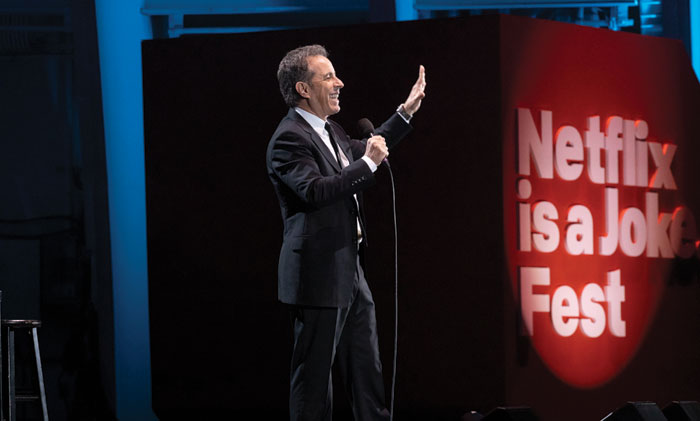
During the second annual “Netflix Is a Joke” festival – the largest comedy festival in North America – 400 shows took place across 35 venues in Los Angeles, including the Hollywood Bowl, the Comedy Store, the Hollywood Improv and Largo. Several Jewish comedians were there to offer up jokes, entertain audiences and lighten the mood. 

The festival, which ran from May 1-12, kicked off with Jerry Seinfeld headlining The Hollywood Bowl with Sebastian Maniscalco, Jim Gaffigan and Nate Bargatze. During his set, Seinfeld – who closed out the show – talked about turning 70, the impulse to use cell phones instead of experiencing life, his new Netflix movie “Unfrosted” and being married to his wife Jessica for over two decades. 

“When my wife tells me what we’re doing, it doesn’t matter if I knew about it or not,” he said. “Why would I have a conversation with my wife about what I thought was happening? Who would benefit from that? No one that I can think of. It would make as much sense as explaining to the dog what has been planned for the rest of his day. The dog doesn’t care or need to know. Dogs and husbands both understand: Just be ready to go out.”

On May 9, Phil Rosenthal, star of “Somebody Feed Phil” and executive producer of “Everybody Loves Raymond” took to the stage at the United Theater with Pete Holmes. The two discussed Rosenthal’s travels eating different foods around the world, and Rosenthal reminisced about his late parents, Max and Helen, Holocaust survivors who frequently appeared on their son’s show. 

When Rosenthal was asked what his last meal would be, he said, “a tuna fish sandwich” because that’s what his mom would make him when he was a kid. He also told Holmes that his father’s favorite thing in the world was fluffy eggs. Rosenthal’s wife, actress Monica Horan, along with his daughter Lily and son Ben were in the audience. He made sure to promote the new book he co-authored with Lily, “Just Try It!” which encourages children to try new foods. 

Other Jewish acts at “Netflix Is a Joke” included Todd Glass performing his show “The Event of a Lifetime” at the Upright Citizens Brigade; “The Comedy Baraar,” featuring Or Mash, Dan Ahdoot, Tehran and Menachem Silverstein at the Comedy Store; Jeff Ross at G.R.O.A.T. The Greatest Roast Of All Time: Tom Brady; standup and TV writer Morgan Murphy, who opened for Colin Quinn at Largo; Rachel Bloom at The Montalbán Theatre; and Howie Mandel with Arsenio Hall at The Comedy Store.

The first “Netflix Is a Joke” festival took place in 2022 and sold 260,000 tickets. For the past 10 years, the streaming service has been producing stand-up shows, with more than 350 currently available on the platform. According to their latest stats, comedy tours saw an increase of 127% in 2022 vs. 2019.

“This is a special time for comedy, both for Netflix and the genre at large,” Robbie Praw, Netflix VP of Stand-up and Comedy Formats, said. “We have the privilege of working with comedians who are selling out arenas, winning awards and building fandoms in the millions. In the 10 years that we’ve been doing stand-up we’ve seen the art form reach levels we didn’t think possible. This festival aims to capture this moment by bringing together the world’s best comedians for an unforgettable 11 days.”

Jewish Comedians Shine at ‘Netflix Is a Joke’ Festival Read More »