fbpx

May 15, 2024

Parent of Sonoma State Jewish Student Blasts University’s Deal With Pro-Palestinian Encampment

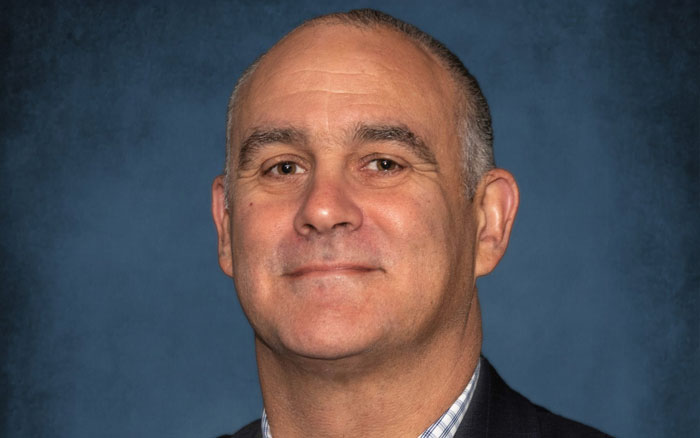
Grant Gochin, whose son is a student at Sonoma State University (SSU), blasted the university’s recently announced deal with the pro-Palestinian encampment on campus in an interview with the Journal.

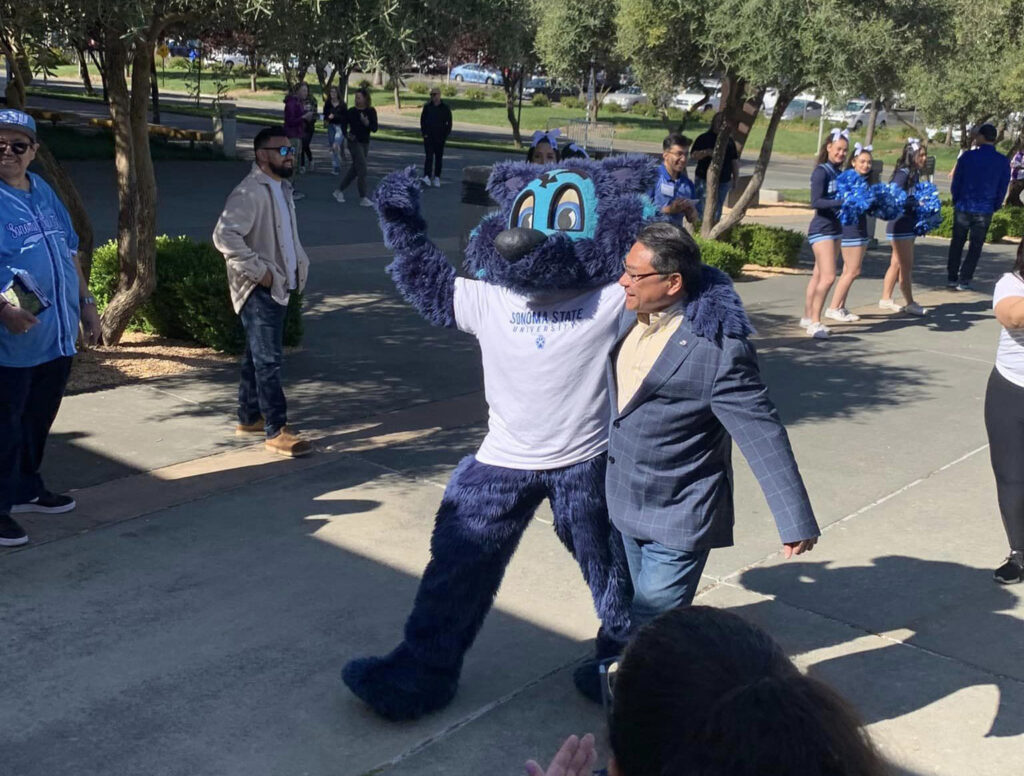
University President Ming-Tung “Mike” Lee announced in a May 14 community email that he had met with the members of the encampment earlier that day as well as on May 10 after senior administrators had listened to their demands. “None of us should be on the sidelines when human beings are subject to mass killing and destruction,” Lee said. “I have said this before and it merits repeating: There is no political, religious, or cultural principle that merits the murder of the innocent, and the one battle we should all be engaged in is the fight for inclusion, respect, and freedom for all people, regardless of their background or identity. I appreciated the civility and respect that centered our conversations, which opened the door to new ideas and opportunities.”

Lee proceeded to highlight the five aspects of the agreement. The first is the establishment of the Advisory Council of Students for Justice in Palestine (SJP), which Lee described as “a collaboration between SJP and Sonoma State and will be composed of members from the encampment, faculty, staff, administrators, Palestinian alumni, and other interested students, as determined by Students for Justice in Palestine” that will be meeting regularly at the beginning of the following semester. Their meetings will be open to the public. The council will hold the university accountable to “all agreements,” according to Lee.

The university will also be investigating their investments and will “determine a course of action leading to divestment strategies that include seeking ethical alternatives” in a meeting with the SJP Advisory Council and university administrators. “SSU will post and disseminate a Disclosure Statement related to funding amounts, the use of funding, and conditions attached to funds,” Lee stated.

As part of the agreement, “SSU will not pursue or engage in any study abroad programs, faculty exchanges, or other formal collaborations that are sponsored by, or represent, the Israeli state academic and research institutions,” added Lee. “SSU also commits to immediately updating any SSU pamphlets and SSU-hosted websites that may still be circulating or searchable and to remove hosting or linking to any pamphlets, flyers, or brochures advertising the study abroad program where students are encouraged to study abroad in Israel. SSU will make it clear to any students that any such programs are terminated until further notice and not simply suspended. SSU remains committed to upholding principles of academic freedom and open scholarly exchange. As such, SSU welcomes opportunities to engage Palestinian scholars and students, as well as individual Israeli scholars acting in a personal capacity.”

Further, Lee announced that the university will be developing “curriculum and programming for Palestine Studies” and that he is calling for a ceasefire in the ongoing Israel-Hamas war. “Both SSU Students for Justice in Palestine and I, President Mike Lee, oppose and condemn all acts of genocide, ethnic cleansing, racism, antisemitism, and other activities that violate fundamental human rights,” he stated. “And thus, I call for a ceasefire so that a process for permanent, peaceful resolution can be established.”

“They’ve clearly given into all the Hamas demands, putting the Hamas crowd in charge of the university program,” Gochin, who is based in Los Angeles, told the Journal. “It’s race-based, giving Palestinian students control. They’re going to teach Palestinian history and what exactly is that Palestinian history, who’s going to determine what is accurate and what is inaccurate? Are these universities now in the business of teaching propaganda or teaching facts?”

“They’ve clearly given into all the Hamas demands, putting the Hamas crowd in charge of the university program … It’s race-based, giving Palestinian students control.”- Grant Gochin

Gochin lambasted Lee’s statement as being “completely one-sided” and “a completely ideological response that isn’t based on fact … There was no insight to the Israeli side,” he contended. “Academic boycotts are illegal. It’s holding Israel to a completely different standard than any other country. The whole thing is completely outrageous.” He also argued that Lee’s statement violates Title VI and Title VII of the Civil Rights Act and that Lee’s intellect “should be called into question.”

“If somebody is so easily duped by student groups when it’s already known that these are Hamas groups putting out this propaganda, this faculty’s intellect itself should be called into question,” Gochin added.

Gochin has spoken to lawyers on the matter, and while his son would not have standing to sue because he’s on the verge of graduating (May 15 is his final day on campus), “we will be looking for other litigants and I hope there is litigation.”

His son “puts his head down and doesn’t get involved in all this other stuff,” Gochin added.

State Senator Scott Wiener (D-San Francisco) posted on X, “Yesterday the President of Sonoma State University aligned the campus with BDS [Boycott, Divestment and Sanctions], a movement whose goal is the destruction of Israel, home to 7M Jews. Several other UC & CSU campuses are doing this more subtly. Sonoma State simply said the quiet part out loud. The mask is off.”

The university is expected to release a statement on the matter later today.

UPDATE: Lee said in a statement to the campus community on the afternoon of May 15 that the May 14 statement was not approved by the usual CSU channels and that he is going on leave. He also apologized for the May 14 statement.

“My goal when meeting with students at the encampment was to explore opportunities to make meaningful change, identify common ground. and create a safe and inclusive campus for all,” Lee said. “I now realize that many of the statements I made in my campuswide message did just the opposite. In my attempt to find agreement with one group of students, I marginalized other members of our student population and community. I realize the harm that this has caused, and I take full ownership of it. I deeply regret the unintended consequences of my actions.

“I want to be clear: The message was drafted and sent without the approval of, or consultation with, the Chancellor or other system leaders,” he continued. “The points outlined in the message were mine alone, and do not represent the views of my colleagues or the CSU.”

Lee added: “As I step away on a leave, I will reflect on the harm this has caused and will be working with the Chancellor’s Office to determine next steps.”

Parent of Sonoma State Jewish Student Blasts University’s Deal With Pro-Palestinian Encampment Read More »

UC Berkeley’s Commencement Ceremony Disrupted by Pro-Palestinian Protesters

It’s not uncommon for a university like UC Berkeley with a rich history of student activism to see protests and demonstrations. However, the recent protest during Saturday’s commencement ceremony at California Memorial Stadium was particularly disruptive for the thousands of parents and family members attending. As the California Memorial Stadium filled with spectators, one section prominently displayed Palestinian flags and signs expressing opposition to Zionism and Israel. Once the ceremony started, hundreds of protesters began chanting in unison, disrupting the speakers with chants like: “Hey, hey, ho, ho, the occupation has got to go!” and “Free, Free Palestine.”

Sydney Roberts, the student body president, struggled to speak as the crowd kept loudly chanting. 

Photo by Ayala Or-El

At this point, Sunny Lee, the dean of students, interrupted her speech and spoke to the crowd: “Many see your pain. We hear you.” He then asked them to quiet down and allow Roberts to continue. “It wouldn’t be Berkeley without a protest,” she commented. 

Chancellor Carol Christ opened the ceremony by acknowledging the protests that took over the campus. “I’m saddened by how this conflict has divided students, faculty and staff,” Christ said. “While most of our campus community has engaged peacefully, political positions have bled over too easily and quickly to antisemitism and anti-Palestinian harassment.” Though she used a microphone to speak, it was difficult for people sitting in the benches next to the protesters to hear what was said. 

Melinda Vasquez, whose son was graduating, shared her heartbreak: “Unfortunately for us, we were sitting right next to them and they kept screaming in our ears. We were waiting for this moment and they simply ruined it for us. It was pretty scary and we felt intimidated. Nobody dared say anything to them.”

Vasquez said she had family arriving from as far as Texas for the ceremony and they were very disappointed that the demonstrators weren’t asked to leave. “I expected them to be escorted out at any moment, but they were allowed to disrupt the entire event, from beginning till end.”

Eti Mizrahi (Photo by Ayala Or-El)

Eti Mizrahi, whose daughter Ariel was graduating, said that her daughter missed having her high school graduation because of COVID, like many of the students who were graduating this year. “Now, they missed out on having on this experience too,” she said in an interview with the Journal. “I was sitting next to parents whose children were the first ones in the family to graduate university and they were in tears.”

“I noticed that there were two Palestinian flags held by members of the faculty on stage. I was shocked they allowed this. I believe the administration and faculty are antisemitic. Why did they allow this?”

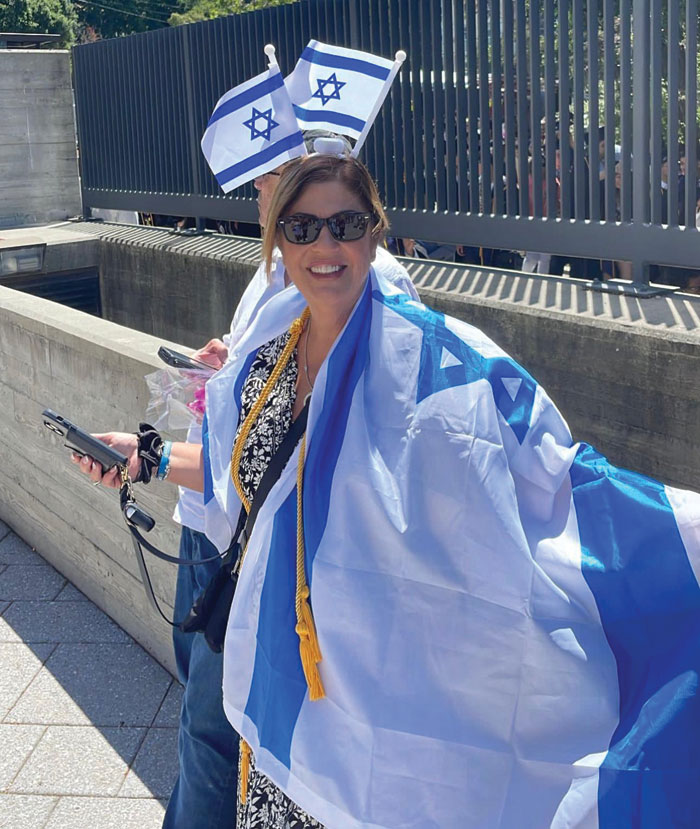
Mizrahi, Los Angeles resident, arrived with her husband and younger daughter. She had the Israeli flag wrapped around her shoulders and had two small Israeli flags on her head. As the crowd around her kept waiving the Palestinian flag, she and her family were holding the blue and white flag.

“I got up and started singing ‘The Hatikvah.’ Some people, not Jews came and kissed the flag as showing support. When we got out to leave, I noticed one woman in a wheelchair, she was holding the Israeli flags. The pro-Palestinians snapped the flag from her and started stepping on it. I started screaming at them: Shame on you! They didn’t dare touch me.”

As the 23,000 attendees exited the stadium, hundreds of protesters awaited, waving Palestinian flags, some wrapped with a black and white Palestinian scarf and chanting anti-Israel slogans. Many wore masks, some appeared to be graduating students, wearing black robes and caps and a blue and golden stole.

Lee, a Jewish student who asked to be identified by her first name only, spoke to The Journal about her experience sitting with the 7000 undergraduates. 

“It was pretty hot to sit there and wait for the ceremony to end. It took an additional 20 minutes because of the protesters. Many students around me seemed unfazed or even supportive of the protests. As a Jewish student, it made me very uncomfortable. I just wanted the whole thing to be over with.”

Many attendees reacted negatively to the protests, expressing disappointment in the university’s lack of action to stop the disruptions during the ceremony. 

Many attendees reacted negatively to the protests, expressing disappointment in the university’s lack of action to stop the disruptions during the ceremony. 

“It seemed like the administration care more about the pro-Palestinian than the students and parents,” Albert Ruiz said. “I understand there is free speech, but what happened here has nothing to do with it. They made it a mission to ruin it for thousands of people and succeeded.”

Later that day, adjacent to the “pro-Palestinia”n encampment, protesters organized children’s activities. In one area, children participated in a musical circle, learning chants like “From the river to the sea, Palestine will be free,” and “I’m nervous, I’m scared but I’ll be brave.”  Just across from there, under a large sign reading “Stop the Gaza Genocide,” parents and children engaged in art activities.

A week prior, at the same spot where children were now decorating posters against Zionism and Israel, a man stood quietly holding an Israeli flag. Across from him, an anti-Zionist forcibly took the flag and began assaulting him. No arrests were made.

UC Berkeley’s Commencement Ceremony Disrupted by Pro-Palestinian Protesters Read More »

Activist’s Bracelets Spread Message of Jewish Solidarity and Pride

When you meet Jason Ciment, one of the first things you notice are the five bracelets he’s sporting. It’s not a fashion statement, but rather a means of expressing his beliefs and values.

The idea of distributing bracelets has been brewing since last year, when Ciment was given a bracelet while attending an Aish HaTorah minyan on Shavuot. He wore that for around six months, he told The Journal. But it wasn’t until six months later, when Ciment and his wife attended the Jewish National Fund-USA conference in Denver and the Republican Jewish National Convention in Las Vegas and noticed various organizations distributing bracelets, that he was inspired to create his own bracelet, something unique with a positive message.

The idea to incorporate meaningful messages onto the bracelets came after hearing stories of individuals concealing their Jewish identity out of fear saddened him deeply. Motivated by hearing speakers at the Vegas event — politicians and members of Congress — repeatedly tell the audience to never be ashamed or embarrassed for being Jewish, he thought, “I wanted to find another angle on feeling empowered. Something different than ’Am Israel Chai.’” He decided to inscribe the phrase “Ve-lo, Nevosh” (“And we shall not be ashamed”) in red letters on the bracelets as a symbol of solidarity and pride.

The words “Ve-lo, Nevosh,” appearing in various prayers and rituals, hold significant meaning in Jewish tradition, serving as a reminder to stand firm in one’s beliefs.

Every morning, as Jews prepare to recite the Shema, they sing the following words: “Ve-Lo nevosh, ve-lo nicalem, ve-lo nikashel, l’olam va’ed.”

These words remind us not to feel ashamed, humiliated, or discouraged because of who we are. It’s a fundamental teaching within Jewish prayer — the notion that we should embrace ourselves without shame, knowing that we are accepted and loved just as we are.
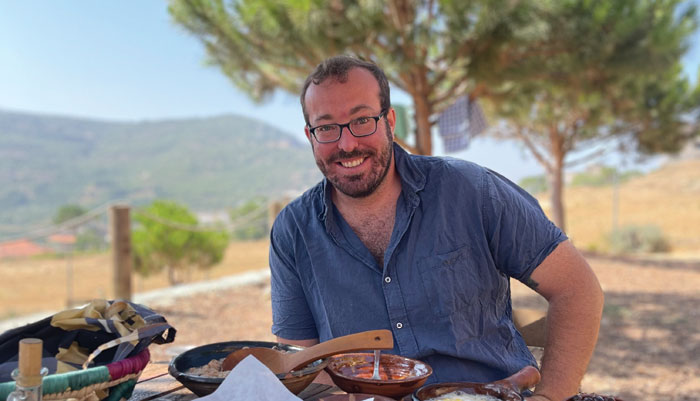

Joining forces with his brother Avi, who lives in Florida, Ciment ordered 3,000 bracelets and began distributing them to fellow Jews at events like the UCLA rally for Israel. (Avi does his part, handing out over 700 bracelets at his shul in Miami.) The response was overwhelming, with many expressing support and solidarity. “I hand them out personally by either pulling one off my wrist,” he explained, “I try to always have a few on my wrist,” or taking one from his pocket. At the UCLA rally, he “put out hundreds on a table that almost everyone had to pass by to get into the rally and people just took them and put them on.” He also tried to give each person at least two bracelets, so they can give somebody else one.”  

In light of the rise in antisemitism, the sight of people openly supporting Israel through wearing these bracelets heartens Ciment. He recalled an instance where a non-Jew expressed a desire to stand in solidarity with Israel. “I went to a business meeting and this woman asked me about the bracelets I was wearing,” he said. “I explained it to her, and she said she said, ‘I’m not Jewish but I want to support Israel and show the world I stand by it.’ I gave her a bracelet and a month later, I happened to see her, and she was still wearing it.”

Encouraged by the positive reception, Ciment launched an Instagram page, at the urging of Dr. Matt Lefferman, to raise awareness. “He took hundreds of them and handed them out in Israel because his son made Aliyah and joined the IDF,” Ciment said. He called Lefferman “my most inspiring partner” who hands bracelets out and sends Ciment photos to be posted on Instagram.

Ciment, who owns the Get Visible marketing agency and is actively involved in outreach programs such as kiruv with NCSY & JSU (Jewish Student Union), finds this endeavor deeply meaningful and accessible to all.

These bracelets symbolize not only his personal conviction but also a collective commitment to pride and resilience in the face of adversity. With only 100 bracelets remaining from the initial order of 3,000, Ciment plans to replenish his stock.

Activist’s Bracelets Spread Message of Jewish Solidarity and Pride Read More »

Meet the Young, Start-Up Nonprofit Working to Tell More Diverse Jewish Stories

It’s no secret that today, being labeled “white” can be a liability. And if you are Jewish, there are those who relentlessly argue you are not only white, but that your voice has no place in the discourse on fighting hate. 

I have never believed that Jews, even the most blonde-haired and blue-eyed Ashkenazim, are white. That is the only commonality I share with the Ku Klux Klan. 

But it’s also no secret that Ashkenazi identity and culture inform what most Americans think they know about Jews (cue the bagels, latkes and reruns of “Seinfeld”), and what many Jews think they know about each other. 

When I arrived in America, I was the first Iranian Jew many Ashkenazim had met. My face, food and customs were strange. Even the way my community chanted Jewish prayers was strange. 

I often wonder if those curious Jews ever realized that for me, they were truly alien, because until then, my entire world had consisted of dark-skinned, curly-black-haired Iranian Jews with names like Shokrollah and Shahnaz.

Daniel Osborn, a history educator and researcher, grew up in Massachusetts learning mostly about Ashkenazi history and culture, and attending a synagogue that was “entirely Ashkenazi,” he told me. Today, he is the President and Executive Director of Project Mosaics, a nonprofit he founded in Spring 2022 with the goal of using a “global approach to bringing the study of Jewish peoplehood into classrooms through digital multimedia content,” he said. 

Osborn’s work is unique because it focuses exclusively on history education as it relates to non-Ashkenazi Jews (particularly from Iran), and because the program is currently offered to a population that may know the least about the diversity of Jewish history: students and teachers at public schools. 

For Osborn, who is based outside of Boston, the emphasis on Jewish plurality, whether relating to history, arts or identities, is key. A high school freshman when Sept. 11 occurred, Osborn graduated high school frustrated with the nature of the social studies education he received at his public school. 

“My understanding of the peoples that populate the Middle East and North Africa was malnourished because the history of this part of the world was not part of the education I received,” he said. And that included the history of the Jews of the Middle East and North Africa. 

Osborn was already “years into an internal exploration” about Jewish history and identity when, as a junior at a Quinnipiac University in 2007, he visited Israel during a Birthright trip and had “deep, meaningful interactions” with young Israelis whose families hailed from Iraq, Iran, Morocco, Egypt and Yemen. The experience helped Osborn realize that he felt “intellectually ill-prepared” in understanding the dynamic plurality of the Jewish people. 

In the years that followed, he graduated magna cum laude with a bachelor’s degree in arts and history, and received a master’s degree in secondary education teaching. In 2012, Osborn received a Master’s in Near East and Judaic Studies from Brandeis University, where his capstone project was titled “Defended with Distinction: A Political and Intellectual History of the Middle East in the Twentieth Century: A Curriculum.”

In 2016, Osborn received a doctorate in education in Curriculum and Teaching; History and Social Studies Education from Boston University. Project Mosaics is Osborn’s response to the omission of lesser-known, but deeply vibrant Jewish histories that teach students about the other half of world Jewry. And if anyone knows how to put together an engaging and nuanced curriculum, it is Osborn, who has also created professional learning programming for K-12 teachers that have emphasized inclusivity. 

Osborn obtained his doctorate in education with the intention of “continuing to play a role in affecting change in history education in public schools, not as a teacher, but at the level of writing curriculum, influencing policy, and having a more seismic change,” he said. As a result, he became a curriculum writer. He also spent years working at nonprofits and helping train teachers to make classrooms more representative of human diversity.

The Project Mosaics website captures Osborn’s astute understanding of teaching. “Education is changing,” according to the website. “Students are demanding more inclusive history and educators need teaching tools that are accessible and compelling. There is room for Jewish joy and pluralism in this changing landscape.”

Osborn acknowledges the importance of learning about the Holocaust, but, given his background, he also understands the limits: “One thing I saw again and again was that students reported they were touched by Holocaust education, but they weren’t asked what they learned about Jewish people, how Jewish people identified, or how they felt joy as Jewish people.”

Yes, learning about Jewish joy is as important as learning about Jewish suffering. 

“The Holocaust deserves to be taught,” Osborn added, “however, students need a multifaceted understanding of Jewish contributions over thousands of years. Otherwise, the Jewish people are narrowly defined.”

Holocaust education is vital, but its main takeaway for students can often focus on how Jewish people have been dehumanized. “It’s a real disservice because we also need education on Jewish joy, life and creativity.” – Daniel Osborn

Osborn is right. Holocaust education is vital, but its main takeaway for students can often focus on how Jewish people have been dehumanized. “It’s a real disservice because we also need education on Jewish joy, life and creativity,” he said. “It’s an incomplete education because we don’t say, ‘If antisemitism is wrong, here is what’s right.’”

Project Mosaics has launched its debut film series, “The Jews of Iran,” and Osborn has collaborated with poets, scholars, artists and memoirists to tell vibrant and untold stories of Jewish dynamism. In one video, “Rooted in Tehran,” author Roya Hakakian sheds light on Jewish life in Iran before the 1979 revolution (Hakakian is the author of “Journey from the Land of No: A Girlhood Caught in Revolutionary Iran”).

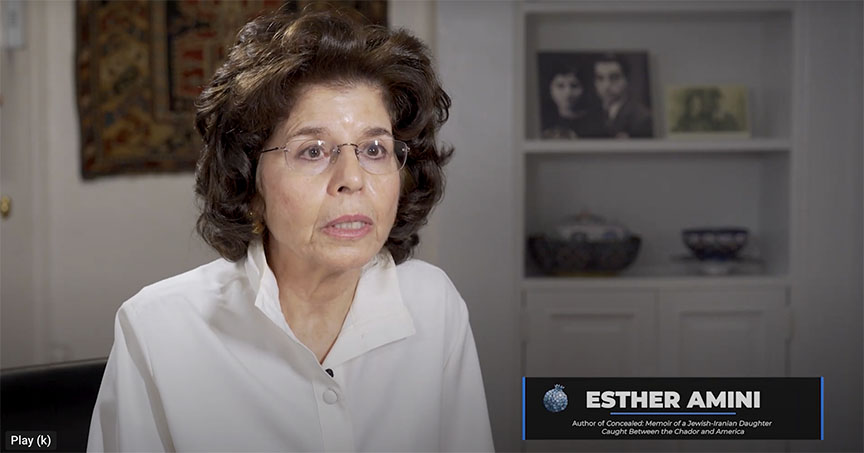
In several other videos, Esther Amini, author of “Concealed: Memoir of a Jewish-Iranian Daughter Caught Between the Chador and America” discusses the incredible story of the crypto-Jews of the Iranian city of Mashhad, as well as the trials and tensions of growing accustomed to life in America, while still feeling deeply connected to Iran.

Screenshot of Esther Amini being interviewed (projectmosaics.org)

“Mizrahi Jews, coming from various Middle Eastern countries, have unfortunately been lumped together as all the same,” Amini told me. “This, of course, is not true. Each has a distinctly different story. I deeply commend Daniel for taking it upon himself to share our lives and enlighten not only the Jewish world but the world at large.”

Osborn is particularly invested in cultivating relationships with female memoirists and historians to create multimedia resources for students and teachers. Currently, Osborn, who is Project Mosaics’ only staff member, is working with a documentarian to create digital videos, such as “The Jews of Iran,” that may be used as core curriculum resources that will also be complemented by lesson plans, curated primary sources, and accompanying graphic organizers and handouts. 

Videos are designed with student audiences in mind and decisions are based on Osborn’s understanding of trends in curriculum today. For example, he noted that short videos are now often replacing teacher lectures because they are seen as more dynamic.

“Curriculum won’t be taught just because it exists,” said Osborne. “Teachers have to be trained in how they implement it.” Osborn also does not “blame teachers” for what is taught or omitted in classrooms. “Teachers are a product of their own education,” he said. “We teach what we know, and we know what we’re taught.” 

Today, Osborn’s primary focus is on public schools, but content will also soon be available at Jewish schools, after school programs and community centers. The mission of Project Mosaics has perhaps never been more critical, as we are currently witnessing levels of Jewish dehumanization, whether on campus, in the media, or even at a global music competition, not seen since the Holocaust. Osborn has a response to this painful challenge: “Studying Jewish people and Jewish history is itself a vehicle for seeing the humanity of Jews,” he said. “Once students see the humanity of Jews, that is one way we successfully counteract apathy and animosity.” 

For more information, please visit projectmosaics.org


Tabby Refael is an award-winning writer, speaker and weekly columnist for The Jewish Journal of Greater Los Angeles. Follow her on X and Instagram @TabbyRefael.

Meet the Young, Start-Up Nonprofit Working to Tell More Diverse Jewish Stories Read More »

A Manifesto for Jewish Filmmakers

There are two simultaneous wars against the Jewish people: one on the physical battlefronts of Gaza and Lebanon, and one on the battlefronts of the internet and media. IDF soldiers are trained, strong and capable, but we also need to unleash another powerful army: a battalion of Jewish filmmakers.

During the Sundance Film Festival last January I launched the Jewish Filmmakers Network in order to strengthen the community of Jewish filmmakers and content creators. What began as an alliance of like-minded creatives quickly turned into an army of filmmakers using their creative skills to fight Jew-hatred. Since Oct. 7 we have held “Filmmakers Against Antisemitism” events in Los Angeles, London, New York, Park City (Utah), and are planning more in Israel and elsewhere.

In a world where there is such a relentless barrage of antisemitic content, A Manifesto for Jewish Filmmakers can refine and focus our ideas for using creativity to counter the negativity.

The forces of antisemitism are currently so strong that our community is experiencing collective trauma, with anti-Zionist and anti-Jewish rhetoric being conveyed across the majority of news outlets and social media. A good place to start is to focus on guiding principles for Jewish filmmakers.

Context is important. Whereas the Nazis destroyed visual records of their acts, the Palestinians used Go-Pros and Facebook to share their atrocities. Hamas fired the first shots, and now is the time for Jewish filmmakers to shoot back. Instead of guns and rocket-propelled grenades, we can use creativity and cameras to win people’s support.

Storytelling is at the core of Jewish values and tradition, since the entire code of Jewish law is initially conveyed through the narratives of the Torah. The essence of Passover is reading the Haggadah, the book whose very name means “telling the story.” Right now we need to tell our story in every way possible so that it wins people from supporting Hamas to supporting humanity.

Jews created Hollywood but no longer have power over its messaging. In “The Kid Stays in the Picture,” Jewish dominance of Hollywood was so strong that Fox was referred to as “the goyish studio.” Whilst we now lack studio power, our creativity and talent is as strong as ever, and we must use creativity to share our messages. This means dispelling the myths of colonization, apartheid and oppression, overturning the blood libels that the IDF targets innocent people, and countering the fake claims attributing Palestinian attacks to Israel. We have to promote the truth of Israel as the only democracy in the Middle East — a truly inclusive society, which has the most ethical army in the world whose conduct is based on Torah values of kindness and compassion.

We are referred to as the People of the Book, but today we must also be the People of the Film. That means creating as much content as possible to fight the antisemitic propaganda and vastly disproportionate criticism of Israel; whether we are doing it through satire, factual content, short-form films, or memes, and posting across all social media channels.

Today’s pencil is the camera. The most effective way to spread our message is through storytelling, and anyone with a cellphone is carrying around a mini film studio in their pocket. 

Today’s pencil is the camera. The most effective way to spread our message is through storytelling, and anyone with a cellphone is carrying around a mini film studio in their pocket. We may not be soldiers on the battlefront carrying loaded rifles aimed at enemy targets, but today we can all be pro-Israel, pro-humanity filmmakers. We can broadcast globally through social media and achieve massive visibility.

The aim is to produce material at both volume and speed. There may be vast teams of anti-Semitic filmmakers fighting against us including Iran-sponsored content-creation groups, we might be outflanked and outnumbered, but our people’s logo is the Star of David and this is not our first time fighting a Goliath.  

As the narrative around Israel changes, we need to iterate and develop our aims. One goal of the Jewish Filmmakers Network is to gather Jews for in-person gatherings. Many people in the entertainment industry are not regular shul-goers, and plenty of their friends have revealed themselves to be pro-Palestinian. It is incredibly helpful to have a Jewish community space where we can be together.

Another idea is to help one another create content. People often wait for the magic green light of Hollywood to get permission to make something, but there is so much we can achieve on minimal or zero funding. We have collaborators ready to join together in the cause. We need writers, actors, directors, producers, editors, composers, distributors, and there are many more roles that must be filled. I am part of We Make Movies, the largest independent film community in Los Angeles, and its ethos — as the name suggests — is to join together and make your movie. Jewish filmmakers and content creators need to fight the vast army of antisemitic content creators and more, and we have the ability to do so.

How can we measure the efficacy of our efforts? The aim is to “move the needle” on undecided voters. We are not aiming to change the minds of those who hate Jews, nor are we preaching to the choir on our side. Rather, we are aiming to reach the many people who have not yet decided whether they are pro-Hamas or pro-Humanity, and win them over. Today’s call to action is asking people to be “pro-Humanity” rather than pro-Jewish or pro-Israel — being “pro-Humanity” is a universal, nonpartisan call to action, and in line with supporting the higher goals of the Jewish people.

The next principle is to bring in non-Jewish allies. It is good to remember that not everyone hates us, that we do have friends beyond the community, there is a bigger world beyond the highly vocal antisemitic rallies that pose as “we don’t hate Jews, it’s just Israel we have a problem with.”

Finally, there is a tremendous value in creating contacts between Israeli filmmakers and Hollywood, both to help our extended family in Israel, and create content that continues to showcase all the things that make Israel such a profoundly special and unique place.

There are some great industry professionals there promoting the cause. Companies have Jewish affinity groups like Disney’s Shalom. Creative Community for Peace galvanizes industry members to use the arts for pro-Israel and pro-Jewish messaging. The Jewish Writers Initiative, led by Emmy-winning showrunner David Sacks,  is a collective of professional screenwriters to create funny and entertaining pro-Jewish/pro-Israel content. Jew in the City is a Hollywood bureau for the positive representation of Orthodox community. Emmy-winning director Jeremy Kagan (“The Chosen”) is one of the leaders of the charge at the Directors Guild of America to establish its Jewish committee. Shalom Hollywood is a new group for young professionals, and there is so much more. 

It is entirely possible that we will not beat antisemitism since there is a bigger spiritual perspective at play, and we begin every Passover seder meal with the words “in every generation they rise up to kill us.” But as Ethics of the Fathers 2:16 says, “it is not your responsibility to complete the mission, but you cannot refrain from starting it.” The Rabbis also teach “it’s not the talk that counts, but action.” Now is the time for action.

We need soldiers in the creative battle. If you are professional, start contributing to Jewish content. If you want to get started, we’ll help you. Join our Facebook group, come to our events. Or just find a friend and make something. “I don’t have the budget” doesn’t count. Anything is possible, and we are stronger as a community.

This may be a lifelong battle, but we are in it. Chazak ve’Ematz, strength and fortitude. Ready, aim fire – or in our case, lights, camera, action. Start shooting today.


Marcus J Freed is an actor, and founder of the Jewish Filmmakers Network. Their Facebook group is at https://www.facebook.com/groups/jewishfilmmakersnetwork, and Marcus is @marcusjfreed on Instagram.

A Manifesto for Jewish Filmmakers Read More »

Matisyahu’s Concert

The Jewish singer Matisyahu was midway through his hourlong concert at the Saban Theatre in Beverly Hills when he wrapped an Israeli flag around his tall, lanky frame like a superhero cape. 

“Let’s not forget our hostages,” he said earlier, seated center-stage on a barstool, where the beloved performer, dressed casually in an open flannel shirt and baggy jeans, was accompanied by a three-piece band on acoustic guitar, electric bass and drums. “This entire night should feel like a prayer.”

On May 8, the reggae artist-rapper-beatbox extraordinaire was appearing in town to headline a concert organized by If You Heard What I Heard, an initiative conceived in 2021 that’s dedicated to gathering filmed testimonies from the grandchildren of Holocaust survivors.

At a time when we’re all being confronted with the reality that the world maybe doesn’t like us so much, the evening was billed, appropriately, “A Night of Resilience.”

At a time when we’re all being confronted with the reality that the world maybe doesn’t like us so much, the evening was billed, appropriately, “A Night of Resilience.”

While many of his peers in the music industry in the aftermath of Oct. 7 have publicly voiced sympathy for the Palestinians and accused Israel of genocide, Matisyahu — born Matthew Paul Miller — has stood out for going the other way. For the past seven months, he’s used his significant platform to defend Israel while denouncing those who’ve attempted to censor pro-Israel, pro-peace voices like his.

His steadfast support for Israel came to a head earlier this year when on two occasions Matisyahu concerts in the U.S. were canceled because of anti-Israel activists threatening to protest outside the concert venues. The clubs’ owners cited “safety concerns” as the reason for the shows’ cancellations, but the singer posted on social media saying the decisions of the venue owners was a capitulation to anti-Zionism, if not Jew-hatred.

Gathered in Beverly Hills on a chilly Wednesday evening, hate was nowhere to be found. In fact, the near-capacity crowd at the Saban showed nothing but love for the artist who has undergone physical transformations since he burst on the music scene in 2004 but has remained consistently committed to his craft.

From the opening songs of the night — “Jerusalem,” followed by “King Without a Crown” — to the closing “One Day,” the audience was on their feet dancing, singing along and capturing the goosebump-inducing experience on their phones. 

Speaking of phones, there was no shortage of influencers and movers and shakers in the crowd, and it was a novel experience to be at a Jewish event that felt cool, which is exactly what Carolyn Siegel, founder of If You Heard What I Heard, said she was going for when I spoke to her last month. Along with recording testimonies from the last generation that will have had in-person contact with Holocaust survivors, the 41-year-old marketing executive is trying to create a community of young people who care about being Jewish. One of the ways she’s doing that is through the hosting of regularly occurring cocktail parties she calls “Sunset Stories.”

“We’re like the fun, cool organization,” Siegel told me over the phone. If You Heard What I Heard — or IYH, as it’s also known — is, she said, “a testament to the years that I spent in marketing … prior to this.”

Last week’s Matisyahu concert was as much a reminder that the singer/rapper has still got it, even as he’s evolved, as it was an official introduction of IYH to the wider community. It was a bold, declarative and successful statement — the evening reportedly raised more than $215,000 — that a new and yes, cool, Holocaust remembrance organization is on the scene, one that’s coming of age at an opportune moment when Jews, including those in their 20s, 30s and 40s, are finding value in visibly, loudly connecting or reconnecting to their Judaism, even if all that means is wearing a Star of David necklace for everyone to see.

Or in Matisyahu’s case, an Israeli flag.


Ryan Torok is a contributing writer for the Jewish Journal.

Matisyahu’s Concert Read More »

Remembering Ivan Wolkind, a Dedicated Community Leader

Many people in the local Jewish community in Los Angeles were saddened by the untimely death of Ivan Wolkind.

Wolkind passed away on Friday, May 11 of a sudden cardiac arrest while working out in the gym. He was 56 years old. 

Wolkind served as the chief operating and financial officer at The Jewish Federation of Greater Los Angeles, before assuming the role of CEO at Magen Am in August 2023. 

Rabbi Yossi Eilfort the founder of Magen Am which offers security services, remembers Wolkind fondly:  “A year ago, I was going through a hard time and my board said: ‘Find someone who is like a mentor’.  We were looking for someone with experience with Jewish nonprofit in Los Angeles, business experience, security and law enforcement experience. We were joking that it’s like looking for a unicorn. How can you find someone like that? But Ivan was all of those things.”

The two met for the first time around eight years ago. “He joked and called us the scary hairy Jews with guns,” said Eilfort.  “So last year around this time I reached out and we went for lunch and I asked him if he’ll help me through our next step. Over the next couple of weeks he was on the program and he fell in love with the mission and what we do and decided to come on full time.”

Wolkind started as a consultant on August 2023 and joined Magen Am as CEO in December. On an interview with the Journal earlier this year, he spoke passionately about his work with Magen Am. 

“I always believed that we, in the Jewish community, need to be equipped and responsible for our own security. There are no better security guards than people in the community who can recognize what is normal and what is not and act accordingly to protect the community.”

Beyond his professional endeavors, Wolkind served as a reserve police officer with LAPD, patrolling Los Angeles streets regularly. “I do it about three to four times a month. I finish my day job, go home, take a shower, put on the uniform, get my gun and go on patrol. It’s my way to give back to the community, and I take it very seriously,” he said.  

“We were fortunate that he agreed and became part of the team,” Eilfort said. “Everyone on the team loved having him as a part of it. I’m not an easy person to work with, a little of a control freak and he was very patient; his wife told me he is similar so it worked out.”

Despite his excitement about his new position with Magen Am, Wolkind recently accepted an offer from the Holocaust Museum in Houston to serve as their CEO. 

With his youngest children about to leave the house for college he felt it was time to make the move. The family was planning to leave California this summer.

“He always told me, ‘We are going to change how Jews in America are going to live in generations to come.‘ He really believed in helping make the Jewish community more secure.” – Rabbi Yossi Eilfort

“He always told me, ‘We are going to change how Jews in America are going to live in generations to come,” said Rabbi Eilfort. “He really believed in helping make the Jewish community more secure. This is what he truly believed in, but he always put his family first.”

Wolkind is survived by his wife Leah Lesch and three children: Rosie, Lenny and Nettie.

Remembering Ivan Wolkind, a Dedicated Community Leader Read More »

Biden Feeling Heat from Both Sides

Donald Trump endured an unpleasant ordeal last week, forced to listen to an adult film actress share embarrassing details about their assignation with the courtroom, the electorate and the world. But Joe Biden’s week may have been even worse.

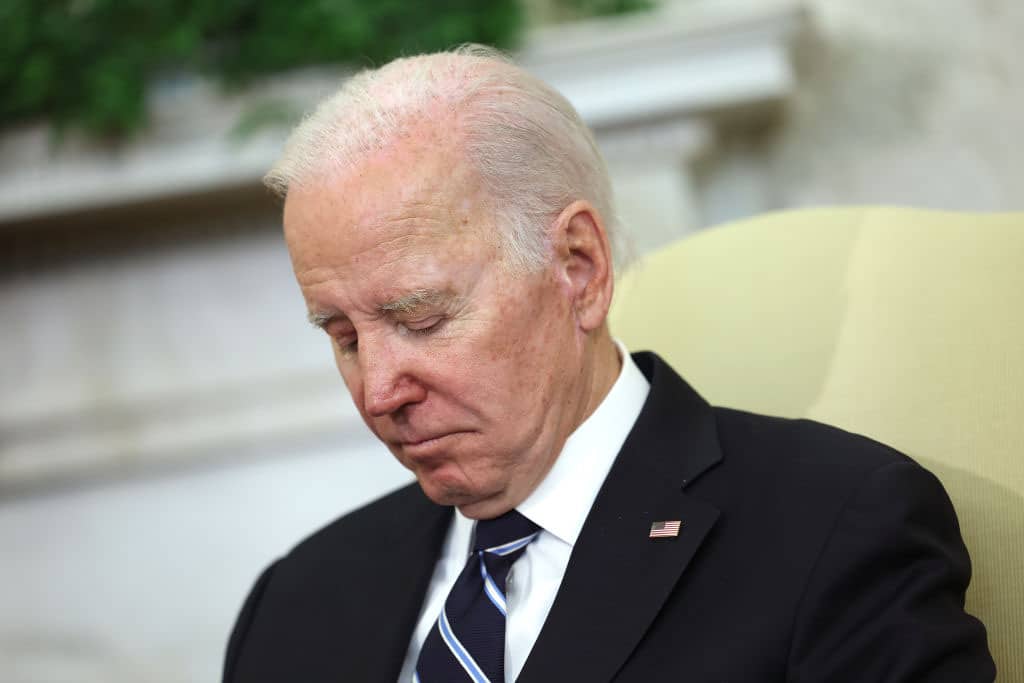
While Trump’s experience was certainly humiliating, it’s still unclear what the legal and political ramifications of Stormy Daniels’ testimony will be. Biden, on the other hand, spent his week unsuccessfully trying to extricate himself from the deepening political morass that the Gaza conflict has become for him. His unsuccessful efforts to placate either side of this debate may have had a more substantive impact not only to the prospects for a lasting peace in the Middle East, but his own hopes for reelection. 

Biden’s week began on a solid note, when he used his speech at a U.S. Holocaust Memorial Museum ceremony to reinforce his solidarity with Israel and the Jewish people. In his remarks, Biden pledged that his commitment to the “security of Israel and its right to exist as an independent Jewish state is ironclad, even when we disagree.” 

Just one day later, Biden told a television interviewer that he had decided to attach conditions to U.S. arms transfers to Israel for the first time. In order to prevent an Israeli military operation into the southern Gaza city of Rafah, Biden announced that he was pausing a shipment of bombs to Israel and threatened to halt additional weapons if the operation went forward in ways that he considered unacceptable. Neither he nor his advisors have publicly articulated the “red line” that Israel would have to cross before additional arms shipments were derailed, creating an extraordinarily ambiguous situation where it is unclear what efforts the Jewish state can take to capture Hamas leaders in their last major urban sanctuary.

(Nor did Biden mention the more than 130 hostages still being held in Gaza during the interview. An administration official said that’s because the reporter did not specifically ask Biden about the hostages.)

Two days after the president laid out this new policy, his administration delivered a report to Congress finding that it was “reasonable to assess” that Israel violated international law using U.S. weapons in Gaza. But paradoxically, the report also stated that the investigation did not find specific instances that would justify the withholding of military aid to Israel.

Progressives in his own party attacked him for not cutting off aid in response to the findings and Israel supporters castigated him for undermining support for the Jewish state at such a dangerous time. 

The report alleged that Israel had not done enough to protect civilians during its attacks on Gaza or to provide them with sufficient humanitarian aid. But saying that such a conclusion was “reasonable” without providing evidence to support such an assertion left Biden open to harsh criticism from across the political spectrum. Progressives in his own party attacked him for not cutting off aid in response to the findings and Israel supporters castigated him for undermining support for the Jewish state at such a dangerous time. If Biden’s goal was to satisfy everyone, he ultimately accomplished just the opposite by angering both sides.

The president now stands less from six months from election day, and his party’s progressive base has seized on the Gaza conflict as a symbol for their grievances with him on several issues where they feel he has been insufficiently progressive. But the majority of the American people still support Israel, including most of the swing voters Biden needs to win reelection. The only way to square this political circle is through a peace agreement — not just a temporary ceasefire but a more durable deal between Israel, Saudi Arabia, a number of other Arab nations and the United States.

Biden’s domestic balancing act is incredibly precarious, but he walks a similarly fine line in the Middle East — with far higher stakes. Both the Israelis and Saudis were unhappy with the president’s machinations, while both countries’ leaders are irritated without being angry enough to stop talking altogether. That may be Biden’s best hope toward getting them together at some point down the line. Such an ambitious agreement is still his long-term goal, and last week’s geopolitical gymnastics may have kept that hope alive.


Dan Schnur is the U.S. Politics Editor for the Jewish Journal. He teaches courses in politics, communications, and leadership at UC Berkeley, USC and Pepperdine. He hosts the monthly webinar “The Dan Schnur Political Report” for the Los Angeles World Affairs Council & Town Hall. Follow Dan’s work at www.danschnurpolitics.com.

Biden Feeling Heat from Both Sides Read More »