When Israel launched its military campaign against Hamas in Gaza, following the massacre of Oct. 7, 2023, a chorus was already chanting the Day After hymn. A similar chorus is likely to chant the same hymn as escalation with Iran turns from possibility to certainty.
Does President Trump have a clear plan for the day after, a clear vision of desired outcomes, a clear objective? Such a demand is both reasonable and annoying. It is reasonable because some vision is required, some minimal expectation for an outcome is essential. It is annoying because it ignores everything we know about battlefields and wars. The outcome is determined by events much more than by plans.
Consider the possibilities President Trump might consider as optional outcomes. A regime change in Iran is the holy grail of all outcomes. But what a regime change entails and how such an event could be encouraged is not easy to tell. When thinking about it, the president could either say “this is not the outcome I desire” or he can say, “this is what I want” while keeping the exact plans a little vague. If circumstances present him with an opportunity to achieve such a goal, he’d grab it. If not – he’ll make do with something else.
Thus, we already compromised the idea of a clear day after. A day after could mean regime change, or it could mean something else, less ambitious. What is a less ambitious and still positive outcome? A much weaker regime. Not a different regime – the same one, with less power to harass its own citizens and other countries in the neighborhood. Would such a goal give us a clear vision of a day after? No. Because a weakened regime has many degrees of meaning. It could be weakened by 20%, or 50, or 80. It could be weakened militarily, economically, politically. It could be weakened in one field while strengthened in another. Example: weakened in its ability to harass other countries – because of the loss of operational means such as missiles – while strengthened in its control over the people – because it managed to withstand an American attack.
I assume you begin to see the general point. An American attack on Iran doesn’t have a clear day after picture, nor should it have. There is a multiplicity of positive outcomes from such an attack – that should be weighed against negative outcomes. As President Trump mulls those outcomes (assuming there is such a rational process going on), one of the main reasons pushing him towards confrontation is the multiplication of positive conclusions and the relative lack of reasons to hold back. “A lot has changed in two years. The risk of regional war has greatly diminished,” the Biden administration’s Marc Gustafson wrote in The Wall Street Journal. “The upside of acting at a moment of Iranian vulnerability.”
Consider a provocative suggestion: the U.S. has very little to lose by attacking Iran. Surely, a war is a serious business that ought to be considered carefully, but the power of Iran to damage the U.S. is small, its ability to fight is limited. Of course, there’s never a guarantee of success, and there’s always a posibility of surprise. And yet – if there was ever a time to try and put an end to the constantly disruptive presence of this menacing regime, now is probably as good as it will ever get.
So the risk in deciding to act is not great, as it is weighed against the reward. But that’s not the end: the risk in deciding to act must be also weighed against the risk in deciding not to act. That decision would give Iran time to rearm, recover, get ready for another round of hostilities under better conditions. It would mean that some future president is going to face a much more difficult task as he or she ponders what to do with Iran. And maybe – that’s not a difficult outcome to imagine – that future president isn’t even going to have much to do with Iran. He or she will just have to live with the grave consequences of indecision when the time was ripe.
More than anything else, the art of leadership is the art of understanding opportunities as they arise and grabbing them at the right moment. The tragedy of Oct. 7 provided Israel with an opportunity to remake its relations with Gaza that it long sought. A weakened Hezbollah provided rebel forces in Syria an opportunity to take over the country after more than a decade of stalemate. One can have plans to do many great things for one’s country or the world, but the only time for great achievements comes when a vision meets opportunity. President Trump seems to have the vision. Now, an opportunity presented itself.
Something I wrote in Hebrew
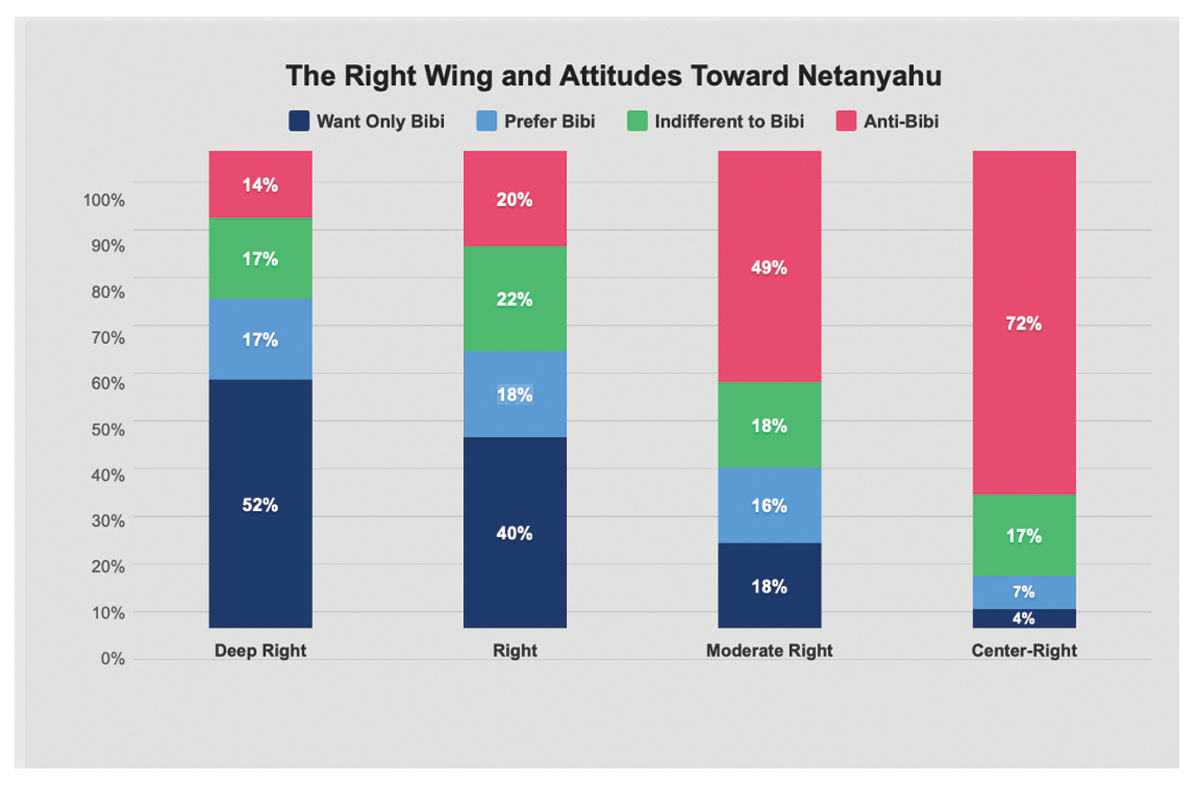
Not all coalition supporters in Israel believe that Netanyahu is the only man that must rule Israel:
We propose a model for categorizing coalition supporters: at the first tier, die-hard “Bibists”— the “Only Bibi” party. At the second tier, soft “Bibists” — the “Prefer Bibi” party. At the third tier, those indifferent to Bibi — the “take him or leave him” party. And there is a fourth tier: coalition supporters in the anti-Bibi camp … only half of coalition supporters are rooted in the “Only Bibi” party — approximately 52%, to be precise. If we look not only at Coalition supporters, but at all Jewish Israelis who define themselves as “Right-wing,” only a quarter fall into the “Only Bibi” category. Roughly another fifth prefer Bibi but not decisively, another quarter are indifferent, and about a third — we are talking about right-wing Jewish Israelis here — simply do not want him to continue.
A week’s numbers
See text above.
A reader’s response
Greg Ozlog writes: “Antisemitism is greatly exaggerated. Jews live safely in the U.S. and should not panic.” My response: Panic is never advisable. Antisemitism is a real threat, and should be acknowledged and dealt with prior to a time when Jews are no longer secure.
Shmuel Rosner is senior political editor. For more analysis of Israeli and international politics, visit Rosner’s Domain at jewishjournal.com/rosnersdomain.