fbpx

February 25, 2026

Larry David Talks Shabbos and Comedy on Elon Gold’s ‘Stars of David’ Podcast

Larry David doesn’t do podcasts. So when he agreed to appear on Elon Gold’s new “Stars of David” podcast, the anticipation felt like a prime-time television season finale.

When asked why he agreed, David told Gold, “Because you are a persistent asshole! You wouldn’t stop the texts!”

In the hour-long video preview of the episode screened by the Journal, Gold calls David “godol hador,” meaning “the great one of this generation.” It sounds like a joke, but Gold is absolutely sincere in his praise.


View this post on Instagram


A post shared by Elon Gold (@elongold)

David has said in past interviews that when he rubs the back of his neck, he’s done and wants to leave. That’s the tell. In this episode, he never does it. The sight of David slouching for most of the hour adds so much. You can watch David’s hilariously irreverent posture and all of the show’s episodes on YouTube.

Gold softens him up early with impressions. His Johnny Carson impression draws the first real belly laugh from David.

Gold told the Journal that he models his interview style after Howard Stern. “I’m only doing Howard Stern,” he said. He calls Stern the greatest interviewer ever and said he studied him closely. David Letterman and Carson round out his top three.

Gold’s co-host is comedian Eli Leonard, who was also a writer on “Curb Your Enthusiasm” and briefly appeared on the show as “the pin guy” in Season 11.

Fans will be delighted to hear David came to the podcast studio that day and shared a multitude of gripes he has with a world that never fails to frustrate him. At one point, David questions the logic of Shabbat restrictions, asking why you can read a book but not watch television.

Last fall, David and his wife had Shabbat dinner at the Gold home in Los Angeles. The next day, David sent a “thank you” text. On the podcast, Leonard reads the text aloud while impersonating David. Eli, as Larry, reads:

“Thank you again for a fabulous dinner. Sometimes at these things the food is great but you’re bored. Other times the company is great but the food stinks. This one hit on both. Very rare. Could it have been a little warmer? Sure. Of course. Was it cold enough to ruin my evening? Maybe a little! Could I have done without Eli? Absolutely!  But overall…I give it 4 “prettys” on the “pretty, pretty, good” rating. And you can’t do better than 4 prettys! So thank you yet again. And your kids are fabulous. And you’re hilarious. And I was completely joking about Eli on the thousand to one chance you took that seriously.”

“Stars of David” is produced by Unpacked, a brand of OpenDor Media. Episodes drop on Thursdays, so listeners have ample time to prepare to discuss the latest episodes on Shabbat.

“Shabbat is always coming,” Gold told the Journal. “When things are tough, don’t worry. Shabbat is always coming. You frame your whole week around that break.”

The conversation moves into familiar David territory, like the time a booker once told him at The Improv that “Carson wouldn’t like you.” David’s reply: “Maybe I wouldn’t like Carson.” He dismisses award culture as well. “Curb Your Enthusiasm” has received 11 Emmy nominations for Best Comedy and had zero wins. He no longer attends award shows, explaining that “if you lose, you feel like a loser.” They revisit the “Seinfeld” finale backlash and a “Saturday Night Live” censorship fight. No matter how many times “Curb” and “Seinfeld” fans hear these stories, David dishing it with his buddies still slaps with each retelling.

Gold also talks about filming a scene for “Curb” in Season 10 that was later cut. David personally called him to say it wouldn’t make the episode. This is a rare occurrence, not for David, but for any actor in Hollywood who has been crushed by their scenes getting axed.

In season 11, Gold was a recurring character on “Curb” as Jake Blum, the head of Hulu (or as he called it “JewLu”). Gold’s performance throughout the season was irritatingly funny. As Jake, Gold asks David, “How we doin’ so far, I mean, J to J?” The term is short for “Jew to Jew,” which became the basis for the title of a Journal cover story on Gold titled, “Talking ‘Jew to Jew’ with Comedian Elon Gold.” He said then and today that David belongs on “the Mount Rushmore of comedians.” That admiration doesn’t get in the way on screen, where their “J to J” chemistry is palpable and hysterical.

On the podcast, Gold pitches to David a film: it would star David and Albert Brooks traveling to Israel for the first time. The working title is “Birth Wrong.” In Gold’s imagined scene, they are at the Kotel, surrounded by Jews crying and praying. David looks around and asks, “Should I be crying? Is everyone performing this? What am I supposed to feel?”

They cover a lot of topics. Yet still, Gold told the Journal that he wanted the interview to dive even deeper into Israel, Oct. 7, and antisemitism with David. But in pure David fashion, the conversation kept returning to comedy.

“His entire brain is wired to see and regurgitate comedy,” Gold said. “If he hasn’t internalized something about the situation in Israel, he can’t express it.”

When asked whether that makes him like David any less, Gold said, “No, it makes me want to be his friend even more.” He added, “Life is dead serious. So if you focus on that, it makes it tougher. If you’re just joking and laughing and doing bits and voices all day and all night, you get to handle it. I’ve said this to other people: I don’t know how everyone’s not a comedian, because if I wasn’t a comedian, I don’t know how I would handle life and the world.”

He said that “Larry David does this to the millionth degree,” and explained, “that is why I can show more humanity — because I’m not at his level of comedic genius.”

Another recent guest on Gold’s “Stars of David” podcast is comedian Tiffany Haddish, who talks about Jewish identity and her first visit to the Kotel. New listeners should go back to the first season and listen to the episode with Howie Mandel — one of the comedians Gold says inspired him to pursue stand-up. And Gold discusses Jewish pride and antisemitism with Montana Tucker, and how to handle the public backlash and losing some fans over it.

With so many comedy podcasts available in 2026, fans often have to put even their favorite comedians to the test to see whether the show works for them. The entire “Stars of David” podcast gives the listener everything they hope to feel before they commit to hitting the subscribe button. Sure you can listen to episodes out of order, but for this show, start with the season two premiere featuring comedian Yohay Sponder. When you’re asked to allow notifications, agree. Then on March 5, remember that Larry David doesn’t do podcasts, but he did this one. And that episode is pretty, pretty, pretty pretty good.

“Stars of David with Elon Gold” is available on Spotify, Apple Podcasts, YouTube, Amazon, PodBean, and iHeartRadio.

Larry David Talks Shabbos and Comedy on Elon Gold’s ‘Stars of David’ Podcast Read More »

On Fighting Antisemitism and the American Dream

Excerpts from a Feb. 10 address at George Washington University.

The story is told of a man who gets a call from his doctor. “I’ve got bad news and very bad news,” says the doctor. “What’s the bad news?” asks the man. The doctor replies: “You have 24 hours to live.” “That’s the bad news!” says the man, “what’s the very bad news?” The doctor responds: “I’ve been trying to reach you since yesterday.”

When we talk about the resurgence of antisemitism these days, we understandably dwell on bad news and very bad news. Today, I want to offer a pragmatic but very different message. History teaches us that antisemitism cannot be eradicated but it can be confronted, exposed as dangerous and corrosive to society and it can be marginalized.

The 20th-century American Jewish poet Delmore Schwartz famously wrote: “In Dreams Begin Responsibilities.”

We should dream of an America that is patriotic and proud, tolerant and strong, productive and safe, decent and kind, centered on the Judeo-Christian virtues on which our country was founded.

We should dream of an America in which our Jewish citizens – unlike today – can drop our kids off at Jewish schools without having armed guards there to protect us from would-be killers or protesters masked in keffiyehs, shouting obscenities and threatening violence.

We should dream of an America that reflects George Washington’s pledge to the Jewish community of his day: “For happily the Government of the United States, which gives to bigotry no sanction, to persecution no assistance requires only that they who live under its protection should demean themselves as good citizens.”

If we still dream of that America, then we need to take responsibility for bringing that society about for all Americans, including Jewish Americans. We need a new attitude – unapologetic, respectful, determined and courageous – and a new action-focused collaboration across government, the private sector and the nonprofit and academic spheres.

If we study the past, we know that when significant societal crises arise, when the tectonic plates of historic, economic and cultural periods shift, unrest inevitably follows. We are living through such a time today.  And it’s especially in these moments that Jews become targets, scapegoats for societal anxiety, unease and discontent.

In the 11th century, when Christians and Moslems clashed during the Crusades, Jewish communities in Europe were slaughtered as by-products of the conflict. Today, as Islamic extremists gain footholds in historically Christian Europe, it is Jews across Europe who are being targeted for persecution and violence.

When the Bubonic Plague swept through Europe in the 14th century, Jews were blamed for causing the disease. In our time, widely-disseminated neo-Nazi and Jihadist conspiracy theories blame Jews for creating COVID-19.

When European agrarian societies shifted to industrialization in the 19th century, Jews were accused of being reactionary architects of exploitative capitalism, and the exact opposite: subversive Marxists who were undermining traditional society. In the 20th century, the dehumanization of Jews by the fascist right led to the genocidal German annihilation of 6 million Jews across Europe, a true genocide, if we have the humility to respect what that word means, as Jews were systematically hunted down for a decade across 20 countries and murdered in death camps on an industrial scale.

After the Holocaust, Soviet Communism cultivated its own obsessive hostility toward Jews and Israel, a hatred that is normative today among many in the intellectual left around the world, in organizations like the United Nations, and in parts of American society as well.

In recent years, we’ve seen conspiracy theories blaming Jews for 9/11, for the global financial crisis, for the murder of Charlie Kirk. The extreme ideological left and right, as well as Jihadist groups, frequently tie Jews, Israel and the United States together as a single adversary. What starts as hatred of the Jew does not end there.

Today, antisemitism from the Islamic world sets the tone for so-called activists in our country who openly lionize Hamas, Hezbollah, Osama bin Laden and Yahya Sinwar, celebrating in the streets and campuses of the United States the ongoing murder of Jews in terrorist attacks, and on a massive scale, in the massacre of Oct. 7, 2023. Technology and AI have only compounded the problem with young people today uninformed about history and easily manipulated by false claims on social media and visual deepfakes.

But while the bad news is real, it is not the challenge – but our response to it – that is going to define us. I want to highlight three pieces of good news – which can be great news – if we are willing to seize the moment.

The first piece of good news is that this administration has been unequivocal in exposing antisemitism as hateful, anti-American and destructive of our nation’s interests and values. Whatever differences may exist on other issues, Americans across the political spectrum should give President Trump credit for his leadership in confronting antisemitism and in calling out the obsessive and false condemnations of the State of Israel, a tiny but inspired country, a trusted ally, a democracy aligned with American national security interests and our shared values in a perennially dangerous and unreliable part of the world.

There is also bipartisan alignment among many in Congress – as well as among state and local politicians – who understand well the historical truth that burgeoning antisemitism is the canary in the coal mine when it comes to a society’s cultural well-being. We in government must work together with greater determination at the federal, state and local level and we must collaborate more effectively across party lines.

A second piece of good news is that many great Americans and people worldwide – in business, law, medicine, entertainment, academia, the nonprofit community and the public at large – are genuinely appalled that overtly antisemitic attitudes, rhetoric and violence have again become casual and acceptable.

We need to move beyond corporate and organizational responses to antisemitism that are no longer effective and forge a much bolder path to preserve the dream of an American society – and, to the extent we can, a global community of nations – that is not corrupted and fatally undermined by normative antisemitic disrespect and violence.

Finally – and most importantly – there is the often-underestimated power of each one of us as individuals.  In May of last year, a young Jewish couple was murdered outside a Jewish event here in Washington. The murderer shouted “Free Palestine” as he shot the young Jews to death near the U.S. Capitol. Antizionism, delegitimization of the State of Israel, boycotts and slander of Israel and Israelis is antisemitism, pure and simple. Those who claim to care about Jewish people in America while justifying boycotts and violence against Jewish people from Israel demonstrate a complete lack of understanding of Judaism and of Jewish history.

When that young Jewish couple was murdered, a Catholic friend of mine told me she’d worry less about me if I didn’t wear my kippah around Washington. The authentic response to antisemitism in our day is not to hide, to take the kippah off our head, to change the name on our Uber app so it doesn’t sound Jewish or to believe the solution lies in ever more security for Jewish institutions. Instead, we should challenge ourselves to be more identifiable as Jews, more confident and more positive, to dedicate ourselves with greater passion to our heritage and ancient mission: to be a holy nation that respects all human beings. To be ambassadors of humanity. To be Jews who are unapologetic, productive and proud Americans.

To our non-Jewish friends – Christian, Muslim and others – you have no idea how much your support means. The essential psychic anxiety of the Jew throughout history is that he or she is all alone. We need your words, solidarity and action more than ever. Jews – in the U.S. and around the world –  just want to live in safety and dignity and to help ensure that we and our brothers and sisters in Israel and everywhere are not, time and again, victims of relentless incitement, defamation, and tragic violence.

There is bad news – to be sure – but there is good news that will be great news if we collectively take the opportunity to work across government at all levels, to bring together leaders of goodwill across key segments of society, and to step forward as individuals – Jews and non-Jews – to ensure that America remains a country that gives to bigotry no sanction, to persecution no assistance, that requires of us only that we demean ourselves as good citizens.


Pierre Gentin is the general counsel of the Department of Commerce.

On Fighting Antisemitism and the American Dream Read More »

Rosner’s Domain | Iran: The Day Before and After

When Israel launched its military campaign against Hamas in Gaza, following the massacre of Oct. 7, 2023, a chorus was already chanting the Day After hymn. A similar chorus is likely to chant the same hymn as escalation with Iran turns from possibility to certainty.

Does President Trump have a clear plan for the day after, a clear vision of desired outcomes, a clear objective? Such a demand is both reasonable and annoying. It is reasonable because some vision is required, some minimal expectation for an outcome is essential. It is annoying because it ignores everything we know about battlefields and wars. The outcome is determined by events much more than by plans.

Consider the possibilities President Trump might consider as optional outcomes. A regime change in Iran is the holy grail of all outcomes. But what a regime change entails and how such an event could be encouraged is not easy to tell. When thinking about it, the president could either say “this is not the outcome I desire” or he can say, “this is what I want” while keeping the exact plans a little vague. If circumstances present him with an opportunity to achieve such a goal, he’d grab it. If not – he’ll make do with something else.

Thus, we already compromised the idea of a clear day after. A day after could mean regime change, or it could mean something else, less ambitious. What is a less ambitious and still positive outcome? A much weaker regime. Not a different regime – the same one, with less power to harass its own citizens and other countries in the neighborhood. Would such a goal give us a clear vision of a day after? No. Because a weakened regime has many degrees of meaning. It could be weakened by 20%, or 50, or 80. It could be weakened militarily, economically, politically. It could be weakened in one field while strengthened in another. Example: weakened in its ability to harass other countries – because of the loss of operational means such as missiles – while strengthened in its control over the people – because it managed to withstand an American attack.

I assume you begin to see the general point. An American attack on Iran doesn’t have a clear day after picture, nor should it have. There is a multiplicity of positive outcomes from such an attack – that should be weighed against negative outcomes. As President Trump mulls those outcomes (assuming there is such a rational process going on), one of the main reasons pushing him towards confrontation is the multiplication of positive conclusions and the relative lack of reasons to hold back. “A lot has changed in two years. The risk of regional war has greatly diminished,” the Biden administration’s Marc Gustafson wrote in The Wall Street Journal. “The upside of acting at a moment of Iranian vulnerability.”

Consider a provocative suggestion: the U.S. has very little to lose by attacking Iran. Surely, a war is a serious business that ought to be considered carefully, but the power of Iran to damage the U.S. is small, its ability to fight is limited. Of course, there’s never a guarantee of success, and there’s always a posibility of surprise. And yet – if there was ever a time to try and put an end to the constantly disruptive presence of this menacing regime, now is probably as good as it will ever get.

So the risk in deciding to act is not great, as it is weighed against the reward. But that’s not the end: the risk in deciding to act must be also weighed against the risk in deciding not to act. That decision would give Iran time to rearm, recover, get ready for another round of hostilities under better conditions. It would mean that some future president is going to face a much more difficult task as he or she ponders what to do with Iran. And maybe – that’s not a difficult outcome to imagine – that future president isn’t even going to have much to do with Iran. He or she will just have to live with the grave consequences of indecision when the time was ripe.

More than anything else, the art of leadership is the art of understanding opportunities as they arise and grabbing them at the right moment. The tragedy of Oct. 7 provided Israel with an opportunity to remake its relations with Gaza that it long sought. A weakened Hezbollah provided rebel forces in Syria an opportunity to take over the country after more than a decade of stalemate. One can have plans to do many great things for one’s country or the world, but the only time for great achievements comes when a vision meets opportunity. President Trump seems to have the vision. Now, an opportunity presented itself. 

Something I wrote in Hebrew

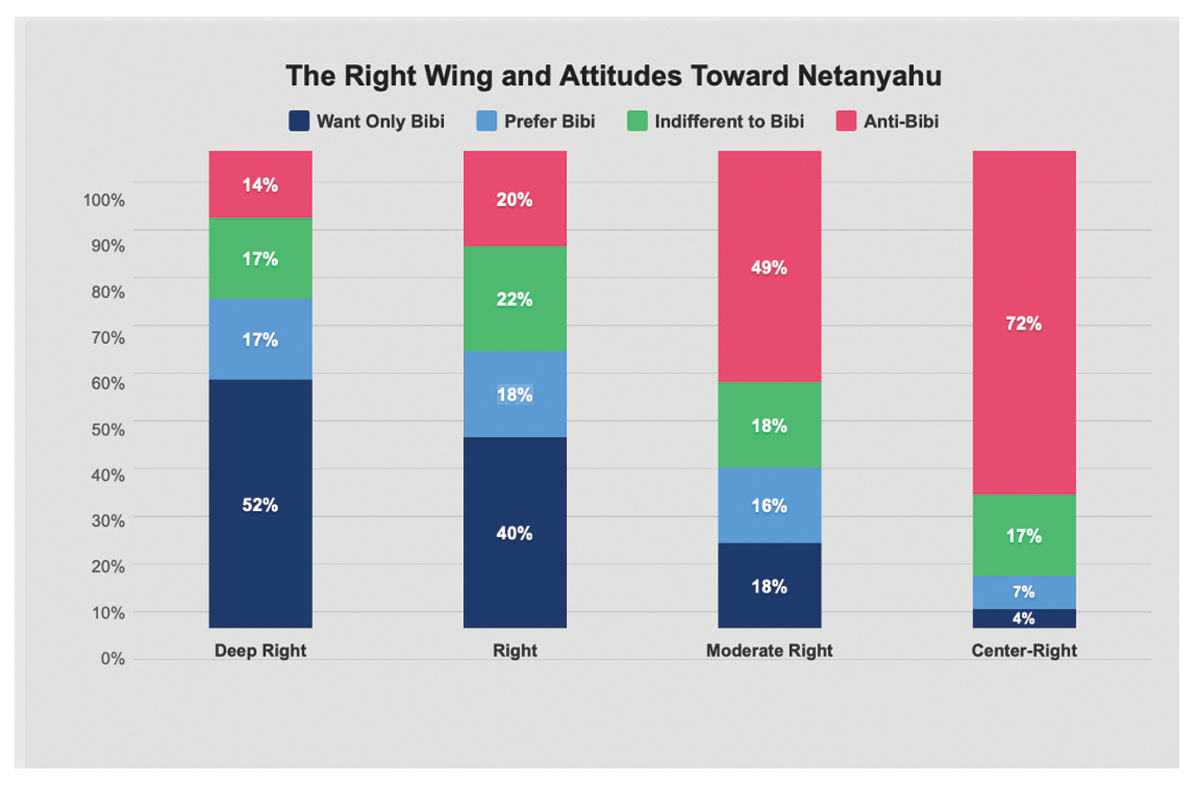
Not all coalition supporters in Israel believe that Netanyahu is the only man that must rule Israel:

We propose a model for categorizing coalition supporters: at the first tier, die-hard “Bibists”— the “Only Bibi” party. At the second tier, soft “Bibists” — the “Prefer Bibi” party. At the third tier, those indifferent to Bibi — the “take him or leave him” party. And there is a fourth tier: coalition supporters in the anti-Bibi camp … only half of coalition supporters are rooted in the “Only Bibi” party — approximately 52%, to be precise. If we look not only at Coalition supporters, but at all Jewish Israelis who define themselves as “Right-wing,” only a quarter fall into the “Only Bibi” category. Roughly another fifth prefer Bibi but not decisively, another quarter are indifferent, and about a third — we are talking about right-wing Jewish Israelis here — simply do not want him to continue.

A week’s numbers

See text above.


A reader’s response

Greg Ozlog writes: “Antisemitism is greatly exaggerated. Jews live safely in the U.S. and should not panic.” My response: Panic is never advisable. Antisemitism is a real threat, and should be acknowledged and dealt with prior to a time when Jews are no longer secure.


Shmuel Rosner is senior political editor. For more analysis of Israeli and international politics, visit Rosner’s Domain at jewishjournal.com/rosnersdomain.

Rosner’s Domain | Iran: The Day Before and After Read More »

Preserving Jewish Tradition in the Digital Age

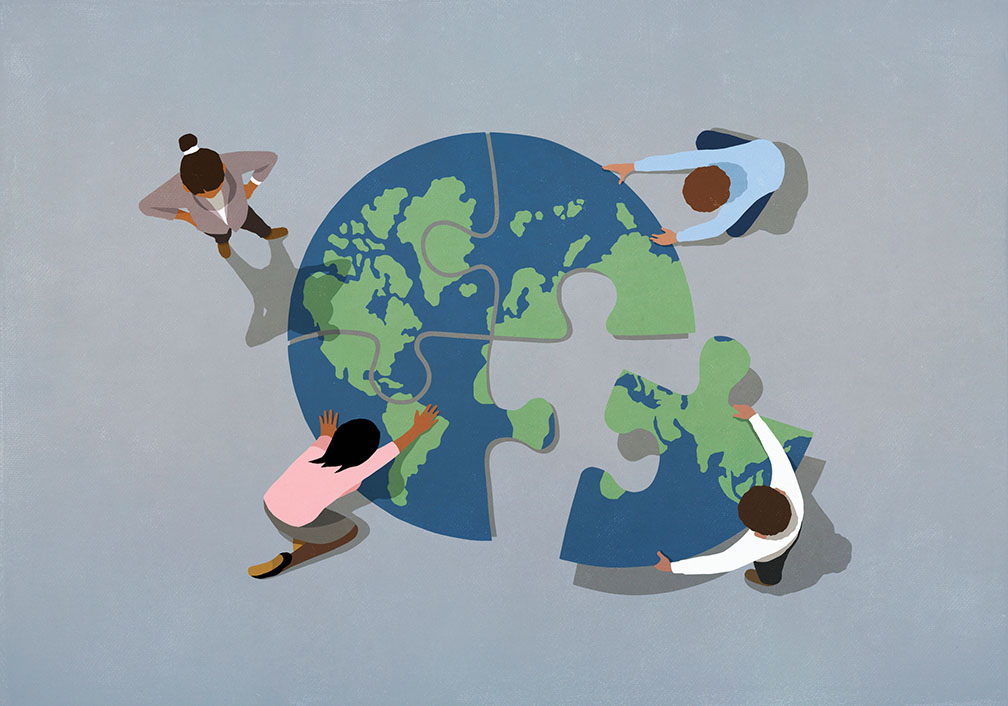
As the world becomes increasingly digital, the ways in which communities preserve and transmit their traditions are undergoing a profound transformation. For the Jewish community, whose rich history and culture span thousands of years, the advent of Artificial Intelligence offers both unprecedented opportunities and complex challenges.

Jewish tradition is woven from a tapestry of texts, rituals, languages and memories. From Torah scrolls to oral histories, from synagogue architecture to the melodies of liturgical music, the preservation of these elements has historically relied on careful stewardship by individuals and institutions.

But as communities become more dispersed due to lack of affordable housing in major metropolitan areas such as Los Angeles, digitization has emerged as a crucial tool for safeguarding Jewish heritage. AI, as the next frontier in digital technology, is now driving innovative projects and reshaping how tradition is experienced and transmitted.

One of the most significant applications of AI in the Jewish world is the digitization and analysis of sacred texts. Massive repositories of Hebrew manuscripts, commentaries and responsa once required scholars to travel or sift through physical volumes. Today, AI-powered platforms can scan, transcribe and translate these texts, making them accessible to anyone with an internet connection. Natural language processing (NLP) algorithms help decode ancient scripts and identify connections among centuries-old writings, offering new insights into Jewish law and philosophy. AI has also enabled the creation of searchable databases, where users can explore the Talmud, Torah and rabbinic literature in ways never before possible.

The Hebrew language, central to Jewish prayer and study, has benefited from AI-driven educational technologies. Apps now use machine learning to tailor language lessons to individual learners, helping revive Hebrew and Yiddish for younger generations. AI also supports ritual practice by guiding users through prayers, holiday observances and lifecycle events with interactive tools. Whether it’s a virtual siddur that adapts to the user’s tradition or a chatbot that answers questions about kosher laws, AI is making Jewish customs more accessible, especially for those outside established communities.

Jewish tradition thrives on storytelling and oral transmission. AI-powered voice recognition and transcription tools are helping archivists document the memories of Holocaust survivors, rabbis and community elders. These technologies allow for the preservation of stories that might otherwise be lost, enabling future generations to access firsthand accounts of Jewish life across the globe. AI can also analyze oral histories, identifying recurring themes and linking personal narratives to broader historical events.

AI is facilitating the creation of online Jewish communities, bridging gaps for those who live far from synagogues or cultural centers. Algorithms can recommend virtual events, connect individuals with similar interests, and foster meaningful engagement through social media. Digital platforms powered by AI help coordinate collective study sessions, organize holiday celebrations and even match people to mentors or study partners. This connectivity is vital for sustaining tradition in a rapidly changing world.

While AI offers many benefits, its implementation in Jewish tradition raises important questions. How can we ensure that digital representations of sacred texts retain their authenticity? What safeguards prevent AI from introducing errors or biases into translations and interpretations? There are also concerns about privacy, especially when documenting oral histories or personal rituals. Jewish ethics, rooted in respect for tradition and human dignity, must guide the use of AI to avoid unintended consequences.

Looking ahead, AI is poised to become an integral part of Jewish preservation and practice. Scholars envision AI tools that not only catalog and interpret texts but also generate personalized study plans, create immersive virtual reality experiences of historical sites and facilitate intergenerational dialogue. As long as technology is harnessed with care and respect for tradition, it can empower communities to keep Jewish heritage alive and relevant in the digital age.

Preserving Jewish tradition in the digital age is a collaborative journey between innovation and reverence for the past. AI stands at the crossroads, offering tools to safeguard history while challenging communities to consider what it means to transmit sacred knowledge in a world where boundaries between physical and digital are increasingly blurred. As Jewish tradition adapts and evolves, the partnership with AI will undoubtedly shape the stories told for generations to come.


Lisa Ansell is the Associate Director of the USC Casden Institute and Lecturer of Hebrew Language at Hebrew Union College-Jewish Institute of Religion Los Angeles.

Preserving Jewish Tradition in the Digital Age Read More »

The ROI of Action: Why Professional Excellence Is the Best Counterprotest

The shortest distance between a divided campus and a stable Middle East was not found in a protest line, but through a 15-hour flight and a transformative 10-day journey through the region’s most dynamic markets.

My journey toward this realization began at UCLA, where I had only a two-week glimpse of normal campus life before the world was shattered on Oct. 7, 2023. Months later, by the time Passover arrived, the anti-American campus encampment was at its peak. Walking to class required more strategic planning than any 19-year-old should do just to attend a lecture.

Watching the demonstrations and counterprotests, it was clear that a traditional counterprotest was fundamentally flawed. Not only was it ineffective, but it also drew more attention to the encampments while simultaneously labeling my peers alongside the encampment’s participants as disruptors actively hindering our education. I didn’t want to be a disruptor; I wanted to be a builder.

This realization was confirmed when a close friend from my finance club expressed his frustration. He wasn’t a staunch supporter of any specific political movement; he was just a UCLA student looking to secure a career and annoyed that his path to class was blocked. It became clear that the best people to build bridges with were those who consistently engage and deliver results. These are the students pursuing investment banking, consulting, and private equity. These students, who possess the grit required for rigorous recruitment cycles, are the ones who will eventually be in the boardrooms making decisions that move global markets. If they see certain nations not as conflict zones, but as economic powerhouses, they will eventually advocate for those partnerships based on the return on investment.

Two years later, after being selected as a Geller International Fellow, I witnessed a new model of engagement firsthand during a 10-day journey to the Middle East to learn more about the impact of the Abraham Accords on the region. I saw nations working side by side because they were trade-aligned, a testament to the success of the Abraham Accords and to the idea that bridges grounded in mutual benefit are stronger than those built on identity alone.

When I returned to UCLA, I was energized to execute this mission within my own network. As a leader in UCLA’s only investment banking-focused finance organization, I chose to provide professional value that mirrored my international experience. Thinking back to the transformative lessons of the fellowship, I hosted Marty Geller, the Founder and CEO of Geller & Company, the first CFO of Bloomberg L.P., and the founder of the Geller International Fellowship, for a fireside chat.

My group draws 500 applicants because of its rigorous technical preparation, including accounting, valuation and technical interviews, but our members are hungry for more than just hard skills; they also care about values-driven leadership. Students entering the finance field today are keenly aware that their decisions have consequences far beyond balance sheets. Economic inequality, technological disruption and political instability are no longer abstract concerns; they sit at the center of the financial world.

Marty’s conversation wove together stories of resilience and purpose, shaped by his history as the son of Holocaust survivors and the lessons learned building one of the most influential financial institutions in the world. He emphasized that true success is measured not by profit alone, but by perseverance, values and a commitment to giving back. His approach resonated deeply as we grappled with big questions regarding how to align investment with values without sacrificing competitiveness.

This shift in focus represents a necessary pivot in campus strategy. For years, the gold standard of advocacy involved engaging with student government bodies. However, as those groups become increasingly radicalized and performative, the “ROI” —Return on Investment— on those connections has plummeted. We have to stop chasing a room that has already closed its doors and start building our own.

When students are given tools to understand global partners as real economic and strategic partners, perspectives shift in ways a protest never could. The future conversation won’t be won on the quad, but in classrooms, internships and, eventually, boardrooms. If we want a lasting impact, we must build where returns compound, creating bridges of substance that are far harder to tear down.


Jonah Nazarian is a third-year Economics student at UCLA and an ICC Geller Senior Fellow.

The ROI of Action: Why Professional Excellence Is the Best Counterprotest Read More »

The Fiddler’s Algorithm

Perhaps you’ve read about a new app that’s all the rage with students at some of the nation’s most prestigious colleges, including Sanford, MIT, Princeton and Columbia.

“Date Drop” connects students in ways that clever come-ons or photos cannot.

It matches students based on their shared values, habits, goals and aspirations – what people actually want for themselves and each other.

The response to the app has been telling.

The novelty of the algorithm isn’t the headline. It’s the spiritual void that it reveals.

“Date Drop” is a small but meaningful attempt to restore the moral architecture of connection, to move people from isolation toward covenant, from choice overload toward shared commitment.

Even in a digital world, face-to-face still matters. Conversation still matters. Chemistry still matters.

In an environment of academic pressure and social anxiety, Date Drop lowers the stakes and raises the odds of something actually happening. The app seems to recognize that its structure represents a new kind of liberation.

One match. One reason to meet. One conversation and …

Date Drop’s inventor told The Wall Street Journal that he’s already raised more than $2 million in venture capital funding.

Imagine if Tevye had that kind of money when he engaged the shadchan, the matchmaker, in “Fiddler on the Roof.”

Consider that famous scene where Tevye wrestles aloud with the very notion of love.   

Can affection really grow from a shared life?

For centuries, matchmakers have worked with precisely that assumption. The shadchan knew that alignment could mature into love. They invested in getting to know a person’s character and temperament, values and beliefs.

That model still works in modern Orthodox communities. Thousands of couples are building marriages not because it’s nostalgic but because it’s a part of the human experience. Character sustains what attraction alone cannot.

There’s a broader lesson for our communities, institutions and spiritual leaders. If we want to see people form meaningful relationships, we cannot outsource the work to an app. We need to design spaces, rituals and pathways to dignify a first meeting. To facilitate it so that it’s unforced. Not random but thoughtful.

Date Drop isn’t merely a dating innovation. It’s merely a modern remix of a time-honored tradition.

In a culture saturated with choices, swipes and infinite optionality, they’re craving something more human. Fewer options, more intention. Less performance, more presence.

Students aren’t resisting structure. They’re leaning into it.

Dating apps are supposed to promise efficiency and freedom. And they have delivered tangible outcomes. I’ve officiated weddings for couples who’ve met on JDate and Hinge.

But for many people, the experience is now utterly exhausting. Too many choices flatten people into stereotypes. Too much control eviscerates any possibility for a lasting commitment.

Technology is powerful but its not terribly wise.

Rabbi Jonathan Sacks warned that loneliness is not a peripheral discomfort but a threat to humankind itself. Our moral lives, he argued, flow from our capacity to form bonds of belonging. To live in a world where people care for one another and that care is reciprocated.

When these bonds break, the cost is profound: fragile families shatter, communities splinter. People lose their purpose.

For Rabbi Sacks, our common welfare is rooted in our connectedness – where relationships are a sacred partnership, grounded in responsibility, love, justice and compassion.

To truly see another human being is to glimpse the divine.

Strip away the software and human connection wins every time.


Rabbi Daniel Kraus serves as Vice President of Strategic Partnerships at the Birthright Israel Foundation and Director of Community Education at Congregation Kehilath Jeshurun in New York. An ordained rabbi with an MBA from Yeshiva University, he was named to The Jewish Week’s 36 Under 36 for his leadership in Jewish engagement.

The Fiddler’s Algorithm Read More »

Welcome Home, Sam

A few weeks ago, I flew to Ft. Lauderdale to perform for Hadassah.  Remember the old joke … two men washed up on a deserted island. One man said, “They’ll never find us here.” The other said, “I owe Hadassah money.  Don’t worry, they’ll find us.”

I then flew to Chicago, where I connected to Wilkes-Barre, Pennsylvania, to perform with Jerry Seinfeld. After two shows in Wilkes-Barre, Jerry and I moved on to Buffalo. Buffalo was having a warm spell; it was 3 degrees out.

I checked Sam (short for rollaway luggage Samsonite) in at the Ft Lauderdale airport and told Sam to meet me in Wilkes-Barre. However, Sam and American Airlines had other plans. Sam needed a well-earned rest from my schlepping him from town to town with zero consideration of how tired he was and how worn out his wheels had become. Sam stayed in Chicago while I arrived in Wilkes-Barre.

Waiting at the carousel in Wilkes-Barre, it was obvious Sam was not coming. Inside Sam, bursting at the seams, were my stage clothes, toiletries and winter garb — much needed for the near-zero-degree temperatures.

Sam is five years old, but in luggage years, that is 77. Sam gets a little farmisht, so I had attached an Apple Air Tag tracker. The carousel stopped in Wilke-Barre and the steel door to the unloading dock slammed shut.  There was no Sam. I opened “Find My” on my iPhone and saw that Sam was still in Chicago, where he stayed for the next four days.

At the baggage office, I filled out the forms and was told that the next flight from Chicago to Scranton/Wilkes-Barre wasn’t until 8:30 the next night. I told them I would be gone by then and to please send Sam to Buffalo, where I had two more shows. They agreed. I asked the American Airlines clerk what happens if nobody claims a lost bag. He smiled and pointed to his shirt and tie.

Three days later, still no sign of Sam. Every time I checked the Air Tag, he hadn’t moved from Chicago.

Except for the clothes on my back, I had nothing to perform in. Jerry and Kevin, the show’s producer, said they would take me shopping. I thought, great—they’ll take me to one of those high-end stores that they frequent, and because they feel so bad for me, they will buy me a new set of expensive duds. Wrong.

Instead, we went to the Wyoming Mall in Wilkes-Barre, whose anchor store is a J.C. Penney, not that there’s anything wrong with that. On June 27, 2025, Jerry was at the Bezos wedding in Venice, Italy, and now he’s shopping with me at H&M in Wilkes-Barre, Pennsylvania.

They helped me pick out a sports coat, pants, shirts, socks, and boxers. Two hundred twenty-five dollars out the door. These two guys have socks that cost more than that. Next, it was over to the mall shoe store where we found a beautiful, shiny vegan pair of black loafers for $39.99. Jerry bent down to squeeze the front of the shoe to make sure I had room. “You’re good.” People walked up to Jerry and told him he looked just like Jerry Seinfeld. He told them he gets that a lot.

Clothes shopping done, I offered to buy a round of Cinnabon’s, but they chose Auntie Anne’s pretzels instead.

In the dressing room, waiting to go on to 3,000 people in my new duds, Jerry joked that I never looked better. I’ll tell my tailor, Jerry said, that I look better in my $79.00 sport coat than he in his $2,000 suit. 

At midnight, American Airlines texted that Sam was leaving Chicago for Scranton/Wilkes-Barre. I called the airlines, told them I left Scranton, and asked them to send Sam to me in Los Angeles.

They said Sam left Chicago, but they would email Scranton to arrange a flight to Philadelphia, where Sam would connect to Los Angeles, and from there, a courier service would bring Sam home.

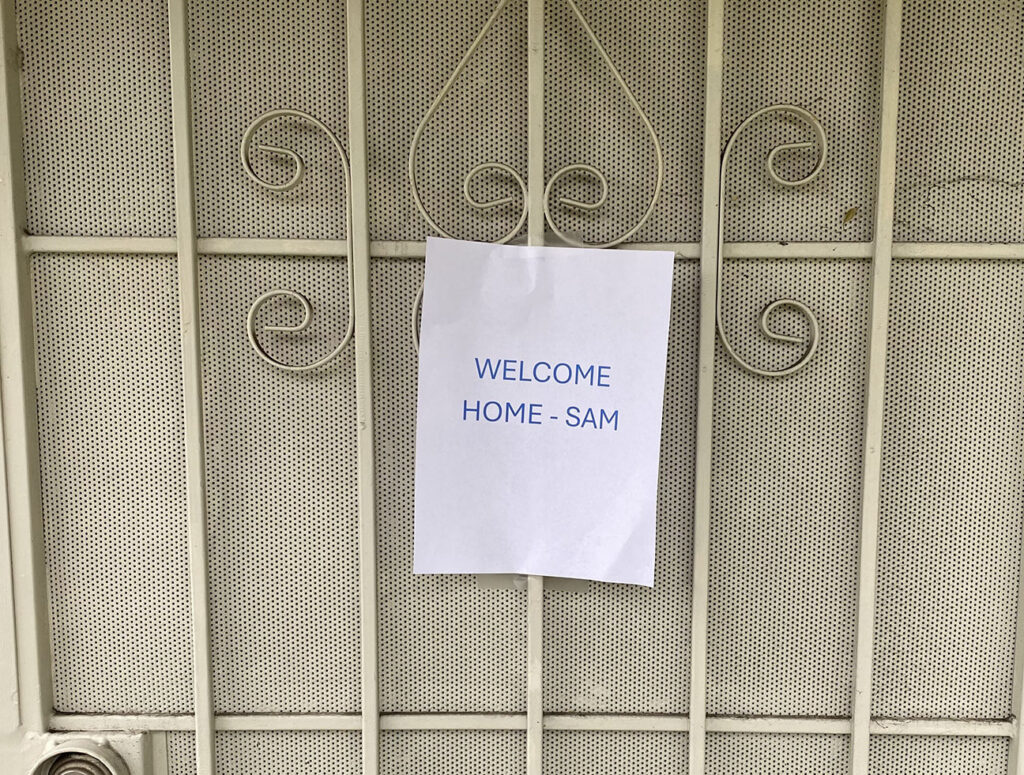
I placed a “Welcome Home, Sam” sign on my front door on Sunday. Sam arrived around 10:30 pm. I waited until morning to unpack Sam.  Then I put him back in the garage for a long snooze until our next trip.  Japan.


Mark Schiff is a comedian, actor and writer and hosts, along with Danny Lobell, the “We Think It’s Funny” podcast. His new book is “Why Not? Lessons on Comedy, Courage and Chutzpah.”

Welcome Home, Sam Read More »

Mamdani Meets His Match

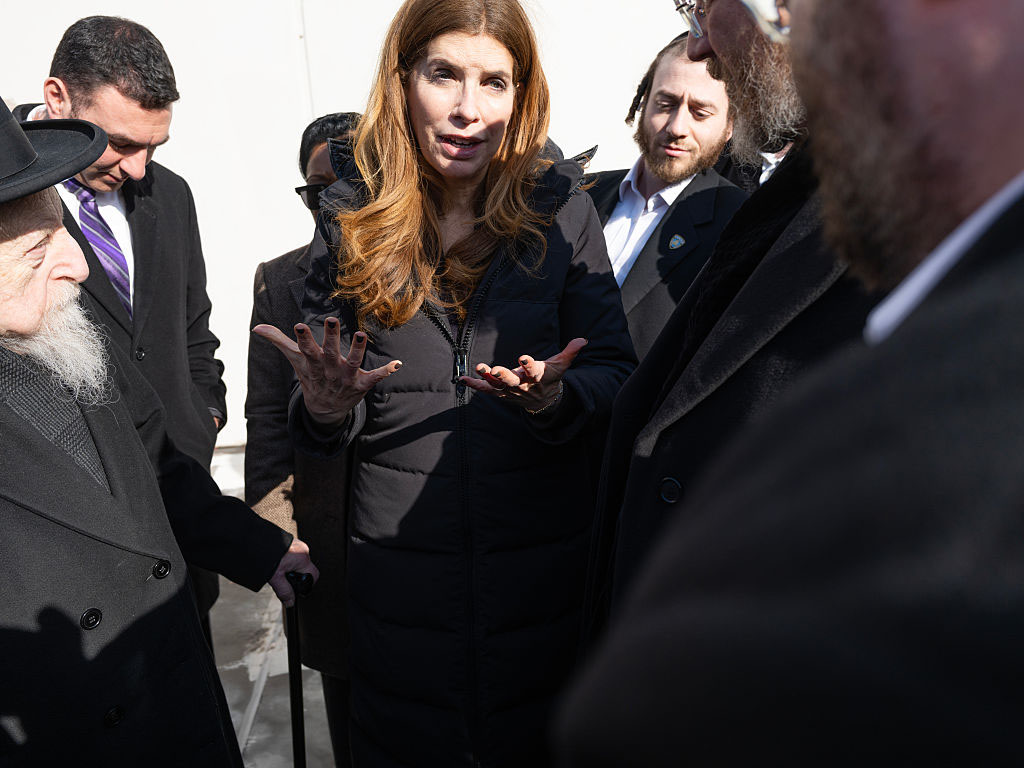
Julie Menin is the Speaker of the New York City Council, which makes her the highest-ranking Jewish official in a government headed by Mayor Zohran Mandani. As such, she may have the most complicated diplomatic challenge in American politics (Steve Witkoff and Marco Rubio run a close second and third. Rep. Mike Johnson [R-La.] and Sen. John Thune [R-S.D.] are not even close.) At this early juncture, she appears to be succeeding.

Mamdani’s problems with Israel seem to come less from any discernable knowledge of history, security or geopolitics than an affinity for progressive ideological fashion. But regardless of their origin or veracity, his beliefs are real and they tend to excite a portion of his electorate who are less enthused about his administration’s approach to snow removal, taxes and other more mundane matters. So he exercises those beliefs publicly whenever possible. His election has unexpectedly thrust Menin, who sought her office on a platform of affordable housing, healthcare costs and small business support, into the position of America’s largest city’s Zionist-in-Chief.

Not surprisingly, she and the mayor have already frequently crossed swords. She has spoken against his recent proposal for a large property tax increase, but most of their differences have been related to Israel and the city’s sizable Jewish community. After her opposition to his decisions to revoke the city’s adoption of the International Holocaust Remembrance Alliance definition of antisemitism and lift local restrictions on the BDS movement, she announced her own task force to combat antisemitism when Mamdani delayed his own appointments to a similarly-tasked mayoral commission. (Mamdani did make his appointments last week.)

Their differences have become most stark after Menin proposed a legislative package that included establishing a 100-foot perimeter at schools and houses of worship to protect students and congregants from overly aggressive protesters. She moved forward with her plan in the aftermath of ugly protests outside of an Upper East Side synagogue when demonstrators gathered there to chant epithets such as “Death to the I.D.F.” and “Globalize the intifada” and a more recent protest when demonstrators chanted their support of Hamas outside a synagogue in Queens.

Mamdani has objected to Menin’s proposal on free speech grounds, but the Speaker has picked up an even more powerful advocate in Governor Kathy Hochul (D), who has announced her own similar policy goal. (Mamdani does sensibly support an almost-identical set of protections for abortion clinics, but has not yet explained why children and worshippers should not be granted the same protection against assailants emboldened by their mayor’s indifference.)

In fairness, Mamdani is not the only person to oppose such restrictions due to First Amendment considerations. For many Jews, these questions can be complicated ones. Pro-Israel advocates frequently gather in front of the United Nations or the consulates of countries like Iran or Qatar to protest anti-Israel resolutions or state-sponsored terrorism.  And one of the most successful Jewish advocacy movements in history was the Save Soviet Jewry campaign. For decades, committed activists stood directly in front of the Soviet Mission to the U.N. in New York City, chanting and holding signs to demand the release of refuseniks.

But these are government buildings, not religious sanctuaries or schools, and the distinction between utilizing political protest to obstruct government work and shutting down a child’s education or religious services is an important one. Distinguishing between the right of protesting a government action and attacking a worshipper’s religious belief should be even less difficult. Unless it requires an elected official to stand up to their most fervent supporters.

Menin has also pushed to expand the city’s reimbursement program for security guards and private and religious schools by providing access to security cameras. Her other proposals include mandating and funding a program that would offer security training to houses of worship; establishing a hotline to report antisemitic incidents to the city’s Commission on Human Rights; and allocating $1.2 million over the next two years for Holocaust education in city schools.

Mamdani has not yet taken a position on any of these matters. This test of wills is just beginning. The smart money would be on Menin.


Dan Schnur is the U.S. Politics Editor for the Jewish Journal. He teaches courses in politics, communications, and leadership at UC Berkeley, USC and Pepperdine. He hosts the monthly webinar “The Dan Schnur Political Report” for the Los Angeles World Affairs Council & Town Hall. Follow Dan’s work at www.danschnurpolitics.com.

Mamdani Meets His Match Read More »

Never Again Means Now

Democracies rarely collapse overnight. More often, they erode — norms bent, institutions pressured, guardrails tested. Citizens sense that something fundamental is shifting but struggle to name it, much less stop it.

Recent warnings about the fragility of American democracy have moved from the margins to the mainstream. Editorial boards, constitutional scholars and former public officials have urged vigilance in protecting elections, judicial independence and the rule of law. Such concerns are not partisan reflexes. History shows that stable democracies can weaken gradually, often under legal and procedural cover.

I grew up in a secular Jewish household where one lesson was transmitted without ambiguity: we would never forget the Holocaust. “Never again” was a moral obligation to recognize early warning signs before they become irreversible. Comparisons between contemporary America and Nazi Germany understandably make people uneasy. The historical contexts are profoundly different, and careless analogies risk trivializing genuine evil. Yet history is not only about repetition; it is also about recognizable patterns.

Authoritarian movements frequently begin by stigmatizing outgroups. In interwar Germany, Jews were portrayed as alien forces responsible for national decline. That rhetoric preceded exclusion, repression and ultimately state violence. America today is not 1933 Germany. Still, when political leaders describe immigrants as “poisoning the blood” of the country or portray entire populations as inherently criminal, historical echoes are difficult to ignore. Dehumanizing language lowers barriers to harsher policy responses and reframes political disagreement as an existential threat.

Authoritarian systems weaken pluralism by casting critics as enemies rather than opponents. The U.S. continues to hold competitive elections, sustain a free press and maintain an independent judiciary — facts that matter enormously. Yet persistent attacks on journalists, judges, civil servants and universities can erode public confidence in institutions designed to function independently of political power.

Democracy depends not only on constitutional design but also on norms of restraint and mutual toleration. When those norms weaken, formal institutions become more vulnerable.

History offers a cautionary example. After the Reichstag fire in February 1933, Germany’s president suspended civil liberties in the name of national security. Weeks later, the Enabling Act transferred legislative authority to Hitler’s cabinet. Democratic structures technically remained, but their substance was hollowed out. Nazi consolidation did not occur in a single dramatic rupture; it unfolded through incremental steps that appeared defensible in isolation yet proved transformative in combination.

The United States faces no equivalent emergency decree today, and its constitutional order remains intact. The comparison is not one of equivalence but of trajectory. Expansive claims of executive authority, threats of political retribution and efforts to politicize civil service institutions raise legitimate concerns about democratic resilience. Backsliding, when it occurs, typically proceeds gradually.

Historians such as Richard Evans and Ian Kershaw have shown that many Germans recognized early dangers in 1933. Yet broad civic resistance failed to materialize. Political fragmentation, economic anxiety and fear encouraged hesitation. Elites accommodated, institutions complied and many citizens withdrew from public life. The regime strengthened not only through coercion but through conformity.

The lesson is not that America is destined for dictatorship. It is that democratic endurance depends on engagement before guardrails fail.

During World War II, Charles de Gaulle asserted the continuity of the French Republic from exile following France’s 1940 collapse. Although the Resistance involved only a minority, its enduring importance lay in preserving legitimacy and uniting disparate factions around democratic principles. In modern democracies, resistance is lawful: coalition-building, electoral participation, litigation, investigative journalism and civic mobilization grounded in constitutional norms.

History’s darkest chapters rarely announce themselves all at once. Democracies falter not only when leaders overreach but when citizens assume that overreach is temporary, justified or someone else’s problem.

“Never again” is therefore not solely an act of remembrance. It is a commitment to vigilance. Institutions do not defend themselves; democratic norms require active stewardship. The United States is not Nazi Germany. But history reminds us that no democracy is immune to erosion.

The decisive variable is not analogy but action — measured, constitutional and sustained. For many Jews, “never again” was a promise passed from one generation to the next. Its meaning extends beyond memory. It asks whether citizens will recognize warning signs early enough to defend democratic institutions while they still can.


Robert M. Kaplan is a Senior Scholar at the Stanford University School of Medicine and a Distinguished Research Professor at the UCLA Fielding School of Public Health.

Never Again Means Now Read More »

Does AI Future Belong to Curiosity?

“The most valuable skill in history just changed forever,” began a post from X.

Is this clickbait? I wondered. Is this person whom I don’t know using extreme hype just to get my attention? Seriously, how can anything be more clickbait than “The most valuable skill in history just changed forever”?

I reserved judgement and kept reading.

“Elon Musk just handed you the only survival framework that matters,” the post continued.

Then it quoted Musk:

“The biggest thing is, what questions do we not know to ask?”

Post: “For centuries, the smartest person in the room held the most answers. AI didn’t level the playing field. It burned it down. Superintelligence in your pocket answers anything. Instantly. Perfectly. For free.”

Musk: “Once you know the question, the answer is usually the easy part.”

Post: “Let that land. The next generation of winners won’t be defined by what they know. They’ll be defined by what they think to ask. AI commoditized execution. Script, plan, code, strategy. Models handle all of it. The bottleneck was never intelligence. It was never labor. It’s curiosity.”

That last word got my attention.

You see, I’ve had a lifelong love affair with curiosity.

A few months ago, I did a Ted-X talk in San Diego on the “Superpower of Curiosity.”

I consider it the most underrated of human traits.

It doesn’t have the well-earned status of the great virtues like honesty, generosity, compassion, kindness and integrity.

But in its quiet, humble way, curiosity can lead to the most wonderful human relationships.

By making us ask questions, curiosity makes us better listeners.

By being better listeners, we learn to receive.

By receiving, we make others feel needed and valued, one of the deepest expressions of love.

Curiosity helps us uncover stories we didn’t know existed. Be curious with grandparents, ask them stories of their past, and you’ll see what I mean.

Curiosity also helps us connect with those who don’t share our opinions or world views. We find things in common. We grow and learn. Instant judgment makes for short conversations; curiosity makes life more interesting.

So much for the human angle.

But what about curiosity for our new world?

Let’s go back to the X post:

“It’s always been curiosity. Traditional education spent decades training you to memorize answers. AI made that obsolete overnight. Human value is no longer tied to knowledge. It’s tied to the judgment of which problems are even worth solving. That’s the gap machines can’t close. Because asking the right question isn’t a skill. It’s a worldview. It requires taste. Intuition. The ability to look at a landscape everyone else is staring at and see the one thing nobody thought to interrogate.”

As great as curiosity and asking questions sound for our new AI age, we live in a world that encourages the very opposite.

We are inundated with answers.

Wherever we look, whether on social media or in manifestos or fundraising pitches or passionate op-eds, the world throws answers at us.

Human nature makes us love answers. Answers mean solutions. Answers give us closure. Questions leave us hanging.

If you’re pitching an idea, the money is in answers, not questions.

The AI future may indeed belong to curiosity and the art of asking questions, but human nature will put up a fight.

So will curiosity, if only by necessity.

“Master the art of asking the exact right question to a machine that knows everything and you can build anything,” the post continues.

“The skill isn’t knowing. It’s knowing what to ask. That judgment, that taste for what’s worth pursuing, that’s the last truly human edge. The only one markets will keep paying for. Answers are infinite now. Free, instant, and available to everyone on earth equally. The only thing separating you from the person who builds the next great company is the quality of your questions. Answers are free. Questions are everything.”

If this new AI world encourages us to ask questions, who knows, we may all become better listeners.

Our Jewish tradition has always elevated the asking of questions. As the late Chief Rabbi Jonathan Sacks writes, “Judaism is the rarest of phenomena: a faith based on asking questions, sometimes deep and difficult ones that seem to shake the very foundations of faith itself.”

Judaism also encourages us to transcend human nature and aim higher; sometimes, even as high as the most valuable skill in history.

Does AI Future Belong to Curiosity? Read More »