It’s 103 degrees in Hollywood, and I’m schvitzing. As I head up the stairs at my synagogue, Tony Guerrero and I exchange greetings.
As usual, he’s looking sharp: pressed
slacks, a clean white button-down shirt, and today — a tie and a kippah.
“Tony,” I ask incredulously, “how can you wear that tie in this heat — don’t you want to at least loosen it a bit?”
“No way,” he answers. “It’s Shabbat.”
His answer impresses me, but it no longer surprises me. For although Guerrero is a Mexican American non-Jew, I have come to understand just how intensely he has embraced the Jewish community and how genuinely at home he feels here.
Non-Jews are common at many Jewish facilities, ensuring the smooth operation of our institutions — understanding and anticipating the needs of members, meeting the standards of our practices. But Guerrero’s story is more than the tale of someone “other” who happens to work among “us.” To hear Guerrero tell it, he has learned both the most fundamental and profound of life’s lessons by being among Jews.
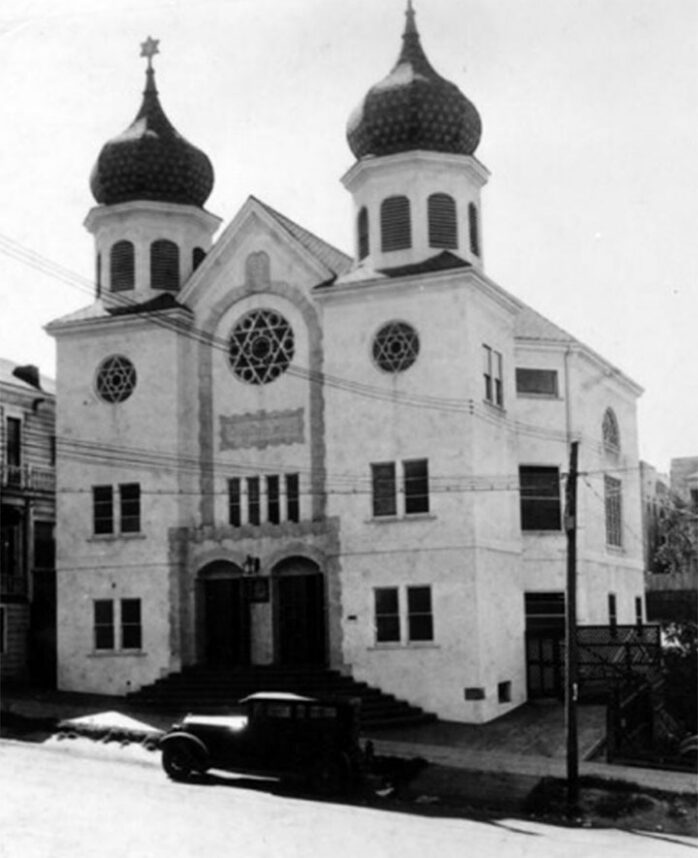
At Temple Israel of Hollywood, where my family has belonged for 10 years, Guerrero attends to all facets of our building’s use: repairs, maintenance, security, and more. He is striking for his efficiency, his quiet presence and the way in which he brings — for lack of a better word — a haimishness to his work. The way he sees it, he’s not just our facilities manager, he’s also “a psychiatrist, a referee … a jack-of-all-trades.”
Born in Mexico, Guerrero came to the United States at the age of 5 with his mother. He quickly adapted to Southern California, acquiring skills that his family came to depend upon. When his uncle needed a new part for his car, Guerrero went along to translate for him. Impressed by the 10-year-old’s maturity and English skills, the owner of the auto shop, Arthur Louis Richman, offered him a job cleaning up after school.
Guerrero learned that Richman was a nonobservant Jew who “had no kids, no family.” He found ways to be useful — and Richman both encouraged and challenged him. By the time Guerrero was 11, he was spending every afternoon and weekend at the shop, and his relationship with Richman became “like a father-and-son thing.”
Through observation and initiative, Guerrero learned much by Richman’s side. Whether the lessons involved auto repairs, coin collecting, or interpersonal behavior, “[Richman] was a perfectionist; he was a very smart man.”
When Guerrero started getting into trouble as a teenager, Richman took him to a boxing gym. At the age of 16, Guerrero had his first amateur fight; at 18 he turned pro.
After four pro fights — he won them all — Guerrero decided he wanted out: “I was just too young to deal with all the pressure.”
Around the same time, his mentor retired.
“After I stopped boxing and he sold his business, I didn’t know what to do. I only had [some] high school … and I was striving; I wanted better.”
In 1989, encouraged by Richman, Guerrero applied for a building maintenance job at Valley Cities Jewish Community Center. Although he felt that he was “out of [his] league,” he says, “I [just] told them the truth — that I’d boxed, that I was a mechanic, that I was good with tools, but that … I wanted to learn.” Modestly, Tony admits “I guess they liked the ambition part.”
Tony quickly got to know many of the families there, and he found them more than willing to help him excel. When he needed to upgrade or repair the building he’d “know who to call on [among the families] to learn from … a plumber, or an electrician, or a carpenter.”
But his learning didn’t stop with the tools of his trade.
“I started seeing how important education was, which I didn’t know before,” he said.
With encouragement from people at Valley Cities, Guerrero completed high school and attended community college.
He also saw Jewish family role models worthy of emulation.
“I started seeing how close the fathers were to their kids,” he said.
He was equally impressed with the kids: “Where I grew up, if you [did] something for a kid … the kid would look at you and say, ‘Who are you?’ and use the f-word.”
But the kids at Valley Cities would “say, ‘Good morning, Tony. How are you?’ and ‘Thank you for fixing’ this.’ It really made me a better person.”
His informal education in Judaism took another leap forward about nine years ago, when he accepted his current job at Temple Israel.
“I didn’t know what a tallit was … what a kippah was, what the Torah was,” he said. “I had to catch on [quickly] when I came here.”
Guerrero tells me that he “isn’t religious,” though he was raised as a Catholic. “But I have a lot of faith. I live by the Ten Commandments, and I try to be the best person I can be.”
Noticing the ways Jews “give back to their community,” Guerrero says, “Now, if I’m able to help somebody, I will; before I wasn’t like that.”
As though still surprised by his good fortune, Guerrero quietly confessed that he had been “a lost soul” before he was taken in and “raised by” Richman. Whenever they speak, he says, “I just thank him, thank him, and thank him. He really taught me how to be a good man.”
Working “with Jews for so long, and coming from where I started [can] make you a smart man, make you a nice man. And that’s the kind of people I belong with.”