
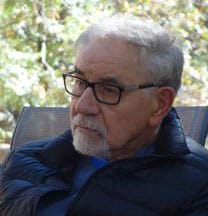
Something extraordinary is going on at Whittier’s Beth Shalom Synagogue, which has been in its present site east of Los Angeles since the early 1960s. As the area’s Jewish population base has dwindled — and as the Conservative congregation has aged — Rabbi Haim Dov Beliak has reached out to the Spanish-speaking community in the area.
“One of the purposes was to educate our neighbors about Judaism,” Beliak said. “But it was also to reach out to those in the Hispanic community who may have had some kind of Jewish connection: people in mixed marriages, those with a Jewish parent or grandparent or those who may have had a Jewish boss they felt close to. Was it with the hope of converting some to Judaism? I would say yes, that, too. All of the above.”
In recent years, several neighbors trickled in and converted, becoming part of the congregation, but it was last February that the real change took place. Beliak asked Argentine-born Rabbi Aaron Katz to teach a class — in Spanish — about Jewish history, philosophy and traditions. The class started with six students of Mexican and Central American background, most having been brought up in Catholic households.
Katz was surprised when the class quickly expanded, some bringing in spouses, friends and children. It was clear to him that the participants felt a deep spiritual connection to Judaism — they weren’t there merely to learn, they came for faith-driven reasons. These people wanted to practice Judaism.
Several in the Grupo Hispano, as a couple of the members referred to the group, said that they had grown up in homes with what they later realized were Jewish traditions: no eating of pork, devotion to study. They have no proof that they’re descended from those forcibly converted to Catholicism 500 years ago, but several said that the first time they stepped into Beth Shalom it felt familiar, as if they had “come home.”
After a couple of months of study, members of the group asked Katz for their own services. So, since June, in a separate room within Beth Shalom, Katz has led them in Spanish-language services, as does another Argentine-born rabbi, Daniel Mehlman.
The Grupo Hispano is also learning Hebrew prayers and songs. It has become a community within a community and now numbers about 30.
Katz said that when he came to the United States four years ago, he had no intention of becoming a congregational rabbi again. He wanted to teach and study, which he’s done at several institutions.
“When I started giving classes to this group,” he said, “I thought it was just a teaching assignment. But their interest and enthusiasm drew me in. So now I’m once again a rabbi with a community. It’s these people. They made me a rabbi again.”
Nearly everyone in the group seems to be in the process of converting or intends to do so soon. Some have already done so.
How has the existing congregation dealt with this?
“Some have grumbled,” Beliak said. “But for the most part, the new members have been welcomed warmly.”
One congregant, 80-year-old Zelda Walker, said, “It’s wonderful! I’ve seen the conversion of two already. I’m delighted to see the community take in new members.”
Other congregants echoed the same thought. Recently, the two groups had Tisha B’Av service together, and now, after the Grupo Hispano has its separate Spanish-language service, members join the English-language congregation for Torah reading and Kiddush.
“Hopefully, in the coming months we will enjoy a renaissance,” wrote Beliak in the shul’s newsletter, Mishpacha, now published in English and Spanish.
Beliak said that the new members are extremely interested in matters of faith and have revitalized his shul.
“They have a yearning for divinity, as sincere as anyone I’ve ever known,” he said. “A sense of the spiritual. They are the ones setting the standard. In their own way, they’re more interested in being observant than the existing congregation.”
“This group,” Katz said, “is intensely involved in the spiritual aspect of our religion. That’s rare in Los Angeles or anywhere else. Of course, the social part is important, but [the Grupo Hispano] is looking for something more, and so am I. For many, it’s going to be their first High Holy Days, and they’re thrilled.”
Beth Shalom is located at 14564 E. Hawes St., Whittier. Parking is at 14579 Mulberry St.
On Sept. 22 at 7:30 p.m., there will be a joint service of the two groups at Beth Shalom’s sanctuary. On Sept. 23-24 at 9 a.m., there will be separate services in Spanish and English, then the two groups will join for Torah reading.
On Kol Nidre, Oct. 1, the two groups will be together, and on Oct. 2, the Spanish-language group will have its own Yom Kippur service, then join the others for Torah reading.
For further information, call (562) 941-8744, visit bethshalomwhit@adelphia.net

































