Daniel, a blue-eyed 24-year-old who was a few credits shy of finishing his undergraduate degree at UCLA last spring, is now an inmate in unit 131 at the Twin Towers Correctional Facility in downtown Los Angeles.
When Rabbi Yossi Carron arrives for his meeting with Daniel — not his real name — an unseen guard in a concrete and black glass bunker releases the latch on the sliding steel door that connects the youth’s dorm pod to the unit’s deserted common area.
On the far side of a thick glass wall, other inmates sleep in their bunks or drift aimlessly beneath the harsh white lights overhead.
Daniel looks awkward in his pale green prison outfit. He has gained 20 pounds since he was convicted three months ago on a charge of dealing methamphetamine, and he’s clearly uncomfortable in his skin.
Carron wraps Daniel in a quick but firm embrace.
“How’s it going?” Carron asks with one hand on Daniel’s slumped shoulder and another on his cheek.
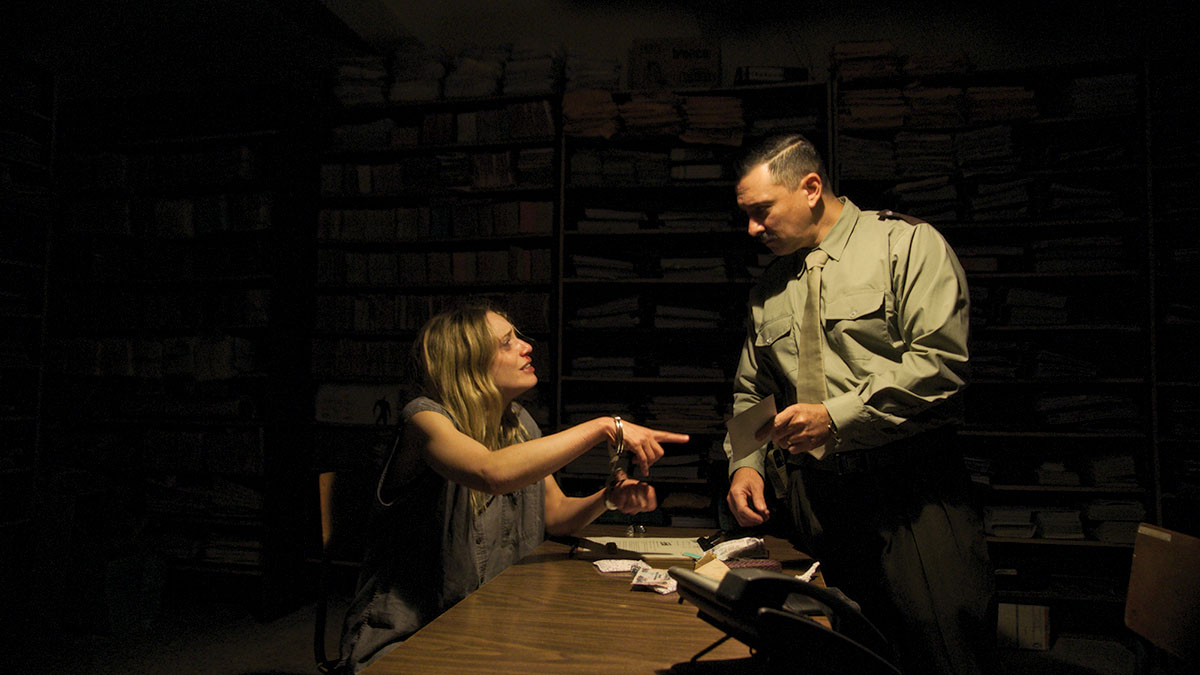
The pair settle into plastic chairs at the corner of a table decorated with a stenciled checker board. From his pants pocket Daniel pulls a small ziplock bag that holds a pencil stub and two sheets of paper covered front and back with Daniel’s dense, neat handwriting. With guidance from Carron, Daniel is working through the recovery movement’s Fourth Step: making a “fearless and searching” inventory of his life.
As Carron scans the sheets of paper, Daniel hunches forward, his elbows on his knees.
“I’ve really had to look at my relationships — friendships and sexual relationships — in this step,” Daniel says. “It’s kind of shocking to see how much I’ve needed other people to feel complete.”
Carron lays the sheets of paper on the table and gives Daniel his full attention.
“It’s still hard, though,” Daniel says, turning his gaze up to meet Carron’s. “I mean, none of my friends have come to see me.”
Carron leans toward Daniel.
“You’re an extraordinary guy, all by yourself,” he says. “I don’t show up for any other reason than I want to.”
Daniel blushes but doesn’t look away.
“Chances are a lot of these people are connected to the parts of your life you want to change,” Carron says. “Am I right?”
Daniel looks down at his hands and nods slowly.
Sitting up, Carron drums a finger on the pages to draw Daniel’s attention to his inventory.
“This is going to be the greatest Rosh Hashanah of your life,” Carron says, “because you’re sober and you’re not lying to yourself or anyone else.”
Daniel sits up and looks squarely at Carron. He takes a deep breath and says, “You make me feel very special.”
With any luck, Daniel will be spending Rosh Hashanah on the outside. It’s likely he’ll soon be making the transition from jail to the recovery program at Beit T’Shuva, a nonprofit that works with at-risk youth.
For the members of Carron’s patchwork prison shul who are still behind bars come next week, however, there will be a holiday Shabbat at Men’s Central Jail, across the street from Twin Towers. Most of the Jewish inmates who participate will be bussed in from one of the five additional jails Carron serves in Los Angeles County. Some of the 70-odd men in Carron’s shul will have to stay away, however, in lock-down or solitary. Others are considered too high-risk to move.
“We’ll have between 20 and 40, including volunteers,” Carron says. “All things considered, that’s a pretty good turnout.”
Carron, a former bandleader at the Beverly Hilton, might seem an unlikely host for such a party.
A decade ago, Yossi Carron was called Jeff. He was a successful 40-something musician with a daughter in grade school, plenty of money in the bank and a nagging sense that something was missing in his life.
“It was all good, but I just wasn’t having fun anymore,” Carron says over braised tofu at a Chinatown restaurant the day before his meeting with Daniel.
The lightbulb over Carron’s head began to flicker when he was asked to serve as the first cantor at the then newly formed Congregation Kol Ami in West Hollywood. The job was a good fit for Carron, who has an impressive voice to match his musicianship. Still, he’d never paid much attention to the flow of services before. But as he threw himself into his new role he began to realize he was feeling deeply fulfilled by the experience.
“I was sticking Post-Its in my siddur,” he says. “Pretty soon I needed to know more, so I started taking classes at Hebrew Union [College-Jewish Institute of Religion (HUC-JIR)].”
As he continued to follow the thread of his curiosity, Carron’s enthusiasm began to blossom into a calling.
One day Rabbi Denise Egger at Kol Ami told Carron, “You should be on the bimah.”
In May 2003, Yossi received his ordination from HUC-JIR.
“I thought I’d have a normal shul,” Carron says. “You know — with ladies organizing bake sales and that sort of thing.”
But not long after his ordination, the Board of Rabbis of Southern California offered Carron a part-time job as a chaplain in the Los Angeles County prison system. The task seemed thankless — the job’s responsibility covered three jails and two hospitals, but there was only enough money to pay for a chaplain’s services one day a week.
“It was frustrating for the person who had the job before me, and I could tell it was going to frustrate me,” Carron says. “But for some reason I wanted it, and I’m the kind of person who pushes to get what he wants. So finally the board came up with the funding for a second day, and then the job seemed do-able to me.”
Carron’s daughter was in high school by that time, and he didn’t want to have to uproot her to take a job somewhere else. So Carron said yes.