
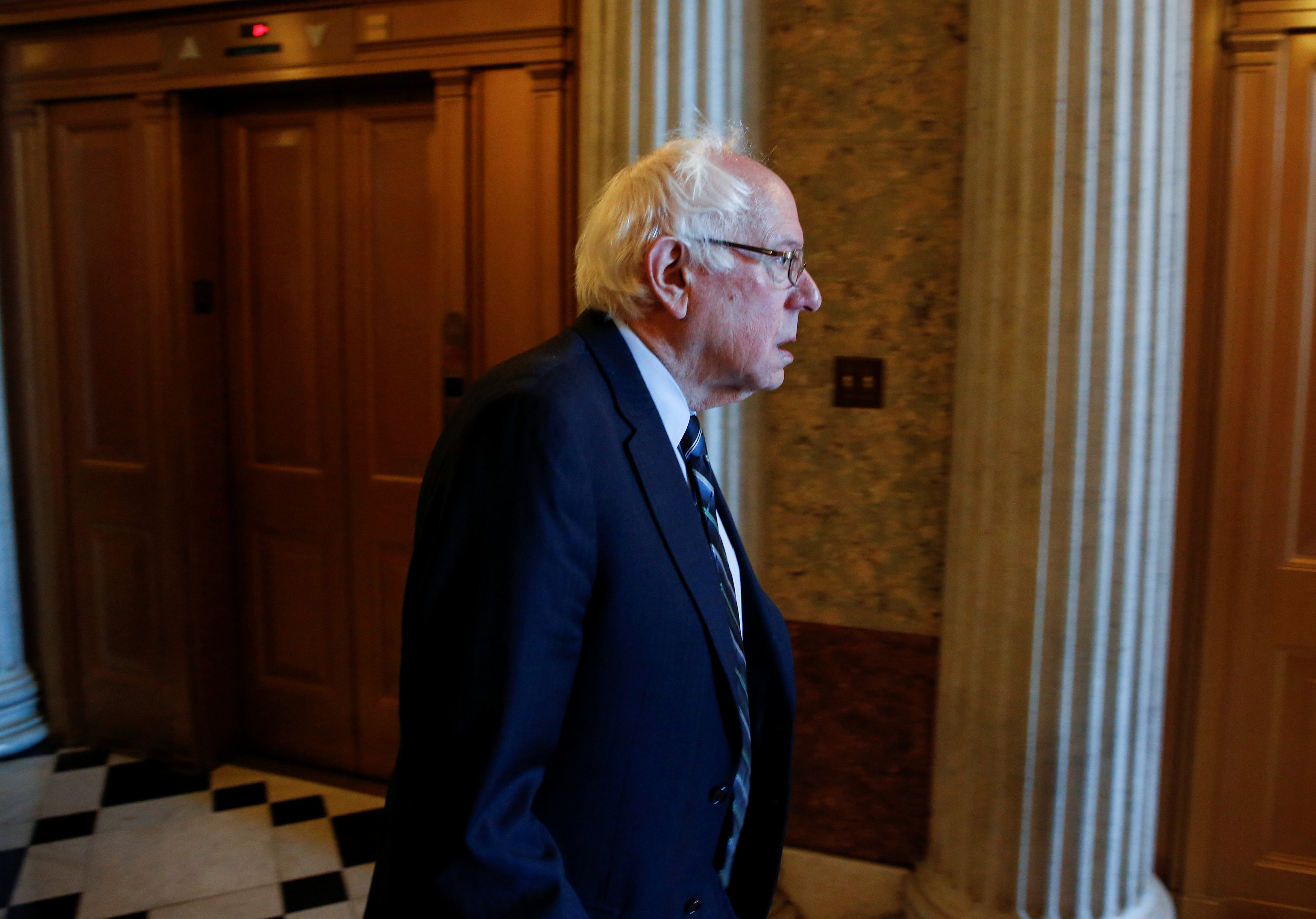
Sens. Bernie Sanders (I-Vt.) and Dianne Feinstein (D-Calif.) urged Senate Majority Leader Mitch McConnell (R-Ky.) and Senate Minority Leader Charles Schumer (D-N.Y.) to not include the Israel Anti-Boycott Act into an upcoming spending bill.
Sanders and Feinstein argued in a letter that they are against the Boycott, Divestment and Sanctions (BDS) movement, but the Israel Anti-Boycott Act is at odds with the First Amendment.
“Federal district courts in Kansas and Arizona have similarly considered state laws that target political boycotts of Israel and found them to violate the First Amendment,” Sanders and Feinstein wrote. “For example, in Jordahl vs. Brnovich, the court held in granting a preliminary injunction, ‘The type of collective action targeted by the [law] specifically implicates the rights of assembly that Americans and Arizonans use ‘to bring about political, social, and economic charge.’”
The senators also criticized the bill for cracking down on “certain constitutionally-protected political activity aimed solely at Israeli settlements in the West Bank.”
“At a time when the [Israeli Prime Minister Benjamin] Netanyahu government is pursuing policies clearly aimed at foreclosing the two-state solution, it is deeply disappointing that Congress would consider penalizing criticism of those policies,” Sanders and Feinstein wrote.
Brooke Goldstein, executive director of the Lawfare Project, told the Journal in an emailed statement that Sanders and Feinstein are “mistaken” about the bill violating the First Amendment.
“Unlike criticism of Israeli policy, which is political speech that is protected under the First Amendment, this anti-BDS legislation applies to commercial speech, which is not afforded the same degree of constitutional protection,” Goldstein said. “Additionally, the Kansas and Arizona laws referenced by Sanders and Feinstein in their opposition are utterly dissimilar in form and function to the IABA, other than that they relate to BDS. That those states’ anti-BDS laws may raise First Amendment issues has no bearing whatsoever on the federal anti-BDS measure in question.”
Eugene Kontorovich, a law professor at George Mason University, told the Journal in an email that the Israel Anti-Boycott Act “is completely consistent with decades of bipartisan law and policy.”
“Existing law prohibits companies from participating in boycotts of Israel (and the territories) promoted by foreign countries,” Kontorovich said. “The new bill merely extends this to boycotts fostered by international organizations like the U.N. The existing anti-boycott provisions have never been controversial, and have been upheld by the courts.”
Kontorovich added that the bill does not penalize protests of Israeli settlements in Judea and Samaria, it simply “restricts participating in U.N. boycotts” and does not touch “individuals or consumer boycotts.”
“The senators’ letter claims to oppose BDS, but in fact it sides with the famously anti-Semitic U.N. Human Rights Council in its effort to bar economic activity with Jews, and not with any other people,” Kontorovich said.
In his 2017 op-ed in The Washington Post, Kontorovich noted that the Israel Anti-Boycott Act updates a 1977 law that prevents American entities from participating in the Arab League’s boycott of Israel to including boycotts of Israel launched by United Nations agency.
The bill is supported by the Jewish Democratic Council of America and the Anti-Defamation League and opposed by J Street and the New Israel Fund.