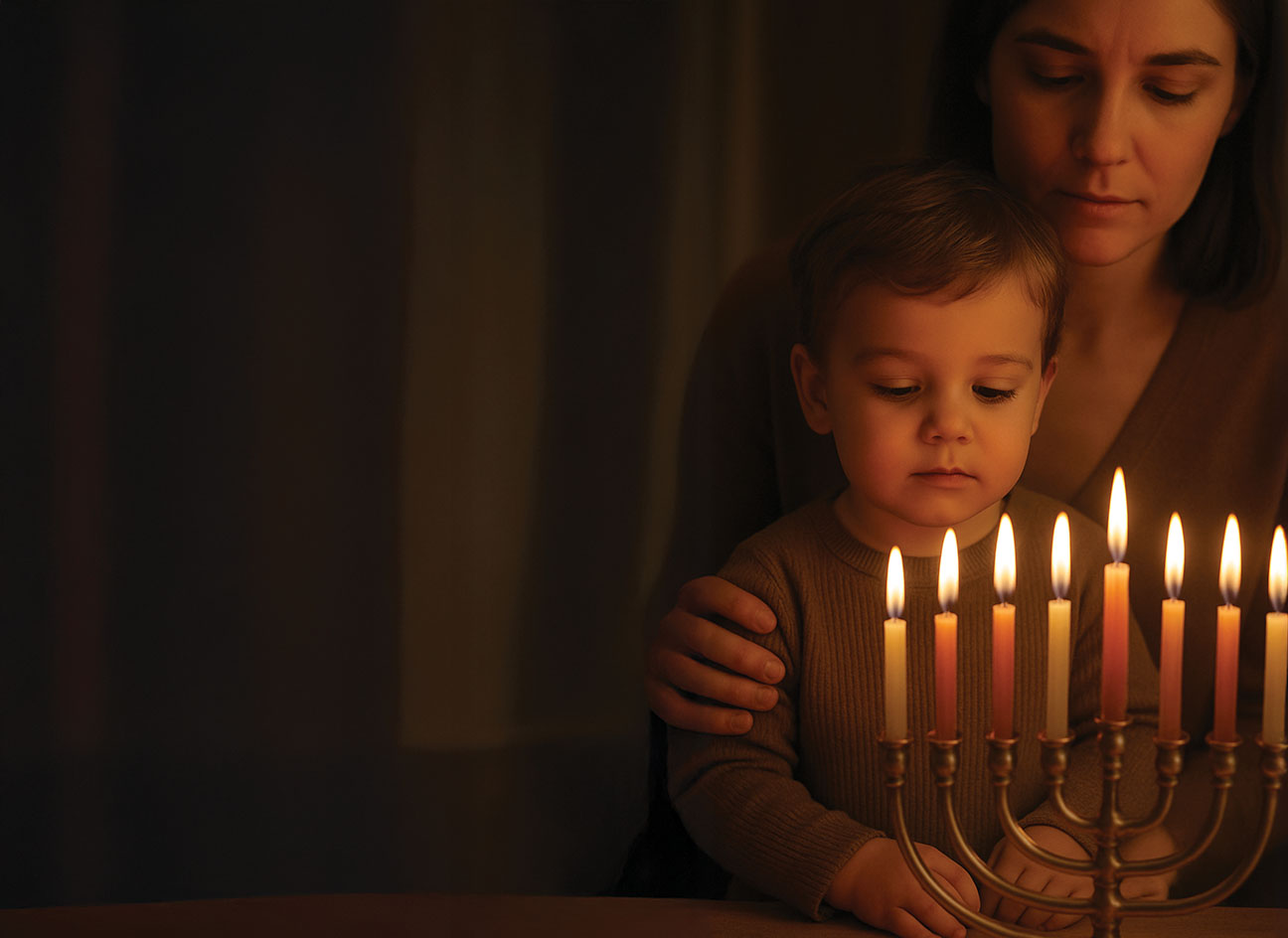
Hanukkah is the only Jewish holiday without a biblical book. But all Jews — not only New York literati and Hollywood filmmakers — demand a story with tension, heroes and villains. We cannot live on candles and short prayer insertions alone.
Jews, abhorring a narrative vacuum, have embraced a central story that exists in two versions. The classical take is the tale of the mother and her seven sons found in Second Maccabees — not in the Hebrew Bible, the Tanakh, but preserved in the Catholic and Orthodox Christian canons. Why is that? Let’s examine this question through the Jewish lens of Yashrut — moral integrity.
Second Maccabees was written by Jason of Cyrene (in today’s Libya), an observant Jew who found deep meaning in martyrdom during the Maccabean revolt against the Syrian Greeks. An unnamed Jewish mother and her seven sons are brought before the emperor and ordered to eat pork and worship idols. One by one, the sons defiantly refuse, each offering a different philosophical reason, and one by one they are tortured to death.
It is a gripping story. The king, terrified of losing face before his court, begs and bribes the youngest son to feign obedience to idolatry. The mother, described as “bearing it all bravely,” leans over her last surviving child and pleads: “My son, have pity on me, who carried you in my womb for nine months and nursed you and reared you … Do not fear this executioner. Be worthy of your brothers and accept death.” He does, excoriating the king and “perishing undefiled.”
For all its loyalty to Jewish faith and its pronounced emphasis on martyrdom, this account — written around 100 BCE — feels strikingly Christian in tone, with its gruesome torture scenes and philosophical professions of belief. Unsurprisingly, it became part of the Church’s lectionary readings.
The Jewish version, found in Midrash Eicha Rabbah (Lamentations Rabbah), composed between the 5th and 7th centuries C.E., gives the mother a name: Miriam. Here, the sons sound like they are in the beit midrash, refuting the king with biblical verses that ingeniously demonstrate how the entire Torah rejects idol worship. Even the youngest — still a small child — delivers a sermon weaving together three verses. These answers are laced with ironic Jewish humor and chutzpah aimed at the emperor. The boy even leads the king into a philosophical trap that uproariously exposes the emperor’s own foolish thinking.
This is unmistakably a Jewish story: the mother is no preacher of martyrdom. Miriam expects her children to remain loyal to our faith, yet she is heartbroken. In faith and in love, she nurses her youngest before his execution — bringing to mind the mothers who did the same for their children on the death lines at Auschwitz. She instructs him: “Go to Father Abraham and tell him, ‘Thus says my mother: do not preen yourself on your righteousness, saying, I built an altar and offered up my son Isaac. Behold, our mother built seven altars and offered up seven sons in one day. Yours was only a test; mine was realized.’” An affirmation of faith, delivered with a good Jewish shtoch — a jab.
Second Maccabees ends in triumph and glory of complete martyrdom: all eight characters pass their test, and one can almost hear the swelling of organ and choir in rapturous praise. The midrashic story ends differently — with the mother, in her grief, throwing herself from a roof. Here we hear not triumph but lamentation, and even God Himself is described as mourning.
Today in Israel, at every bus stop and on every utility pole, you find small stickers placed by friends and family with the likenesses of our young men and women murdered in our war of survival. Their tiny memorials do not focus on martyrdom, even though full duty was expected of them.
Just the other day in Tel Aviv, I paused at a utility pole where someone had placed a small sticker — one among thousands across the country. It held a brightly painted portrait of a smiling, strikingly handsome young man. Above his image were the words: “Boundless love” in Hebrew. Below it, his name and years: Amit Miganzi, 2001–2023. And beneath that, a line he once said: “Use your smile to change the world; don’t let the world change your smile.”
These words convey determination and love of life. When we read them, they break our hearts and yet fill us with love for a moral life well lived. Their memory blesses us.
Rabbi Daniel Landes is the founder and director of Yashrut, a Torah institution in Jerusalem dedicated to the rigorous study of Talmud and Halacha and to the pursuit of moral integrity.