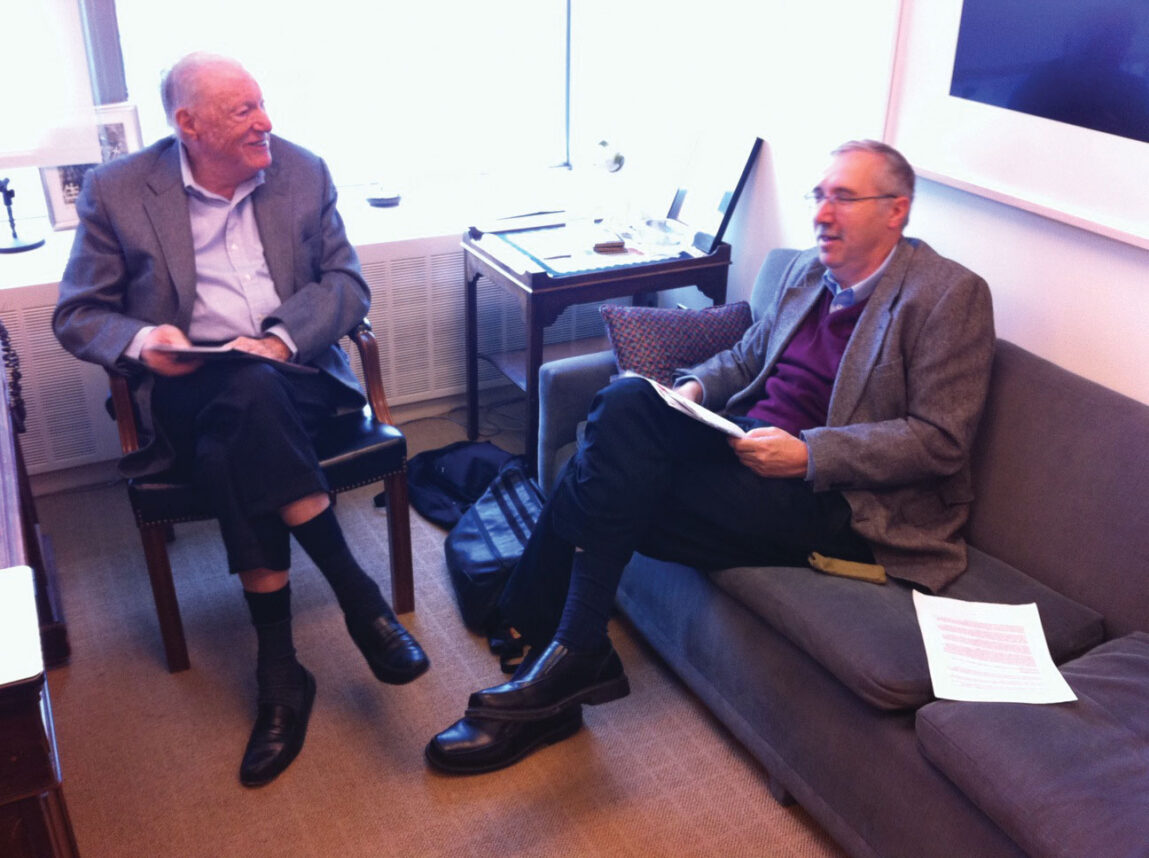
Randolph Louis Braham, a two-time Jewish National Book Award winner for works on the Holocaust in his homeland of Hungary, and a founding member of the U.S. Holocaust Memorial Museum, has died. He was 95.
Braham, whose his parents and siblings perished at Auschwitz, became the foremost American scholar of the Holocaust in Hungary, maintaining what a fellow professor described as a “moral compass” throughout his life. Late in his career, he rejected Hungary’s highest award to protest official attempts to whitewash the country’s collusion with the Nazis in the murder of hundreds of thousands of Jews during World War II.
Braham died on Nov. 25 at his home in Forest Hills, Queens, N.Y. The cause of death was heart failure, his son told The New York Times.
He was born Adolf Ábrahám on Dec. 20, 1922, in Romania and grew up in his parents’ hometown of Dej, in Northern Transylvania, where he attended a Jewish elementary school.
In 1944, during World War II, after escaping a slave-labor unit in the Hungarian army in the Ukraine, he was hidden by a Christian farmer named István Novák, who later was honored by Yad Vashem in Jerusalem as a Righteous Among the Nations. Braham made his way to the American Zone in Berlin, where he became a translator for the U.S. Army.
Braham came to the United States in 1947. He received a master’s degree from the City College of New York in 1949, and a doctorate in political science from The New School for Social Research in 1952. He became a professor at the City University of New York, where he taught Comparative Political Science from 1956 until 1992, when he retired.
His two-volume work, “The Politics of Genocide: The Holocaust in Hungary,” won the 1981 Jewish National Book Award. He won again in 2014 for his three-volume “The Geographical Encyclopedia of the Holocaust in Hungary.”
Braham edited more than 60 books, most of them dealing with the Holocaust in Hungary; co-authored or wrote chapters to 50 others; and published a large number of scholarly articles.
In 2014, when he was in his early 90s, Braham was outraged by the attempts of Hungary’s nationalist government to equate the murders of nearly 600,000 Jews in Hungary during World War II with the suffering of other Hungarians under the German occupation. He responded by returning the country’s highest honor, the Order of Merit, that he had received in 2011 for his years of research. He also asked that his name be removed from the Library and Information Center of the Holocaust Memorial Center in Budapest, The New York Times reported.
In a letter explaining his decision to the president of the center, Braham wrote:
“I realize that for a variety of political and economic reasons the leaders responsible for the operation of the [Holocaust Memorial Center] would or could not speak out against the brazen drive to falsify history. I, on the other hand, a survivor whose parents and many family members were among the hundreds of thousands of murdered Jews, cannot remain silent, especially since it was my destiny to work on the preservation of the historical record of the Holocaust.”
Last year, Braham appeared at an event in Budapest, where he was honored for his work. The Times reported that he was welcomed by professor Maria M. Kovacs of Central European University, who described his “Geographical Encyclopedia” as “an immensely precise, panoramic and microscopic study of the Hungarian Holocaust.” And Braham, she said, was “a moral compass for our profession.”