fbpx

December 12, 2018

New Jersey Teacher Sues Catholic School for Handling of Alleged Anti-Semitic Incidents

A New Jersey teacher is suing a Catholic school he taught for, claiming that they fired him after he complained about anti-Semitism he was facing.

The teacher, Jacob Rabinowitz, alleges that there was a swastika carved onto the blackboard on his first day teaching pre-calculus at St. Joseph’s Regional High School in Montvale during the 2017-18 year as well as swastikas and anti-Semitic slurs written on students’ desks. One such slur was allegedly the “sechs millionen waren nur der anfang,” which is German for “six million was just the beginning.”

Rabinowitz also alleges that students frequently threw coins at him, an apparent reference to the stereotype of Jews loving money, and one student allegedly proclaimed his love for the scene in “Schindler’s List” where a Jewish woman is murdered in front of the class. The student proceeded to act out the scene in front of the class.

In February, Rabinowitz received a performance review that was critical of his teaching skills, including his seeming unwillingness to “engage the students”; Rabinowitz responded on March 20 by pointing out that the review took place a day before a test and detailed the alleged anti-Semitism he endured on a daily basis in the classroom.

Michael Bruno, the principal of the school, allegedly blamed the anti-Semitism on Rabinowitz’s “inability to manage a classroom” in his response to Rabinowitz on March 26. Rabinowitz was then informed on March 29 that the school would not be bringing him back as a teacher in September.

The swastika was taken down from the blackboard on April 23.

“St. Joseph’s was so lax in its approach to the hostile work environment that it allowed a swastika to remain on Rabinowitz’s blackboard after he complained about it,” the lawsuit states.

Rabinowitz has alleged that he shared the classroom with two other teachers and neither of them did anything about the swastika.

Jim Goodness, a spokesperson for the Archdiocese of Newark, which owns the school, told in the Algemeiner that Rabinowitz had already filed a complaint on the matter with the Equal Employment Opportunity Commission (EEOC), and the EEOC cleared the school of wrongdoing. Goodness also argued that Rabinowitz didn’t mention the alleged anti-Semitism until after his negative performance review.

However, Justin Santagata, one of Rabinowitz’s attorneys, dismissed Goodness’ argument to the Algemeiner, arguing that Rabinowitz’s timing of notifying the school about the alleged anti-Semitism “is not an answer for what St. Joseph’s and the Archdiocese allegedly permitted to happen before and particularly after Mr. Rabinowitz’s written complaint.” He also said that the EEOC’s dismissal of the matter was “standard” prior to a lawsuit.

Additionally, Santagata told NJ.com, “The conduct he was subjected to was not kids being kids but conduct highly offensive to a Jewish individual who had to stare at a swastika every day.”

Rabinowitz is seeking compensatory and punitive damages, including damages for emotional distress and compensation for attorneys’ fees on the counts on being subjected to a hostile environment, religious discrimination, and unlawful retaliation. A court date has not yet been scheduled.

New Jersey Teacher Sues Catholic School for Handling of Alleged Anti-Semitic Incidents Read More »

“Maisel,’ ‘Kominsky’ Receive SAG Nominations

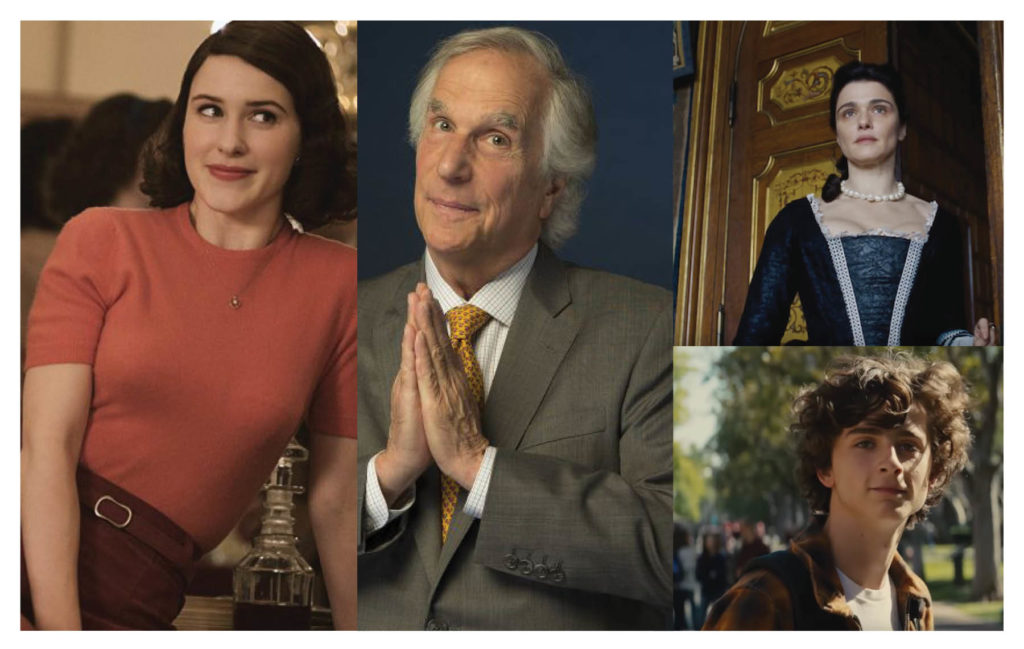
“The Marvelous Mrs. Maisel” continues its streak of accolades, picking up four nominations for 2019 Screen Actors Guild Awards including comedy ensemble, and individual nods for Alex Borstein and honorary Tribe members Rachel Brosnahan (who are both nominated for Female Actor in a Comedy Series) and Tony Shalhoub, who play the title character and her father. Included in the ensemble nomination are Jewish co-stars Michael Zegen, Kevin Pollak and Caroline Aaron.

“The Kominsky Method” is also competing in the TV comedy ensemble category, and its stars Michael Douglas and Alan Arkin were both singled out for outstanding actor nominations. So was Alison Brie of “Glow,” and the show’s ensemble, including Marc Maron and Jackie Tohn, received a nomination. “Barry” Emmy winner Henry Winkler picked up another acting nod, and the show’s ensemble—which includes Sarah Goldberg—was recognized.

On the TV drama side, “Ozark” was nominated for its ensemble, which includes Darren Goldstein, Jordana Spiro, Harris Yulin and Julia Garner, who was also singled out for an individual nomination.

In movies, individual nominees include Timothée Chalamet for “Beautiful Boy” and Rachel Weisz for “The Favourite.” Among the four nominations for “A Star is Born” is a nomination for its cast, including Andrew Dice Clay and Rafi Gavron.

Two stars were nominated for playing Jewish characters: Melissa McCarthy as Lee Israel in “Can You Ever Forgive Me?” and Adam Driver as Flip Zimmerman in “Blackkklansman,” which also landed an outstanding ensemble nomination.

The  25th Annual Screen Actors Guild Awards will air live on TNT and TBS at 5 p.m. PT on Jan. 27.

“Maisel,’ ‘Kominsky’ Receive SAG Nominations Read More »

Celebrating Hanukkah With Country Music Legend Kinky Friedman


<iframe src=”https://www.facebook.com/plugins/video.php?href=https%3A%2F%2Fwww.facebook.com%2Fgreatbigstory%2Fvideos%2F1929903793724279%2F&show_text=0&width=560″ width=”560″ height=”315″ style=”border:none;overflow:hidden” scrolling=”no” frameborder=”0″ allowTransparency=”true” allowFullScreen=”true”></iframe>

Celebrating Hanukkah With Country Music Legend Kinky Friedman Read More »

The Idea of a ‘Radical Middle’ and Hanukkah’s Link to 3 Religions,

The Idea of a ‘Radical Middle’
I really enjoyed Karen Lehrman Bloch’s story about the radical middle (“Hope for a Radical Middle, Dec. 7).  I have long been a fan of “no labels” and am grateful for politicians who work to solve problems rather than vilify the opposing tribe. Jonathan Haidt’s book “The Righteous Mind” was an eye-opener for me.  It helped me to step back and think about politics and policy in a much more constructive fashion.

As Bloch mentions in her story, bipartisan work rarely gets much media attention. It doesn’t sell to say, “We’re actually getting along and making progress toward solving problems.” I’m glad the Journal is shining a light on this.

I want to let you know about another bipartisan project that is gaining traction. I point to the bipartisan climate solutions caucus that was founded in 2016 and grew to 90 members (half Republicans, half Democrats).  A few members of the caucus teamed up recently and on Nov. 27, they introduced the first bipartisan climate legislation in a decade. There are threads of Jewish leadership throughout this entire effort, with three Jewish members of the caucus: Democratic co-founder, Ted Deutch (D-Florida); Lee Zeldin (R-New York); and Alan Lowenthal (D-Long Beach).

I agree with No Labels founder Nancy Jacobson’s assessment that “Americans are hungry for unity.” I believe Americans also are hungry for more stories like Bloch’s, reminding us of what we stand for: a unified vision that can best be implemented by bringing together good minds from all political perspectives.
Judy Berlfein, Encinitas, Calif.

I think it’s a great idea, but social media and political consultants have so poisoned the well that it’s virtually impossible for people, much less politicians, to argue without resorting to labels.

And let’s face it, ideological labels do mean something. Democrats and Republicans have drastically different views of public policy, especially today, and, frankly often view facts differently. It’s fine to say that people in Congress should focus on what’s good for Americans, not what’s good for their side. But, in general, Democrats and Republicans think that what’s best for Americans is what their party wants.

And this is especially true today as the parties have diverged so much. There are fewer areas where some agreement can be reached. But I agree, calling someone “racist” or “sexist” or, on the other side, “socialist” doesn’t achieve much. The problem is that people usually assume that if your label is different, you are automatically wrong or brainwashed or stupid or bigoted, etc.
Marc Schneider, via Facebook

In her story “Hope for a Radical Middle,” Bloch proposes that we put away our radical partisanship and get together in the middle for the sake of the greater good. I am all for it.

The problem is that her middle is substantially to the right of the center. As an example, she states “… while centrists might find President Donald Trump unappealing on a personal level, they have been finding the push toward illiberalism on the left — restrictions on free speech, lack of due process, a biased press — even less appealing.”

Let’s be real. People in the center find much more unappealing about Trump than on a personal level. To mention a few, there are “alternative facts” dishonesty, disregard for science, giving tax breaks to the rich — the list goes on and on. On the other hand, she accuses the left of illiberalism, restrictions on free speech, being against due process and in favor of a biased press. Last I looked, it was the Democrats who fight these things. Has she watched Fox News lately?

I hope that we can produce a “radical middle” based on facts, scholarship and humanity. I, for one, am eager to join.
Michael Telerant, Los Angeles

Hanukkah’s Link to 3 Religions
Thank you, Ben Shapiro for a lucid view of Hanukkah “Hanukkah’s Gift: Unwavering Light,” Nov. 30). But going further in the idea that Hanukkah shouldn’t be seen as a competing holiday with Christmas, I propose that Hanukkah should be seen as an encompassing holiday for all Abrahamic religions.

Here is my point:  As Shapiro says, Hanukkah was a war against Hellenism led in an intifada style by the Maccabees to defend the notion of one God against polytheism. If Judah Maccabee had lost, the Jewish world would have been Hellenized completely, meaning no more temple, no more Cohanim, no more Adonai, no more Judaism starting in 160 B.C.  Furthermore, if Judaism had ceased to exist as such after that time, there would not have been any Jesus nor, for that matter, any Muhammad, who proclaimed himself the Last Prophet coming after a line of prophets that included Abraham, Moses and Jesus.

So if the victory of monotheism at Hanukkah is so primordial to all three religions, why not try to make it a festival for all Abrahamic religions and celebrate together what we have in common?
Alain Cohen, Los Angeles

What Sustained the Jewish People
Nowadays, referring to something that happened a month and a half ago sounds like old news. Still, I’d like to go back to the comments made by New York Times Editor Bari Weiss on Bill Maher’s HBO show.

There, as mentioned in David Suissa’s column (“On Bari Weiss, Franklin Foer and the Values That Sustain our People,” Nov. 5), Weiss confidently stated: “ … the values that have sustained the Jewish people — and frankly, this country — forever: Welcoming the stranger; dignity for all human beings; equality under the law; respect for dissent; love of truth.” Actually, this is the motto of the new Jewish millennial generation, and other progressive groups.

No doubt that all the attributes of the social justice movement — and that’s what these attributes are — enumerated by Weiss, are part of the Jewish conscience. And to a lesser or greater extent, they belong in any civilized society. But as much as Jews have been striving to practice them in the lands of the Diaspora, they have been met with hostility and belligerence. They were not welcomed, dignity was denied to them, they were unequal under the law, their dissent was met with disdain, and hateful lies were spread about their traditions and beliefs.

Still, Jews never have abandoned the principles of justice. But they have survived in the hostile world and managed to remain Jewish by beholding the Torah, believing in their story and history and in the dream of returning to their ancestral land and beloved Jerusalem.

In the last moments of their lives, in the hands of murderous Nazis, many of them exclaimed “Sh’ma Israel,” not “Welcome the stranger.” The social justice’s tenets have roots in the system of Jewish beliefs and teachings, not vice versa. And Jews have been sustained by the latter, not former.
Vladimir Kaplan, San Mateo

CORRECTIONS
In a profile on Frankfurt, Germany Mayor Uwe Becker (“Mayor of Frankfurt Leads German Pro-Israel Activism,” Dec. 7), the German word for “House Church” was misspelled. It is Paulskirche.

In the biography of Reyna Marder Gentin’s column (“How I Became a Novelist,” Dec. 7), her debut novel, “Unreasonable Doubts,” was released in November, not December.

Rabbi David Saiger’s byline was left off a column he co-wrote with Nick Holton (“Hanukkah and the Science of Hope,” Dec. 7). Saiger is the Upper School rabbi at Milken Community Schools.


Your turn. Don’t be shy, send your letters to letters@jewishjournal.com Letters should be no more than 200 words and must include a valid name and city. The Journal reserves the right to edit all letters.


The Idea of a ‘Radical Middle’ and Hanukkah’s Link to 3 Religions, Read More »

Insurance Expert: After the Fires

The November wildfires ravaged vast swaths of Northern and Southern California, resulting in record-setting death and destruction. Losses significantly impacted sects of Los Angeles’ Jewish community with summer camps destroyed and countless Jewish Angelenos losing homes or having to evacuate.   

For many of these people, a nightmarish prospect lies ahead: insurance battles.The Journal reached out to Thomas W. Henderson, a shareholder at the law firm of Burg Simpson Eldredge Hersh & Jardine based in Denver, Colorado. Tom Henderson focuses his practice on representing policyholders in suing insurance companies for bad faith and getting insurance companies to pay what the insurance policy promises to pay.

He’s one of the lead attorneys currently working to bring justice to victims of June’s Durango 416 fire, the sixth largest in Colorado’s history. 

Henderson spoke with the Journal about his personal experience working closely with fire victims and the wide-ranging ramifications going forward for those impacted by the California wildfires. 

Jewish Journal: Given your experience working for victims of the Durango 416 fire, can you speak about what you imagine these people are going through right now? 

Tom Henderson: It’s very similar to stages of grief. Initially, people are just in utter disbelief. Then comes the anger directed at the situation. In Durango, there was no loss of life, but I have represented folks who have lost loved ones, including the families suing for wrongful death. No matter what, it’s really a traumatic experience and, folded into all of that, is the insurance component.

JJ: How does the insurance component compound the problem? 

TH: Once they get over the initial grief, they’re happy they have insurance and are trusting that [it will] take care of them. Unfortunately, insurance too often leaves them shorthanded and frustrated by the whole process. Meanwhile, they’re dealing with trauma, certainly the worst possible kind being losing a loved on, or there’s losing their worldly possessions and their home. It’s not uncommon that, as a lawyer, you end up playing the role of part-time social worker.

JJ: What legal resources should fire victims be turning to? 

TH: I know that the California Bar Association issued a fraud warning to let folks know that, unfortunately, there are some less-than-ideal characters out there who will swoop in and take advantage of trusting people at this stage. What those folks need to do is certainly check references and double check references. The handling of forest fire cases isn’t extraordinarily complicated, but folks are best served when they’re dealing with a lawyer who has been through the drill before. They need someone who knows how to find resources of information to ascertain who is at fault and where there might be remedies.

JJ: What insurance difficulties will California fire victims will be facing? 

TH: Sometimes, where I’ve had the most tears shed on my shoulder by folks who have lost everything is when the insurance companies ask for a complete inventory of everything that was in the house. The trauma that engenders is tremendous. You’re asking a person to rifle through, in their mind, sometimes physically through ash, all of their most cherished belongings. That becomes such a traumatic time, and I’ll put in a plug for a great organization called United Policyholders, a nonprofit that can be found at uphelp.org. They provide a number of helpful pointers in terms of how to help people to navigate through that and other things that come up.  

JJ: What type of future are we looking at in these areas? Will there be long-lasting environmental ramifications? 

 “Sometimes, where I’ve had the most tears shed on my shoulder by folks who have lost everything is when the insurance companies ask for a complete inventory of everything that was in the house. The trauma that engenders is tremendous.”

TH: Most likely yes. After the Montecito fires (in 2017), one of the things that caused the most destruction were rains that came along many months later. After these fires, there’s no longer groundcover to hold topsoil in place so the topsoil doesn’t absorb the rain, and whole slopes shed away causing tremendous damage. That’s a complicated factor and it’s not uncommon. 

JJ: How does that impact insurance? 

TH: Insurance companies will try to deny damage caused by subsequent flooding, since most policies have flood exclusions and most don’t address mud, even though, at its beginnings, it was really all caused by fire. That’s going to end up becoming a significant problem in the areas of California beset by these fires. Even the people that are breathing a huge sigh of relief after narrowly escaping losing a home in the fire, many of those folks will, perhaps this coming spring or whenever the rains come out, find themselves faced with a loss they thought they managed to escape. It really makes you cry.

JJ: How will property value be affected in those areas? 

TH: These types of fires affect property value dramatically. That’s not just because someone’s place burned down. It’s the burn scar. A place that had a beautiful forest now looks like a lunarscape and the trees are just twigs. There’s also the threat of a mudslide, which, generally speaking, takes 10 years for the ground cover to be solid enough to be back to pre-fire status quo. The trees take longer. If you have a home in an area that has potential to be on the wrong side or receiving end of a mudslide, you’re going to suffer a big loss in value.

JJ: In your expert opinion, what do these people need most right now? How can people who want to help but don’t know how be of service? 

TH: I would say just the basic human needs. That probably can be coordinated through the Red Cross or a similar organization. Certainly, for lawyers out there, they need to be willing to meet with folks at no charge to help navigate through their insurance policies. 

JJ: What’s something these victims are going through that most in the general public simply couldn’t know about or understand? 

TH: So many of the victims will end up in an ongoing battle with their own insurance company. I want to add that in situations like this, the communities really rally together. There are kids making banners saying thanks to firefighters and all the first responders. You want to talk about heroes? Those are the real heroes. But, the rallying together, if you think about it, is really the lone positive. 

Insurance Expert: After the Fires Read More »

Pantone Picks 2019 Color of the Year

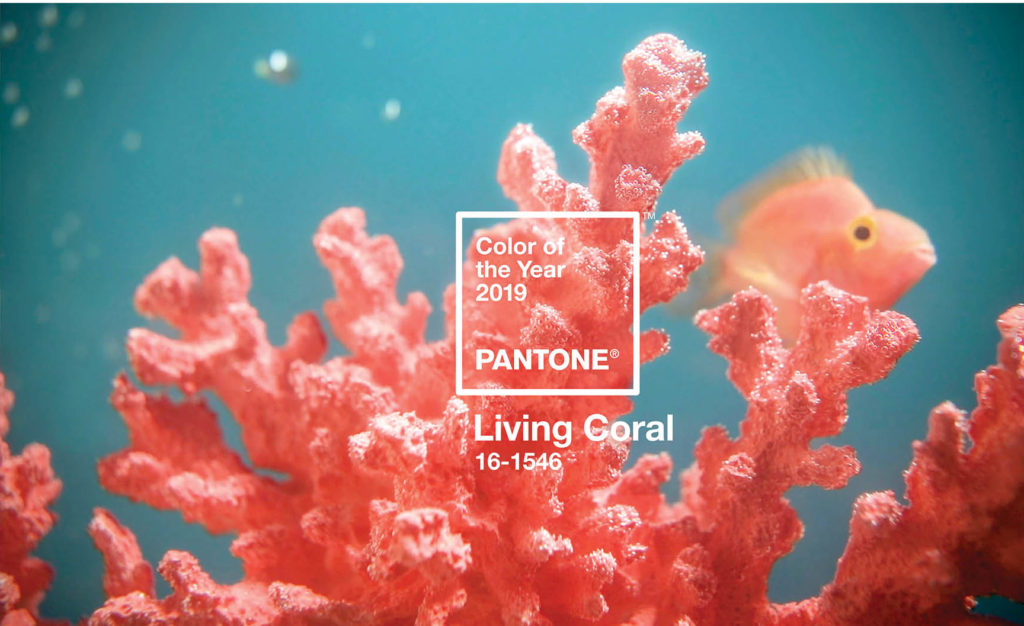
This week, while the television and motion picture industry was eagerly awaiting the announcement of the Golden Globe nominations, the design community was on pins and needles anticipating the announcement of the Pantone 2019 Color of the Year. And the winner is…Living Coral.

Living Coral is an orange hue with a touch of pink that the Pantone Color Institute describes as “vibrant, yet mellow,” adding that the color “embraces us with warmth and nourishment to provide comfort and buoyancy in our continually shifting environment.”

You may be scratching your head remembering that a few months ago I already reported on the Color of the Year, albeit from the paint companies like Benjamin Moore. So what’s the difference? Why is Pantone such a big deal?

Keep in mind that the paint companies are selling paint — they are recommending paint colors that you can purchase and apply on your walls. That’s why the colors they choose are typically more neutral. But Pantone’s pick goes much broader, influencing fashion, home décor and graphic design. Therefore, the Pantone Color of the Year is usually bolder and more polarizing, gaining both admirers and haters the moment it’s announced.

How do you feel about Living Coral? To get you in the mood for it, here are some products you can already find sporting this on-trend color.

Apple already had designed the iPhone XR before the Pantone announcement, so it’s interesting they picked coral as one of the case colors. iPhone XR in coral, available at apple.com



Let there be light with this contemporary table lamp in coral. Robert Alley Delta Melon Ceramic Lamp in coral, available at lampsplus.com


This mezuzah case will shine in the doorway. Coral mezuzah case by Adina Plastelina, available at ajudaica.com

Take a seat with this upholstered coral armchair. It would provide a nice pop of color in a room full of neutrals. Clay Alder Armchair available at overstock.com


Jonathan Fong is the author of “Flowers That Wow” and “Parties That Wow,” and host of “Style With a Smile” on YouTube. You can see more of his do-it-yourself projects at jonathanfongstyle.com.

Pantone Picks 2019 Color of the Year Read More »

Obituaries: Hungary Holocaust Scholar Randolph Braham, 95

Randolph Louis Braham, a two-time Jewish National Book Award winner for works on the Holocaust in his homeland of Hungary, and a founding member of the U.S. Holocaust Memorial Museum, has died. He was 95.

Braham, whose his parents and siblings perished at Auschwitz, became the foremost American scholar of the Holocaust in Hungary, maintaining what a fellow professor described as a “moral compass” throughout his life. Late in his career, he rejected Hungary’s highest award to protest official attempts to whitewash the country’s collusion with the Nazis in the murder of hundreds of thousands of Jews during World War II.

Braham died on Nov. 25 at his home in Forest Hills, Queens, N.Y. The cause of death was heart failure, his son told The New York Times.

He was born Adolf Ábrahám on Dec. 20, 1922, in Romania and grew up in his parents’ hometown of Dej, in Northern Transylvania, where he attended a Jewish elementary school.

In 1944, during World War II, after escaping a slave-labor unit in the Hungarian army in the Ukraine, he was hidden by a Christian farmer named István Novák, who later was honored by Yad Vashem in Jerusalem as a Righteous Among the Nations. Braham made his way to the American Zone in Berlin, where he became a translator for the U.S. Army.

Braham came to the United States in 1947. He received a master’s degree from the City College of New York in 1949, and a doctorate in political science from The New School for Social Research in 1952. He became a professor at the City University of New York, where he taught Comparative Political Science from 1956 until 1992, when he retired.

His two-volume work, “The Politics of Genocide: The Holocaust in Hungary,” won the 1981 Jewish National Book Award. He won again in 2014 for his three-volume “The Geographical Encyclopedia of the Holocaust in Hungary.”

Braham edited more than 60 books, most of them dealing with the Holocaust in Hungary; co-authored or wrote chapters to 50 others; and published a large number of scholarly articles.

In 2014, when he was in his early 90s, Braham was outraged by the attempts of Hungary’s nationalist government to equate the murders of nearly 600,000 Jews in Hungary during World War II with the suffering of other Hungarians under the German occupation. He responded by returning the country’s highest honor, the Order of Merit, that he had received in 2011 for his years of research. He also asked that his name be removed from the Library and Information Center of the Holocaust Memorial Center in Budapest, The New York Times reported.

In a letter explaining his decision to the president of the center, Braham wrote:

“I realize that for a variety of political and economic reasons the leaders responsible for the operation of the [Holocaust Memorial Center] would or could not speak out against the brazen drive to falsify history. I, on the other hand, a survivor whose parents and many family members were among the hundreds of thousands of murdered Jews, cannot remain silent, especially since it was my destiny to work on the preservation of the historical record of the Holocaust.”

Last year, Braham appeared at an event in Budapest, where he was honored for his work. The Times reported that he was welcomed by professor Maria M. Kovacs of Central European University, who described his “Geographical Encyclopedia” as “an immensely precise, panoramic and microscopic study of the Hungarian Holocaust.” And Braham, she said, was “a moral compass for our profession.”

Obituaries: Hungary Holocaust Scholar Randolph Braham, 95 Read More »