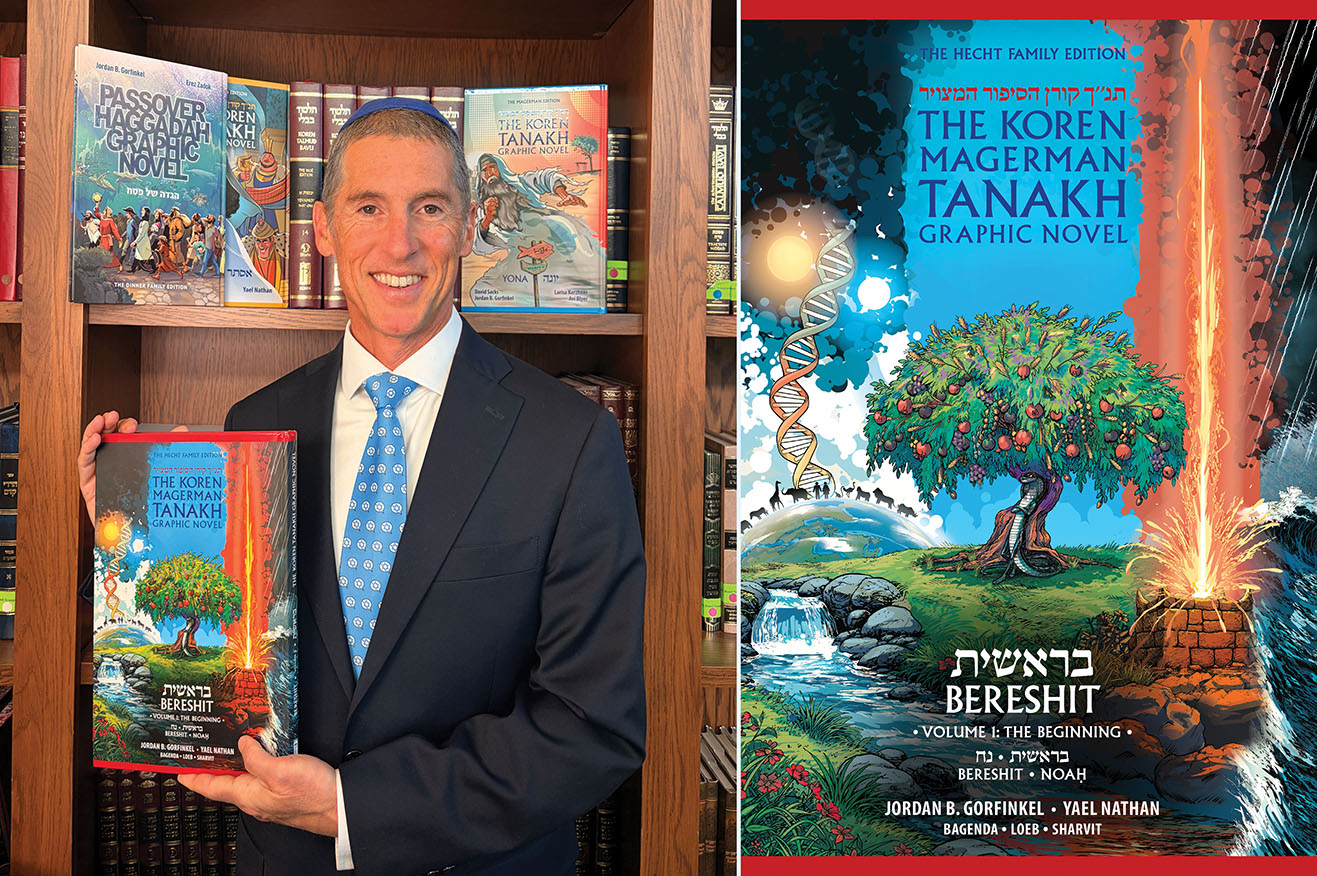
Jordan B. Gorfinkel is a multi-hyphenate. An artist, singer, lecturer and mainstream entertainment content creator and producer, he’s now dedicating his energies to quite the intimidating task – taking the Five Books of Moses and refashioning them in graphic novel form with Koren Publishers.
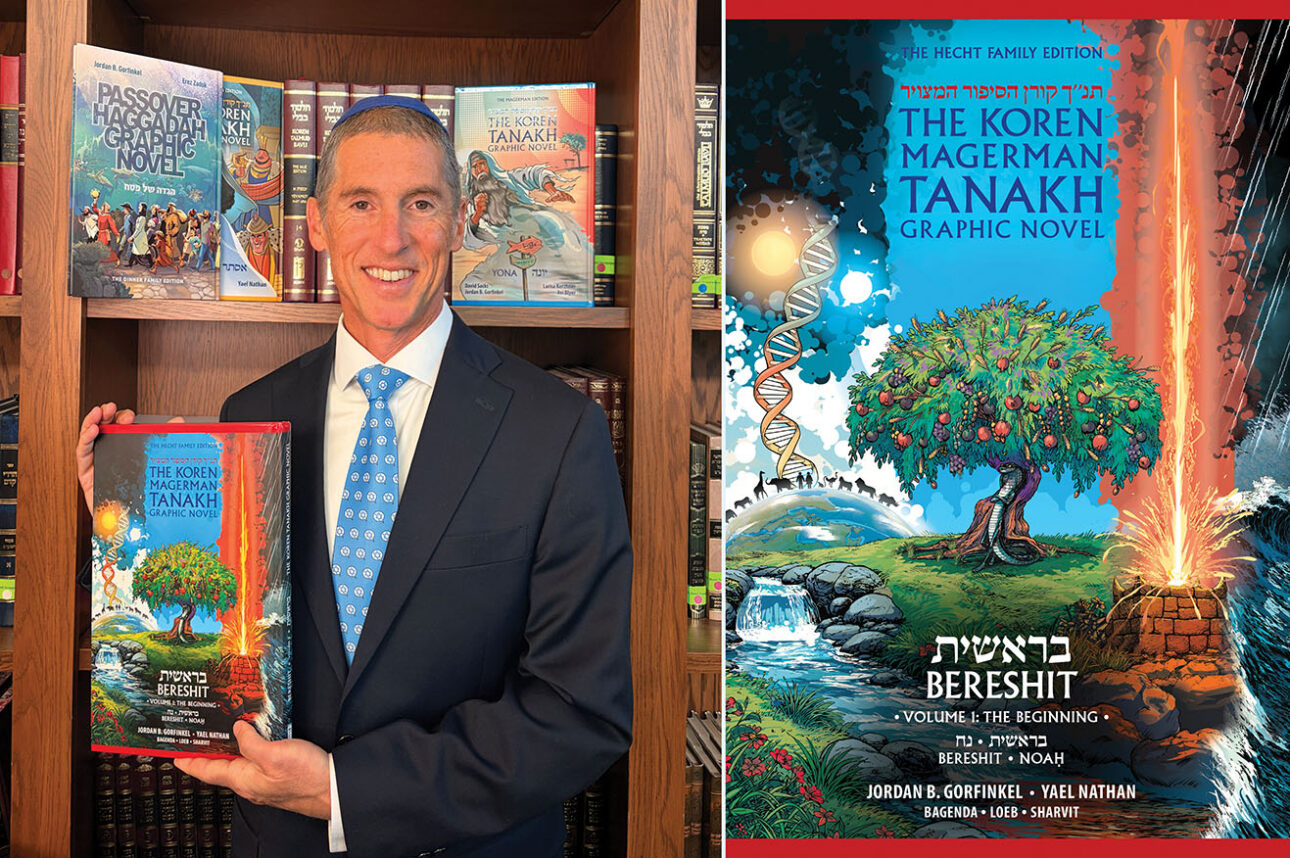
Following on the heels of his earlier presentations of the Passover Haggadah and the books of Esther and Jonah, Gorfinkel, known to his friends as “Gorf,” along with Israeli illustrator Yael Nathan and a team of specialized artists, have produced “The Koren Magerman Tanakh Graphic Novel: Bereshit Vol. 1,” which renders the first two Torah portions in Genesis, Bereshit and Noah, in dynamically engaging visual narrative form.
Jewish Journal columnist Rabbi Stuart Halpern interviewed Gorf for an inside look at the creative process, colorful midrashim, and “roasted eggs” that went into his unique take on the world’s best-selling book.
Stuart Halpern: Your graphic novels on the Haggadah and a couple of books in the Hebrew Bible have been sequenced in what would seem to be an unexpected order. Why Bereshit and why now?
Jordan Gorfinkel: George Lucas is my Rebbe: start in the middle and work your way back to the origin story.
Seriously, the “Passover Haggadah Graphic Novel” — kind of the Wikipedia of Jewish knowledge and practice — was our proof of concept for an entire Jewish Graphic Novel line. Now that we have built up our team, we’re going back to the beginning.
My background of managing Batman for DC Comics sets a high bar for Jewish graphic novel productions. The concept was never to make adaptations in the conventional sense. Adaptations change the source material to fit the medium. We’re applying the medium to the holy source material.
Specifically, our unique approach to sifrei kodesh [holy books] fuses the original, unabridged Torah text, in English translation, with sequential illustration, what my “rebbe” calls narrative art. The result is as much Torah as the text version. We’re merely re-presenting it in the insanely popular and expressive medium of graphic novels to reveal visually what’s always been inherently captivating about Torah. I’d like to think Rashi and other classic commentators would do similarly if they were expositing today.
The graphic novel, of course, was conceived by American Jewish immigrants. We’re flipping the script by using the same medium that they used to assimilate into American culture to help assimilate Jewish people into our mesora, our heritage.
When I say “we,” I mean the collaboration between Koren Publishers, world-famous for excellence in textual precision and aesthetic presentation, and my Jewish creative production studio, @JewishCartoon.
We’ve been called The New Midrash. I like that!
SH: Assuming you shouted “Avengers Assemble!” to gather the best creative team you could for this latest project, tell us a bit about the heavy-hitters who constituted your creative team.
JG: Mostly, we shout “Kiddush!”
We’re not making any old story. We are representing the writ of Sinai! Making a mistake chanting from the Torah doesn’t hold a candle to the rotten tomatoes I’d have thrown at me if I depict Tanakh wrong. That’s a tremendous responsibility — and opportunity to get things right.
We field two complementary units within our production team. One is the JewishCartoon creative unit of writers, illustrators and designers sourced from the highest levels of graphic novel and Hollywood talent, who’ve worked on everything from “Batman” to “Star Wars” to “The Simpsons.”
Particularly important to me is working with Israeli artists. They bring a special authenticity drawn — by hand — from personal experience. It’s also done wonders for my Hebrew.
The second is the Koren scholars unit. Their combined expertise encompasses the rabbinical—translation, parshanut [commentary], midrash, aggadah, intertextualities, Talmud, philosophy — and the academic — archaeology, sociology, topography, geography, geology, sociology, science.
Producing a Jewish graphic novel feels like going for my Ph.D. and rabbinic ordination at the same time — and then drawing it!
SH: The opening chapters of Genesis are centered on order, specifically the six days of Creation, followed by the Sabbath. Not to compare you to God creating the universe, of course, but how did you sequence the design process for your work?
JG: Great question. How do I answer it without spoilers? I want readers to come to the book fresh, which is incredibly ironic given the rather well-known source material.
But that’s simultaneously the thrill and the challenge of crafting this series: you only thought you knew the story!
The design process itself can be boiled down to one question: WHY?
Why did each pasuk [Torah verse] make the cut? Why were they written specifically in this way? Why will its textual and subtextual meanings inspire our lives right now?
There have been countless adaptations of this source material already. I don’t think we need another one that simply sets the text against beautiful illustrations. My guiding principle is the Why. And the answers from our team are the fuel for the creative process.
Let’s take a spoiler-free example. I learned that in the first telling of Creation — there are two, as Rabbi Joseph B. Soloveitchik discusses in his classic work “The Lonely Man of Faith” — Days 3 and 4 seem to be out of order. Why do plants precede the sun, photosynthesis? Not how, but why? I use all the tools of the graphic novel trade to explore the conundrum: Page layout to establish the narrative pattern. Color to elucidate the evolution. Yes, evolution! And “There Panels” to draw comparisons. “There Panels” are like flashbacks or flashforwards, except they take place right there, rooted to a specific location — a window through time.
Torah Multiverse, anyone?
By the way, you’re welcome to compare me to God, though I’m sure my wife and kids will have something to say about that. (Laughs)
SH: Speaking of divine design, during the pages depicting the creation of the world, you include what is colloquially referred to as a Kabbalah tree. For those nonmystics among us, what is the significance of that imagery and how you are utilizing it?
JG: It is said there are 70 Faces of Torah. As we say in the “Passover Haggadah Graphic Novel,” we are all chachamim and nevonim, scholarly and wise, in Torah, each of us in our own right. All we need is the hook, like the Batman approach of a graphic novel, to draw us in.
In my travels to speak and lead programming connecting Judaism and pop culture, I see firsthand that there is no such thing as a cookie-cutter Jew. We come in all colors, shapes and sizes and opinions, of course. I want everyone to be able to see themselves in the graphic novel — to relate to it and never feel excluded or “other.”
That diversity is baked into us, all the way back to antiquity. In the “Bereshit Graphic Novel,” we see our foreparents coming from a variety of places and blending together into the tapestry that is the Jewish people until this day.
Beyond the physical, there’s also a spiritual dimension to our diversity. Some people approach Torah from the mind. Others approach it from the heart.
When I started this journey, I naively thought that truly authentic Hebrew Bible exegesis required an “originalist orthodoxy.” So I eschewed Midrashic interpretation and commentary that often becomes conflated with the original text, for fear of obscuring the true meaning.
Boy, was I off-target.
To paraphrase Mr. Spock from “Star Trek VI: The Undiscovered Country”: logic is only the beginning of Torah wisdom, not the end.
Perush, commentary — and especially the imaginative storytelling that is often found in Midrash — is revelatory, not only to help our minds understand text that is often opaque or elliptical, but to connect us with our hearts and souls.
That’s why it was important to me to include the Sefer Yetzirah tree. Someone who approaches Torah from a mystical Kabbalah standpoint should be able to look at the book, smile and immediately think, “This book is for me, too.” And for those to whom it is introducing a new concept, even cooler!
My big-tent orientation of embracing myriad perspectives was reinforced by Emmy Award-winning writer David Sacks. When we were creating the “Yona Graphic Novel” together, he told me, essentially, You want to make the boats period-accurate? Go ahead, knock yourself out. What I’m interested in is the prophet’s soul — and the holy souls of the readers who are going to be inspired by our rendition.
If you want more details, and maybe even a few spoilers, invite me to your community and let’s geek out!
SH: The back of the book showcases a pretty extensive bibliography of both traditional and academic scholarship on Bereshit and Noah. But the book contains no footnotes or study guide. How did you integrate various interpretations into the work, and in what way do you signal to the reader that what on the surface seems like a simple image is actually drawing from a diverse array of commentators over centuries?
JG: We integrate various interpretations by blending text and subtext into the illustrated pages. The Jewish tradition of storytelling both illuminates Torah and compels us to grapple with it further. The graphic novel is the natural contemporary extension of that tradition.
The words and pictures provide the visual context needed to understand the basic text. Look more closely, though, and you may exclaim, “That’s Rambam’s interpretation! They knew the Malbim, Rabbi Hirsch, Nechama Leibowitz …” That’s subtext, and layering it into the narrative art is intentional.
The absence of footnotes or a study guide is intentional, too. We want to entice readers into discovery rather than spoon-feed our intentions.
Everyone enjoys Batman and Marvel for the energy and excitement, from total fanboys with encyclopedic knowledge of the multiverse, to the casual movie-goer. Likewise, our energetic and exciting depictions of the “O.G. multiverse” are crafted to engage everyone, whether you have tons or little to no Torah background.
Fun fact: DC and Marvel graphic novels did away with footnotes decades ago; they take you out of the story. Likewise, we follow the first rule of graphic novel storytelling: give the reader everything they need to understand the story right there on the page. But we also want you to want to explore the Torah-verse further — to go on a scavenger hunt and discover the wisdom behind the wisdom.
SH: Punning off of the term “Easter egg” – a hidden message, object or reference intentionally placed by filmmakers for viewers to find – you make reference, in a short “behind the scenes” section, to what you call “roasted eggs,” playing off the traditional Passover food item. Let us in on a couple that you stuck in for the keen-eyed reader.
JG: There are lots of intertextuality-roasted eggs, callbacks or callforwards to interrelated events or themes, including famous midrashim that aren’t on the spine of our story, but we know people will expect to see nonetheless. Og the Giant hanging onto the side of Noah’s ark is the best example. You gotta really look for it, because otherwise it would be a distraction, but he’s there. My absolute favorite is how we worked red apples into Gan Eden. There are pop culture homages to Pixar, the Matrix and X-Men comics. Torah is inseparable from the zeitgeist.
SH: There are some immediately striking artistic choices that jump out. One, early on, is having Adam and Eve initially created as [SPOILER ALERT!]. Tell us about the thinking behind that decision.
JG: Sorry, folks. I’m going to have to pixelate the spoiler-ly part of that question.
I love when someone comes up to me at a community workshop or Scholar in Residence program, holds up the graphic novel and says, “Gorf, I saw this interpretation on this page. You drew it this way for such-and-such reason, am I right?!?”
I don’t tell them what to think. They tell me! I’ll deny it if you ask me, but sometimes they’re even seeing an interpretation I never consciously intended! How phenomenal is that?
Nevertheless, in the “Bereshit Graphic Novel,” I acceded to the call for further explanation a teensy bit — and also to address one of our biggest branding challenges. I included a little behind-the-scenes spread at the back of this book, to defuse the widespread presumption that if a book has illustrations, it must be only for elementary school kids.
Not so. We’re child-friendly but not childish. Fun, but serious fun. We’re deliberate in our depictions, particularly when rendering our greatest righteous ancestors, to be modest and not gratuitous.
People ask, “You’re doing Genesis …” I see the gleam in their eyes and already know where they’re going: “So Adam and Eve before they get clothes — how are you going to handle that?”
There are no strategically placed fig leaves here, folks. We don’t take the easy outs.
Our sages actually give us excellent direction. There’s a Talmudic analysis that unlocked how I approached this sensitive imagery. All I’ll give away is that it’s cited in the midrashic collection Genesis Rabbah 20:12.
There are deliberate choices behind every illustration. We work overtime to strike the right balance, to be elevated and respectful, reverent and captivating.
SH: Amid the seriousness of the subject matter, in addition to the “roasted eggs,” you also inject levity with visual gags, like the giant Og spitting into the hand of a member of Noah’s family as an expression of his skepticism that a flood will rain down. How did you approach the opportunities for, and appropriateness of, these, well, comic moments?
JG: To paraphrase the Joker: Why so serious? Finding levity in weighty subjects, particularly dark ones, is a hallmark of the Jewish experience. If you don’t believe me, go read the Talmud!
The answer to your question is simple: anything that felt cringe-y being placed side-by-side with the accompanying Hebrew text that contains God’s name, I ruled it out. As the Koren Editor-In-Chief says when we flag an objectionable portrayal, “Gorf will find a solution.” There’s always another way, you just have to dig deep and find it. Craft helps, too. I’m a Structure Wonk — three-act drama structure, comedy gag structure, screenplay structure — tricks of the trade that guide the creative process.
SH: Another panel that jumped out at me is a scientific formula that transitions into an emoji. Tell us about what the intention is with that quintessentially modern visual expression.
JG: I’m always seeking modern expressions that can render esoteric concepts instantly relatable and relevant.
As I said before, there are 70 Faces Of Torah and one of them is scientific. The Torah says God created the world in six days. Now, intellectually, we know the world was not created in six days. We have scientific findings showing that it was millions and millions of years.
How do we reconcile these seemingly conflicting positions? We live in a world of faith and observance, but we also live in a world of rationality and science. How do you make the mind and heart cohere?
Illustration is going to make that conflict evident immediately. Oftentimes I’m heard muttering, “Wonderful interpretation, dearest Rashi. But how do you draw it?” I do a program called Rabbi Batman in which my participants become my Writers Room. We take a portion of a parsha and ask all the detailed questions I tackle in my own process: What do the people look like? Tall, short, big, petite? What color is their hair, their eyes, their skin? What about costuming, what are they wearing? Be specific! Talk to me about textiles, building materials, construction techniques. What did they eat? Did they sit at a table? Four legged or a tripod? Did they eat with a fork or their hands? What’s the time of day? What’s the weather? On and on, until we bring our ancestors’ world back to vivid life. We go through the same exercise spiritually, investigating symbolism to express the intangibles, philosophical, mystical, heavenly. Believe me, you haven’t learned Torah until you’ve visualized it!
My role is like making a movie but pausing at the storyboard stage. The genres and devices are the same: drama, suspense, yes comedy. Theme, conflict, symbolism, anachronisms. Anything that generates clarity and connection emotionally and appropriately.
SH: How should the reader approach this work? What age group(s) is it really intended for?
JG: Adults, teens, students, especially families reading together. Approach with wonder, adventure and joy!
If I’m doing my job right, the “Koren Bereshit Graphic Novel” and all the Jewish graphic novels are a clear, elegant, thought-provoking version of Torah that belies the mind-boggling sophistication and complexity of the source material. And most of all, tons of fun!
My message to everyone: no matter who you are, where you go or what you do, Make Judaism Your Superpower!
Rabbi Dr. Stuart Halpern is Associate Provost for Strategic Initiatives at Yeshiva University and Deputy Director of Y.U.’s Straus Center for Torah and Western Thought. His books include the newly released “Jewish Roots of American Liberty,” “The Promise of Liberty: A Passover Haggada,” “Esther in America,” “Gleanings: Reflections on Ruth” and “Proclaim Liberty Throughout the Land: The Hebrew Bible in the United States.”