
Every story has a beginning, a middle, and an end. Both Aristotle and my fourth-grade teacher Mrs. Epstein agreed about that. Of the three, the end matters most. Psychological studies confirm this.
Daniel Kahneman explains that we fixate on conclusions because humans live life both as “experiencing selves,” meaning what we perceive in the moment, and “remembering selves,” meaning what we remember afterwards. The “remembering self” is a storyteller who holds on to snapshots of the past and builds a narrative from them. Since the “remembering self” reconstructs memories into stories, it focuses especially on the ending.
That is why we intuitively seek a feel-good ending in books and movies. Even the Bible is mindful of the importance of a good ending. The Talmud notes that “the prophets concluded their books with words of praise and consolation.” Four books (Isaiah, Malachi, Lamentations, and Kohelet) do end with a final verse that is negative. But that was later changed. Rabbi Eliezer ben Yoel HaLevi of Bonn, who lived in the 12th century, says one should repeat the second-to-last verse at the end of reading these four books; this way these books will also end with consolation.
The Jewish calendar is built to end on a positive note. Its final holiday has two names. Shemini Azeret, “the Eighth Day of Assembly,” is its biblical name. Simchat Torah, “the Joy of the Torah,” came later, when Jews began completing the annual Torah reading on this day. In Israel, both names belong to a single day; in the diaspora, the holiday stretches over two days, and the second is called Simchat Torah.
It is the most joyous of all the holidays, and it is the last holiday of the year. It is not only the end of Sukkot; it is also the final day of the three pilgrimage festivals and the three Tishrei holidays. And Simchat Torah is when we complete the Torah reading, with the closing parsha, V’Zot HaBrachah.
It is puzzling why the Torah reading concludes on a holiday rather than on a Shabbat. But the reason for this, too, has to do with creating a positive ending.
V’Zot HaBrachah contains Moses’s farewell blessing to the Jewish people. Rabbi Avraham ben Yitzchak of Narbonne notes that V’Zot HaBrachah echoes Solomon’s farewell blessing after dedicating the Temple, which took place on Shemini Azeret. Solomon’s blessing was then added as the passage for the haftarah.
This is closure in the best sense of the word: We conclude a full cycle of holidays on the perfect note, with Shemini Azeret/Simchat Torah, a holiday of pure joy, being celebrated with reading Moses’s and Solomon’s blessings.
That is a happy ending.
All of this is beautiful in theory. But unfortunately, life doesn’t always work that way. Tragedy intrudes, upending best-laid plans. When that happens, listening to stories of redemption with happy endings is painful; they mock the grieving and heartbroken who have no comforting closure to grasp on to.
At times, there seems to be no way to escape an unhappy ending. Or is there?
Some writers and filmmakers have rebelled against the tyranny of a compulsory ending. They tell their stories out of chronological order, placing the conclusion anywhere but at the end. Or, they simply refuse to resolve anything at all, ending an engrossing story with a black screen that leaves one wondering what happens next.
Simchat Torah grapples with the meaning of endings as well. As mentioned, Simchat Torah ostensibly embraces a conventional happy ending. But lurking beneath the surface is the tragic awareness that all is temporary. Moses will die at the end of the Torah; the Talmud says the last words of the Torah reporting his death were written with tears. And according to several medieval sources, Satan is ready to denounce the Jews on Simchat Torah, claiming that once they have finished reading the entire Torah, they will neglect it.
After every happy ending, there is a void filled with vulnerability.
Shemini Azeret/Simchat Torah offers a fascinating way to escape the ending’s iron grip. It insists that no ending is final. Let me explain how.
The holiday of Shemini Azeret takes place on the eighth day of Sukkot; this makes Sukkot one day longer than its sibling holiday of Pesach. Rashi cites a Midrash that accounts for this anomaly: “It is similar to the case of a king who invited his children to a banquet for a certain number of days. When the time arrived for them to take their departure he said, ‘Children, I beg of you, stay one day more with me; it is so hard for me to part with you!’”
With Shemini Azeret, the yearly holiday schedule comes to a close. So the Torah adds an eighth day to offer a final farewell to the holidays. However, the Midrash itself raises a question. How will staying one more day make it easier to say goodbye? The problem will simply return the next day! If anything, the delay will only intensify the pain of parting.
I think the answer is this. By staying one more day beyond the end, we have demonstrated that the end is not the end. With an extra day, the last day of Sukkot is no longer the last day of Sukkot. And when a last day is not a last day, then no ending is a real ending. In other words, Shemini Azeret is an attack on the very notion of endings.
It is no accident that medieval Jews added two traditions to the holiday of Simchat Torah. First, right after concluding V’Zot HaBrachah, we return to read the first chapter of the Torah in Parshat Bereishit. Second, a new haftarah was introduced: the first chapter of the Book of Joshua.
To immediately read Bereishit after finishing the Torah defies the idea of endings altogether. It makes the statement that although the Torah has a final chapter, it has no end. We will return again and again to the Torah.
It never ends.
Then we read from the Book of Joshua. Moses has died, but that is not where the story ends. His disciple Joshua will carry on his traditions. The people he loved will enter the land of Israel, something Moses could only dream of.
Even after their teacher dies, the people continue on their mission. The Book of Joshua reminds us that Jewish history doesn’t have a final chapter. Simchat Torah carries a powerful message of resilience: that tragedy does not define the never-ending story of a never-ending people.
It was on Simchat Torah in 2023 that Hamas attacked Israel. Three years later, the Jewish world is still traumatized. Israel endured deaths, rapes, injuries, and bereavements; the turmoil that followed has led to an increase in bankruptcies and divorces. Around the world, antisemitism has come roaring back. Jews now bear the mark of Cain, marginalized by TikTok-educated ignoramuses who incessantly repeat the genocide libel as if it were a mantra.
As in the Yom Kippur War, Israel’s counterattack won an exceptional victory, but at a very high price. The wounds run deep and have left Israel reeling in pain. It feels like we are stuck in limbo, with different versions of the same bad news arriving every day.
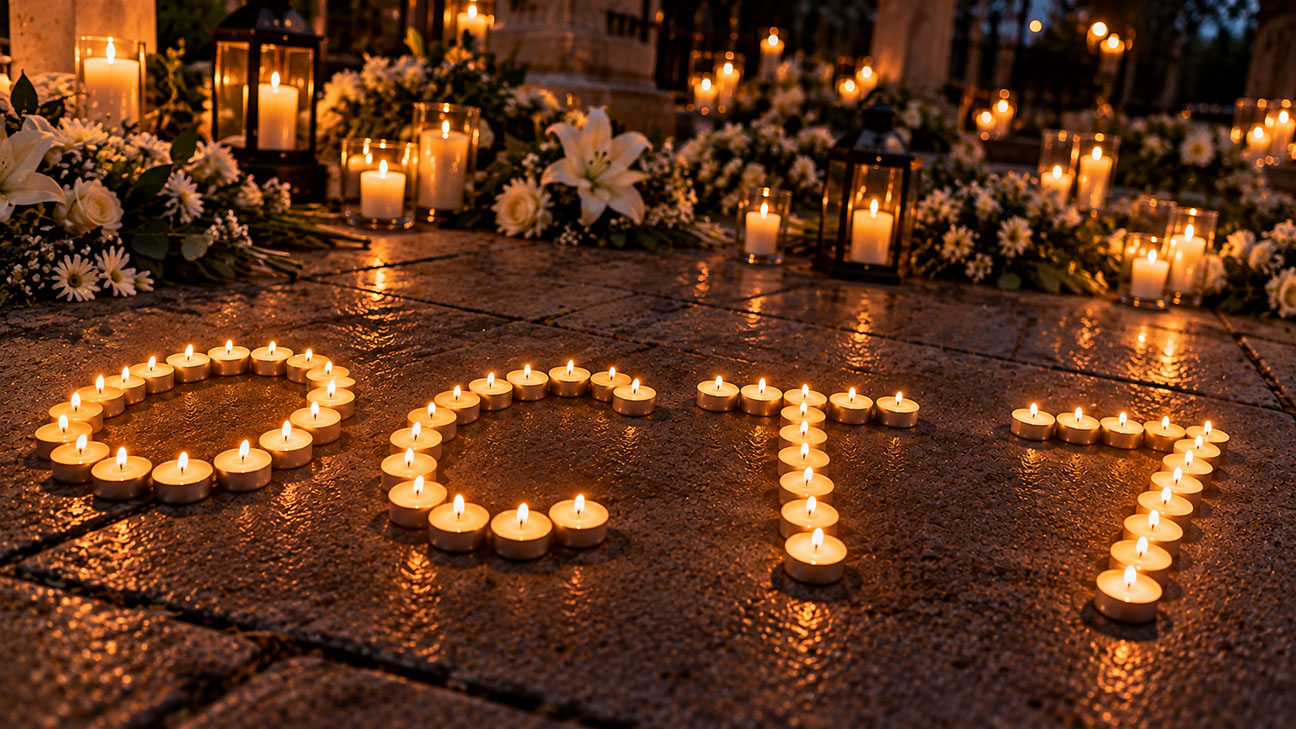
Right now, there is no closure, no happy ending possible. Simchat Torah is no longer just a holiday; it’s also a yahrzeit, the anniversary of a national tragedy.
But the message of Simchat Torah is particularly fitting for a moment like this, on a holiday now tinged with grief. We celebrate with the awareness that no matter what Satan or the Angel of Death may want, it is up to us to decide what the future holds and where the story ends.
For generations, the Jewish people have refused to read their own obituary. We won’t start now.
In the last three years, so many heroic people have decided that October 7th will not be the tragic end. Edan Alexander was a hostage for 584 days; after his release, Edan promptly re-enlisted in his unit. Ben Binyamin and Gali Segal, who each lost their right leg in the Nova Festival attack, learned how to walk again with a prosthesis. They got married a few months later, and to everyone’s shock, they marched down the aisle and shared a first dance. Another young woman, who lost both her parents that day, has gotten married since. This summer, I got a text from my friend Naava informing me that this young woman had just given birth to her first child.
These people are starting over from Bereishit and writing a new beginning.
Perhaps the most remarkable of all is the story of Gadi Moses. On that day, at age 79, he was taken hostage. Gadi was held in captivity for 482 days; his partner, Efrat Katz, was killed in the attack. In an interview, Gadi recounted: “The terrorists asked where I would return to. I said, to my home in Nir Oz. They said, ‘But we burned Nir Oz.’ I answered, ‘Then I will return to burned Nir Oz.’”
And he did. Right now, Gadi is once again farming the fields of Nir Oz. Gadi knows the secret of Simchat Torah: In Jewish history, there are no bad endings; we simply start a new chapter and rebuild.
Rabbi Chaim Steinmetz is the Senior Rabbi of Congregation Kehilath Jeshurun in New York.