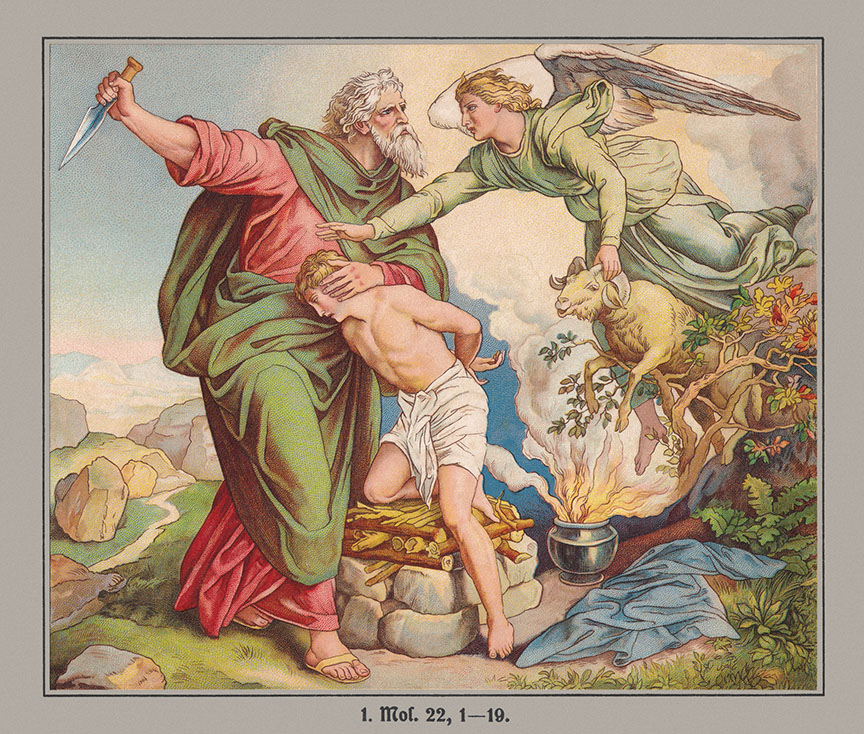
We have been horrified in recent years as Hamas used Gaza’s own children as human shields; their deaths are not a bug but a feature of the terrorists’ strategy. Yahya Sinwar believed more Palestinian civilian deaths worked to his advantage and were “necessary sacrifices.” Even more disturbingly, a leading Quranic model for sacrifice is that by Ibrahim of his son — the parallel to the Bible’s Akedat Yitzhak (Binding of Isaac).
Most commentary celebrates Abraham’s willingness to sacrifice Isaac. It inspired medieval Jewish fathers who took their children’s lives to spare them from slaughter by sadistic Crusaders. More generally, it helped Jews manage the bitterness of their lives. But we live in a different world today, with different priorities. Our goal is not to accept death but to preserve life.
The Akedah has become a proxy for other debates within (and beyond) Judaism.
• How do we balance devotion to God with shalom bayit (peace in the home)? Can moving closer to God separate us from our family?
• Should we emphasize the particular or the universal? Does Torah govern only the Jewish people’s relationship with God, or should it be comprehensible to others as our contribution to wider moral discourse?
• Are the commandments moral by intuition or definition? The latter reflects R. Kalonymus Shapira’s view that “Stealing is forbidden because the God of truth has commanded it.” Nachmanides instead held theft’s wrongfulness “is an intuitive matter, which needs no Torah.” (Benjamin Franklin agreed that stealing “is not harmful because it is prohibited; it is prohibited because it is harmful.”)
• Is the relationship between God and the Jewish people one between a king and subjects, prizing obedience, or between a teacher and students, prizing understanding? If, as many contend, God wished to teach humanity to avoid human sacrifice, and, as the Talmud teaches, Isaac’s death never entered God’s mind (BT Taanit 4a), what if Abraham declined — because he already had internalized that lesson? Would God instill fear or express love? (See BT Bava Metzia 59b.)
We cannot change the Biblical text to fit modern sensibilities. But there are grounds for questioning the conventional (though hardly unanimous) conclusion that Abraham fully passed the test.
The two directives
The text is cryptic. ELOKIM (God’s name that inspires awe or fear) commands the sacrifice, and Abraham’s preparation shows he is “ELOKIM-fearing.” (Gen. 22:12.) But HASHEM (God’s name that inspires love) stops the slaughter — through an angel — and promises reward.
Rabbi Aaron Koller’s book, “Unbinding Isaac,” contends that the unusual request in the biblical era would not be to sacrifice a child but to release him. Accordingly, Abraham deserves praise less for following the initial command (by ELOKIM) to sacrifice than for following the second, revolutionary call (by HASHEM) to desist.
The text supports this thesis. Verse 12 praises Abraham because “you did not withhold your son.” But verse 16 provides praise because “you have done this thing, and have not withheld your son,” separating these praises with a grammatical (merchah) comma. “This thing” seems separate from not withholding. What “thing” happened after verse 12, before 16? Abraham substituted the ram, and unbound Isaac. Only after this release does the angel promise reward.
Rashi, among others, perceived a request to raise Isaac up — and then bring him down, not kill him. This reinforces the sensibility that God would not command murder.
This reading accords with an ambiguity. God commands “vahaalehu,” which usually means “sacrifice,” but can also mean “raise.” Rashi, among others, perceived a request to raise Isaac up — and then bring him down, not kill him. This reinforces the sensibility that God would not command murder.
Sacrificing the Self — or Another?
Rashi thus distinguishes the commanded act of “sacrifice” from the forbidden act of murder. The Akedah threatens Abraham’s line of progeny, and Isaac’s life. As Leon Kass explained, “To give of what one treasures most is praiseworthy; to kill … is not.” If Abraham declined, it could be for the selfish goal of preserving progeny, or the selfless goal of saving life.
Commentary conflates the two because they stand or fall together: either both progeny and Isaac live, or die. But that is not always true: When the “real” mother judged by Solomon asked him not to divide the baby, she chose the latter over the former. She would forfeit her interest in progeny to save his life: “Please … give her the live child; only don’t kill it.” (I Kings: 3:26.)
Rambam celebrates Abraham’s self-negation:
“How great must have been his delight in the child! … And yet because he feared God, and loved to do what God commanded, he thought little of that beloved child, and set aside all his hopes concerning him, and consented to kill him …”
Abraham receives praise for not withholding Isaac rather than for killing him. One might wish to “withhold” one’s son — or daughter — to run the family business, but that child might prefer to teach, make aliyah or serve in the military. The archetype of such offering is Hannah’s offering Samuel to serve God, and he eventually guides the entire nation.
Abraham receives praise for not withholding Isaac rather than for killing him. One might wish to “withhold” one’s son — or daughter — to run the family business, but that child might prefer to teach, make aliyah or serve in the military.
Sacrifice is not about harming oneself but about helping others. The Torah prescribed that people with many animals should sacrifice one in the Temple — and thereby feed the poor.
Especially heroic was the sacrifice of Gil Ta’asa. When terrorists threw a grenade near his sons on Oct. 7, he jumped on it to save their lives — at the cost of his own.
Had Abraham refused the command out of selfishness, he would have definitely failed the test.
But the Akedah would take more than Abraham’s heir; it would take Isaac’s life. Focusing on only the former issue suggests there would be no dilemma if Abraham had been asked to murder someone else’s child.
If a child is parental property, one should follow Maimonides and think little of him. R. Koller recalled the Hammurabi Code, which prescribes that if someone built a home that later collapsed and killed the owner’s son, the builder’s son would be killed. (§§ 229-230) The bumbling builder’s penalty is loss of progeny.
But the Torah sees children not as parental property, but independent beings, created in the Divine image, with moral agency. “Fathers shall not be put to death for [the sins of] sons, and sons shall not be put to death for fathers. Each shall be put to death for his own sin.” (Deut: 24:16.)
The analogue to the bumbling builder is Jephthah, who foolishly promises to sacrifice whatever exits the “doors of my house to greet me” after victory in battle. (Judges 11:31.) (After all, humans, not livestock, reside in houses, and “greet” others.) His daughter greets him — and pays the price. Killing a child for the parent’s mistake follows Hammurabi, not Torah.
The last trial
The supposed proof of Abraham’s triumph is the promise of multiplied descendants. But this had been promised already. (See e.g. Gen. 13:16.) And the price is steep: Abraham descends the mountain alone, without Isaac.
His marriage suffers; the next we read of Sarah is her death. Many link that to her discovery that Abraham tried to murder their son. This is not an outdated concern: The tension between personal religious devotion and shalom bayit continues today in many families.
Moreover, Abraham’s religious growth ceases; he has no further contact with God. (It is counterintuitive that God would directly impose such an extraordinary test and then delegate congratulations to an angel.) Some explain this by claiming the Akedah was the last of 10 trials, so there was nothing left to do. The Artscroll humash teaches there was no further communication because Abraham had reached his “zenith.”
But this contradicts the Jewish understanding of trials. They are not diagnostic: Rabbenu Nissim notes “the Almighty does not try a person in order to prove … whether he is capable of withstanding the trial since God is all-knowing …” To the contrary, as Rambam explains, they serve a training function, for the “benefit of the recipient.” … “[T]he trial commands him in order to translate into action the potentialities of his character.”
The trial thus functions not as a scale, to measure, but a barbell, to develop the user’s strength. God is training Abraham for leadership. “Shall I conceal from Abraham what I am doing? And Abraham shall become a great and mighty nation.” (Gen 18:17-18.) When Abraham passed his prior trials, he was ready for harder ones. It would completely change the nature of trials to end them because Abraham’s moral reasoning had advanced so far.
It is more consistent with the Jewish concept of trials that this was Abraham’s last because it was the first he did not completely pass.
Akedah theology
There are thus grounds for greater ambivalence about Abraham’s response. But more importantly, the Akedah is not just one Torah episode, it shapes analysis of all the rest. R. Yeshayahu Leibowitz asserted “the highest symbol of the Jewish faith is the stance of Abraham on Mount Moriah, when all human values were annulled and overridden by fear and love of God …” This so-called “Akedah theology,” celebrating the annulment of universal ethics, poses several problems.
First, it can lead to immoral consequences. Self-denial may be praiseworthy when it curbs appetites, but curbing moral intuitions often harms others. As Moshe Halbertal explains, “when morality is depicted as a temptation to be surmounted in the name of the higher goal, it is always someone else who pays the price.”
It is heroes like Ta’asa who show true sacrifice.
Second, it reduces the Jewish audience. There will always be a devoted core who commit themselves to any and every religious command, and some rabbis may prefer a congregation with such followers — disinclined to ask questions. But Akedah theology will not inspire the broader community, and will thus diminish the reach of rabbinic voices on many questions where they need to be heard.
Third, “overriding” universal ethics reduces Jewish engagement with the world. Pirke Avot teaches, “Who is wise? Someone who learns from everyone.” (Avot 4:1.) But Akedah theology constrains our capacity to import and export ideas. Treating Torah as a private teaching from God to the Jewish people dims our “light unto the nations.”
This is a special concern for military ethics. If there are no universal moral norms, so each culture may determine its own, we cannot expect non-Jews and non-Israelis to condemn Oct. 7. As if anticipating Sinwar, Rav Hartman wrote, “When the faith commitment has been insulated from and is unresponsive to rational criticism, there is nothing that cannot be justified. … People who believe that authentic faith requires that they follow the model of the Akedah may sacrifice thousands of innocent human beings in the name of their ‘insane’ love for God.” Koller fairly asks, “How can we condemn … atrocities without condemning Abraham as well?”
Kol Hashem vs. Torat Hashem
The biggest problem with Akedah theology is it conflicts with Torah itself. Deuteronomy 4:6 teaches the wisdom of Torah should be recognizable by other nations, so “when they hear all these statutes, they will say: ‘It is a particularly wise and understanding people, this great nation.’” The real Akedah theology concerns how the Bible instilled upon the world a revulsion for child sacrifice.
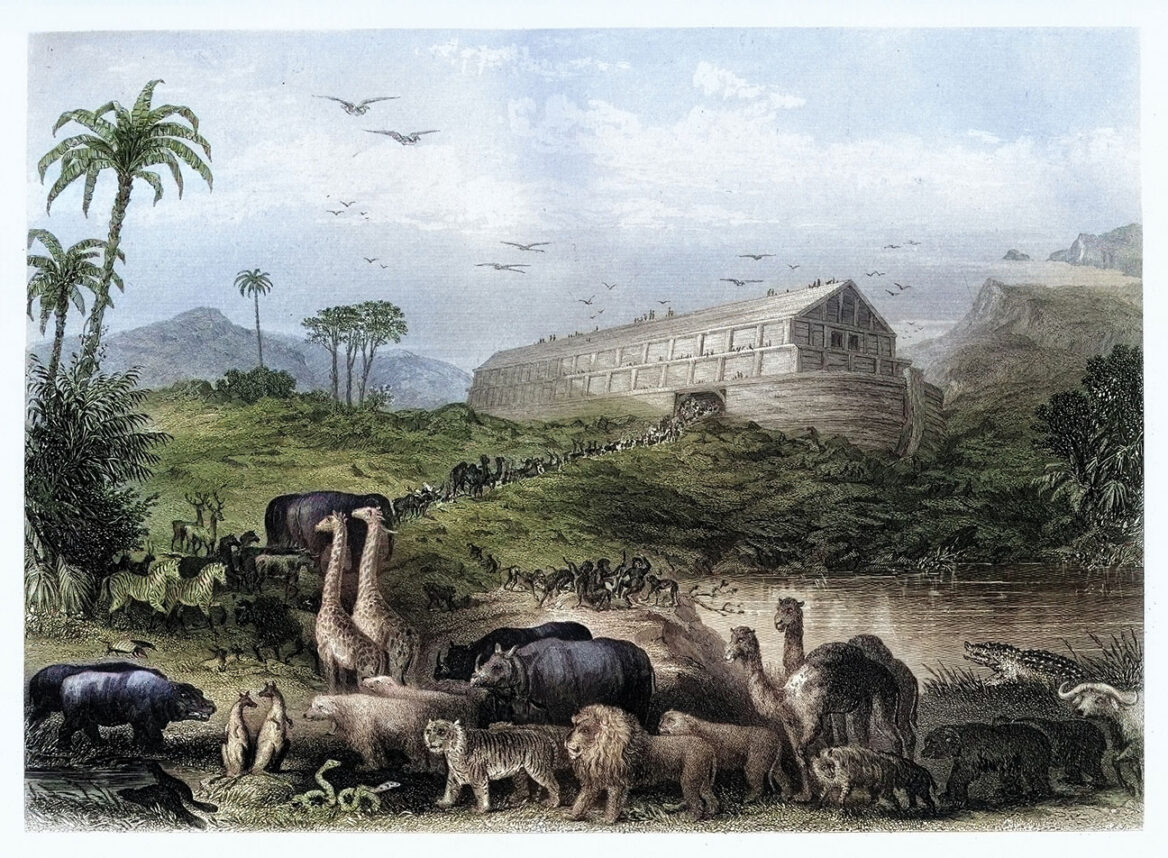
The progression of leadership in Genesis indicates God wants leaders who don’t just “follow orders” but who evaluate and even challenge them. Yisrael means “wrestle with God,” not “submission.” (Both Israel’s and Ukraine’s militaries have benefitted from a culture that enables lower-ranking troops to make decisions on their own when necessary.) Noah perfectly followed God’s command in building the ark, but did nothing more: “Noah did according to all that God had commanded him.” (Gen. 7:22.)
Abraham reached a higher level by arguing for mercy. Rabbi Adin Steinsaltz identified Abraham’s challenging the punishment of Sodom as the “clearest proof” of “morality independent of God.” When Abraham asks “shall the Judge of all the earth not practice justice?” (Gen 18:25), he presumes an external standard that even God must follow.
Noah knew only Kol Hashem (God’s voice), but Abraham also had Torat Hashem (God’s teaching). The limits of humans’ ethical intuition led God to create a limited legal code, the Noahide commandments. In Leon Kass’ words, “[N]o human being following uninstructed only the native inclinations of his heart,” would reach the necessary moral level unless the “way of nature” was “replaced by the way of law.”
Abraham had advanced beyond Noah’s level of morality, and seemed ready for a harder test. But Abraham was not ready to “read between the lines” and infer that God did not really want Isaac to die.
Trained at Sinai, Israel’s greatest leader could read between the lines. After the Golden Calf, God directs Moses, “Now allow Me . . . and I will destroy them, and I will make you into a great nation” — saving Moses’ progeny from the nation’s punishment. (Ex 32:10.) Like Ta’asa, Moses could have stood by while others died, but instead risked his life to save the nation: “Bear their sin; if not, please erase me from Your book.”
Moses had learned more than Noahide commandments, and realized what God really wanted. The Talmud even has Moses tell God His proposed punishment would be a sacrilege, a hillul Hashem. (BT Berachot 32a.)
The Talmud celebrates the ultimate triumph of Torat Hashem over Kol Hashem. In the Akhnai story, R. Eliezer calls upon Kol Hashem to confirm he is correct in his dispute against other sages. But the Sages override Kol Hashem through Torat Hashem. “We do not pay attention to a heavenly voice because You already [taught] the Torah at Mount Sinai.” (BT Bava Metzia 59b.) God responds with laughter, observing “My children have defeated me.”
As Torat Hashem replaced Kol Hashem, sages replaced prophets as the nation’s leaders, leading Rav Hartman to conclude “the community has a higher appreciation of its covenantal relationship to God when it sees Him as its teacher that when it sees him as an authoritative voice dictating His will.” Parents, at different phases, act as both an authoritative voice and a teacher. In a child’s early years, “Because I said so” is enough. But as children age, and leave home, the parents’ voice might be unavailable; children need to internalize their teaching.
The end of prophecy had the same effect on the Jewish people. Nachmanides taught that because even the Torah could not document “all the practices that a person should undertake” in everyday life, people needed to study the specific laws to derive general principles, which would apply to new circumstances. Our task today is not to hear Kol Hashem but to study and understand Torat Hashem.
In sum, there are textual grounds for concluding Abraham was rewarded for unbinding Isaac, not for trying to kill him, an effort that cost Abraham his relationship with his wife, son and God. And if Abraham had the fuller exposure to the Torat Hashem later enjoyed by Moses, he would have realized the idea that Isaac should die never entered God’s mind.
Regardless of how one interprets this specific narrative, it is time to retire Akedah theology. It produces harmful results, alienates Jews from their faith, separates us from non-Jews promoting morality in the world, and contradicts Torah itself. If not now, when?
A former law professor, Mitchell Keiter is a certified appellate law specialist in Beverly Hills, and the author of “Combat, casualties, and causation: Life-saving lessons of the California Supreme Court.”