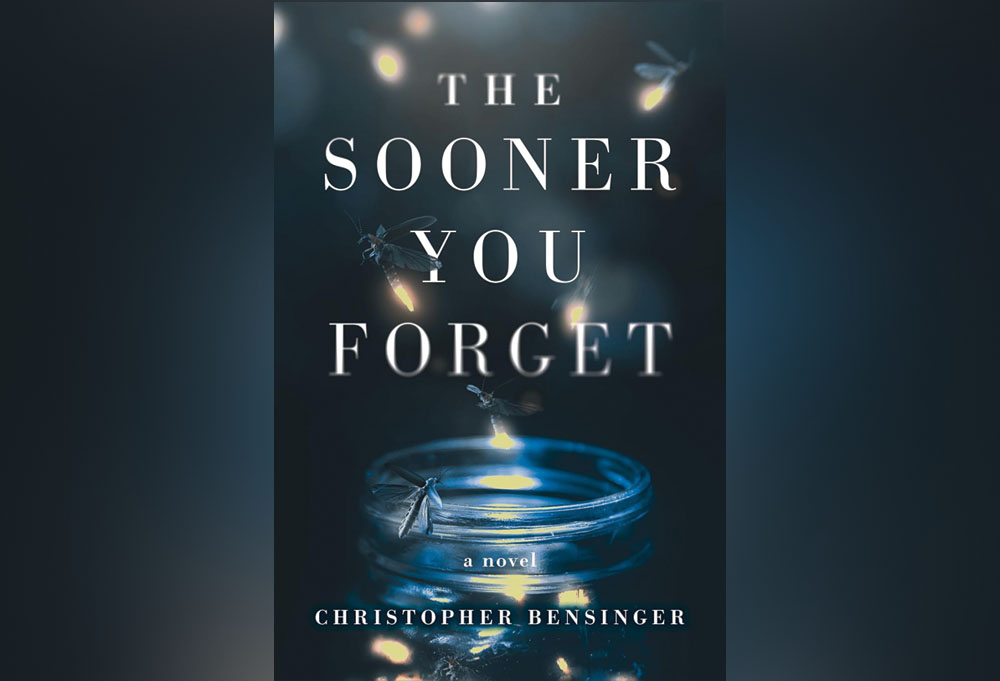
Chris Bensinger’s novel “The Sooner You Forget” follows the story of a young Catholic man who, while serving in the United States Army, ends up in a Nazi labor camp. It takes readers through the lasting effects of trauma, showing what happens when painful truths are suppressed—whether imposed by others or self-inflicted.
The book begins in a suburb of Milwaukee, Wisconsin, shortly after the Allied invasion of Normandy in 1944. Charlie Buckley, a hotheaded baseball player, dreams of going professional. But in the city championship game, in front of major league scouts, an umpire makes a bad call. Charlie loses his temper, and his dreams of going pro — and escaping his home life — are shattered.
Soon after, Charlie starts a romance with a Jewish girl named Sandee Gold. His bigoted father disapproves, seeing their relationship as unacceptable. Though his father harbors hatred toward Germans, he supports the Nazi persecution of Jews in Europe. Charlie is drafted into the U.S. Army Air Corps and ships out to Europe, carrying a photo and note from Sandee, now his fiancée.
One of Charlie’s closest friends in his unit, Jacob, is a soldier studying to become a rabbi. A well-paced, frightening set of scenes leads to Charlie, Jacob and their fellow soldiers being captured by the Nazis. While being a prisoner of war is already brutal enough, Charlie is mistakenly identified as Jewish and sent with them to the Berga labor camp.
“Initially, I was writing a story about a young kid growing up in the Midwest in kind of a complex family dynamic, and his way out would be through baseball,” Bensinger told the Journal. “I was at my mother-in-law’s house in Florida, and they had a bunch of old Life magazines. And there was this vague reference to this slave labor death camp called Berga, where they had taken only American Jewish soldiers and others.”
Bensinger spent a year researching Berga and the stories of those who survived. Though Charlie’s story is fictional, the characters are well-developed and their troubles are painfully vivid to read.
One of the most gut-wrenching moments comes when Charlie, realizing he may not survive, asks Jacob to convert him.
“He could have a sense that he would go in peace connected to the woman he loved and the faith that he learned about through the trials and the horrors of what went on to the Jewish soldiers,” Bensinger said.
The Jewish American soldiers who survived Berga were forced by the U.S. government to sign nondisclosure agreements, forbidding them from speaking about their capture. While researching the story, Bensinger, who himself isn’t Jewish, discovered as an adult that he had relatives who were murdered in the Holocaust.
“The history of what went on my father’s side, it was just buried,” Bensinger said. “It was never spoken of. And so through my research when I found a distant cousin, another Bensinger whose family, many of them were murdered by the Nazis, I was floored. It was, it’s almost like when Charlie says, ‘It’s as if Berga never existed.’”
Bensinger, has spent much of his career in storytelling and theater, producing Broadway musicals such as “The Book of Mormon” and “La Cage aux Folles.” With this well-dramatized debut novel, Bensinger sees the arts as a critical means of processing and conveying these experiences.
“I think that any time one can experience healing through trauma, and that means telling the story of what went on, trauma doesn’t really go away,” Bensinger said. “You learn to live with it. In that sense, I tell people not to feel you have to bottle this up just because it’s been belabored or ‘that isn’t the truth of how human beings are.’ We’re emotional human beings, and that carries down through our genes. It’s really a hereditary trauma.
“Through Charlie, we all can recognize how we can navigate holding in the truth—and it needs to come out.”
“The Sooner You Forget” was published on Feb. 4 and can be found anywhere books are sold.