In an unprecedented collaboration, the Jerusalem Botanical Garden has teamed up with British-based Outset Contemporary Art Fund, British Friends of Israeli Museums, the Jerusalem Foundation and others to create an open-air exhibition titled “Returning to Nature.”
Currently on display, the exhibition highlights diverse Israeli works that populate the landscape along a winding self-guided path. Within this junction of art and nature, one particular piece offers inspiration for those weary of the coronavirus. Like a talmudic phoenix rising from the ashes, a broken sculpture by the late celebrated Israeli sculptor and painter Menashe Kadishman (1932-2015) has been expertly restored and installed high above the garden’s majestic lily pond.
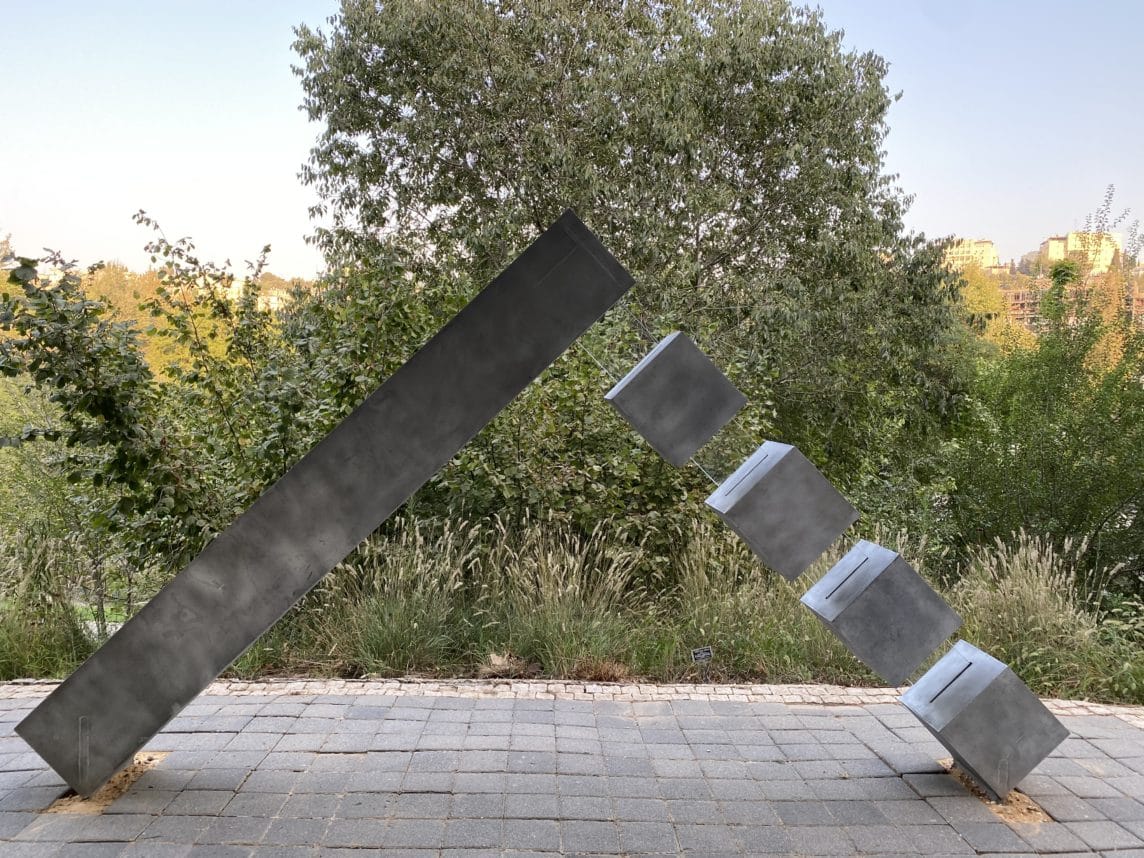
Kadishman is strongly associated with sheep in the Israeli public’s imagination. His paintings of the farm animals surged in popularity when Kadishman revealed them in the early ’80s. In 1995, he won the renowned Israel Prize for sculpture. Five years after his death, Kadishman’s “Segments II” now is installed in the botanical garden, which is slated to reopen after the current lockdown lifts. In addition, the “Return to Nature” exhibition may be extended beyond its scheduled run through November. Meanwhile, a Wix-sponsored website, which will launch during Sukkot, offers a virtual tour, online catalog and educational videos.
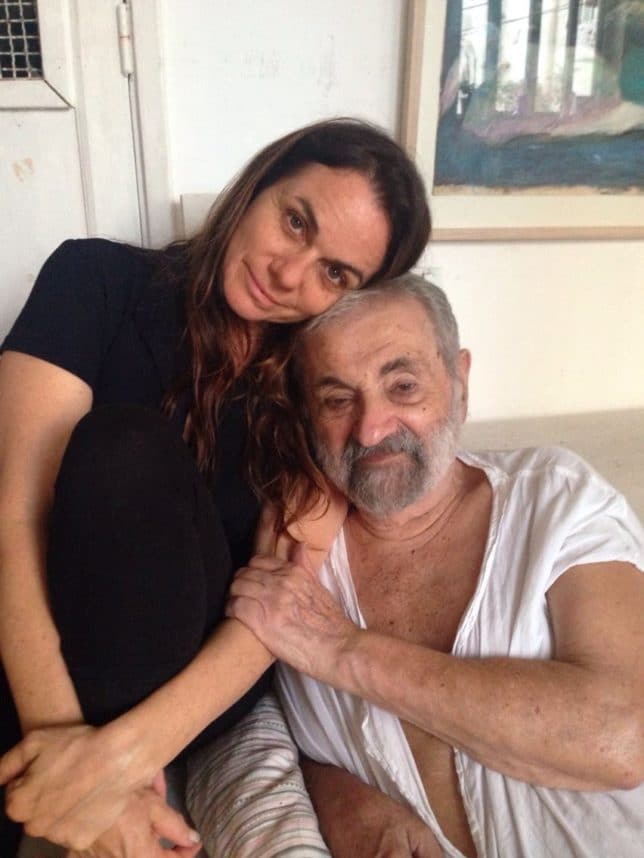
The Journal spoke with actor/curator Maya Kadishman, Kadishman’s daughter, during a sneak peek at the exhibition before the country’s latest lockdown.
Jewish Journal: What can you tell us about the meaning of your father’s “Segments II” sculpture?
Maya Kadishman: “Segments II” is part of a larger series my father created as a leader in the international geometrical/antigravity movement in the early 1960s in London and the U.S. The works defy gravity and show the background through glass with the sculptures as part of the environment. Examples are found at New York MOMA (Museum of Modern Art), the president’s house in Jerusalem and Storm King Art Centre in upstate New York.
JJ: Given its installation on an east-west axis, this piece suggests the kinetic energy or waves of Tel Aviv meeting the more strictly defined “foundational stone” of Jerusalem. What might your father say about that?
MK: My father would have loved that interpretation.
JJ: What does the piece represent to you?
MK: Playfulness, daring, seeing the world from an all-inclusive point of view, yet keeping one’s individuality — and also my childhood. My father’s sculptures were placed in our garden in London and they became my childhood playground. I climbed, slid and hid in them. I absolutely love them.
JJ: How did “Segments II” join the exhibit?
MK: Curator Hadas Maor requested an early piece. It was in special storage. One of the glass pieces had to be mended …. I am thrilled to have been able to bring it back to life. One of the major themes of the anti-gravity movement is that one can defy the impossible. Nothing can stop us being who we are. We can always find a way to grow above, beyond. Even in the pandemic, we do not give up our true selves, our individuality. The environment is seen through us but is not us. We stay strong.
JJ: How do you feel about its placement in Jerusalem?
MK: There is a very important work from the same era on permanent display in the Israel Museum and so it is, in a way, returning home. It is iconic in its own right and so the lily pond was an obvious place to exhibit: an icon reflecting an icon. I’d like it to stay there for as long as needed. Unless it is transferred to another important exhibition, it’s hard to hide it away again. It is a constant reminder of my father’s great mind, spirit and art/heart.
JJ: What are some of your other treasured pieces?
MK: The ones that were in my childhood garden. The one called “OM” is incredible. It was in the collection of a great man and collector, a very close friend of my father, Jerome Stern.
JJ: Your father worked as a kibbutz shepherd as a teen. How did sheep recur in his work?
MK: The “Flock of Sheep” in Venice was an early live installation and the inspiration for the paintings. Some of the first sheep were painted on photos of sheep from the Biennale.

JJ: Your father’s use of sheep took on political significance, protesting the loss of life in war as sacrificial lambs. Could you tell us more about that?
MK: He was an artist of the people’s pain, not the politicians’. His art was used in political contexts but came from the pain of the individual and the collective, which he felt personally, deeply and managed to transfer into images in such a touching, powerful manner.
JJ: How has your father’s work impacted your identity?
MK: I was included in my father’s art from birth and extremely close to him. His art was him, and his life, and I was by his side any possible moment. I traveled with him all over the world and attended all his major exhibitions. I grew up in the hallways of the Jewish Museum in New York and the Israel Museum in Jerusalem. I walked the streets of Venice as a young girl, while my father was walking the sheep in the Biennale. I was present by his side as he curated the curators in his exhibitions, and so my experience of his art, his mind, his creation is immense. He treated his works as his children and, to me, they are like my brothers.
As a curator now myself, I see his “Beyond Limits” mind present in my decisions; my own creations. It’s like tapping into the source of creation, which is where his work came from, which is why it is so powerful.
Lisa Klug is a freelance journalist and the author of “Cool Jew” and “Hot Mamalah: The Ultimate Guide for Every Woman of the Tribe.”