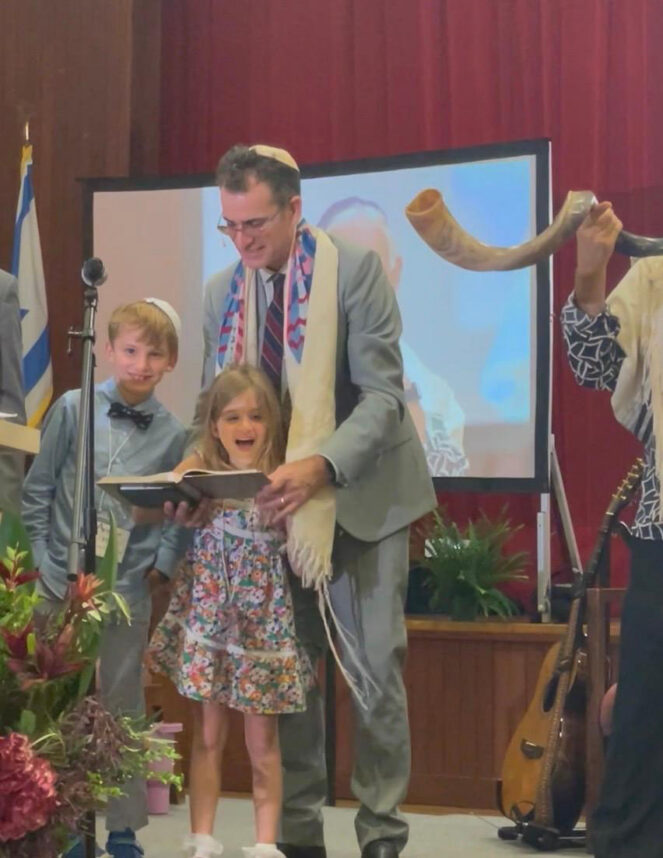
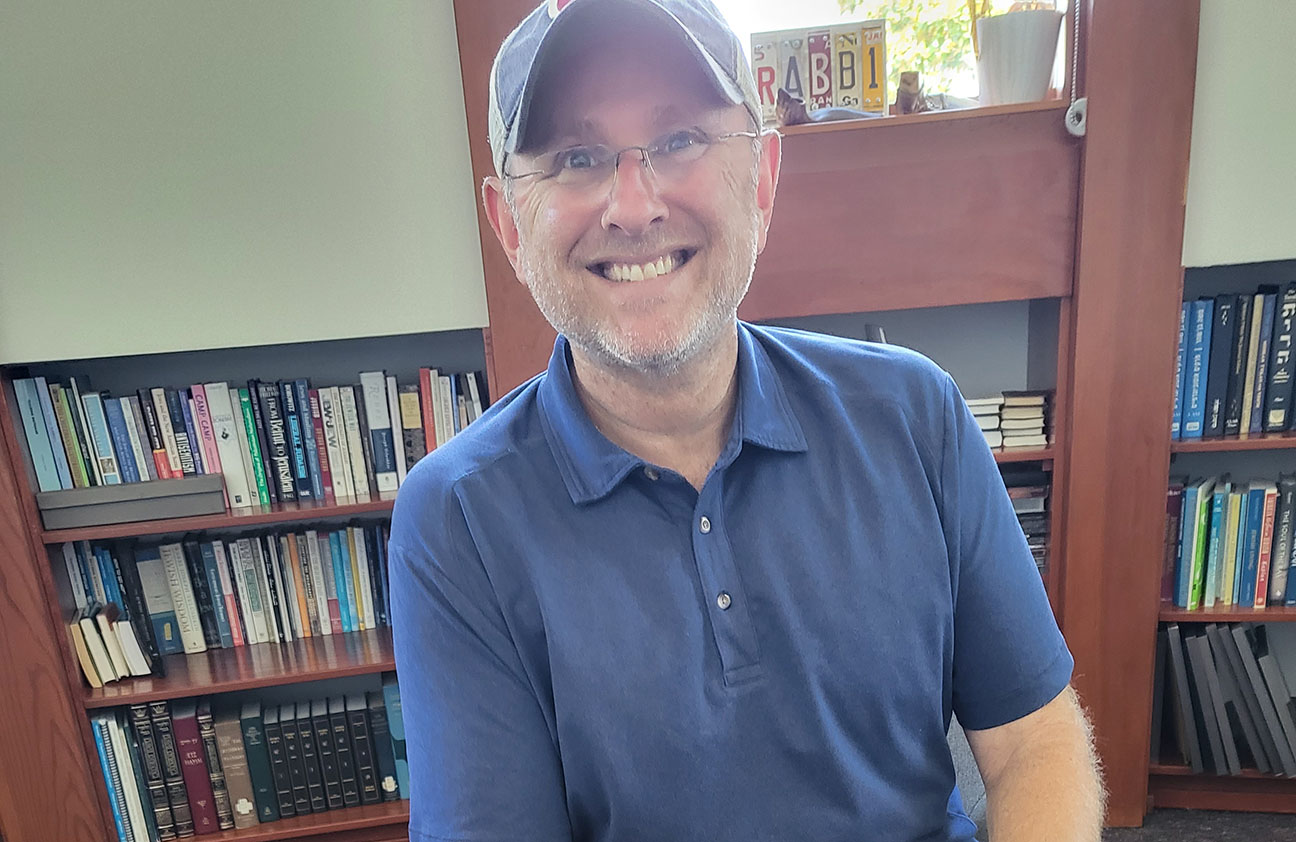
Since 2006 — the year he was ordained — Wilshire Boulevard Temple’s (WBT) Rabbi David Eshel has lived by a simple creed: “Everything I do is done through a camp lens,” he said. “Everything.”
He could be in a room with 1,700 people during the High Holy Days, or on the floor telling stories at the Early Childhood Center (EEC) — even when helping shepherd people through dark times in their lives, camp is “the lens through which I see the rabbinate and my life.”
In the summer, he said, “I am at camp full-time. I move up there to Hess Kramer and Hilltop. But we are not there now because of the fires. We are in Carlsbad at the Army-Navy School.” The morning he met The Journal, Rabbi Eshel was decked out in camp style: Bermuda shorts and baseball cap
But for the past few years, camp has not been camp. “Going from Malibu, our home — and we still look to go back there – versus being displaced by the fires and going to Channel Islands, and after that came COVID. So we did online camp. After that, we went to Camp Buckhorn in Idyllwild for three years.” Last year, WBT’s campers _ age eight to 15 — landed in Carlsbad at the Army-Nazy Academy.
“During the summer,” he said, “it’s all camp. And I move up there.” His favorite saying in the camp world is, “ten for two. You make your way through 10 months in order to love your best self for two months.”
His weekly routine differs during the off-season. “Tuesdays are my Camp Focus Day where I meet with the directors and we start planning programming for the next year. Also, thinking about recruitment and fundraising. Wednesdays are pretty much all ECC and Religious School, and then teen programming in the evening, sprinkled in with meetings throughout the day. Thursdays –we have our clergy meeting for strategy – and we also meet with the greater leadership of the temple. From there, it’s lunches and meetings, and programming perhaps in the evenings. “Fridays – we have Shabbat with the ECC and then Shabbat with the Day School, then Shabbat with the community.”
What about Monday? “My day off,” he said, but immediately followed it by saying, “my heart is with camp – absolutely,” he declared. “I would love to do camp fulltime. In a perfect world. But there are other necessities.” While his vigor and enthusiasm for camp are obvious, it’s not something he could have predicted. “I didn’t grow up going to camp,” he said. “It wasn’t even in my lexicon.”
The only child of Israeli parents who came to America before he was born, “I grew up here –ish,” he said. He said he comes from Irvine because “that is where I lived longest.” He was there for high school, but lived a lot of different places growing up, including Florida, New Jersey and Israel. “My dad worked for a company that had us moving around a lot.”
Los Angeles is his home because “I have lived here a long time,” he said. “I raised my family here and also in Israel. I spent a lot of time in Israel growing up, and now I go twice a year with the temple, for the temple, in different capacities.”
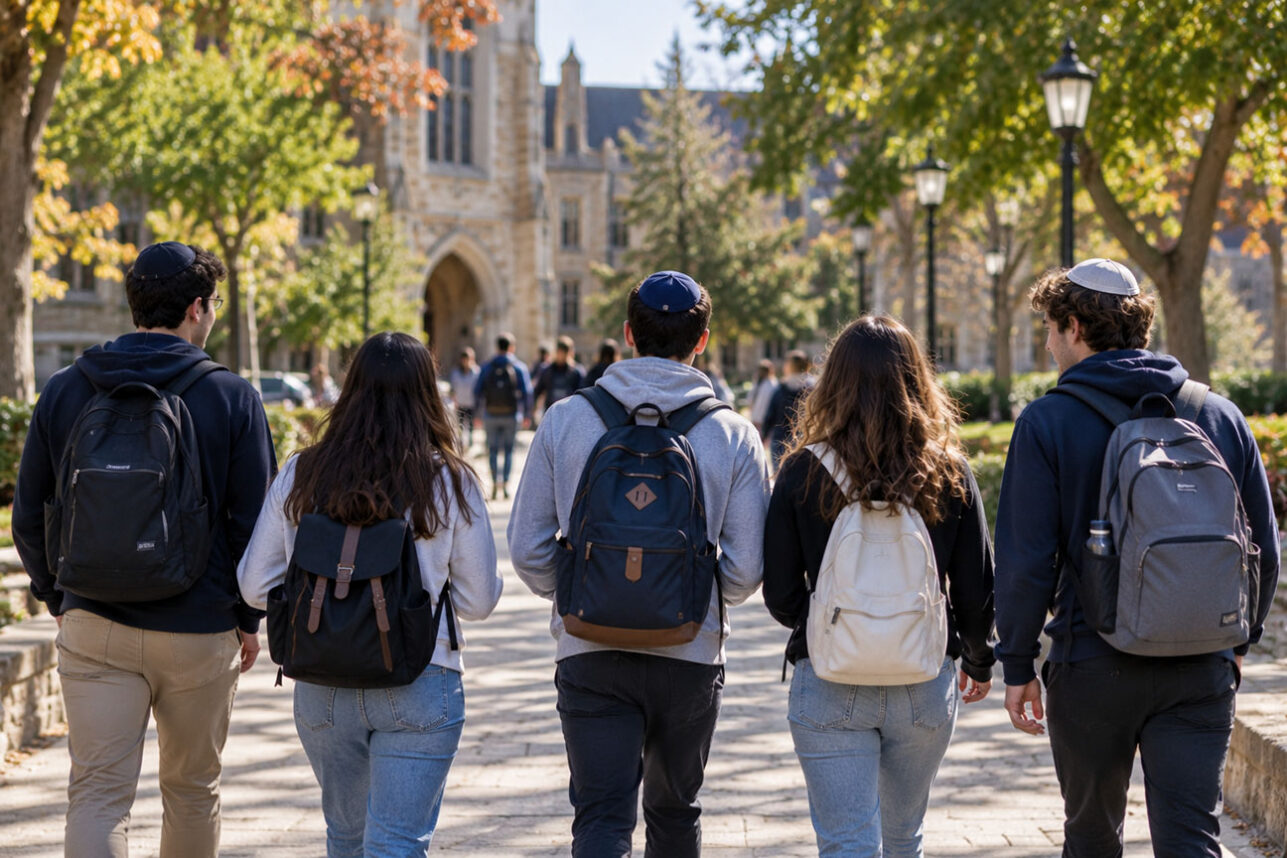
As he entered young adulthood, Eshel found education more appealing than a rabbinic life. But then “a friend in my class was coming to Hilltop to be the educator of the camp. He asked if I wanted to come to camp. I had no idea what that meant, but I said sure.” He turned out to be the most happily surprised person on the grounds. “I was a unit head that first summer, in charge of counselors and kids (8 to 15),” he recalled. “I never had been to camp. And here I was in charge. … I loved who I was there!” His fellow counselors were around his age, 18 to 21. “I fell in love. I said ‘Wow! This is it!’ This is what will sustain the Jewish people as a people moving forward.”
He called his program “Guts Judaism.” It means “living on Jewish time 24/7, creating a safe place, a laboratory, if you will, for children to explore their Jewish identity, explore their personal identity, their individuality, their places in the collective, a place to feel safe to explore.” For his charges, this means “living it from the moment they wake up,” he said. “I look at the V’ahavta (‘you shall love’) – and that is camp. From the moment you wake up until you go to sleep. … It’s phenomenal education, learning. It’s implicit and no less powerful.
How was he different at camp? “It’s not even that I was necessarily different,“ he said. “It’s an extension of finding a place to eventually articulate my meta-mission of being a guide for people on their Jewish journeys.”
Camp was where discovered his life’s mission: “Being that person to help create the opportunities for things to happen.” In choosing his career, he was struck by the influence of rabbis. “When I saw the impact they had on people, I said I don’t know what it means, but I want to do that.”
Fast Takes with Rabbi Eshel
Jewish Journal: What is your favorite childhood memory?
Rabbi Eshel: Going to Laguna Beach early in. the morning with my parents and having cookies and cream ice cream.
JJ: What do you do on your day off?
RE: I don’t know what it means because I don’t look at my life as an on-and-off. It’s always in the front or the back of my mind, what’s next?
JJ: Your favorite Jewish food?
RE: For me, the best hummus in America is the worst hummus in Israel with warm pita, olives on the side.