Every time we think the lies against Israel couldn’t be more flat-out crazy, we’re proven wrong. Now it’s the Israeli-rape-dog charge: a lurid phantasmagoria that any reasonable person must know cannot be true, but which The New York Times saw fit to print in the opinion section, under the byline of one of its most respected columnists. There’s an unnerving, out-of-body sense of having traveled through the looking-glass, emerging into a bygone age of mass delusion. Circa-1930 Germany seems chillingly accessible, but it also feels like we’re reliving a much more primitive age—times we’ve read about but find hard to believe really happened, when townsfolk literally believed that Jews were fork-tongued devils. It seems impossible that the world has gone this stark raving mad, so we’re forced to question our own sanity.
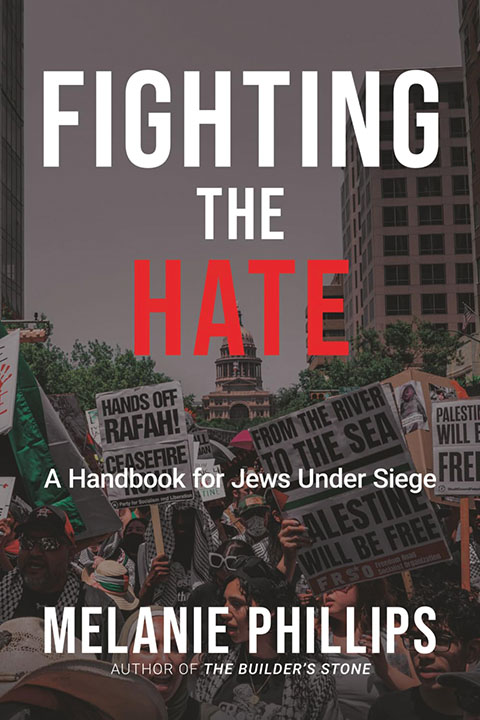
Melanie Phillips has written an essential book for anyone struggling to wrap their minds around the tsunami of euphoric Jew-hatred that has engulfed the globe since Oct. 7, 2023. Beyond reassuring the reader that they are neither crazy nor alone, it is short, punchy and practical, providing (as promised in the subtitle) a “Handbook for Jews Under Siege.” If you’re shocked, saddened and scared about today’s skyrocketing antisemitism, but have no idea what to do about it — read Phillips’ book. She offers intelligent, creative suggestions for turning the libels around. Her techniques probably won’t set off an immediate flashbulb moment in the Jew-hater’s mind, but they might, as she puts it, let in a chink of light. And they give Israel’s supporters the satisfaction of choosing their ground, rather than endlessly engaging in Whack-a-Mole.
Phillips’ tips give Israel’s supporters the satisfaction of choosing their ground, rather than endlessly engaging in Whack-a-Mole.
“Stop playing defense” is easy advice to give, but hard to actually do. We’re wired to assume that other people are rational, and assume that if we respond to their outlandish charges calmly, deploying our side’s incontrovertible facts, surely they must see the merits of our argument. Phillips calls this attitude an unfortunate failure to grasp the range and depth of the moral and intellectual rot. “Diaspora Jews need to understand what too many of them have either failed to notice or seek to deny” — she writes — “the collapse of education and the ability to think, the denial of objective truth and its replacement by subjective emotion, the substitution of power for conscience and morality, and the embrace of unhinged anti-Jewish, Muslim narratives that have capitalized on the implosion of rationality and conscience in the West.”
That “Muslim narratives” is going to trip up some readers, but Phillips comes by her views through experience. Born in London, she began her career in the ‘70s as a liberal journalist with The Guardian, that bastion of reputable British liberal opinion. It must have felt like a perfect fit for Phillips, who’d grown up seeing the fight against oppression as essential to Jewish values.
But her progressive colleagues made her acutely aware that as a Zionist, she was a bad leftist, and implicitly a bad person. The “Baby killer!” days may not have been mainstream yet, but they were wafting in the corridors of the Guardian pressroom. By the late ‘90s, remaining in its hostile climate had become impossible. She left The Guardian and its sister paper, The Observer, penning a memoir years later about her experience, “Guardian Angel: My Journey from Leftism to Sanity.”
After the Second Intifada, she wrote the books that now seem damningly prescient — damningly, because they were ignored, or furiously rejected, by the mainstream liberal establishment and so many of us. If general introspection and action had followed the publication of “Londonistan” (2006) — which argued that the U.K. had become a hub for Islamic extremism – London might not be such a hellscape for Jews today. Instead she was declared an Islamophobe, a bigot and a right-winger, a term progressives consider self-evidently synonymous with “evil.” And yet the U.K.’s steady drip-drip-flood of fetid Islamic and progressive Jew-hatred shows she was right.
She kept sounding the alarm with books like “The World Turned Upside Down” (2010) and last year’s “The Builder’s Stone: How Jews and Christians Built the West — and Why Only They Can Save It,” which I reviewed for The Journal. “Fighting the Hate” briefly repeats some of the points found in her other works, laying out the context for the surge of Jew-hatred. “The period following the Oct. 7 atrocities revealed that a fundamental boundary line in the West has now been broken,” she writes. “The West has lost its moral compass. That’s a large part of the reason it has picked on Israel and the Jews — the people who created the moral codes of the West — and their Jewish state that embodies the principles it now forgets, denies or seeks to obliterate.”
But more than analysis, this book is a guide to action, and Phillips’ advice is genuinely clever. Her punchline is epitomized in one subhead title: “Don’t Get Emotional, Get Smart.”
For instance, justified and tempting though it may be, do not respond to anti-Israel slander with “You’re an antisemite,” or more roundabout variations like “That view reflects centuries of Jew-hatred.” Jews often feel they must say it, because it is true, and that should be reason enough. But it won’t get them anywhere. Dyed-in-the-wool Jew-haters will swat the charge away; others, who don’t understand that their vicious tropes are antisemitic, will likely respond with all the thoughtfulness of a Doberman Pinscher. In our upside-down world, it’s widely believed that Zionists “weaponize” the charge of antisemitism, as part of their mission to defend the murderous state of Israel. As Phillips writes, “one could well say that this charge is itself antisemitic, but that isn’t very constructive or realistic either. The fact is that when the ‘a-word’ is used, it shuts down discourse, leaving issues not only unaddressed but overlaid with a resentment that the word was deployed at all.” Worst of all — and this really is the rub — it leaves the Jew more frustrated, isolated and defeated than ever.
So don’t do that. Instead, Phillips counsels, “treat the barb or the troubling behavior not so much as an affront but as an opportunity. Use it to respond with what you want to put out there. Turn it around so that you take the initiative and place in front of your antagonist some information they’re not expecting and will never have heard before.”
Wield what you know about your antagonist’s beliefs and values. Are they progressive or conservative, Christian or Muslim, gay or a passionate feminist? Craft your response accordingly. Try to plant the idea that what they’re doing or saying violates their own principles.
Wield what you know about your antagonist’s beliefs and values. Are they progressive or conservative, Christian or Muslim, gay or a passionate feminist? Craft your response accordingly. Try to plant the idea that what they’re doing or saying violates their own principles.
“Wow,” you might say to someone wearing a Palestine pin. “I’m surprised you’re wearing a terrorist symbol. I thought you supported dialogue and peace …?” The pin-wearer will probably retort that the symbol is the flag of Palestine, not any terrorist organization. Phillips suggests responding with some historical facts that connect the symbol to Arab and Palestinian terrorism, and chances are the pin-wearer won’t seem open to your speech. But you will have deposited a carefully chosen seed.
As she writes:
“Israel’s supporters need to move from their implicit protest, ‘Why are you being so unfair to us?’ to the implicit charge, ‘You are betraying everything you claim to stand for.’ If their armor is to be dented, the enemies of Israel and the Jews have to be challenged on their own grounds of justice and conscience and be revealed as standing for everything they claim to despise.”
Along the way, surprise them, Phillips writes. Intrigue them. Tell them something they don’t know, in a way that flatters their intelligence. Maybe even make them laugh. (For example: “It’s the Hamas-run health ministry who claim 70,000 Palestinians were killed in Gaza. In fact, that’s the total death rate during the war. So amazingly, it means no one died of natural causes during that period! You’ve got to hand it to the Israelis. They’ve cured natural death!”) Lower your expectations about what might be achieved in the moment. The antizionist isn’t going to burst out, “Oh, I get it — the IDF is the most moral army in the world!” (although speaking from experience: they may think exactly that one day). If you get a look of stupefaction and an “Oh, I didn’t know that” — you’ve won.
An effective fight can only begin once you’ve got your head around “the epic, near-unbelievable extent to which the public has been systematically lied to, manipulated and duped.” This means not only recognizing that the anti-Israel media campaign du jour relies on falsehoods spread by Hamas, but understanding how the truth of the conflict has been turned on its head over many years.
Like the instinctive belief in the other person’s rationality, we tend to assume that the other side’s grievances are totally legitimate. Wanting to be moral people, we assume our share of blame. But sometimes that laudable impulse is exploited by forces more deep-down malicious and irrational than we’re prepared to accept. So it is when it comes to the conflict between Israel and the Palestinians — the latter being in itself a dubious term, manufactured in the 20th century by Arabs from throughout the Middle East, as part of the violent campaign to expel the Jews from the Jewish homeland.
But going there means being that kind of Zionist: the hard-nosed kind who call a spade a spade. It means understanding that the story itself is built on a series of falsehoods — many of which are accepted as conventional wisdom even by Israel’s supporters.
“For decades, the Jewish world allowed its enemies to frame the narrative,” Phillips writes. “They hijacked language and weaponized the West’s post-truth, post-moral culture to push their agenda that Israel and the Jews were on the wrong side of everything that was good and just because of their ‘oppression’ of the Palestinian Arabs and ‘occupation’ of their land.” By allegedly denying the Palestinians their own state, “Israel came to be perceived as the enemy of humanity itself. The Palestinians were the big issue. The Arab and Muslim world couldn’t reconcile itself to the West because their plight remained unresolved. Israel was the big problem.”
Phillips calls this narrative “the Big Lie.” The Palestinian story of displacement and suffering tugs at the heartstrings. A tale of the apparent underdog, it sounds righteous and inspiring. Puncturing the myth requires digging below the surface, and dealing in hard, sometimes tedious facts.
Jews largely know about the many times Palestinians rejected Israel’s serious offers of a state in the West Bank and Gaza — everything the Palestinians supposedly wanted. What’s less widely known, or fully appreciated, is how the roots of this mess were laid especially in the last century, in a familiar combination of Arab terrorism and Great Power appeasement. “Fighting the Hate” provides a helpful primer in this history.
As Phillips explains, the right of the Jewish people to restore their ancient homeland in the land of Israel was established by the Great Powers at the San Remo conference of 1920 and the League of Nations in the 1922 Mandate for Palestine. Those terms have never been rescinded, no matter what haters claim about the Jewish presence being “illegal.” In 1921, Britain handed three-quarters of Palestine to the Hashemite dynasty to form Transjordan — a move Phillips calls the original two-state solution. The Palestinians have already been granted a state — today’s Jordan — and it happened well before the Holocaust or the birth of Israel.
Britain was supposed to begin the legal process for the Jews to settle in the remaining teensy portion of Palestine. However, after the Arabs initiated a terror campaign against Britain and the Jews, a not-so-funny thing happened: Britain effectively rewarded them. In 1936 they offered the Arabs a slice of the remaining Palestine, to create an Arab state alongside the Jewish one. The Arabs refused, as they’ve refused every subsequent offer of a state alongside Israel. From the beginning, the Jews have accepted every offer of a two-state solution, no matter how unfavorable the terms; the Arabs — today’s Palestinians — have consistently refused. They will accept nothing short of the elimination of Israel.
So much for the myth that “The Jews stole the Palestinians’ land from them to create the State of Israel.”
But no potted history can do justice to this vexedly complicated region, and Phillips emphasizes that readers should completely trust no one. More than that, she writes, don’t completely trust yourself. Know about confirmation bias, where you instinctively believe information that confirms what you already think. Realize that not everyone on your side is reliable or correct. No one is infallible.

A final chapter addresses particular challenges, such as Family and Friends; Students and Faculty on Campus; the Left-Wing Ideologue; the American Isolationist. Phillips’ background as a former leftist makes her especially spot-on addressing “The Agonized ‘Progressive’” — the “conflicted Jews” who have seen the implosion of everything they thought was axiomatically right. She understands the powerful forces keeping their minds closed: the paralyzing terror of becoming ‘right wing,’ and the fear of losing all their left wing friends if they start acknowledging the truth about Israel. While that may sadly happen, she writes, these former progressives will learn the truth about their friends’ claims to being moral. And they’ll make new friends among people who aren’t necessarily right wing at all — just decent and sane. As she remarks: “Trust me on this. I’ve been there, done that, got the T-shirt.”
Melanie Phillips spoke inconvenient truths when virtually no one else was willing, or able, to do so. “Fighting the Hate” is a gift from a brilliant intellect to her people, and it should be received with gratitude for this unique woman’s clarity and grit. Schools would be well advised to use it, as part of educating the next generation and steeling them in struggle. As she writes: “Giving up is not an option.”
Kathleen Hayes is the author of ”Antisemitism and the Left: A Memoir.”