fbpx

May 21, 2026

When Jews Are Told We Don’t Belong

Remember when Jews were excluded from universities, law firms, hospitals, country clubs, neighborhoods, and entire professions? Remember the quotas at Ivy League schools designed specifically to keep Jewish students out? Harvard, Yale, Columbia, and others openly limited Jewish enrollment because there were “too many Jews.” Remember the signs that read “No Jews Allowed” at resorts, hotels, and clubs across America? Remember restrictive housing agreements that prevented Jews from buying homes in entire neighborhoods?

Remember hearing about how Henry Ford published “The International Jew,” helping to legitimize antisemitism in the 1920’s not only in America but abroad, including in Nazi Germany? Remember Father Charles Coughlin, the immensely popular radio priest who spread antisemitic conspiracy theories to millions of Americans in the 1930’s?

Too few people remember this history, but it continues to impact us today. Many Jews changed their last names and hid their identities because they understood how shallow, exclusionary, and prejudiced far too many people were. Jews created their own institutions because doors were closed to them. They founded Brandeis University, Yeshiva University and Touro College because elite schools often excluded them. Jews founded hospitals across America because Jews faced discrimination in other hospitals.  Many medical schools imposed quotas, and many hospitals refused Jewish physicians admitting privileges. Jewish lawyers built their own firms because major firms would not hire them.

Jewish immigrants built Hollywood because other industries shut them out. MGM, Warner Bros., Paramount, Universal, and Columbia Pictures were founded largely by Jewish immigrants or their children who were excluded elsewhere. They helped create one of America’s greatest industries (which is now largely run by multinational corporations led by people from many different backgrounds).

Jewish comedians transformed American entertainment as well. Jack Benny, Milton Berle, George Burns, Joan Rivers, Mel Brooks, Sid Ceasar, Carl Reiner, Larry David, Jerry Seinfeld and countless others shaped American humor and culture, often beginning in spaces where Jews created opportunities for one another when others would not.

Jews even created their own social institutions because they were unwelcome elsewhere. Country clubs like Hillcrest in Los Angeles, Fresh Meadow in Long Island, Century Country Club in New York, the Standard Club in Chicago, and so many others were founded because Jews were barred from joining many existing clubs.

And after all these decades following the Holocaust, after “Never Again” became the moral promise of the civilized world, are we really heading back toward this kind of discrimination?

That question no longer feels rhetorical.

Today, Jewish students on far too many campuses report being harassed, intimidated, excluded from organizations, shouted down, or treated as morally suspect simply because they are Jewish or express their love for Israel.  Antisemitism is too often rationalized, minimized, or disguised as acceptable political expression. Social media amplifies hatred at lightning speed. A swastika displayed on a campus building is no longer enough to produce universal shock and outrage. The world is becoming dangerously numb to these serious occurrences.

There are troubling signs elsewhere too. Jews in a variety of industries increasingly speak about their discomfort expressing their Jewish identity publicly. Films about Jewish history or Jewish suffering reportedly struggle for support in too many cultural spaces. Jewish voices are too often treated as uniquely suspect when speaking about antisemitism.

So we must ask an uncomfortable question: if this climate continues, will Jews once again need to build separate institutions and industries simply to participate equally in society?

History proves that we can. Jews have done it before. We survived exclusion by building schools, hospitals, businesses, charities, defense organizations, cultural institutions, and networks of mutual support. We succeeded not because we wanted separation, but because exclusion forced us to adapt.

But from our end, we never wanted to shut others out. Quite the opposite. Jews have overwhelmingly believed in and supported integration, pluralism, education, civil rights, and in contributing to the broader society around us. Never forget Julius Rosenwald, a Jewish American Businessman and philanthropist who worked with Booker T Washinton and built nearly 5,000 schools for Black children across the South in the early 20th century.  American Jews helped build modern America with a full heart precisely because they wanted to participate fully in American life.

That is why this moment feels so heartbreaking and stressful.

Because the overwhelming majority of Jewish Americans do not want a segregated future. We do not want separate campuses, separate industries, separate cultural spaces, or separate civic life. We want the same thing every minority has always wanted: equal dignity, equal protection, and equal opportunity.

The question now is whether enough people will see this marginalization of Jewish people and stand up to this ugly, discriminatory hate.

Will university presidents, media leaders, elected officials, educators, and ordinary citizens do the right thing and finally say, “this is wrong. Enough!”  Will they confront antisemitism with the same moral clarity applied to every other form of hatred against other minorities? Will they recognize that silently tolerating antisemitism never ends with the Jews?

Or will deafening silence and rationalization continue until Jews once again conclude that they can rely only on themselves?

I sincerely hope not.

Because history teaches us something else as well: Societies that normalize hatred against Jews do not remain healthy, democratic, tolerant, or thriving for very long.

The question now is: who will be the decent human beings who will stand up and stop this madness before it is too late?


Roz Rothstein is the daughter of Holocaust survivors. She is the CEO and co-founder of StandWithUs, a 25-year-old international organization that supports Israel and fights antisemitism through education.

When Jews Are Told We Don’t Belong Read More »

The Rabbinical School of Chicken Soup

Rabbi Eliezer of Worms describes a dramatic Shavuot morning ritual from the 1100s:

“The custom of our ancestors is for young children to begin their studies in Torah on Shavuot, for it is the day on which the Torah was given … At dawn on the day of Shavuot, they bring the children … and they cover the child under a cloak from his house, and bring him to the synagogue or to the Rabbi’s house … They then bring a slate upon which the alphabet is written, forward and backward … The Rabbi reads every single letter of the alphabet, and the child repeats after him; then every word of the backward alphabet, and the child repeats after him … The Rabbi then places a bit of honey on the slate, and the youth licks the honey off the letters with his tongue.”

This colorful custom is just one of many colorful Shavuot customs.

It is common practice to stay up all night on Shavuot and study Torah. This originated in the Zohar, which offers a mystical rationale: Shavuot is the night before the wedding of the Shekhinah, the divine presence, with God. The Torah studied that night became “adornments” for the bride.

Students of Kabbalah popularized all-night study on Shavuot and introduced a special program of study for the evening called Tikkun Leil Shavuot.

This custom eventually went mainstream, and the Magen Avraham offered a simpler rationale for it. He explained that “because the Israelites slept throughout the night, and the Holy One, blessed be He, had to awaken them, as is stated in the Midrash. Therefore, we must rectify this [i.e. by not sleeping].” We stay up all night on Shavuot to express how excited we are to receive the Torah.

More controversial is the practice of placing flowers and tree branches in homes and the synagogue. This custom first appeared in the 1400s. Synagogues would spread aromatic grasses on the floor and weave flowers on the Ark and branches surrounding the bimah.

Here, too, several reasons are given. Shavuot is, according to the Mishnah, the day when the fruits of the tree are judged; the Magen Avraham explains that the branches are a reminder of this judgment. The Levush cites a midrash stating that when God gave the Torah, the desert near the mountain bloomed; the grass is a reminder of this. Others say that the sweet fragrance of the flowers allows everyone to better rejoice in the giving of the Torah.

But this practice met with harsh opposition from the Vilna Gaon, who argued that it was an imitation of Christian practices. In Germany and Poland, people decorated homes and churches with birch branches and spring flowers to celebrate the Christian holiday of Pentecost. The Vilna Gaon declared that it was forbidden for Jews to adopt this foreign custom.

The tradition of eating dairy on Shavuot is the most enigmatic. It is first mentioned in the 1200s, but the reason is obscure. Some early sources say that the midrash compares the Torah to milk and honey, and so we eat dairy foods, but it’s unclear then why there are no honey dishes as well. The difficulty of finding a clear reason for this custom has inspired multiple theories, to the point that one rabbi, Moshe Dinin, published an essay that collected no less than 159 reasons for this custom.

There are many other customs as well. In some Sephardic communities, they pour water on the chazzanim and other dignitaries. There are unique additions to the liturgy, such as reading a “Ketubah” about the marriage between God and the Jewish people, or the well-known poems of Akdamut and Azharot.

Shavuot has an endless variety of customs.

This stands in stark contrast to the biblical description of Shavuot, which is the only holiday that has no ritual. And it would seem that precisely because of this vacuum, the customs of Shavuot emerged.

But that only deepens the question. Why didn’t the Torah provide any rituals for Shavuot? And why was it so important for Jews to create their own customs?

On the question as to why Shavuot has no ritual, Rabbi David Zvi Hoffmann explains it is because Shavuot commemorates the giving of the Torah. He writes:

“No symbolic ritual was established for the festival of Shavuot to commemorate the revelation at Sinai. And there is a good reason for this: the revelation at Sinai cannot be captured in any physical symbol. Rather, the people of Israel are meant to take to heart that they saw ‘no form on the day the Lord spoke to you at Horeb from the midst of the fire,’ lest they fall into the illusion of making an idol or image of God.”

Any ritual that attempts to recreate the revelation at Sinai would verge on idolatry.

But Jews couldn’t leave the silence of Shavuot alone. Instead, they created minhagim, customs, to celebrate receiving the Torah. Even when the Torah omits, perhaps intentionally, any ritual for Shavuot, the Jews stepped forward with cheesecakes and flowers, ready to bring joy and inspiration to this holiday.

And nothing could be more fitting. Intellectually, the revelation at Sinai is too pristine and pure to be recreated. But the Torah cannot be relegated to a transcendent world of ideas; it must speak to real people made of flesh and blood. God gave the Torah on Sinai, but it was never meant to remain there, surrounded by fire and thunder, beyond human reach. It must be translated into a human language, and only then does it become the Torah that the Jews accepted at Sinai.

Minhag speaks to the passion with which the Jews accepted the Torah. Some are dramatic customs, such as Kol Nidrei; and some are halakhically controversial, such as Kol Nidrei. And as the Vilna Gaon pointed out about tree branches on Shavuot, some minhagim seem very similar to non-Jewish practices. But even trivial minhagim deserve our attention. Rabbi Maimon, the father of Maimonides, wrote about the importance of eating donuts (sfenj) on Chanukah. Minhagim are memorable and inspiring, the small touches that bring a large impact.

The Torah is a lived tradition that is transmitted from person to person and generation to generation. As Professor Haym Soloveitchik pointed out, “a way of life is not learned but rather absorbed. Its transmission is mimetic, imbibed from parents and friends.”

Minhagim are central to the lived tradition of Judaism.

The lived tradition of Judaism is often associated with the Jewish mother. Rabbi Joseph Soloveitchik offers a powerful description of her role. He explains that there are two aspects of the Jewish tradition: mussar avikha, the instruction of the father, and torat imekha, the teaching of the mother. He offers an example to explain the difference between the two:

“The laws of Shabbat, for instance, were passed on to me by my father; they are a part of mussar avikha. The Shabbat as a living entity, as a queen, was revealed to me by my mother; it is a part of torat imekha. The fathers knew much about the Shabbat; the mothers lived the Shabbat, experienced her presence, and perceived her beauty and splendor.

“The fathers taught generations how to observe the Shabbat; mothers taught generations how to greet the Shabbat and how to enjoy her twenty-four-hour presence.”

The source for every minhag is in torat imekha. They too add beauty and splendor to every observance. And Shavuot, with all of its customs, is a celebration of torat imekha.

A rabbi once quipped that “I learned more from my mother’s chicken soup than all my years in rabbinical school.”

He wasn’t deprecating rabbinical school. He meant to highlight the importance of torat imekha, how small touches of joy and love are critical in transmitting a grand intellectual and spiritual tradition.

And on Shavuot, as we prepare to stand again at the foot of Mount Sinai, let’s not forget the cheesecake or the flowers, or, for that matter, the chicken soup. They teach us lessons that cannot be learned in rabbinical school.

And without them, the Torah would have disappeared.


Rabbi Chaim Steinmetz is the Senior Rabbi of Congregation Kehilath Jeshurun in New York.

The Rabbinical School of Chicken Soup Read More »

The Faculty Member Who Could Not Be Named

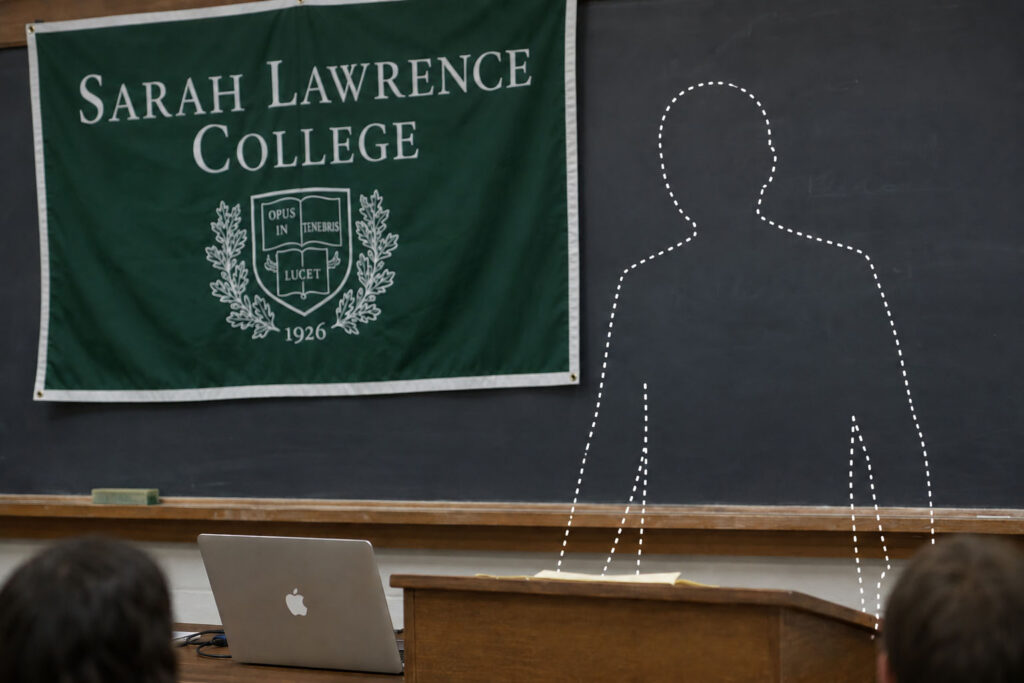
On May 13, the Jewish Telegraphic Agency published a detailed report on the Sarah Lawrence College student senate’s decision to deny recognition to a campus chapter of J Street U, the liberal Zionist student group whose national platform supports a two-state solution and a negotiated peace. The report is thorough, sourced, and damning with audio recordings of senate deliberations, transcripts of meetings, and on-the-record comments from the dean of students, the Hillel director, and the J Street national president. A senator is on the record describing recognition of the group as akin to recognizing “a white supremacist organization.”

The story is a portrait of a campus.

Before going further, a clarification. The argument that follows does not depend on agreement with J Street U’s positions. J Street is a progressive Jewish organization whose views on Israel and American foreign policy are well to the left of my own; I have substantive disagreements with several of its platform commitments. None of that is relevant here.

The argument depends on a simple principle that an institution committed to free inquiry should already accept: A mainstream student group cannot be denied recognition on the basis of its viewpoints. The students who applied to form a J Street U chapter had the right to organize regardless of whether their classmates, their professors, or their administrators shared their politics. The question is not whether J Street is correct. The question is whether Jewish students at Sarah Lawrence are allowed to organize around a viewpoint that disagrees with the campus consensus.

With that established, let’s return to the JTA piece. The most telling fact in it is not in any of the quotations. It is in a parenthetical.

In March, the Jewish students who had applied to form the J Street U chapter appealed their denial. JTA reports that supportive faculty, including the students’ advisor, had planned to attend the appeal meeting. But just before the meeting, the student senate announced that only two people would be permitted to attend, and that they would have ten minutes to make their case. Supportive faculty were excluded from the room.

The reporter describing this episode adds a parenthetical: “The faculty advisor declined to be identified publicly out of fear of the repercussions for their own standing in academia.” That is the entire sentence. A faculty member at an elite liberal arts college, working with Jewish students to form a chapter of a mainstream liberal Zionist organization—and then excluded from the procedural hearing where their students’ appeal was decided—asked a national reporter for anonymity to describe what happened. The reporter, applying JTA’s editorial standards for granting anonymity to sources, agreed.

Pause on that. A national newspaper concluded that a faculty member at Sarah Lawrence had a credible enough fear of professional consequences—consequences from their own institution—that their name needed to be withheld from a news story about their work with their own students. That is not a partisan characterization of the campus climate. That is the editorial judgment of an independent national outlet, on the record, in print.

This is the climate at Sarah Lawrence, in a single documented fact. And it is worth dwelling on, because everything else about the J Street U story and about the broader pattern of which it is the most recent example follows from it.

This is the climate at Sarah Lawrence, in a single documented fact.

Consider, in this light, the faculty petition that was eventually organized to urge the administration to grant J Street U recognition. JTA describes it as a petition “circulated to a limited number of faculty members” that gathered “more than 20 signatures.” Each of those three details—the circulation, the public posture, and the final count—deserves attention.

First, the circulation. The petition was not sent to the full faculty. It was sent to a hand-picked list of likely signers: colleagues the organizers had identified in advance as receptive. The initial distribution went to fewer than two dozen recipients. Sarah Lawrence has a long institutional tradition of full-faculty petitions on contested questions, and the mechanisms for broad consultation exist and are used routinely. When students associated with Students for Justice in Palestine have faced disciplinary consequences for varied actions over the years, a more robust public faculty discussion followed, drawing far broader participation than anything mustered for J Street U. The infrastructure for full-faculty mobilization is not theoretical. It is in working order. It is used. It was simply not used for these students.

This means that the organizers, working on behalf of Jewish students, made a deliberate calculation: They would not ask the broader faculty whether it agreed. The most plausible reading of that calculation is that they already knew what too many of their colleagues would say. They knew which faculty members are hostile to liberal Zionist and Jewish students. They knew which colleagues would refuse to sign, or worse, would actively organize against the petition. The hand-picked list is not just a list of allies. It is also, by implication, a documentary record of the organizers’ assessment of where the rest of the faculty actually stands.

This is, in its way, the most clarifying single fact in the entire matter.

The argument that the Sarah Lawrence climate is hostile to Jewish students is not a claim made by outside critics or by faculty members like me who have been writing about it for years. It is a claim made, implicitly, by the very faculty members who organized this petition. They know their colleagues. They made calculations about which of their colleagues could be asked. The petition’s targeted distribution is, in effect, a private faculty intelligence assessment, conducted by faculty in good faith, of who on this campus can be relied upon to defend Jewish students and who cannot. The number who could be relied upon, by the assessment of those best positioned to know, is fewer than two dozen.

Second, the public posture. The petition’s existence is known to the press—JTA references it in its reporting—but the petition itself has not been released publicly with its signatories attached. It has not been posted to the campus, published in the student paper, or attached to any public statement of faculty solidarity with the students. The signatories’ names are not, to date, on any public document. Whatever the petition is, it is not a public expression of faculty solidarity. It is an internal one, delivered behind closed doors, in a form that the administration can file, debate, or quietly ignore without any of the faculty signatories being publicly identified.

Third, the count. Sarah Lawrence employs approximately 285 instructional faculty. The petition gathered roughly twenty signatures (JTA’s reported figure) and at most around thirty by the time it was delivered. Even at the higher number, that is roughly ten percent of the teaching faculty. Ninety percent of the institution’s teachers either declined to sign or, far more likely given the targeted circulation, were never asked.

There is no reading of that ratio that flatters Sarah Lawrence.

Either a substantial majority of the faculty actively opposes recognizing a mainstream liberal Zionist student group, or the organizers correctly assessed that asking the majority would produce a refusal. Both readings describe a faculty body in which open defense of Jewish students seeking to organize around a mainstream Jewish viewpoint is a minority position, and known to be one.

Both readings describe a faculty body in which open defense of Jewish students seeking to organize around a mainstream Jewish viewpoint is a minority position, and known to be one.

Taken together: a targeted ask, a private posture, and a participation rate that suggests the broader faculty would not have signed if asked. This is not a portrait of faculty conscience asserting itself. This is a portrait of a small, hand-picked group doing the most they could do in an environment where doing more was understood, by everyone involved, to be unsafe.

And it is worth noting what other Jewish faculty have, over the past decade, watched unfold on this campus without speaking publicly—a swastika on a Jewish professor’s office door; a Students for Justice in Palestine chapter awarded the college’s Group Excellence Award in spring 2024, an institutional honor the House Education and Workforce Committee later cited as evidence of administrative “emboldening” of campus antisemitism; the November 2024 occupation of the main administrative building by students distributing pro-Hamas material; the January 2026 disruption and shouting-down of New York Times columnist Ezra Klein as a “Nazi normalizer” at a “building bridges” event the sitting president treated as a joke from the stage; a Divestment Coalition “boycott of an entire faculty member’s courses” in 2024; the departure of Jewish students from the college, including Sammy Tweedy, son of Wilco frontman Jeff Tweedy, who described being treated as a “pariah” for visiting Israel; the Hillel International judgment that the climate is “among the worst we’ve seen”; and the opening of a House Committee on Education investigation that named the college among institutions whose responses were found wanting.

They had reasons. The reasons are now in print, in a parenthetical, in JTA.

None of this means the faculty who organized the petition did anything wrong. They did what they could, in the climate as it actually is. A private letter signed by ten percent of the faculty is more than no letter signed by none. The advisor who has spent the year doing the actual work of supporting these students, even under cover of anonymity, has done more than the administrators who hold the bylaw authority to grant recognition and have, to date, declined to use it.

The point is not that any individual faculty member failed. The point is that an institution that describes itself in its own Principles for Mutual Respect as committed to “honest inquiry, free speech, and open discourse” has produced an environment in which honest inquiry on this question, free speech on this question, and open discourse on this question are practiced behind closed doors, by curated lists of insiders, with the on-the-ground organizer asking a national reporter for anonymity to protect their career.

Imagine the equivalent in any other context. Imagine a campus where defending a mainstream Black student group, or a mainstream LGBTQ student group, or a mainstream Muslim student group required a private faculty memo signed by ten percent of the teaching staff, circulated only to a curated list, with the actual on-the-ground advisor asking a national reporter for anonymity to protect their standing in academia, after being barred from the appeal hearing where their students’ case was decided. The headline would write itself. The administration would face calls for resignation. The board would convene an emergency meeting. Donors would demand accountability. Accreditors would take notice.

At Sarah Lawrence, in May 2026, this is what defending Jewish students looks like. And the institutional response, so far, has been silence.

The college president has not invoked her authority under the student senate bylaws, which explicitly permit her office to grant recognition to a student organization. The relevant provision reads: “Under circumstances requiring immediate action or when it is in the best interest of the college, the Office of Student Involvement and Leadership may grant, suspend, or remove recognition of the organization.” Note the breadth. The bylaw does not require a procedural emergency, a finding of misconduct, or any specific predicate. It permits intervention whenever the administration determines that intervention is in the college’s best interest. The dean of students has nonetheless told JTA the administration “does not intervene in the process unless there is a clear violation of policy”: a framing that treats the administration’s own bylaw authority as if it were narrower than it is, and that treats viewpoint-based denial of recognition to Jewish students as not, evidently, the kind of circumstance for which the bylaw was written.

The student senate chair who presided over the denial of J Street U is herself a named plaintiff in Abdulhaqq v. Sarah Lawrence College, a federal lawsuit filed in the Southern District of New York in August 2025 that names both her own institution and the House Committee on Education and the Workforce as defendants, alleging that the institutional response to allegations of campus antisemitism has unlawfully chilled pro-Palestinian speech. The appeals committee that affirmed the J Street U denial did so without recording its vote tally and without giving a reason—and only after restricting attendance at the hearing to exclude the supportive faculty who had planned to be there.

Each of these facts, on its own, would be a procedural irregularity at a healthy institution. Taken together, they describe an administrative posture in which the institution has decided, in practice, that Jewish students seeking to organize around a mainstream liberal Zionist platform may be denied recognition by their peers, with attendance at appeal hearings restricted to keep supportive faculty out of the room, and that the administration’s role is to gesture at process while declining to act on substance.

This is what viewpoint discrimination and antisemitic hate looks like when it has become institutionalized. It is not a single incident. It is not a hostile speech. It is not a vote. It is an ecosystem—of student senate practices that exclude Jewish viewpoints under the cover of procedural opacity, of administrative postures that decline to intervene on the principled grounds that intervention is uncomfortable, of faculty self-protection so calibrated that the people doing the right thing must do it in private, of campus rhetoric so saturated that a reporter for a national Jewish newspaper applies the editorial standard normally reserved for sources in vulnerable positions and concludes that the request for anonymity is warranted.

The students at Sarah Lawrence who applied to form J Street U did nothing wrong. They asked, in good faith, to organize around a platform held by a substantial portion of the American Jewish community and represented in mainstream American political life. They were denied. They appealed. They were excluded from their own appeal hearing along with the faculty who would have spoken on their behalf. They were denied again. Their faculty advisor, working quietly to support them, could not afford to be named in the newspaper covering their case. A small group of their professors organized a private letter on their behalf, signed by less than one in ten of their colleagues, that the college administration has so far declined to act on.

The students at Sarah Lawrence who applied to form J Street U did nothing wrong.

This is the climate. The faculty advisor’s anonymity is the proof. And the institution that produced both has so far refused to meaningfully address what is plainly visible to anyone—journalists, students, parents, donors, accreditors, investigators—who is willing to look.

A community worth belonging to does not require its members to be anonymous in order to defend its values. A college worth its tuition does not require its faculty to choose between their conscience and their career. An administration worth its salary does not respond to a national story about viewpoint discrimination on its campus with procedural deflection and silence.

Sarah Lawrence will not fix this on its own. The pattern is too old, the incentives too entrenched, the institutional habits too settled. What changes the climate is external attention, sustained public scrutiny, and the willingness of those who are not yet at professional risk to say out loud what those who are at risk cannot. The faculty advisor could not speak. I will and others must.


Samuel J. Abrams is a Professor of Politics at Sarah Lawrence College and a Nonresident Senior Fellow at the American Enterprise Institute.


The Faculty Member Who Could Not Be Named Read More »

No Sleep ’til Brooklyn – A poem for Shavuot

Shavuot — weeks

It’s been seven weeks since Egypt
and we’re ready for the next Big Thing.

Seven weeks is three and a half vacations
in my world, and like all matters of import

much more time is spent planning them
than doing them.

In this case, one moment at a mountain
defined our whole thing.

That sounds like the opposite of what I
just said, but it’s been thousands of years

and we’re still trying to figure it out.
I said we’re ready but as soon as we got it

we asked for an intervention.
Would you mind, Moses, handling the

direct connection to our Revelation?
We like to do what is spoken, but

it’s a bit much to hear it out loud.
So pass it through you, while we

still have you, and we promise to
get to the doing. In the meantime

let’s get some blintzes on the table.
No sleep ’til Brooklyn some of our sages

once sang. We’re going to be talking about this
all night.


Rick Lupert, a poet, songleader and graphic designer, is the author of 29 books including “God Wrestler: A Poem for Every Torah Portion.” Visit him at www.JewishPoetry.net

No Sleep ’til Brooklyn – A poem for Shavuot Read More »

A Bisl Torah — God’s Emergent Voice

There is a tradition to stay up late on Shavuot: studying and pouring over the texts of our tradition.

The ritual is said to have come from the hevruta between Rabbi Yosef Caro and Rabbi Shlomo Alkabetz. They and a few other great scholars learned with intensity, fervor, and spirit. As they bantered through the texts, God’s voice emerged, thanking the rabbis for replacing God’s fallen crown. That it is through study, learning, respectful dialogue, and discourse that God’s crown is securely placed.

What a profound lesson as Shavuot begins. God’s voice emerges when we put anger, gossip, vitriol, and slander away and instead engage each other with kindness, curiosity, and joint introspection. Using Torah as our foundation, we can find a way to connect; even through differing opinions, we are meant to find ways to relate and live together.

Shavuot is our annual reminder that through study comes understanding; through learning comes patience. As we dig into our ancient sources, timeless teachings arise. With Torah as our guide, God’s voice emerges as we turn towards each other.

 Chag Sameach and Shabbat Shalom


Rabbi Nicole Guzik is senior rabbi at Sinai Temple. She can be reached at her Facebook page at Rabbi Nicole Guzik or on Instagram @rabbiguzik. For more writings, visit Rabbi Guzik’s blog section from Sinai Temple’s website.

A Bisl Torah — God’s Emergent Voice Read More »

A Moment in Time: “Shavuot (and Chess) – Between Moves we Choose who we Become”

Dear all,

Eli and I came across an oversized chess board last weekend. At six and a half, he’s already a formidable player—and he wasn’t about to pass up the chance to challenge me.

So we played.

Standing there, moving life-sized pieces, each turn required pause. And as we each considered our next move, I found myself thinking: how often do we do the same in our own lives?

Which choices are defensive—made just to hold our ground?

Which ones move us forward with purpose?

Which are made out of habit, or distraction, or simply because we can’t see another option?

And which choices might look like a loss in the moment—but are, in truth, the beginning of something greater?

This Thursday night, Jews celebrate Shavuot—the moment we stood at Sinai and chose to receive Torah.

Shavuot reminds us that Judaism is not only something we inherit —it is something we choose. And it’s not only about the choices that led us to today – but also in the decisions we make moving forward. It’s about the values we live, and the future we shape.

Like a game of chess, we don’t always control what’s in front of us. But we do control how we respond. We make informed and meaningful choices of how to move forward.

And that choice—that ongoing, intentional choosing—in each moment in time– THAT is what it means to stand at Sinai.

With love and Shalom,

Rabbi Zachary R. Shapiro

PS.  Eli won the game.

A Moment in Time: “Shavuot (and Chess) – Between Moves we Choose who we Become” Read More »

Greek Figs, Jewish Limes

Diogenes Laertius loved telling fancy anecdotes
concerning diets of great Greek philosophers. Green figs
were Zeno’s favorite food, Diogenes Laertius notes,
not asking whether he was Jewish, and avoided pigs.
Such avoidance would have been a major paradox.
Its prevalence in members of the Jewish race is
quite inexplicable, unlike the presence of cream cheese and lox
that with great logic every kosher Jew on bagels places.

Some philosophers died strangely. Empedocles leaped
to death by jumping into Etna’s fiery crater.
At jumping like Jehosophat, great Jews were not adept,
but helping a one-legged gentile once proved Hillel greater
than Shammai, when they both were challenged by a non-Jew who
asked for a quick conversion. Only Hillel appeared willing,
while the gentile stood on one leg, to change him to Jew,
his wish to be a model monopedal Jew fulfilling.

The leap of faith of Empedocles is literally connected
not just to fiery deaths of Aaron’s sons, Nadab and Abihu,
martyred in the tabernacle,
but to the legend that the Torah by the Israelites was not rejected
by all Jews’ ancestors, whom God threatened to be buried
beneath Mount Sinai if they rejected Torah’s legal shackle.

This would have meant they’d not be forty-niners, celebrating Shavuot,
the Jews’ Pentecost,
and the mysterious rationale for eating cheesecake on this festival
have been therefore lost,
like longing for the joy of Torah on Simchat Torah or
forty-niners for Clementine
after celebrating Sukkot, for their favorite of four species,
an etrog, not a lemon lime.


B88a Sabbath states:

״וַיִּתְיַצְּבוּ בְּתַחְתִּית הָהָר״, אָמַר רַב אַבְדִּימִי בַּר חָמָא בַּר חַסָּא: מְלַמֵּד שֶׁכָּפָה הַקָּדוֹשׁ בָּרוּךְ הוּא עֲלֵיהֶם אֶת הָהָר כְּגִיגִית, וְאָמַר לָהֶם: אִם אַתֶּם מְקַבְּלִים הַתּוֹרָה מוּטָב, וְאִם לָאו — שָׁם תְּהֵא קְבוּרַתְכֶם. אָמַר רַב אַחָא בַּר יַעֲקֹב: מִכָּאן מוֹדָעָא רַבָּה לְאוֹרָיְיתָא. אָמַר רָבָא: אַף עַל פִּי כֵן הֲדוּר קַבְּלוּהָ בִּימֵי אֲחַשְׁוֵרוֹשׁ, דִּכְתִיב: ״קִיְּמוּ וְקִבְּלוּ הַיְּהוּדִים״ — קִיְּימוּ מַה שֶּׁקִּיבְּלוּ כְּבָר.

The Gemara cites additional homiletic interpretations on the topic of the revelation at Sinai. The Torah says, “And Moses brought forth the people out of the camp to meet God; and they stood at the lowermost part of the mount” (Exodus 19:17). Rabbi Avdimi bar Ḥama bar Ḥasa said: the Jewish people actually stood beneath the mountain, and the verse teaches that the Holy One, Blessed be He, overturned the mountain above the Jews like a tub, and said to them: If you accept the Torah, excellent, and if not, there will be your burial. Rav Aḥa bar Ya’akov said: From here there is a substantial caveat to the obligation to fulfill the Torah. The Jewish people can claim that they were coerced into accepting the Torah, and it is therefore not binding. Rava said: Even so, they again accepted it willingly in the time of Ahasuerus, as it is written: “The Jews ordained, and took upon them, and upon their seed, and upon all such as joined themselves unto them” (Esther 9:27), and he taught: The Jews ordained what they had already taken upon themselves through coercion at Sinai.

An etrog (Hebrew: אֶתְרוֹג) is a yellow, fragrant citrus fruit—a type of citron (Citrus medica)—used during the Jewish holiday of Sukkot. It is one of the “Four Species” (along with a palm branch, willow, and myrtle) that are held and waved during prayers. Often described as looking like a bumpy, thick-rinded lemon, it represents the “fruit of a goodly tree” in Lev. 23:40, identified as a citron by the rabbis.


Gershon Hepner is a poet who has written over 25,000 poems on subjects ranging from music to literature, politics to Torah. He grew up in England and moved to Los Angeles in 1976. Using his varied interests and experiences, he has authored dozens of papers in medical and academic journals, and authored “Legal Friction: Law, Narrative, and Identity Politics in Biblical Israel.” He can be reached at gershonhepner@gmail.com.

Greek Figs, Jewish Limes Read More »

Confronting a Mob With a Winning Attitude

It was one of those enchanted afternoons in downtown Montreal, when the colors of spring announce the arrival of sunnier times after the long dark slog of winter.

As my friend and I strolled down Sherbrooke Boulevard on our way to visit my alma mater McGill University, we were interrupted by a loud group of demonstrators waving Palestinian flags.

We were in a happy mood; the drumbeats made us feel like dancing.

As we got closer, we were especially happy to see a sweet elderly lady holding up an Israeli flag.

It was her against the mob.

My friend and I quickly walked over to give her a hug. “We’re with you,” we told her. “We’re 100% with you.”

We took photos as if we were old relatives who had found each other.

Our jovial selfies, however, were quickly overtaken by the sounds of human anger.

It’s one thing to write about the animosity Jews have been facing on streets around the world – it’s another to come face to face with it.

That animosity shot up when the mob realized it was no longer just one quiet elderly Jew in their midst – now it was three animated Jews taking selfies with a flag they despised.

As they came closer and their energy felt more threatening, I did the only thing I could think of.

“Long live Israel!” I shouted with all the vocal timber I could muster, as my friend yelled “Down with Jew hatred!”

Our presence angered them, but so what? We were also free to express ourselves, and we were glad to show these Israel-haters that there is, in fact, such a thing as proud Zionists.

Their anger made no difference to me. The sun kept shining. I was still in a joyful mood.

But their rage was live and real. I was no longer on my laptop writing about Israel-hatred. Now I was on a street corner confronting that hatred. I could see the faces of hate.

If I could write in my columns about the need for a winning attitude, this was now my chance to show it.

“We always win,” I blurted out. “We win, you lose.”

Their anger was now mixed with a kind of confusion. They seemed flummoxed. This guy is calling us losers!

They yelled back things like “murderers,” while I repeated that “we always win, you always lose.”

The more I said we were winning, the more confident I looked, the more it drove them nuts.

I was aware, of course, that “Jews” and “winning” are not words that go together well these days.

But on the street, that didn’t matter. What mattered was our attitude. We showed the haters they didn’t have the power to anger us or sadden us or weaken us.

We weren’t just proud Jews and strong Jews. We were happy Jews. And happy people win.

The thing is, we really were in a great mood. It felt so good to be back in a city that held so many fond memories.

So, while the haters continued to yell and abuse their vocal cords, we continued on our merry way into our nostalgia tour. We visited the gorgeous McGill campus and found an old bookstore and vegan cafe in the village.

As I reflected that night on our eventful day, it struck me that an unfortunate side effect of our fight against antisemitism is that it puts us in a lousy mood – and for good reason! The global surge in Jew-hatred is a deadly serious matter.

It also struck me, however, that we don’t need to give our enemies easy victories, such as: You have the power to scare us, embitter us, depress us, unravel us.

They don’t have that power. Once we realize that, we can start fighting with a winning attitude.

I saw something later that night that further boosted my confidence. It was a quote from the late, great Charles Krauthammer, who also hailed from Montreal:

“Israel is the very embodiment of Jewish continuity: It is the only nation on earth that inhabits the same land, bears the same name, speaks the same language, and worships the same God that it did 3,000 years ago. You dig the soil and you find pottery from Davidic times, coins from Bar Kokhba and 2,000-year-old scrolls written in a script remarkably like the one that today advertises ice cream at the corner candy store.”

The hate mob that confronted us knew nothing about the legitimacy of the Jewish state. Maybe that’s why it drove them nuts to see such happy Zionists.

And we weren’t even faking it.

Confronting a Mob With a Winning Attitude Read More »

Print Issue: Smart Fighting | May 22, 2026

CLICK HERE FOR FULLSCREEN VERSION

Print Issue: Smart Fighting | May 22, 2026 Read More »

Luxury Travel in 2026 Is Not What You Think.

The old: Glitzy Hotel Rooms The New: Peace and Restoration

Close your eyes for a moment and imagine sitting at a long wooden table at dusk on a working estate in Tuscany. The wine in your glass was pressed from grapes you helped harvest that afternoon. The bread was baked in a wood-fired oven by a woman whose family has worked this land for four generations. There is no spa menu. There is no swim-up bar. There is no check-in line. There is just this: the smell of woodsmoke, the sound of crickets, and the very specific feeling that you are exactly where you are supposed to be.

Luxury in 2026 is not a chandelier. Not a butler. Not a logo on a bathrobe. Those things still exist and they still have their place, but the most discerning travelers in the world have quietly moved on from performing luxury and started chasing something far more valuable: the feeling of a life fully lived, one extraordinary experience at a time.

If you have been wondering whether your next trip should feel different, the answer is yes. And I am here to show you exactly what that looks like.


What Luxury Actually Means Right Now

The shift has been building for years but 2026 is the year it became undeniable. Virtuoso, the global authority on luxury travel, calls it a move from FOMO to Slow-mo. Travelers who once obsessed over ticking destinations off a list are now asking a different question entirely: not where can I go, but how do I want to feel when I get there?

The data backs it up. Classic Vacations’ 2026 Luxury Travel Trends Report found that the top three motivations driving luxury bookings this year are celebrating milestones, genuine rest and restoration, and meaningful family time. Not status. Not Instagram content. Not bragging rights.

What this means in practice: fewer destinations per trip, longer stays, and a relentless focus on experiences that could not be replicated anywhere else in the world. The travelers I work with are not asking me to show them the most impressive hotel suite. They are asking me to show them something they will still be talking about in twenty years. Those are two very different briefs, and knowing how to answer the second one is exactly what a great travel advisor is for.


Farm and Estate Travel: The Luxury Nobody Saw Coming

The fastest growing trend in luxury travel right now is one that surprises almost everyone when I tell them about it: farm stays. Not rustic. Not roughing it. Think private estate stays on working Andalusian fincas where you pick olives and learn the art of sherry-making. Think vineyard harvest experiences at family-owned estates in Portugal where your dinner is built entirely from what the land produced that week. Think truffle hunting in Provence followed by a private lunch with the family who has worked that forest for generations.

Domestically, luxury ranch stays in Montana and the high desert of Utah are attracting the same affluent traveler who once defaulted to a five-star resort. Napa and Sonoma are evolving beyond wine tasting into full immersive estate experiences: private harvests, cellar dinners with winemakers, farm-to-table cooking classes on the property where the ingredients were grown that morning.

Traditional farm stays have evolved into premium eco-retreats that blend sustainability with genuine sophistication, appealing to travelers who want immersive rural experiences without any compromise on comfort. The agritourism market is approaching $205 billion globally and growing fast, which tells you everything about how seriously the luxury travel world has embraced this shift.

Why is it resonating so deeply right now? Because it delivers the one thing a five-star hotel lobby never could: the feeling of belonging somewhere real.


Hushpitality: The Art of Going Quiet

The term is new but the desire is ancient. Hushpitality is the growing demand for quiet, exclusive, crowd-free escapes that put wellness, privacy, and genuine rest at the center of the experience. No packed pool decks. No DJ sets by the beach bar. No tour buses outside the window.

Boutique retreats in California wine country, secluded lodges in Colorado, wellness retreats in Big Bear Lake, private coastal properties in Maine, intimate wellness sanctuaries in Iceland and the Scottish Highlands. These are the properties filling up fastest right now, driven by travelers who are done with over stimulation and ready for restoration.

Related to this is what Classic Vacations calls “dead zoning”: deliberate, device-free travel where disconnecting from the noise of daily life is not an inconvenience but the entire point. If you have ever come home from a vacation more exhausted than when you left, hushpitality is the antidote.


Immersive and Experiential: Living Inside the Destination

Savvy travelers are no longer chasing the perfect photograph. They are chasing the perfect moment. The difference is significant.

Immersive travel means being inside a culture rather than observing it from a comfortable distance. A private cooking experience or dinner with a Moroccan grandmother and family in her home in Marrakech. A dawn fishing trip with a local family on the Sea of Cortez. A night in a working lighthouse on the Icelandic coast. A private audience with a master artisan in Kyoto. These are not excursions you find on a hotel activities board. They are experiences that require relationships, insider knowledge, and the kind of access that takes years to build.

This is precisely the kind of travel I specialize in building for my clients, and it is what separates a trip that was lovely from a trip that genuinely changed something in you.


The White Lotus Effect: Where Your Screen Is Taking You

If you have watched The White Lotus, you already know that a great television series can make a destination feel like a character. And it turns out that feeling translates directly into bookings.

Virtuoso’s 2026 Luxe Report confirms that film and television continue to reshape luxury travel in real and measurable ways. Thailand is at the center of that momentum, pulling travelers into the cinematic landscapes of Season 3. Provence is surging with renewed energy as filming locations for Season 4 draw a new wave of visitors to the French Riviera. Cornwall in the UK, with its rugged filming locations from House of the Dragon and Poldark, is seeing significant interest from travelers who want to step inside the narrative rather than just visit the backdrop.

The travel industry calls it set-jetting and it is one of the most genuinely exciting trends I track, because the destinations it elevates are often extraordinary in ways that go far beyond what the screen can capture.


Roots Tourism: Going Back to Where It All Began

One of the most emotionally powerful trends of 2026 is inheritourism: travel driven by ancestry, heritage, and the desire to understand where you come from. Multigenerational families are booking private researcher-guided journeys through Ireland, Italy, Eastern Europe, and South Africa to trace family histories, visit ancestral villages, and connect with a sense of identity that no resort experience can offer.

If this speaks to something in you, it is worth knowing that these trips require a very specific kind of planning and access. Done well, they are among the most profound travel experiences I have ever helped create.


What All of This Means for Your Next Trip

The through line connecting every single one of these trends is the same: the world’s most experienced travelers have stopped trying to impress anyone and started trying to feel something. Meaning over mileage. Depth over breadth. The five-star feeling rather than the five-star performance.

The question is not whether you deserve that kind of travel. The question is whether you have someone in your corner who knows how to build it for you.

That is exactly what I do. I am not a booking engine. I am not a search algorithm. I am the person who knows which estate in Portugal harvests in October and takes only eight guests. I know which Montana ranch has the guide who will make your teenagers fall in love with the land. I know which ryokan in Kyoto books eighteen months in advance and exactly how to get you in.

If any of these trends sparked something in you, I would love to talk about what that could look like for your next trip.

Contact me today to craft your personalized experience. With exclusive local partnerships, insider itineraries, and seamless logistics, I’ll transform your destination into your next unforgettable reality. Reach out to me at the email below. Alternatively, complete the form with your dates and interests for your (and or your loved one’s) upcoming trip. These memories will warm your heart for years to come.

Email me at Contact@luxetravelpartner.com. You can also find more information about my agency at www.luxetravelpartner.com.  

Luxury Travel in 2026 Is Not What You Think. Read More »